All of the evidence provided on Hippocampome.org are quotes from scientific texts.
However, because quoted passages may be difficult to understand in isolation, contextual information and expanded abbreviations set in square brackets have been added for clarity.
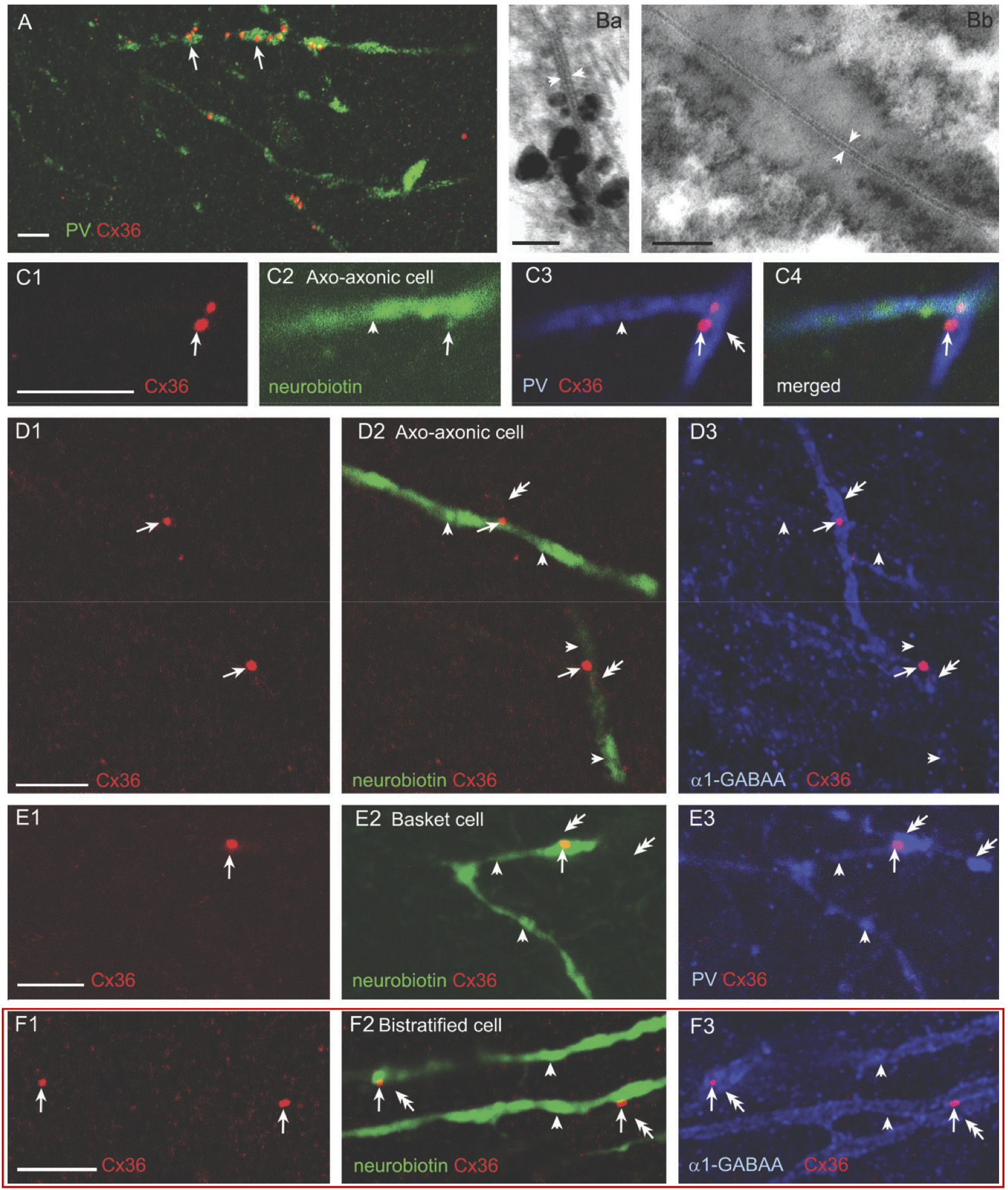
"Figure 8. Axoaxonic, basket, and bistratified cells express Cx36-immunopositive clusters at dendritic junctions. ... (C-F) Confocal views of neurobiotin-filled dendrites (arrowheads) of axoaxonic (T103b, T88a), basket (T119a), and bistratified (C22a) cells expressing Cx36-immunoreactive dots (arrows) at junctions with dendrites of unfilled cells immunoreactive for PV [parvalbumin] and alpha1-GABA[gamma-aminobutyric acid]AR (double arrows). Note that in (C1), one of the Cx36-immunoreactive dots (arrow) is located on a spine emanating from the filled dendrite (arrow in C2). Axoaxonic cell T88a in (D3) expresses low amounts of alpha1-GABAAR but forms a Cx36-immunoreactive junction with a strongly alpha1-GABAAR--expressing dendrite, presumably originating from another type of cell. Arrowheads show that the dendrites of the filled cells are immunoreactive for PV (C3, E3) or a1-GABA A (D3, F3)."
"The lack of PV [parvalbumin] immunoreactivity in VGLUT3[vesicular glutamate transporter type 3]-positive somata and boutons, the obligatory coexpression of VGLUT3 and CCK [cholecystokinin] in interneuronal somata and the perisomatic location of boutons double-labelled for GAD and VGLUT3 in the principal cell layers demonstrate that VGLUT3 is present in a distinct type of basket cell. Some basket cells expressing CCK but negative for PV also express VIP [vasoactive intestinal polypeptide] (reviewed in Freund & Buzsaki, 1996). However, in our material, neither VIP-positive cell bodies nor boutons were positive for VGLUT3. Therefore, the CCK- and VGLUT3-positive cells constitute a novel subtype of basket cell {CA1 Basket CCK+}."
Interpretation notes: Glutamatergic and GABAergic PV+ types in CA1 SLM_SR_SP_SO are probably vGlut3-
"In somata and boutons there was no overlap between PV and VGLUT3 imunoreactivity, regardless of their colabelling with GAD, in the CA1 area (Fig 7D and E). Similarly, none of the 112 VGLUT3-positive cells tallied in other hippocampal areas and the isocortex was immunoreactive for PV."
Interpretation notes: Glutamatergic and GABAergic PV+ types in CA1 SLM_SR_SP_SO are probably vGluT3- by contrapositive logic
 Browse
 Search
 Help
 positive