All of the evidence provided on Hippocampome.org are quotes from scientific texts.
However, because quoted passages may be difficult to understand in isolation, contextual information and expanded abbreviations set in square brackets have been added for clarity.
Animal:
Protocol:
Expression:
Show:
Order:
EXPRESSION: negative (inference)
ANIMAL: rat
PROTOCOL: immunohistochemistry
Page location: p400, right bottom
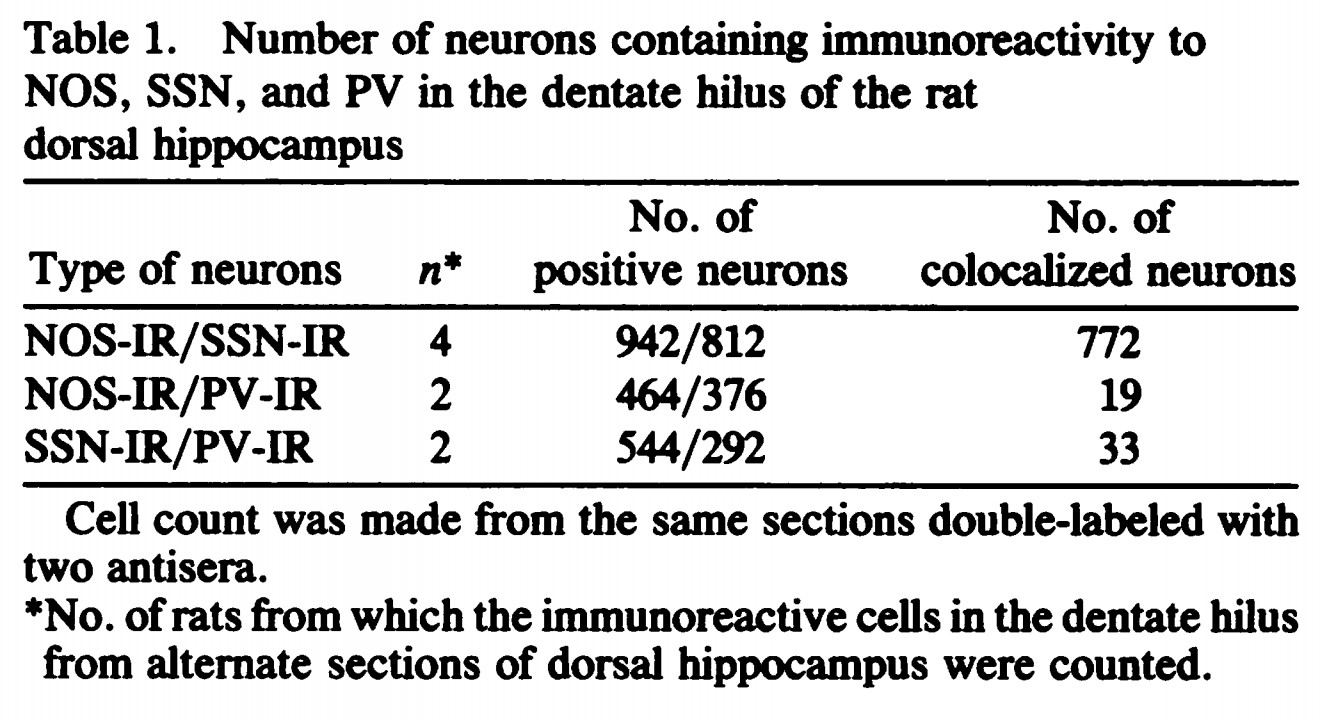
"In the dentate gyrus, the majority (95%) of hilar SOM[somatostatin]-containing neurons were also shown
to be immunoreactive for NOS [nitric oxide synthase]. In the same region, only a negligible
number (5%) of PV[parvalbumin]-positive cells contained NOS immunoreactivity
(Dun et al., 1994; Divila et al., 1995)."
Interpretation notes: Glutamatergic and GABAergic nNos- types in DG H are probably SOM- by contrapositive logic; Clopper-Pearson confidence interval lower bound = 93.2% (n = 771/812)
EXPRESSION: negative (inference)
ANIMAL: rat
PROTOCOL: immunohistochemistry
Page location: p2957, Table 1
"Table 1. Number of neurons containing immunoreactivity to NOS [nitric oxide synthase], SSN [somatostatin], and PV [parvalbumin] in the dentate hilus of the rat dorsal hippocampus"
Interpretation notes: Glutamatergic and GABAergic nNos- types in DG H are probably SOM- by contrapositive logic; Clopper-Pearson confidence interval lower bound = 93.2% (n = 771/812)
EXPRESSION: negative (inference)
ANIMAL: rat
PROTOCOL: immunohistochemistry
Page location: p775, right mid
"In these experiments, all the cells of the hippocampus immunoreactive for somatostatin were strongly immunoreactive for mGluR[metabotropic glutamate receptor]lalpha, and likewise the cells immunoreactive for mGluRla were also immunoreactive for somatostatin (Figures 2A and 2B)."
Interpretation notes: Glutamatergic and GABAergic mGluR1a- types in DG Smo_Smi_SG_H are probably SOM- by contrapositive logic
 Browse
 Search
 Help
Help negative; confirmed by inference(s)