All of the evidence provided on Hippocampome.org are quotes from scientific texts.
However, because quoted passages may be difficult to understand in isolation, contextual information and expanded abbreviations set in square brackets have been added for clarity.
"The Neurobiotin-labeled axon was immunonegative for PV [parvalbumin], CR [calretinin], CCK [cholecystokinin], VIP [vasoactive intestinal polypeptide], vAChT [vesicular acetylcholine transporter], ChAT [choline acetyltransferase], GlyT2 [glycine transporter 2], CB1 [cannabinoid receptor 1], and GAD [glutamic acid decarboxylase] (tested with two antibodies). The latter is surprising, but judging from the relatively low level of GAD [glutamate decarboxylase] mRNA in the soma of many ENK[enkephalin]positive cells, the terminals may express levels of GAD undetectable with our methods and antibodies. The axon terminals tested
for VIAAT [vesicular inhibitory amino acid
transporter] were immunopositive (Fig. 2B)."
EXPRESSION: negative (inference)
ANIMAL: rat
PROTOCOL: immunohistochemistry
Page location: p1217, Table 1
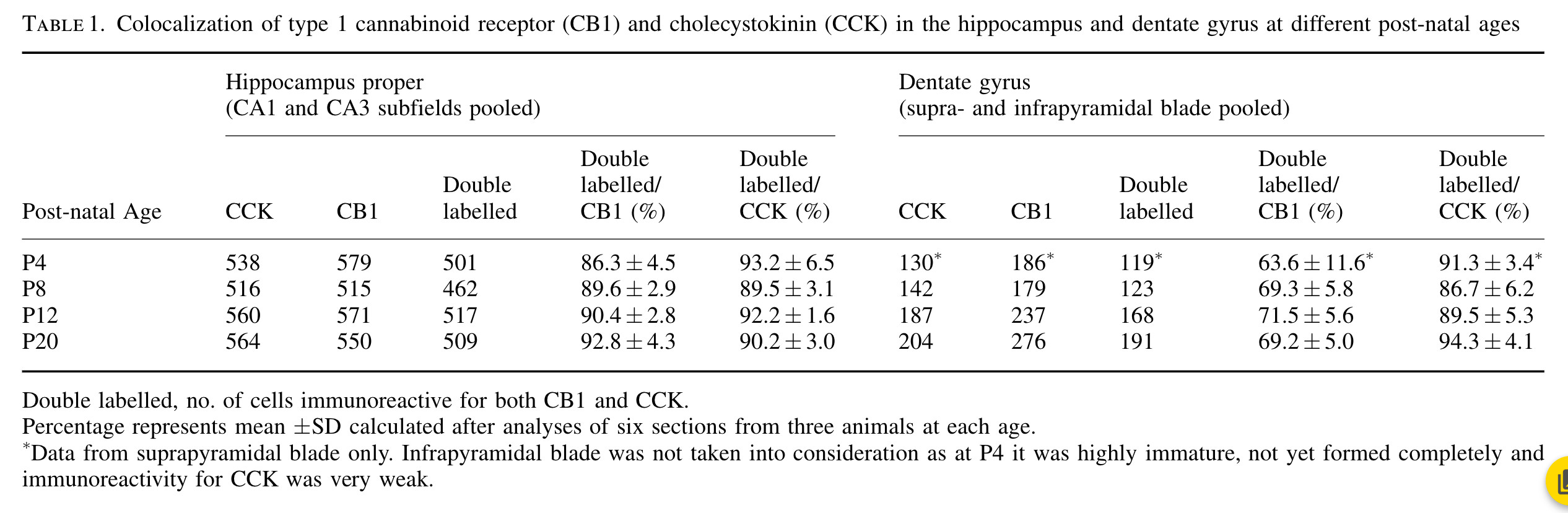
"Table 1. Colocalization of type 1 cannabinoid receptor (CB1) and cholecystokinin (CCK) in the hippocampus and dentate gyrus at different post-natal ages."
Interpretation notes: Glutamatergic and GABAergic CCK- types in CA1 & CA3 SLM_SR_SP_SO are probably CB1- by contrapositive logic; Clopper-Pearson confidence interval lower bound = 90.2% (n = 510/550)
EXPRESSION: negative (inference)
ANIMAL: rat
PROTOCOL: immunohistochemistry
Page location: p1217, Fig. 3
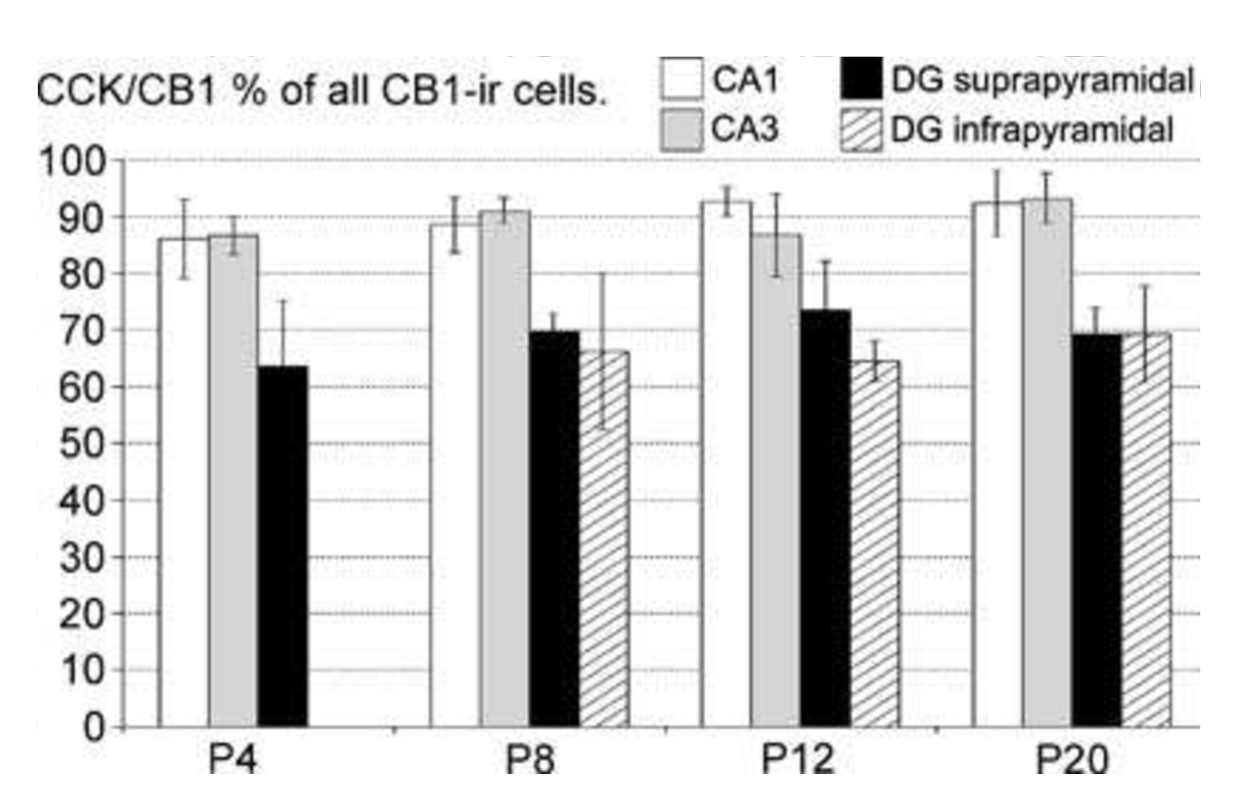
"Fig. 3. Occurrence of cholecystokinin (CCK)/type 1 cannabinoid receptor (CB1) double-labelled cells in proportion of all CB1-immunoreactive (ir) neurons in the CA1 and CA3 subfields as well as in the supra- and infrapyramidal blade of the dentate gyrus (DG) at different post-natal ages. Data from the infrapyramidal blade on the fourth post-natal day were not taken into consideration as the blade was highly immature, not yet formed completely and immunoreactivity for CCK was weak. Data represent means after analysis of six sections from three animals at each age +/- SD."
Interpretation notes: Glutamatergic and GABAergic CCK- types in CA1 SLM_SR_SP_SO are probably CB1- by contrapositive logic
 Browse
 Search
 Help
 negative; confirmed by inference(s)