|
| Morphology |
| Soma | |
| EC:III | |
| EC:IV | |
| EC:V |
| Axons | |
| EC:III | |
| EC:IV | |
| EC:V | |
| EC:VI |
| Dendrites | |
| EC:I | |
| EC:II | |
| EC:III | |
| EC:IV | |
| EC:V |
| Representative figure |
|
Morphological characterization of rat entorhinal neurons in vivo: soma-dendritic structure and axonal domains. Lingenhohl K, Finch DM Exp Brain Res, 1991, 84 (1), pages: 57 - 74 PMID: 1713171; DOI: 10.1007/BF00231762 |
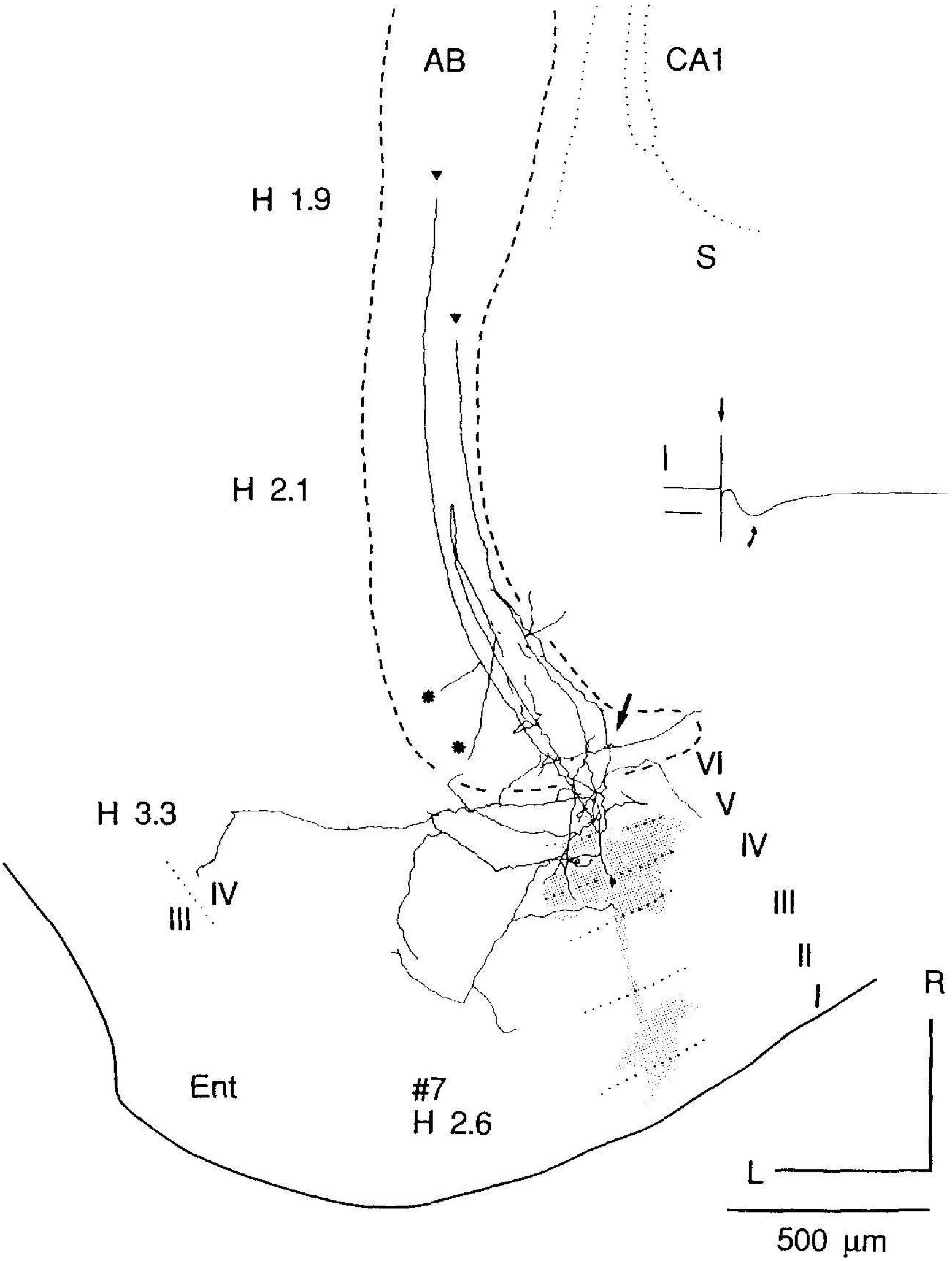 "Fig. 13. Intracellular recording and drawing tube reconstruction of the axonal projection pattern of layer IV pyramidal cell no7 {EC LIII-V Bipolar Pyramidal} (soma-dendritic structure shown in Fig. 5). Physiological data : Intracellular recording, average of responses to 50 hippocampal stimuli (CA3). Arrow indicates the stimulus artifact and the curved arrow indicates the IPSP. Calibrations: 15 mV and 10 ms. Axonal reconstruction : the surface of the brain, fiber tracts, and cell layers are drawn as they appeared at nearby axonal segments. Different dorsal-ventral levels (H) are indicated. *, these branches ended in deep layers of the entorhinal cortex. Axons faded at the arrowheads. The arrow shows the location of large boutons in the angular bundle, whose photomicrographs are shown in Fig. 10b. Note that, in contrast to layer II cells, axons projected rostrally in the angular bundle but did not appear to project toward the dentate gyrus or hippocampus. Note also the peculiar course of one axon, which projected rostrally in the AB and then turned 180¡ to project back to the entorhinal cortex." |
| Molecular markers |
| Positive | |
| None known |
| Negative | |
| GABAa\alpha 6 (inference) |
| Mixed expression | |
| CCK (subtypes) | |
| CRF (subtypes) | |
| SOM (subtypes) | |
| VIP (subtypes) | |
| Electrophysiological properties |
| Key: [range] OR representative value±SD (measurements); Number of sources (total measurements): [min , max] | |
| Resting membrane potential (Vrest): [-69.0, -67.0] mV (2); 1 source | |
| Input resistance (Rin): 490±79.4 MΩ (28); 1 source | |
| Time constant (τm): 36±15.9 ms (28); 1 source | |
| Threshold potential (Vthresh): [18.2, 21.8] mV (2); 1 source | |
| Fast afterhyperpolaziring potential amplitude (Fast AHP): [5.6, 8.7] mV (2); 1 source | |
| Action potential amplitude (APampl): 70±15.9 mV (28); 1 source | |
| Action potential width (APwidth): 1.48±0.2 ms (28); 1 source | |
| Max firing rate (Max F.R.): >29 Hz (1); 1 source | |
| Slow afterhyperpolarizing potential amplitude (Slow AHP): [2.0, 7.0] mV (2); 1 source | |
| Sag ratio: 0.86±0.1 (28); 1 source |
| Notes |
| This cell type is a merger of EC (+)223331 horizontal V neurons, EC (+)233331 bipolar V neurons, EC (+)223331 large pyramidal III neurons, and LEC (+)223333 large pyramidal cells V. Excitatory (Lingenhöhl -> spiny; Quilichini -> principal, spiny, excitatory; Canto 2008 -> projecting; Canto 201X LEC preprint -> spiny, "principal," projecting; Tahvildari -> sparsely spiny, projecting; Canto 2011 LEC -> spiny, "principal," projecting; Canto 2008 -> spiny). Notes on EC (+)223331 horizontal V neurons - Re-added Lingenhohl & Finch cell #7 at GAA's suggestion. This cell was previously mislabeled as inhibitory but is in fact excitatory based on the fact that the dendrites have spines, which is usually an indication that a cell is excitatory. - The overall interpretation of this cell type now includes D:III because of Quilichini's Supplementary Table 1 and Lingenhohl & Finch's cell #7, which has at-threshold presence in this layer. - Threshold: D:II and D:III Notes on EC (+)233331 bipolar V neurons - n=4 in Canto LEC preprint - Added Lingenhohl & Finch cell #9 (formerly classified as 223330 in suspended animation) at Giorgio's suggestion - Threshold: A:II Notes on LEC (+)223333 large pyramidal cells V - It is unclear whether this cell type exists in MEC. |
| Firing Pattern |
| Images | |
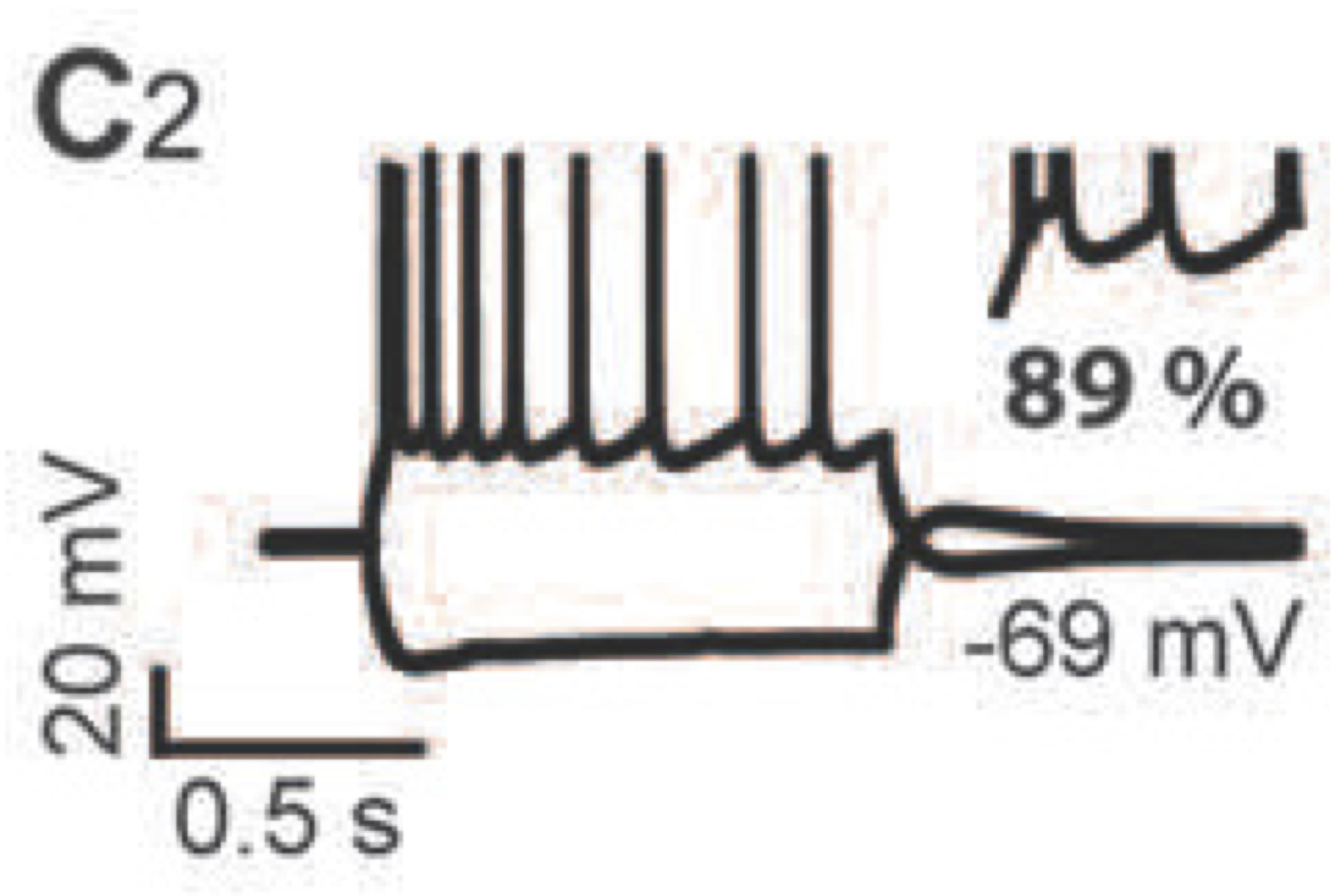 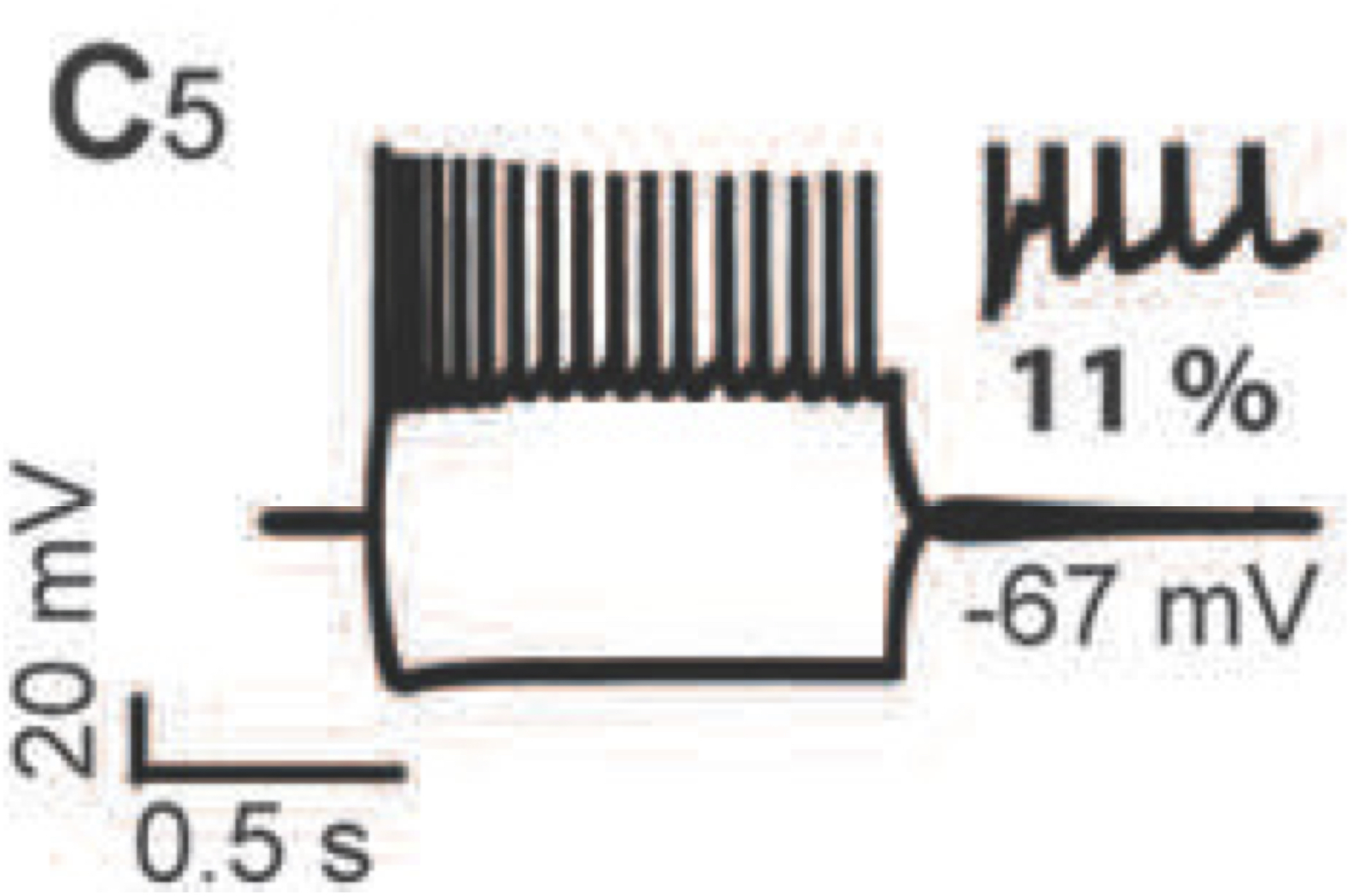 |
| Parameters | View page | |
| ASP. | [Evidence] [Firing Pattern] | |
| NASP | [Evidence] [Firing Pattern] |
| Izhikevich Model |
| Parameters | Single Compartment | Downloads | Simulate |
| subtype: 1 k=0.62;a= 0;b= -22.09;d= 37;C= 240;Vr= -67.73;Vt= -40.44;Vpeak= 21.38;Vmin= -48.28; | Simulate | ||
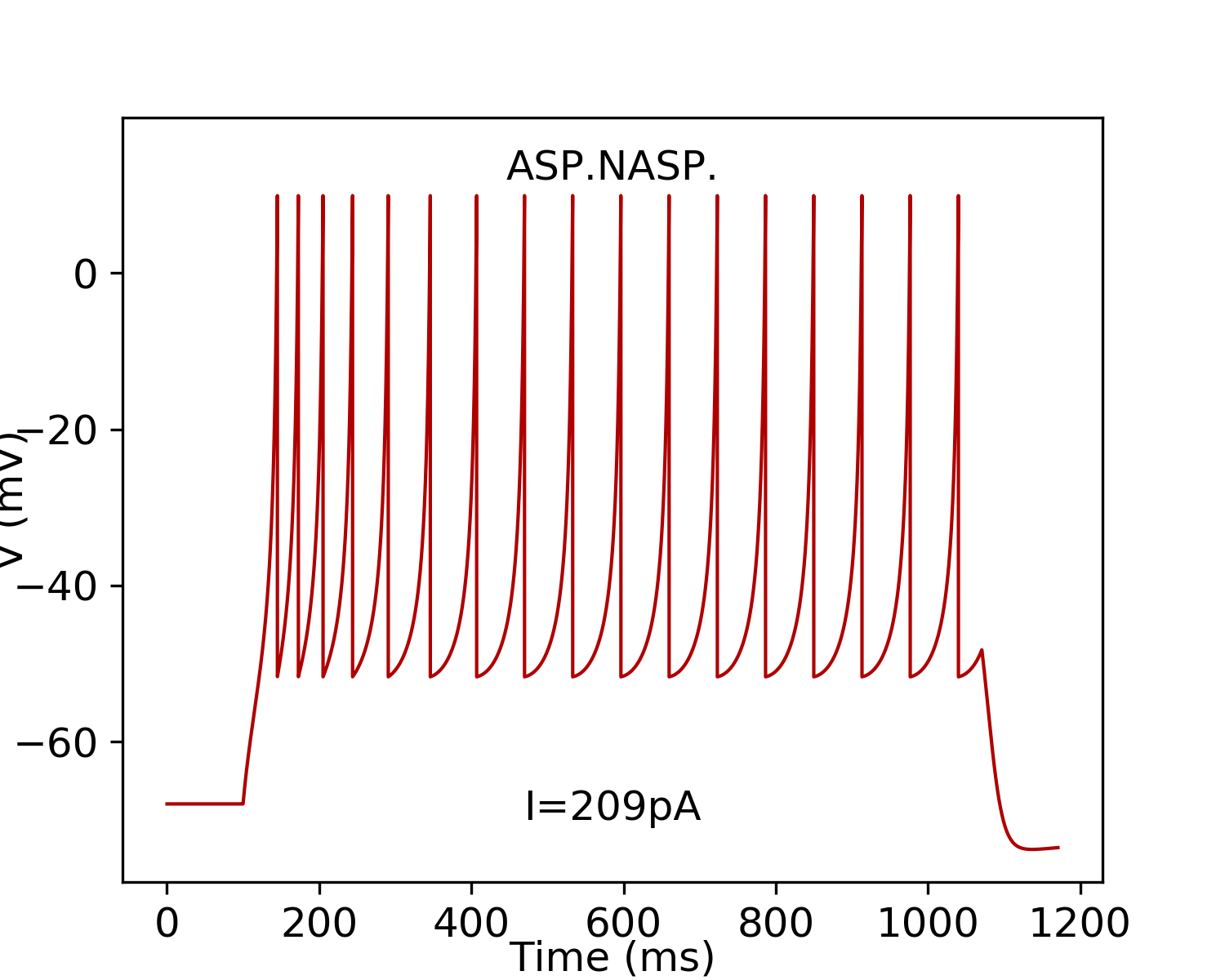
| subtype: 2 k=0.55;a= 0.003;b= -5.78;d= 51;C= 195;Vr= -67.98;Vt= -44.21;Vpeak= 9.92;Vmin= -51.71; | Simulate |
| Images | |
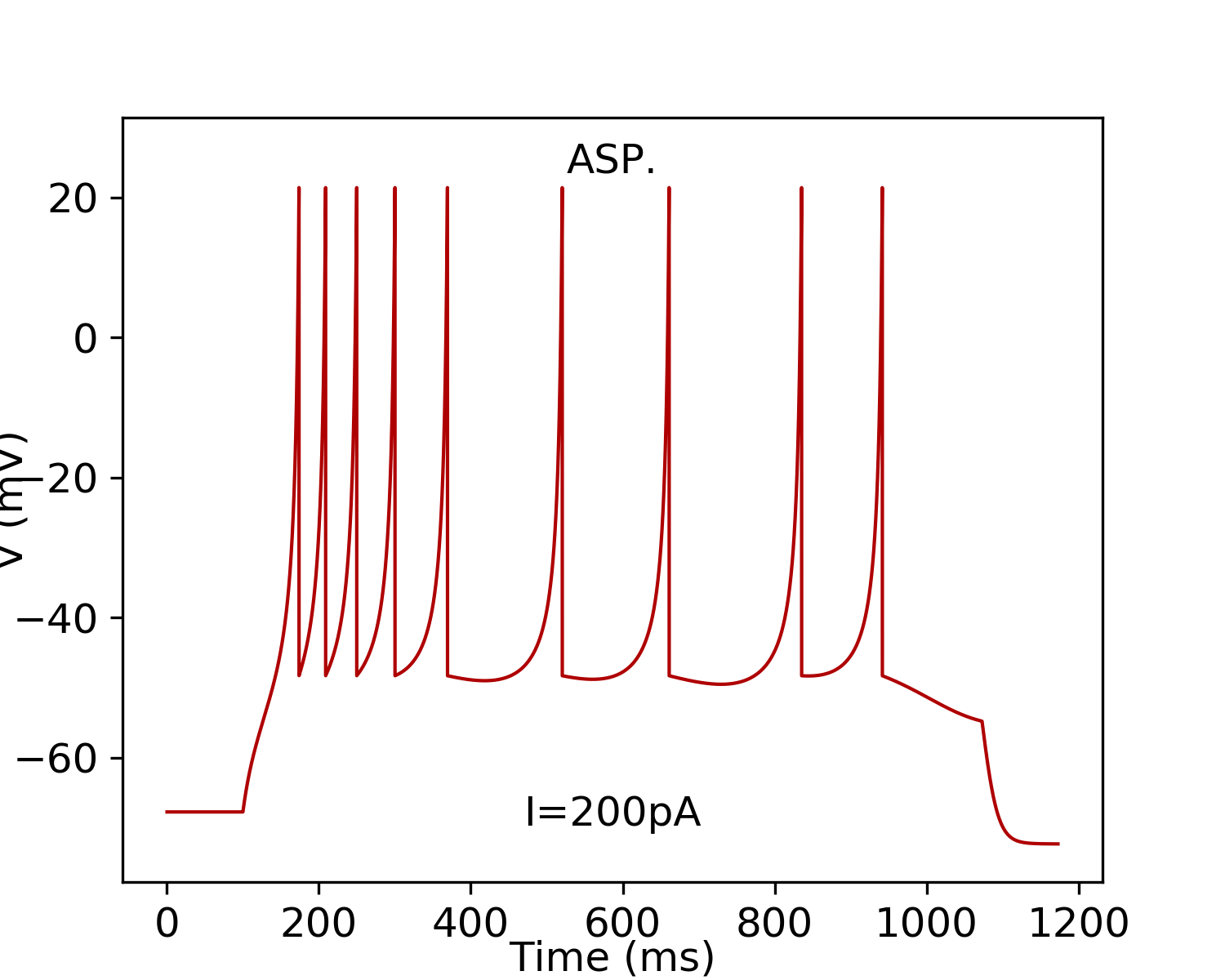  |
| ModelDB Model |
| Model Accession Number | PubMed ID |
| Sources of Input |
| Targets of Output |
|
|
|
| Oscillation Phase Locking |
 Browse
 Search
 Help