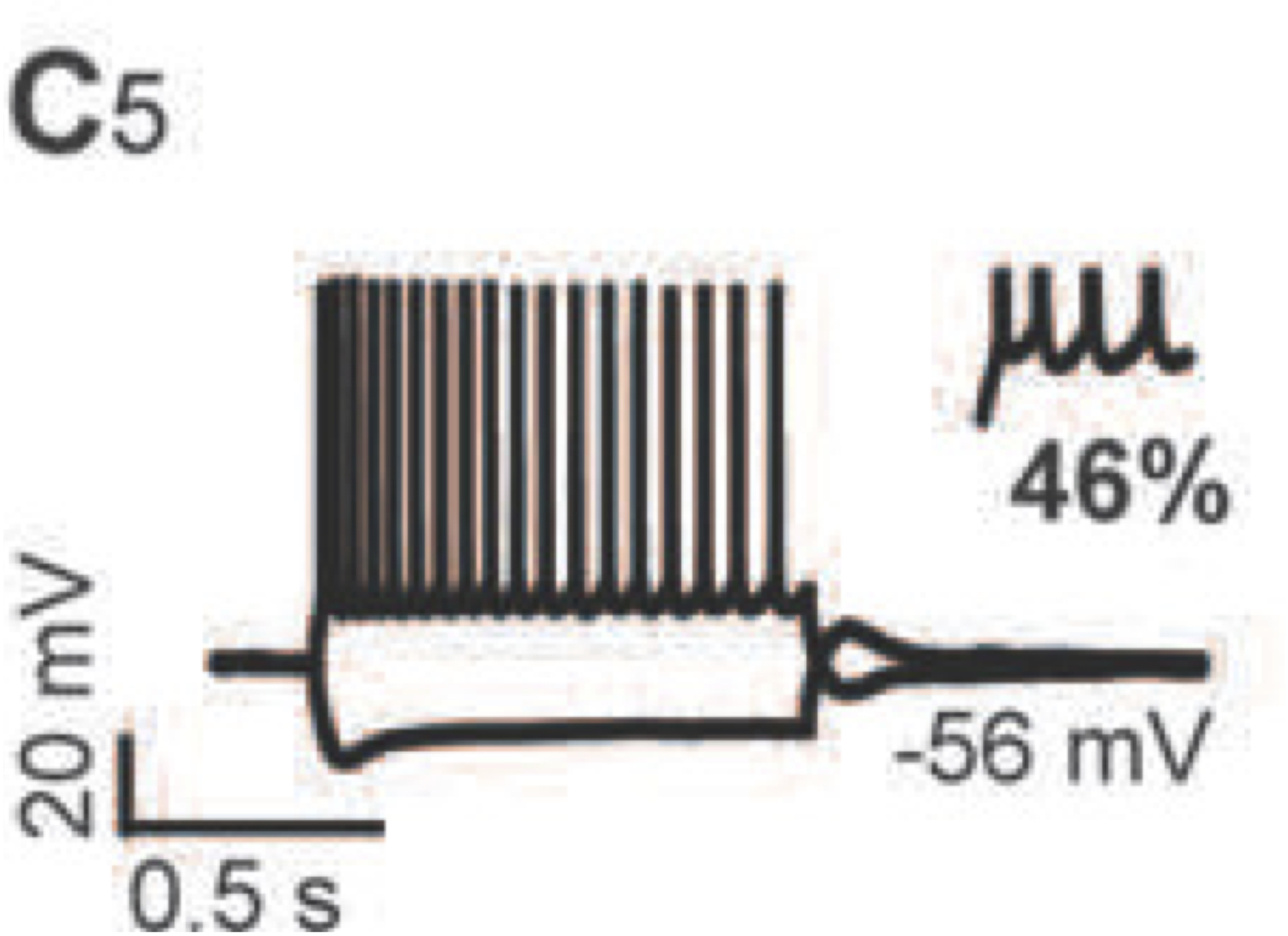
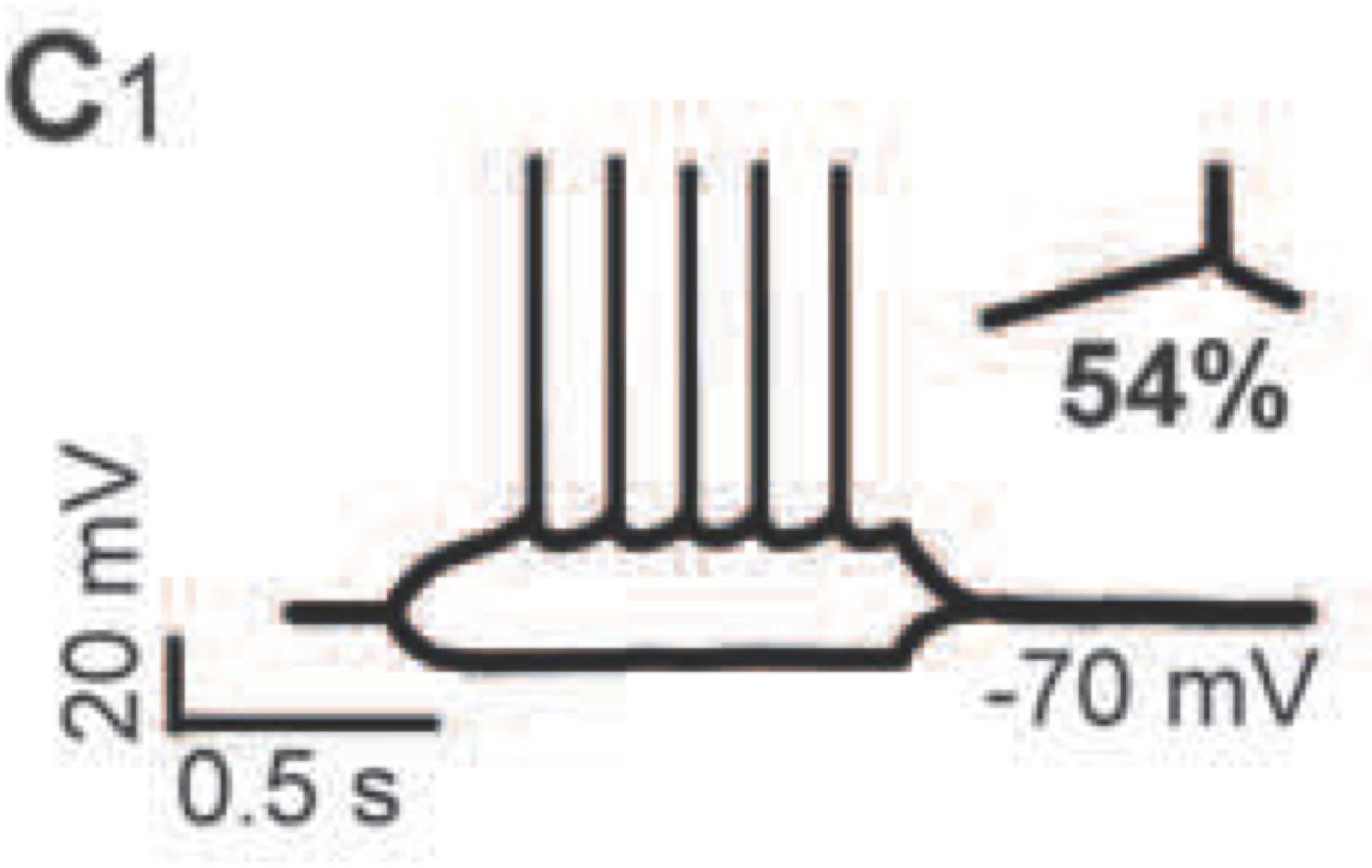
EC LI-II Multipolar-Pyramidal
* indicates new v2.0 neuron type
Name Supertype (ID:Family:Type:Subregion)
EC (e)231000 LI-II Multipolar-Pyramidal S061706:Glutamatergic II:LI-II:EC

Name derivation
This name is a hybrid of the two most frequently cited names.

Synonym(s)
EC layer I small multipolar cell
EC layer I small spherical multipolar neuron
LEC LI multipolar principal neuron
LEC LII fan neuron
LEC LII oblique pyramidal neuron
LEC LII pyramidal neuron
MEC LI horizontal principal neuron
MEC LI multipolar principal neuron

List of articles
Click here to view the list
Burgalossi A  (2011) Neuron
Microcircuits of functionally identified neurons in the rat medial entorhinal cortex.
Burgalossi A, Herfst L, von Heimendahl M, Forste H, Haskic K, Schmidt M, Brecht M.
Neuron, 2011 May 26, 70 (4), Pages: 773 - 86
PMID: 21609831; DOI: 10.1016/j.neuron.2011.04.003
Tags: phases, synapse probabilities
Canto CB  (2012) Hippocampus
Cellular properties of principal neurons in the rat entorhinal cortex. II. The medial entorhinal cortex.
Canto CB, Witter MP.
Hippocampus, 2012 Jun, 22 (6), Pages: 1277 - 1299
PMID: 22161956; DOI: 10.1002/hipo.20993
Tags: morphology, synapse probabilities
Canto CB  (2012) Hippocampus
Cellular properties of principal neurons in the rat entorhinal cortex. I. The lateral entorhinal cortex.
Canto CB, Witter MP.
Hippocampus, 2012 Jun, 22 (6), Pages: 1256 - 1276
PMID: 22162008; DOI: 10.1002/hipo.20997
Tags: morphology, membrane biophysics, firing patterns, synapse probabilities
Wouterlood FG  (2000) J Comp Neurol
Calretinin in the entorhinal cortex of the rat: distribution, morphology, ultrastructure of neurons, and co-localization with gamma-aminobutyric acid and parvalbumin.
Wouterlood FG, van Denderen JC, van Haeften T, Witter MP.
J Comp Neurol, 2000 Sep 18, 425 (2), Pages: 177 - 192
PMID: 10954838; DOI: 10.1002/1096-9861(20000918)425:2<177::AID-CNE2>3.0.CO;2-G
Tags: morphology, marker
Supplemental PMIDs
Click here to view the list of PMIDs


Morphology
Soma
EC:I
EC:II
Axons
EC:II
EC:III
Dendrites
EC:I
EC:II

Molecular markers
Positive
CR
Negative
CB (multiple confirming inferences)
CB1 (inference)
GABAa\alpha 6 (inference)
PV (multiple confirming inferences)
Mixed expression
None known

Electrophysiological properties
Key: [range] OR representative value±SD (measurements); Number of sources (total measurements): [min , max]

Resting membrane potential (Vrest): [-70.0, -56.0] mV (2); 1 source
Input resistance (Rin): 430±121.7 MΩ (37); 1 source
Time constant (τm): 25±15.2 ms (37); 1 source
Threshold potential (Vthresh): [8.1, 23.1] mV (2); 1 source
Fast afterhyperpolaziring potential amplitude (Fast AHP): [3.7, 7.3] mV (2); 1 source
Action potential amplitude (APampl): 77.5±15.2 mV (37); 1 source
Action potential width (APwidth): 1.22±0.4 ms (37); 1 source
Max firing rate (Max F.R.): >50 Hz (1); 1 source
Slow afterhyperpolarizing potential amplitude (Slow AHP): 4.7 mV (1); 1 source
Sag ratio: 0.78±0.1 (37); 1 source

Notes
This cell type represents a merger between LEC (+)231000 fan-oblique pyramidal II and EC (+)231000 MPN I. Failed unofficial merger proposals with MEC 331111 stellate II, EC 331000 excitatory II, and EC 221100 oblique pyramidal-stellate II. Spiny, principal -> excitatory. 70% of multipolar I are excitatory (Wouterlood 2000). A class of EC oblique pyramidal cells with A:I has been split off into a separate 331000 class based on a strong statement in the text about axons reaching the level of the pia with a diameter of up to 900 microm. However, note that Figure 5 Panels A and B do not support this statement. The second fan neuron shown in Figure 5 is included in the 331000 cell type. The text notes that axons are occasionally in deep layer I (as they are in this neuron). However, since the 331000 cell type is pre-existing, that neuron is included there in spite of the hippocampome rule about the word "occasionally."

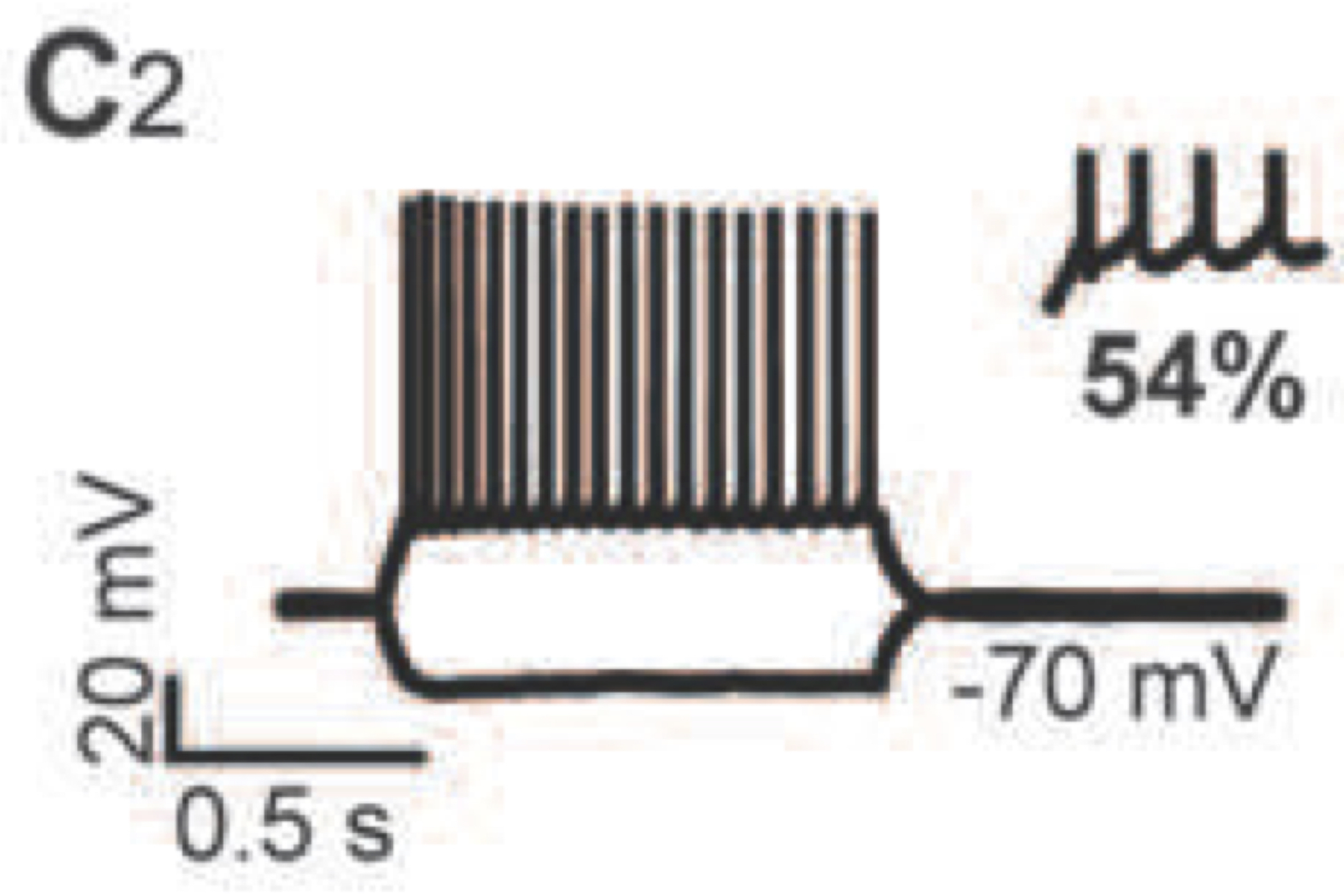
Firing Pattern
Images
Image MissingImage MissingImage Missing
Parameters View page
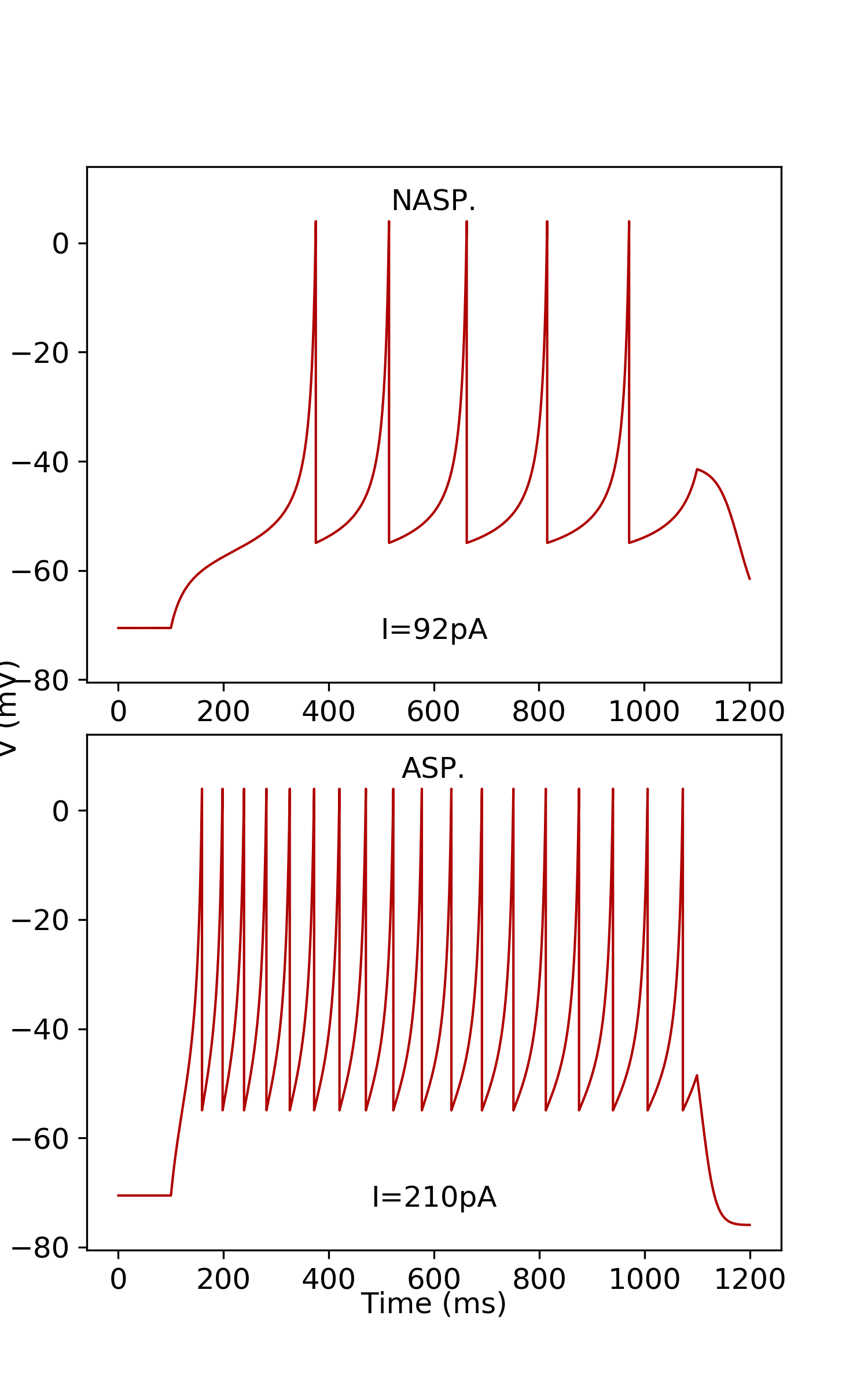
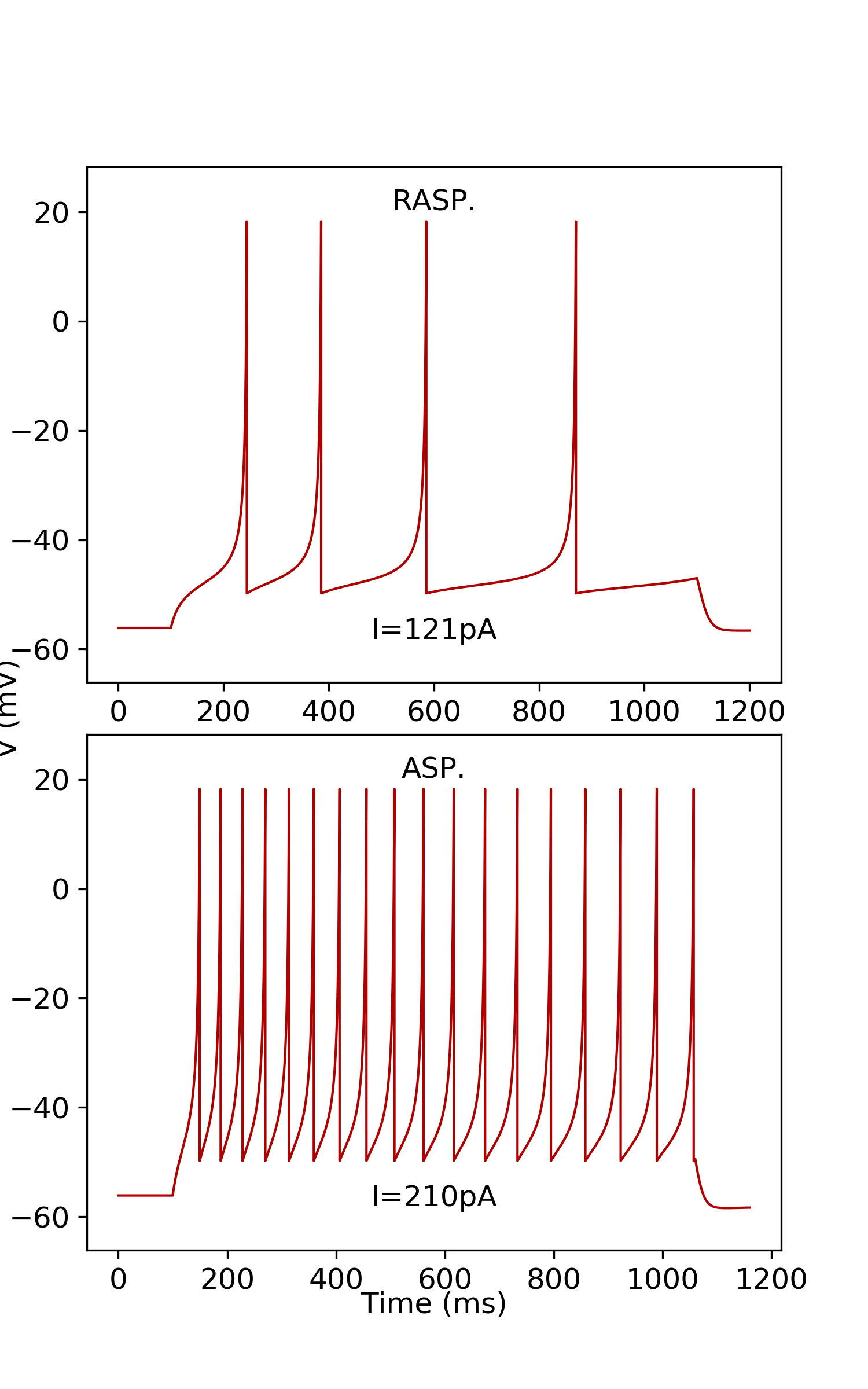
ASP. [Evidence] [Firing Pattern]
NASP [Evidence] [Firing Pattern]
RASP. [Evidence] [Firing Pattern]

Izhikevich Model
Parameters Single Compartment Downloads Simulate
subtype: 1 k=0.37;a= 0.001;b= -4.08;d= 13;C= 204;Vr= -70.53;Vt= -39.99;Vpeak= 3.96;Vmin= -54.95; Simulate
subtype: 2 k=1.53;a= 0.001;b= 0.01;d= 7;C= 286;Vr= -56.14;Vt= -39.78;Vpeak= 18.27;Vmin= -49.81; Simulate
Images
Image MissingImage Missing
ModelDB Model
Model Accession Number PubMed ID

Sources of Input
Known sources
Excitatory or Inhibitory
none known

Potential sources
Excitatory or Inhibitory
CA2 Pyramidal
EC LI-II Multipolar-Pyramidal
EC LI-II Pyramidal-Fan
MEC LII Stellate
MEC LII-III Pyramidal-Multiform
EC LII-III Pyramidal-Tripolar
LEC LIII Multipolar Principal
LEC LIII Complex Pyramidal
MEC LIII Complex Pyramidal
MEC LIII Bipolar Complex Pyramidal
MEC LV Pyramidal
MEC LV Superficial Pyramidal
MEC LI-II Polar Interneuron*
EC LII Axo-axonic
MEC LII Basket
EC LII Basket-Neurogliaform
MEC LIII Multipolar Interneuron
MEC LIII Superficial Multipolar Interneuron
MEC LI Neurogliaform*
EC LII-III Superficial Polymorphic Interneuron*
MEC LIII Superficial Trilayered Interneuron

Potential sources known to be avoided
Excitatory or Inhibitory
none known

Targets of Output
Known targets
Excitatory or Inhibitory
none known

Potential targets
Excitatory or Inhibitory
EC LI-II Multipolar-Pyramidal
EC LI-II Pyramidal-Fan
MEC LII Oblique Pyramidal
MEC LII Stellate
MEC LII-III Pyramidal-Multiform
EC LII-III Pyramidal-Tripolar
LEC LIII Multipolar Principal
MEC LIII Multipolar Principal
EC LIII Small Pyramidal
LEC LIII Complex Pyramidal
MEC LIII Complex Pyramidal
MEC LIII Bipolar Complex Pyramidal
EC LIII Pyramidal
EC LIII Stellate
EC LIII-V Bipolar Pyramidal
EC LIV-V Pyramidal-Horizontal
MEC LV Principal*
MEC LV Pyramidal
EC LV Deep Pyramidal
MEC LV Superficial Pyramidal
MEC LI-II Polar Interneuron*
EC LII Axo-axonic
MEC LII Basket
EC LII Basket-Neurogliaform
EC LIII Bipolar Interneuron*
LEC LIII Multipolar Interneuron
MEC LIII Multipolar Interneuron
MEC LIII Superficial Multipolar Interneuron
EC LII-III Superficial Polymorphic Interneuron*
EC LIII Pyramidal-Looking Interneuron
MEC LIII Superficial Trilayered Interneuron

Potential targets known to be avoided
Excitatory or Inhibitory
none known

Oscillation Phase Locking
Category
Value