EC LIII Pyramidal-Looking Interneuron
* indicates new v2.0 neuron type
Name Supertype (ID:Family:Type:Subregion)
EC (i)023300 LIII Pyramidal-Looking Interneuron S152006:GABAergic:iLIII:EC

Name derivation
This is the simplest and most descriptive name of the ones in the cited literature.

Synonym(s)
EC layer III pyramidal looking interneuron
EC layer III Type 1-(Kumar) cell
EC layer III Type 3-(Gloveli) cell
LEC layer III pyramidal looking interneuron
MEC layer III pyramidal looking interneuron
MEC layer III type 3 local circuit cell

List of articles
Click here to view the list
Canto CB  (2008) Neural Plast
What does the anatomical organization of the entorhinal cortex tell us?
Canto CB, Wouterlood FG, Witter MP.
Neural Plast, 2008, 2008, Pages: 381243 -
PMID: 18769556; DOI: 10.1155/2008/381243
Tags: morphology, marker, connectivity, synapse probabilities
Gloveli T  (1997) Neuroscience
Morphological and electrophysiological characterization of layer III cells of the medial entorhinal cortex of the rat.
Gloveli T, Schmitz D, Empson RM, Dugladze T, Heinemann U.
Neuroscience, 1997 Apr, 77 (3), Pages: 629 - 648
PMID: 9070741; DOI: 10.1016/S0306-4522(96)00494-0
Tags: morphology, membrane biophysics, firing patterns
Wouterlood FG  (2000) J Comp Neurol
Calretinin in the entorhinal cortex of the rat: distribution, morphology, ultrastructure of neurons, and co-localization with gamma-aminobutyric acid and parvalbumin.
Wouterlood FG, van Denderen JC, van Haeften T, Witter MP.
J Comp Neurol, 2000 Sep 18, 425 (2), Pages: 177 - 192
PMID: 10954838; DOI: 10.1002/1096-9861(20000918)425:2<177::AID-CNE2>3.0.CO;2-G
Tags: morphology, marker


Morphology
Soma
EC:III
Axons
EC:III
EC:IV
Dendrites
EC:II
EC:III
EC:IV

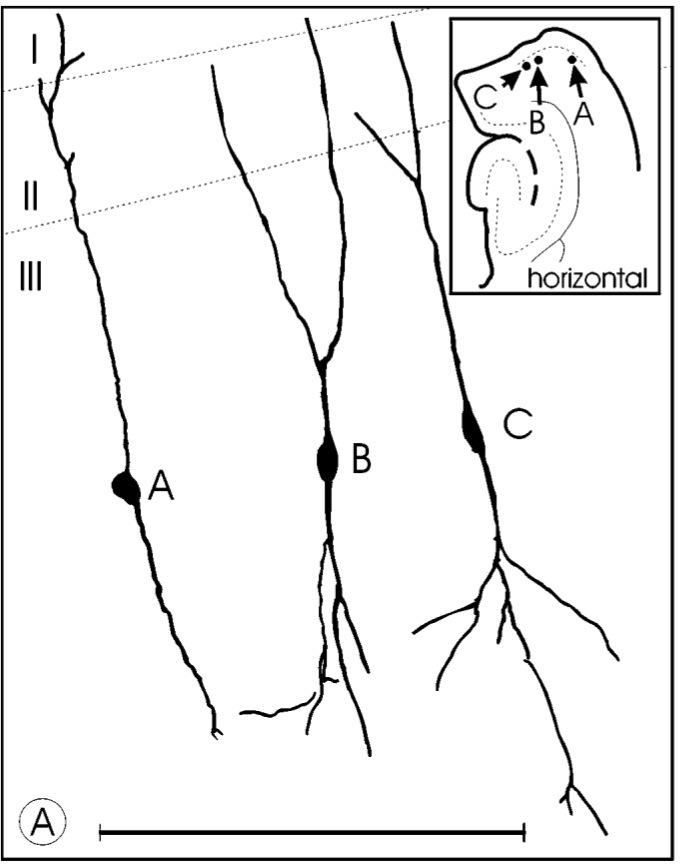
Representative figure
Calretinin in the entorhinal cortex of the rat: distribution, morphology, ultrastructure of neurons, and co-localization with gamma-aminobutyric acid and parvalbumin.
Wouterlood FG, van Denderen JC, van Haeften T, Witter MP
J Comp Neurol, 2000 Sep 18, 425 (2), pages: 177 - 192
PMID: 10954838; DOI: 10.1002/1096-9861(20000918)425:2<177::AID-CNE2>3.0.CO;2-G


"Fig. 4. Examples of entorhinal calretinin cell types. Composite drawings (the exact locations of cells are shown in the insets; horizontal sections). A: Bipolar cells {EC LIII Pyramidal-Looking Interneuron} in MEA [medial entorhinal area]. É Cortical layers are indicated with roman numerals. Scale bars = 100 [micro]m."


Molecular markers
Positive
CR
Negative
CB (multiple confirming inferences)
CB1 (inference)
GABAa\alpha 6 (inference)
PV (multiple confirming inferences)
Mixed expression
VIP (subtypes)

Electrophysiological properties
Key: [range] OR representative value±SD (measurements); Number of sources (total measurements): [min , max]

Resting membrane potential (Vrest): -71.4±0.8 mV (23); 1 source
Input resistance (Rin): 50.5±5 MΩ (23); 1 source
Time constant (τm): 24.5±1.9 ms (23); 1 source
Threshold potential (Vthresh): [25.4, 34.3] mV (2); 1 source
Fast afterhyperpolaziring potential amplitude (Fast AHP): [7.8, 13.7] mV (2); 1 source
Action potential amplitude (APampl): [57.2, 60.6] mV (2); 1 source
Slow afterhyperpolarizing potential amplitude (Slow AHP): 9.8 mV (1); 1 source

Notes
Merger of EC (+)023300 pyramid looking III neurons and EC (+)023100 spindle III neurons Inhibitory because they have aspiny dendrites, are nonprojecting, have synapses on dendritic shafts and cell bodies, and have an indented nucleus. These cells have a long time constant (p. 3) which is similar to Gloveli type 1 cells which are excitatory spiny pyramidal cells. Borderline Dend. in L1

Firing Pattern
Images
Image Missing
Parameters View page
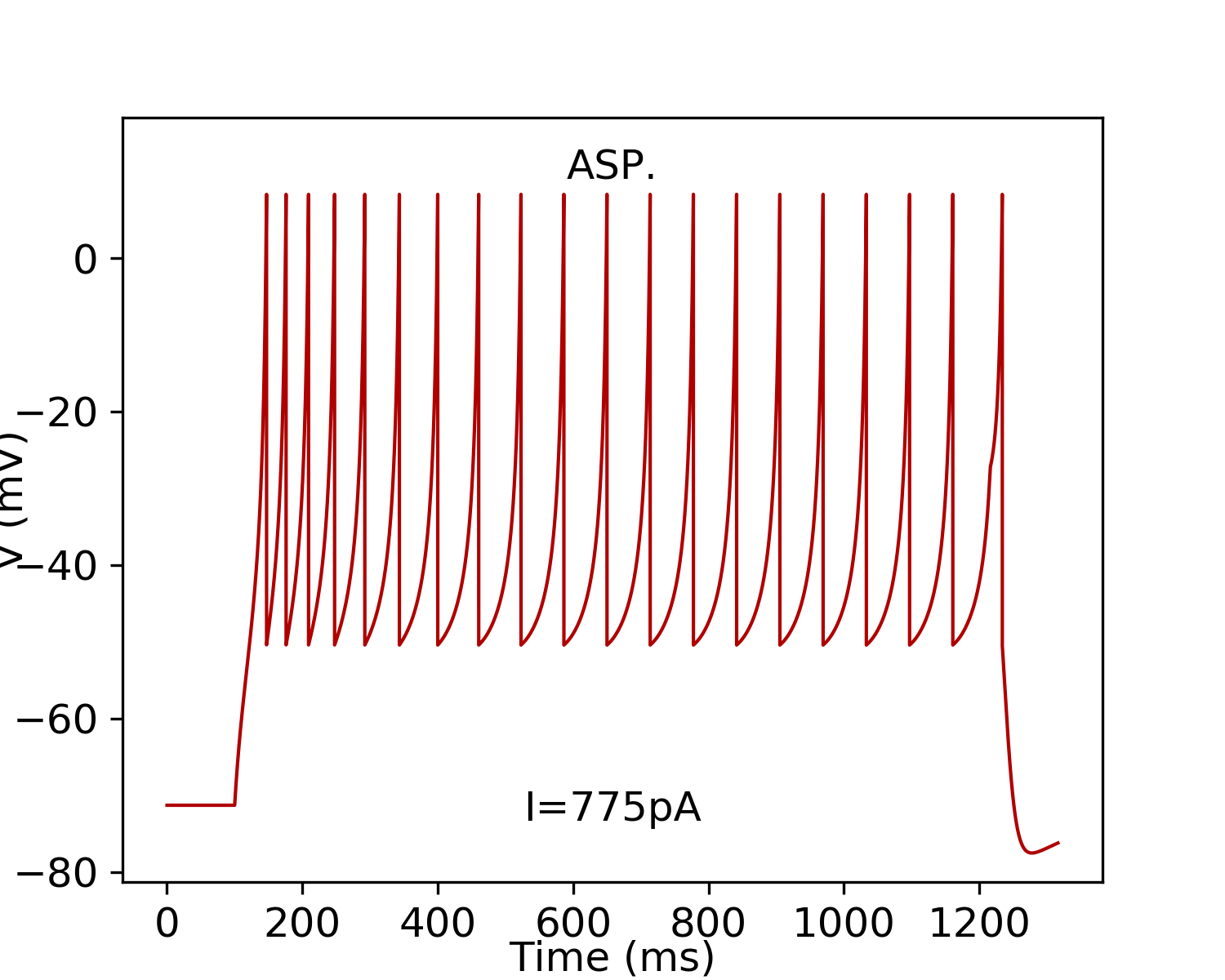
ASP. [Evidence] [Firing Pattern]

Izhikevich Model
Parameters Single Compartment Downloads Simulate
subtype: 1 k=1.23;a= 0.008;b= 10.68;d= 25;C= 521;Vr= -71.29;Vt= -37.78;Vpeak= 8.3;Vmin= -50.42; Simulate
Images
Image Missing
ModelDB Model
Model Accession Number PubMed ID

Sources of Input
Known sources
Excitatory or Inhibitory
none known

Potential sources
Excitatory or Inhibitory
CA2 Pyramidal
Sub EC-Projecting Pyramidal
EC LI-II Multipolar-Pyramidal
EC LI-II Pyramidal-Fan
MEC LII Oblique Pyramidal
MEC LII Stellate
MEC LII-III Pyramidal-Multiform
EC LII-III Pyramidal-Tripolar
LEC LIII Multipolar Principal
MEC LIII Multipolar Principal
EC LIII Small Pyramidal
LEC LIII Complex Pyramidal
MEC LIII Complex Pyramidal
MEC LIII Bipolar Complex Pyramidal
EC LIII Pyramidal
EC LIII Stellate
EC LIII-V Bipolar Pyramidal
EC LIV-VI Deep Multipolar Principal
MEC LV Multipolar-Pyramidal
MEC LV Pyramidal
MEC LV Superficial Pyramidal
LEC LVI Multipolar-Pyramidal
EC LII Axo-axonic
MEC LII Basket
EC LII Basket-Neurogliaform
EC LIII Bipolar Interneuron*
LEC LIII Multipolar Interneuron
MEC LIII Multipolar Interneuron
MEC LIII Superficial Multipolar Interneuron
EC LII-III Superficial Polymorphic Interneuron*
EC LIII Pyramidal-Looking Interneuron
MEC LIII Superficial Trilayered Interneuron

Potential sources known to be avoided
Excitatory or Inhibitory
none known

Targets of Output
Known targets
Excitatory or Inhibitory
none known

Potential targets
Excitatory or Inhibitory
MEC LII-III Pyramidal-Multiform
EC LII-III Pyramidal-Tripolar
LEC LIII Multipolar Principal
MEC LIII Multipolar Principal
EC LIII Small Pyramidal
LEC LIII Complex Pyramidal
MEC LIII Complex Pyramidal
MEC LIII Bipolar Complex Pyramidal
EC LIII Pyramidal
EC LIII Stellate
EC LIII-V Bipolar Pyramidal
EC LIV-V Pyramidal-Horizontal
EC LIV-VI Deep Multipolar Principal
MEC LV Multipolar-Pyramidal
MEC LV Superficial Pyramidal
EC LIII Bipolar Interneuron*
LEC LIII Multipolar Interneuron
MEC LIII Multipolar Interneuron
MEC LIII Superficial Multipolar Interneuron
EC LII-III Superficial Polymorphic Interneuron*
EC LIII Pyramidal-Looking Interneuron
MEC LIII Superficial Trilayered Interneuron

Potential targets known to be avoided
Excitatory or Inhibitory
none known

Oscillation Phase Locking
Category
Value