EC LIV-VI Deep Multipolar Principal
* indicates new v2.0 neuron type
Name Supertype (ID:Family:Type:Subregion)
EC (e)000333p-Sub_111 LIV-VI Deep Multipolar Principal S081906:Glutamatergic Deep:LIV-VI:EC

Name derivation
The core name borrows from one of the frequenctly cited name sin the literature. "Principal" distinguishes this type from the multipolar interneurons. "Deep" describes the containment of both the axons anbd dendrites within the deep layer of EC.

Synonym(s)
EC layer V polymorphic MPN
EC layer VI MPN
LEC layer V multipolar cell
LEC LV deep pyramidal neuron
LEC LV multipolar principal neuron
LEC LV tilted pyramidal neuron to multipolar neuron
LEC LVI multipolar to tilted pyramidal cell
LEC LVI multipolar to tilted pyramidal neuron
LEC LVI tilted pyramidal to multipolar neuron
LEC tilted pyramidal-multipolar LV principal neuron
MEC deep layer nonpyramidal projection neuron
MEC layer IV vertical bipolar cell
MEC layer V multipolar cell
MEC layer V multipolar neuron
MEC layer VI multipolar cell
MEC layer VI pyramidal cell
MEC LVI multipolar neuron
MEC LVI multipolar principal cell
MEC LVI multipolar principal neuron
MEC multipolar live principal neuron

List of articles
Click here to view the list
Canto CB  (2008) Neural Plast
What does the anatomical organization of the entorhinal cortex tell us?
Canto CB, Wouterlood FG, Witter MP.
Neural Plast, 2008, 2008, Pages: 381243 -
PMID: 18769556; DOI: 10.1155/2008/381243
Tags: morphology, marker, connectivity, synapse probabilities
Canto CB  (2012) Hippocampus
Cellular properties of principal neurons in the rat entorhinal cortex. II. The medial entorhinal cortex.
Canto CB, Witter MP.
Hippocampus, 2012 Jun, 22 (6), Pages: 1277 - 1299
PMID: 22161956; DOI: 10.1002/hipo.20993
Tags: morphology, synapse probabilities
Canto CB  (2012) Hippocampus
Cellular properties of principal neurons in the rat entorhinal cortex. I. The lateral entorhinal cortex.
Canto CB, Witter MP.
Hippocampus, 2012 Jun, 22 (6), Pages: 1256 - 1276
PMID: 22162008; DOI: 10.1002/hipo.20997
Tags: morphology, membrane biophysics, firing patterns, synapse probabilities
Gloveli T  (2001) Eur J Neurosci
Properties of entorhinal cortex deep layer neurons projecting to the rat dentate gyrus.
Gloveli T, Dugladze T, Schmitz D, Heinemann U.
Eur J Neurosci, 2001 Jan, 13 (2), Pages: 413 - 420
PMID: 11168548; DOI: 10.1046/j.0953-816X.2000.01405.x
Tags: morphology, membrane biophysics, connectivity, firing patterns, synapse probabilities
Hamam BN  (2002) J Comp Neurol
Morphological and electrophysiological characteristics of layer V neurons of the rat lateral entorhinal cortex.
Hamam BN, Amaral DG, Alonso AA.
J Comp Neurol, 2002 Sep 9, 451 (1), Pages: 45 - 61
PMID: 12209840; DOI: 10.1002/cne.10335
Tags: synapse probabilities


Morphology
Soma
EC:IV
EC:V
EC:VI
Axons
SUB:SM
SUB:SP
SUB:PL
EC:IV
EC:V
EC:VI
Dendrites
EC:IV
EC:V
EC:VI

Representative figure
Properties of entorhinal cortex deep layer neurons projecting to the rat dentate gyrus.
Gloveli T, Dugladze T, Schmitz D, Heinemann U
Eur J Neurosci, 2001 Jan, 13 (2), pages: 413 - 420
PMID: 11168548; DOI: 10.1046/j.0953-816X.2000.01405.x


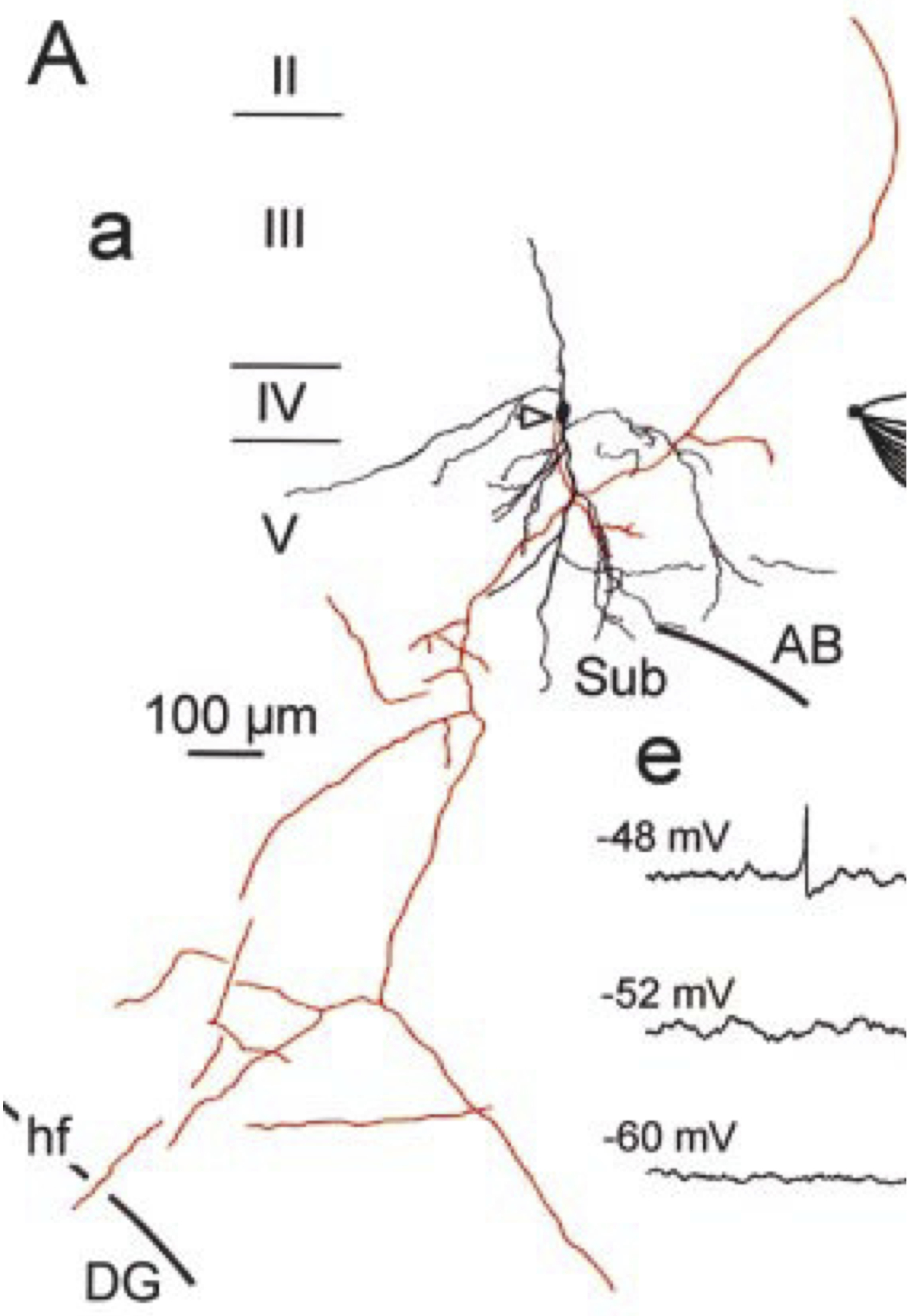
"FIG. 4. Properties of deep layer nonpyramidal projection neurons {EC LIV-VI Deep Multipolar Principal} [in entorhinal cortex]. (Aa) and Ba) Axonal and dendritic morphology of the neurons. For better visualization, the soma and dendrites are drawn in black, the axon is drawn in red. For abbreviations, see Fig. 1A. Open arrows point to the origin of the axons. (Aa) Camera lucida reconstruction of a vertical bipolar cell with a soma located in layer IV. The axon which started from the flat side of the soma reaches the molecular layer of the DG [dentate gyrus]. Note the axonal arborization to the superficial layers."


Molecular markers
Positive
None known
Negative
GABAa\alpha 6 (inference)
Mixed expression
NPY (subtypes)
PV (subtypes)
SOM (subtypes)
Sub P (subtypes)

Electrophysiological properties
Key: [range] OR representative value±SD (measurements); Number of sources (total measurements): [min , max]

Resting membrane potential (Vrest): -59.8±6.8 mV (8); 4 sources (14): [-69 , -59.8]
Input resistance (Rin): 272.3±105.8 MΩ (8); 4 sources (13): [272.3 , 490]
Time constant (τm): 26.6±6.5 ms (8); 4 sources (13): [25 , 36]
Threshold potential (Vthresh): 14.5 mV (1); 4 sources (4): [13 , 36]
Fast afterhyperpolaziring potential amplitude (Fast AHP): 5.7 mV (1); 4 sources (4): [5.7 , 15]
Action potential amplitude (APampl): 80.4 mV (1); 4 sources (4): [69 , 80.4]
Action potential width (APwidth): 1.39±0.6 ms (8); 4 sources (13): [1.39 , 1.7]
Max firing rate (Max F.R.): >70 Hz (1); 1 source
Slow afterhyperpolarizing potential amplitude (Slow AHP): 1.2 mV (1); 2 sources (2): [1.2 , 4.4]
Sag ratio: 0.95 (1); 3 sources (3): [0.85 , 0.95]

Notes
This cell type represents a merger between EC (+)000333p-SUB 111 multipolar projecting V neurons and EC (+)000033 multipolar-pyramid VI neurons. Excitatory cells (Gloveli 2001 -> GABA negative, projecting, similar EP characteristics to principal neurons; Canto & Witter 201X LEC preprint -> projecting, spiny, "principal"; Canto 2008 -> spiny, projecting). The former 000033 class contains an unspecified axonal projection to the subiculum, and the former 000333 class is known to project to all 3 layers of the subiculum. In 000033, evidence for axons and dendrites in IV is subthreshold, but there is a presence, so an aggressive merger was approved.

Firing Pattern
Images
Image MissingImage MissingImage MissingImage Missing
Parameters View page
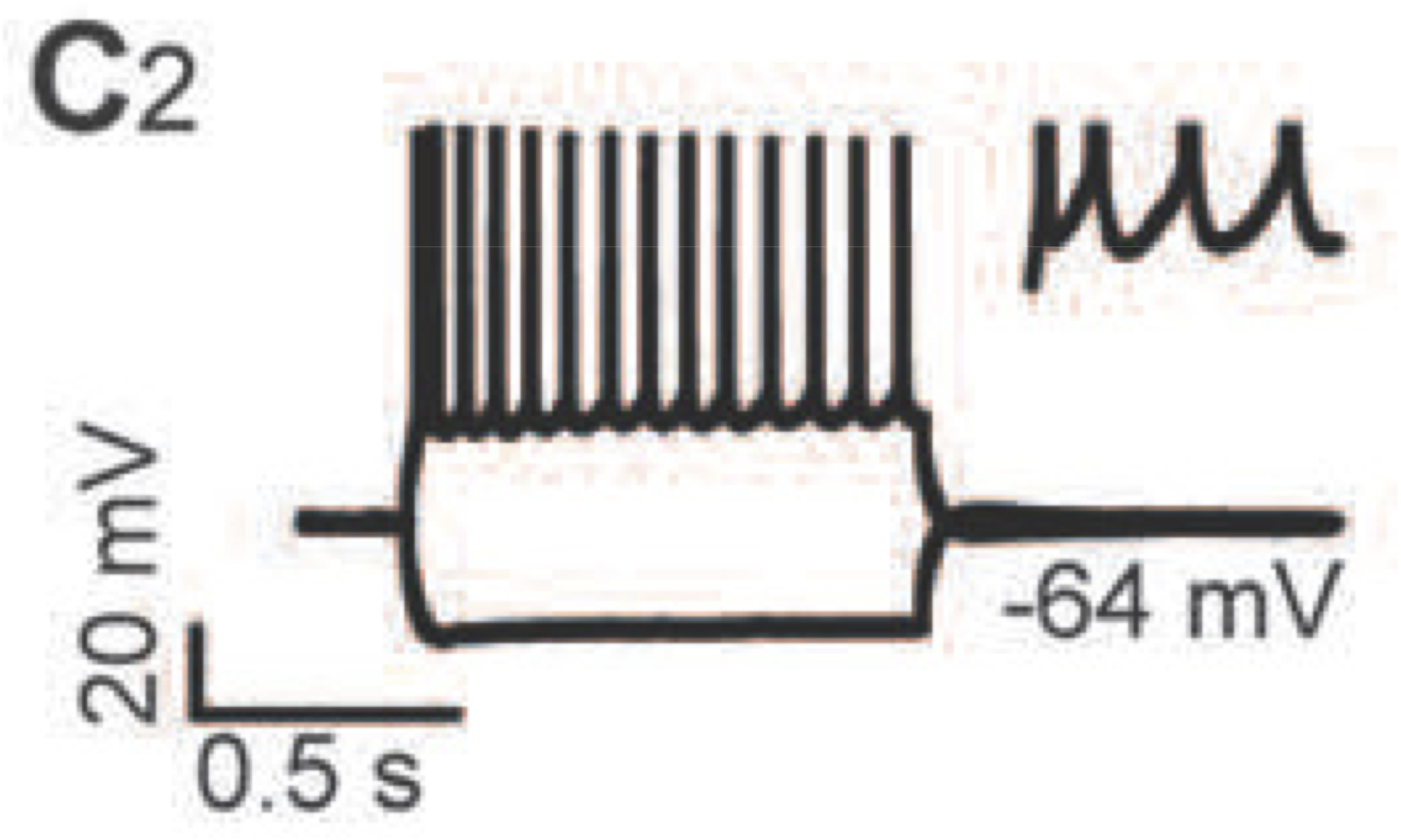
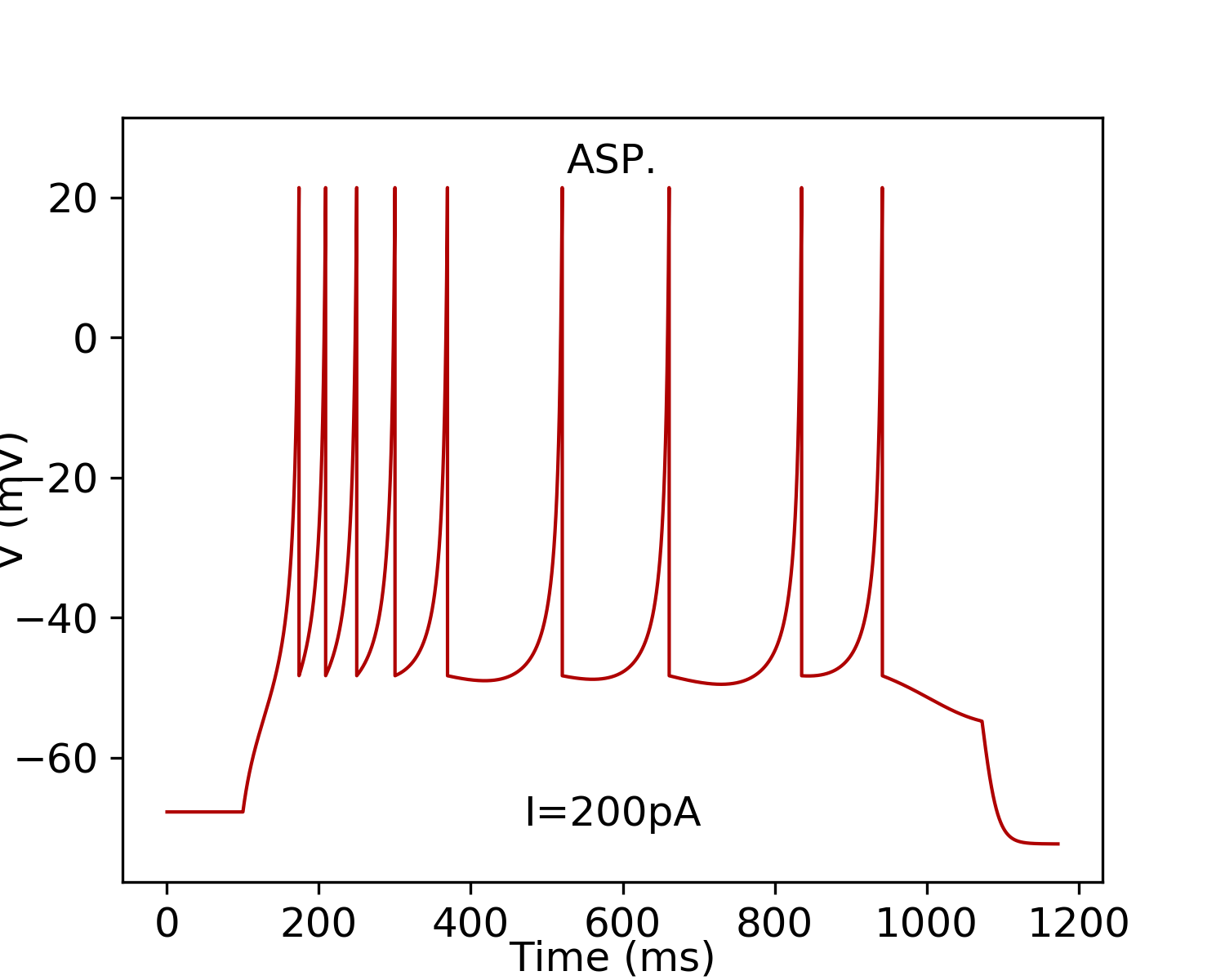
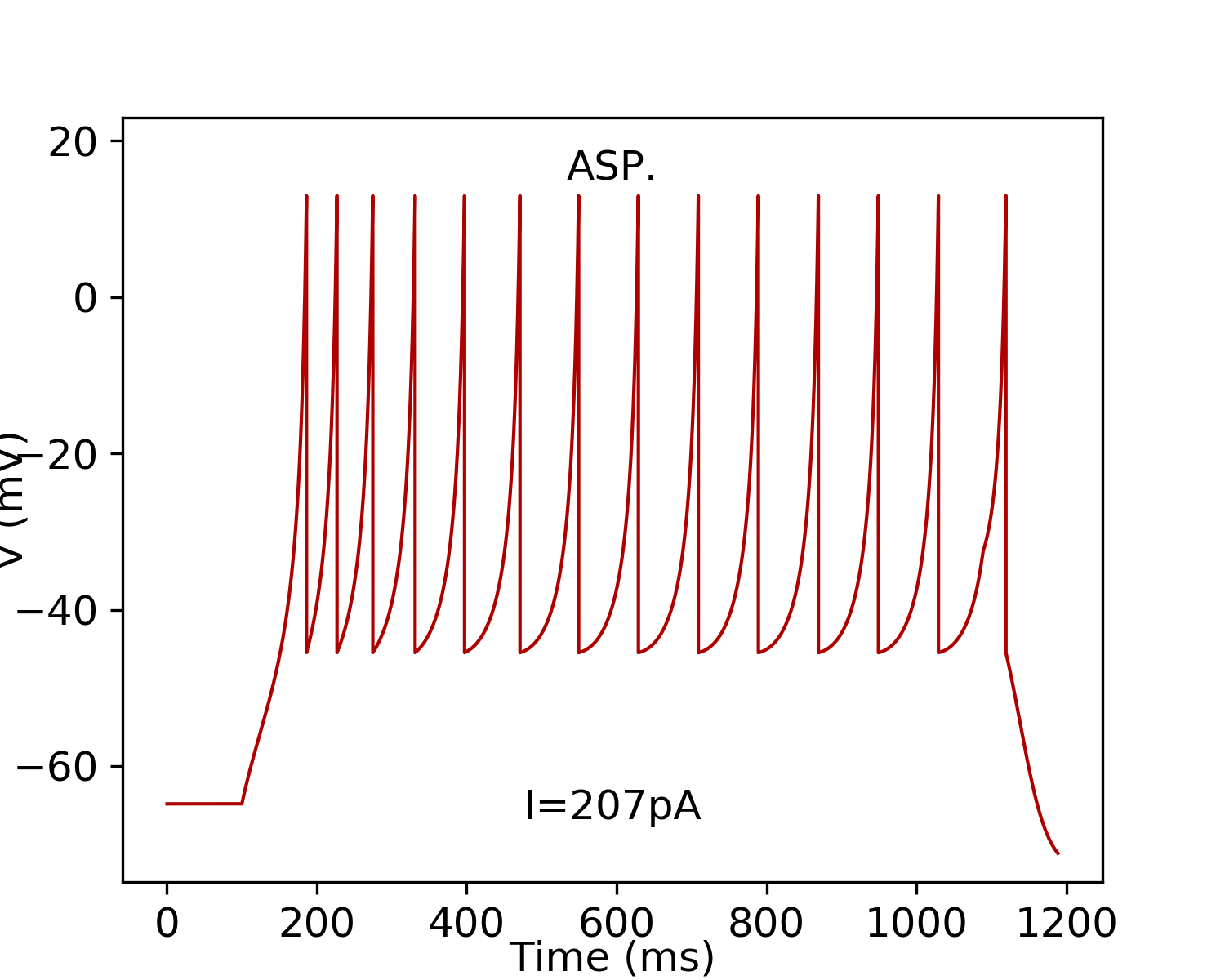
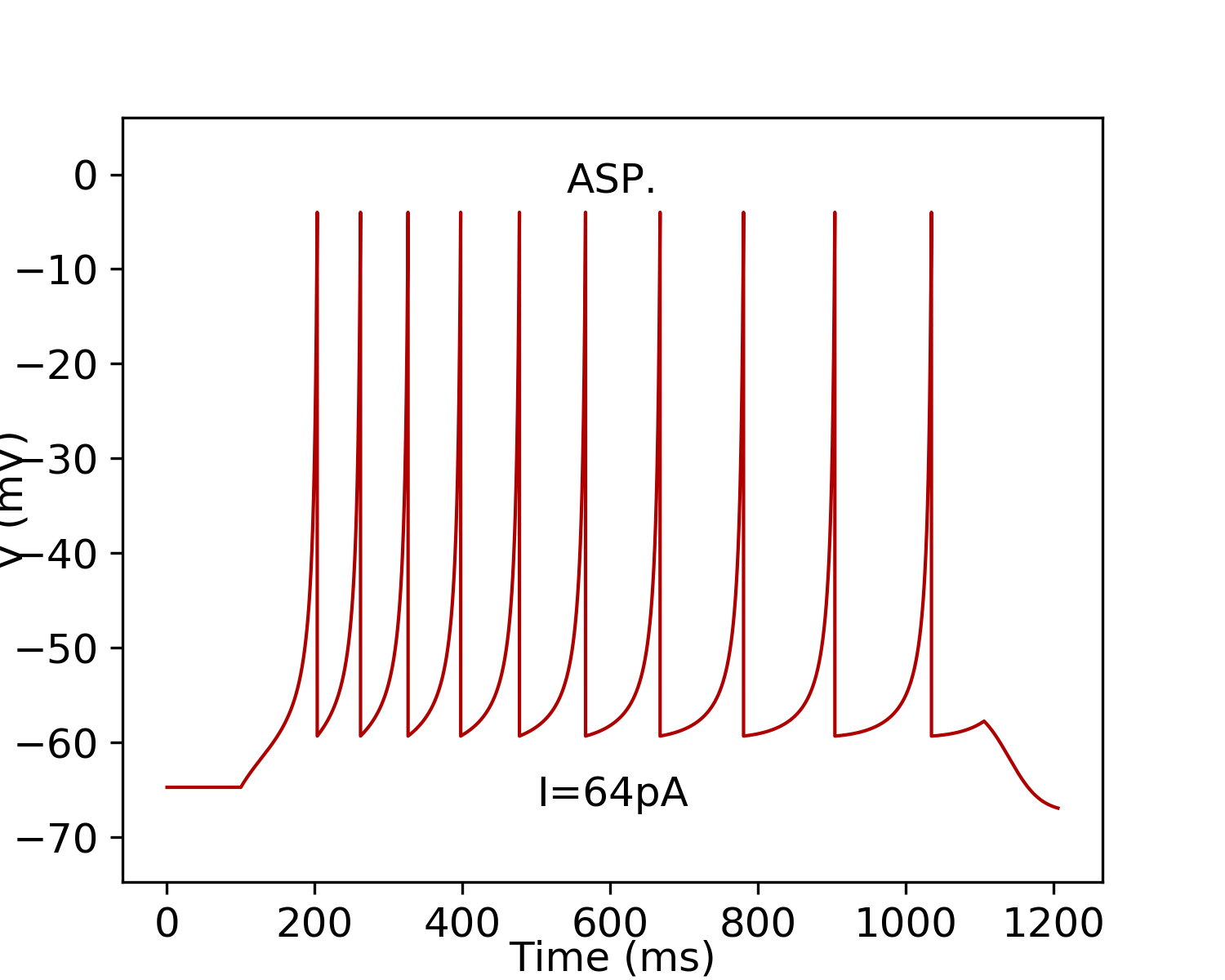
ASP. [Evidence] [Firing Pattern]
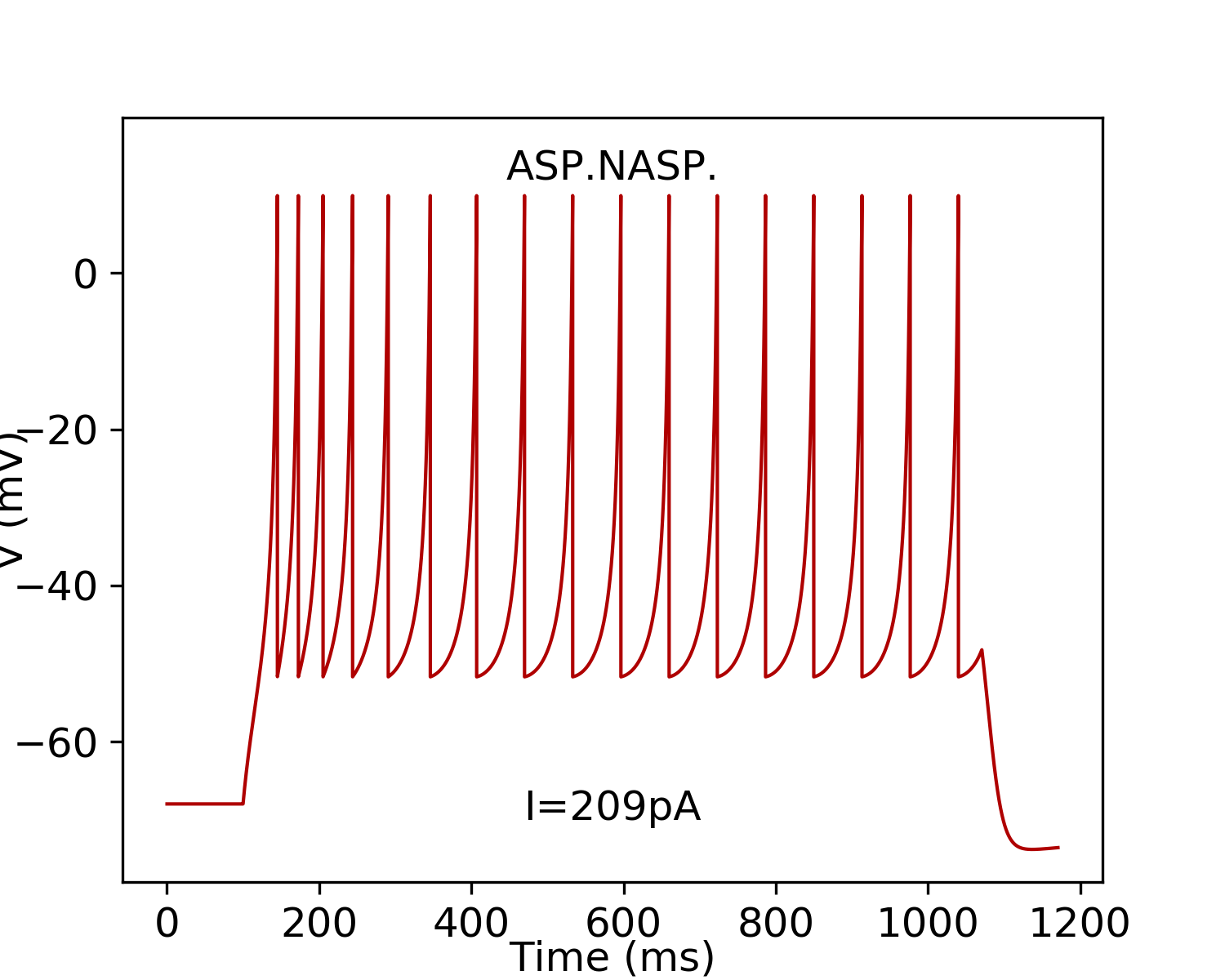
NASP [Evidence] [Firing Pattern]

Izhikevich Model
Parameters Single Compartment Downloads Simulate
subtype: 1 k=0.62;a= 0;b= -22.09;d= 37;C= 240;Vr= -67.73;Vt= -40.44;Vpeak= 21.38;Vmin= -48.28; Simulate
subtype: 2 k=0.55;a= 0.003;b= -5.78;d= 51;C= 195;Vr= -67.98;Vt= -44.21;Vpeak= 9.92;Vmin= -51.71; Simulate
subtype: 3 k=0.63;a= 0.003;b= -4.6;d= 82;C= 459;Vr= -64.84;Vt= -46.39;Vpeak= 12.95;Vmin= -45.5; Simulate
subtype: 4 k=1.8;a= 0.002;b= 2.58;d= 7;C= 476;Vr= -64.72;Vt= -58.76;Vpeak= -4.01;Vmin= -59.31; Simulate
Images
Image MissingImage MissingImage MissingImage Missing
ModelDB Model
Model Accession Number PubMed ID

Sources of Input
Known sources
Excitatory or Inhibitory
none known

Potential sources
Excitatory or Inhibitory
CA1 Pyramidal
CA1 Deep Pyramidal
CA1 Superficial Pyramidal
Sub EC-Projecting Pyramidal
MEC LII Oblique Pyramidal
MEC LII Stellate
MEC LII-III Pyramidal-Multiform
LEC LIII Multipolar Principal
MEC LIII Multipolar Principal
EC LIII Small Pyramidal
LEC LIII Complex Pyramidal
MEC LIII Complex Pyramidal
MEC LIII Bipolar Complex Pyramidal
EC LIII-V Bipolar Pyramidal
EC LIV-V Pyramidal-Horizontal
EC LIV-VI Deep Multipolar Principal
MEC LV Multipolar-Pyramidal
MEC LV Principal*
MEC LV Pyramidal
EC LV Deep Pyramidal
MEC LV Superficial Pyramidal
MEC LV-VI Pyramidal-Polymorphic
LEC LVI Multipolar-Pyramidal
EC LIII Bipolar Interneuron*
EC LIII Pyramidal-Looking Interneuron

Potential sources known to be avoided
Excitatory or Inhibitory
none known

Targets of Output
Known targets
Excitatory or Inhibitory
none known

Potential targets
Excitatory or Inhibitory
Sub CA1-Projecting Pyramidal
Sub EC-Projecting Pyramidal
Sub Axo-axonic
Sub Pyramidale Multipolar Interneuron*
Sub Wide-arbor Polymorphic*
Sub Recurrent Polymorphic-Moleculare*
LEC LIII Multipolar Principal
MEC LIII Multipolar Principal
LEC LIII Complex Pyramidal
MEC LIII Complex Pyramidal
EC LIII Pyramidal
EC LIII-V Bipolar Pyramidal
EC LIV-V Pyramidal-Horizontal
EC LIV-VI Deep Multipolar Principal
MEC LV Multipolar-Pyramidal
MEC LV Principal*
MEC LV Pyramidal
EC LV Deep Pyramidal
MEC LV Superficial Pyramidal
MEC LV-VI Pyramidal-Polymorphic
LEC LVI Multipolar-Pyramidal
EC LIII Bipolar Interneuron*
MEC LIII Multipolar Interneuron
EC LIII Pyramidal-Looking Interneuron

Potential targets known to be avoided
Excitatory or Inhibitory
none known

Oscillation Phase Locking
Category
Value