EC LII-III Pyramidal-Tripolar
* indicates new v2.0 neuron type
Name Supertype (ID:Family:Type:Subregion)
EC (e)333000p-DG_1000-Sub_111 LII-III Pyramidal-Tripolar S061706:Glutamatergic II:LI-II:EC

Name derivation
This name is a hybrid of two frequently cited names.

Synonym(s)
EC layer II horizontal tripolar cell
EC layer II horizontal tripolar neuron
EC layer II stellate
EC layer II tripolar cell
EC stellate cell of layer II
EC stellate neuron of layer II
LEC layer II multiform cell
LEC LII pyramidal cell
LEC LII pyramidal neuron
LEC LIII complex pyramidal neuron
MEC L2P
MEC layer II stellate cell
MEC layer IIb stellate cell
MEC LII oblique pyramidal neuron
MEC LII pyramidal cell
MEC LII pyramidal neuron
MEC LII SC

List of articles
Click here to view the list
Amaral D  (2007) The Hippocampus Book
Hippocampal Neuroanatomy
Amaral D, Lavenex P.
The Hippocampus Book, 2007, Pages: 35 - 112
ISBN: 9780195100273
Tags: morphology, connectivity, synapse probabilities
Canto CB  (2008) Neural Plast
What does the anatomical organization of the entorhinal cortex tell us?
Canto CB, Wouterlood FG, Witter MP.
Neural Plast, 2008, 2008, Pages: 381243 -
PMID: 18769556; DOI: 10.1155/2008/381243
Tags: morphology, marker, connectivity, synapse probabilities
Canto CB  (2012) Hippocampus
Cellular properties of principal neurons in the rat entorhinal cortex. II. The medial entorhinal cortex.
Canto CB, Witter MP.
Hippocampus, 2012 Jun, 22 (6), Pages: 1277 - 1299
PMID: 22161956; DOI: 10.1002/hipo.20993
Tags: morphology, membrane biophysics, firing patterns, synapse probabilities
Canto CB  (2012) Hippocampus
Cellular properties of principal neurons in the rat entorhinal cortex. I. The lateral entorhinal cortex.
Canto CB, Witter MP.
Hippocampus, 2012 Jun, 22 (6), Pages: 1256 - 1276
PMID: 22162008; DOI: 10.1002/hipo.20997
Tags: morphology, membrane biophysics, firing patterns, synapse probabilities
Klink R  (1997) Hippocampus
Morphological characteristics of layer II projection neurons in the rat medial entorhinal cortex.
Klink R, Alonso A.
Hippocampus, 1997, 7 (5), Pages: 571 - 583
PMID: 9347353; DOI: 10.1002/(SICI)1098-1063(1997)7:5<571::AID-HIPO12>3.0.CO;2-Y
Tags: morphology
Lingenhohl K  (1991) Exp Brain Res
Morphological characterization of rat entorhinal neurons in vivo: soma-dendritic structure and axonal domains.
Lingenhohl K, Finch DM.
Exp Brain Res, 1991, 84 (1), Pages: 57 - 74
PMID: 1713171; DOI: 10.1007/BF00231762
Tags: morphology
Quilichini P  (2010) J Neurosci
Intrinsic circuit organization and theta-gamma oscillation dynamics in the entorhinal cortex of the rat.
Quilichini P, Sirota A, Buzsaki G.
J Neurosci, 2010 Aug 18, 30 (33), Pages: 11128 - 11142
PMID: 20720120; DOI: 10.1523/JNEUROSCI.1327-10.2010
Tags: phases, synapse probabilities
Schwartz SP  (1981) Exp Neurol
Neurons of origin of the perforant path.
Schwartz SP, Coleman PD.
Exp Neurol, 1981 Oct, 74 (1), Pages: 305 - 312
PMID: 7286122; DOI: 10.1016/0014-4886(81)90169-2
Tags: morphology
Spruston N  (2007) The Hippocampus Book
Chapter 5: Structural and functional properties of hippocampal neurons
Spruston N, McBain C.
The Hippocampus Book, 2007, Pages: 133 - 200
ISBN: 9780195100273
Tags: morphology, connectivity, synapse probabilities
Tahvildari B  (2005) J Comp Neurol
Morphological and electrophysiological properties of lateral entorhinal cortex layers II and III principal neurons.
Tahvildari B, Alonso A.
J Comp Neurol, 2005 Oct 17, 491 (2), Pages: 123 - 140
PMID: 16127693; DOI: 10.1002/cne.20706
Tags: morphology, synapse probabilities

Supplemental PMIDs
Click here to view the list of PMIDs

List of Hippocampome.org to NeuroMorpho.Org mappings
Click here to view the list of mappings
  • Peng

  • Morphology
    Soma
    EC:II
    EC:III
    Axons
    DG:SMo
    SUB:SM
    SUB:SP
    SUB:PL
    EC:I
    EC:II
    EC:III
    Dendrites
    EC:I
    EC:II
    EC:III

    Representative figure
    Morphological characterization of rat entorhinal neurons in vivo: soma-dendritic structure and axonal domains.
    Lingenhohl K, Finch DM
    Exp Brain Res, 1991, 84 (1), pages: 57 - 74
    PMID: 1713171; DOI: 10.1007/BF00231762


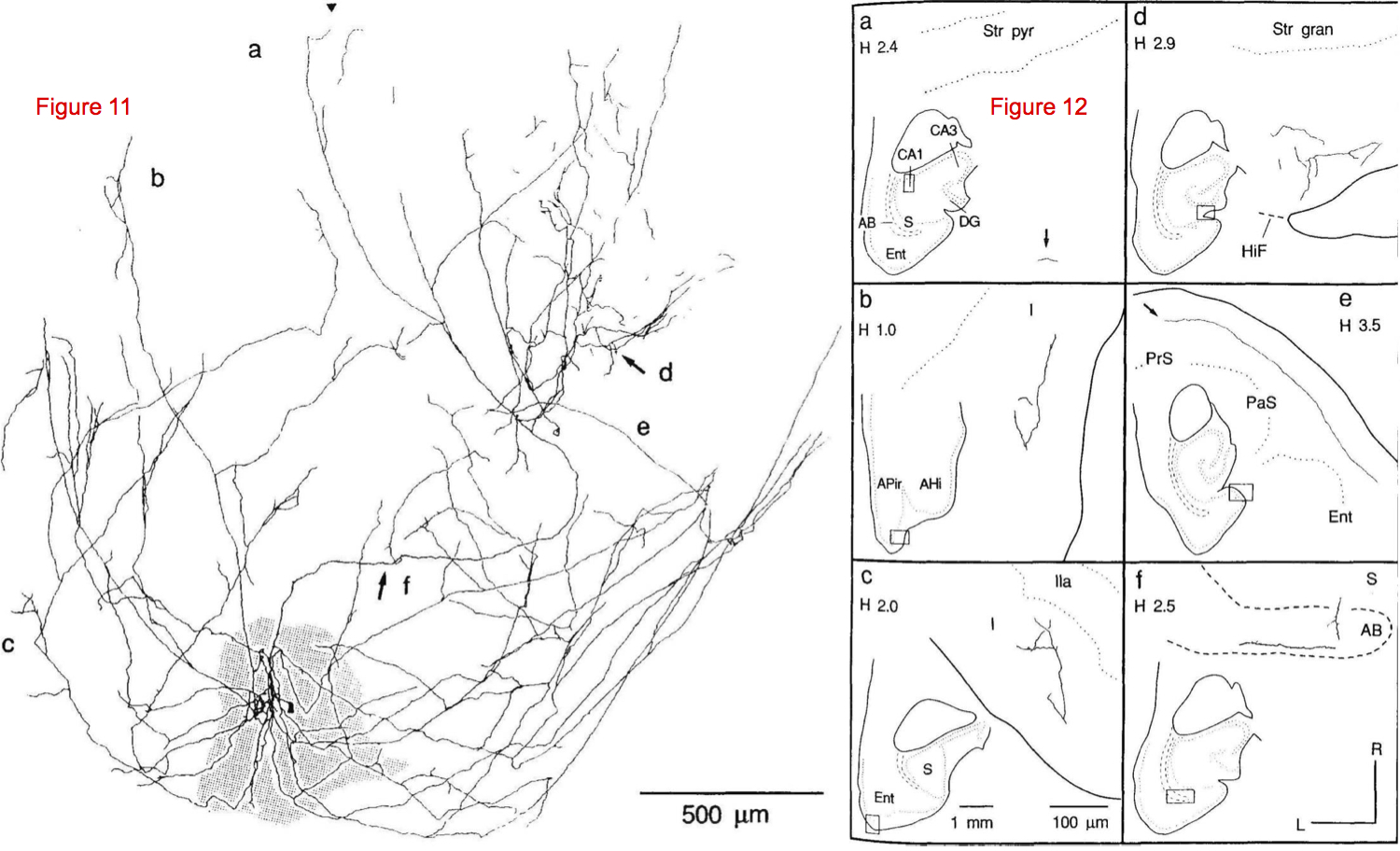
    "Fig. 11. Drawing tube reconstruction (horizontal plane) of an HRP[horseradish peroxidase]-filled layer IIb neuron (cell no 14) {EC LII-III Pyramidal-Tripolar}, located in the medial entorhinal cortex. Labels a-f indicate axonal branches in different entorhinal and extra-entorhinal areas. These correspond to the same labels in Fig. 12."


    Molecular markers
    Positive
    None known
    Negative
    CR
    GABAa\alpha 6 (inference)
    PV
    Mixed expression
    CB (subtypes)

    Electrophysiological properties
    Key: [range] OR representative value±SD (measurements); Number of sources (total measurements): [min , max]

    Resting membrane potential (Vrest): [-70, -56] mV (2); 2 sources (4): [-70 , -62]
    Input resistance (Rin): 400 MΩ (96); 2 sources (133): [400 , 430]
    Time constant (τm): 16 ms (96); 2 sources (133): [16 , 25]
    Threshold potential (Vthresh): [8.1, 23.1] mV (2); 2 sources (4): [7.5 , 8.1]
    Fast afterhyperpolaziring potential amplitude (Fast AHP): [3.7, 7.3] mV (2); 2 sources (4): [3.7 , 7.1]
    Action potential amplitude (APampl): 69±19.6 mV (96); 2 sources (133): [69 , 77.5]
    Action potential width (APwidth): 1.25±0.5 ms (96); 2 sources (133): [1.22 , 1.25]
    Max firing rate (Max F.R.): >40 Hz (1); 1 source
    Slow afterhyperpolarizing potential amplitude (Slow AHP): 3 mV (2); 2 sources (3): [4.7 , 4.7]
    Sag ratio: 0.66 (96); 2 sources (133): [0.66 , 0.78]

    Notes
    This class is a merger of MEC (+)333000p-DG 1000-SUB 111 stellate II cells, EC (+)333000 principal cells, and LEC (+)333000 complex pyramidal III neurons MEC (+)333000p-DG 1000-SUB 111 stellate II cells have explicit connections to DG and SUB, whereas EC (+)333000 principal cells and LEC (+)333000 complex pyramidal III neurons only have axons that project to the angular bundle. Deep layer collaterals are attributed to Tamamaki, which is in EC (+)331111p stellate II cells. The multiform cell does fit in this cell type. The text only description of occasional extended collaterals is insufficient to warrant a class change. Although Klink and Alonso's Figures 9 and 10 appear to be the same cell, both depictions are included, since 9 depicts more of the dendritic extent and 10 depicts the axon in color for clarity. Canto 2011: LEC (+)333000 pyramidal III neurons have borderline A:IV. Lingenhöhl 1991: stellate II are spiny

    Firing Pattern
    Images
    Image MissingImage MissingImage Missing
    Parameters View page
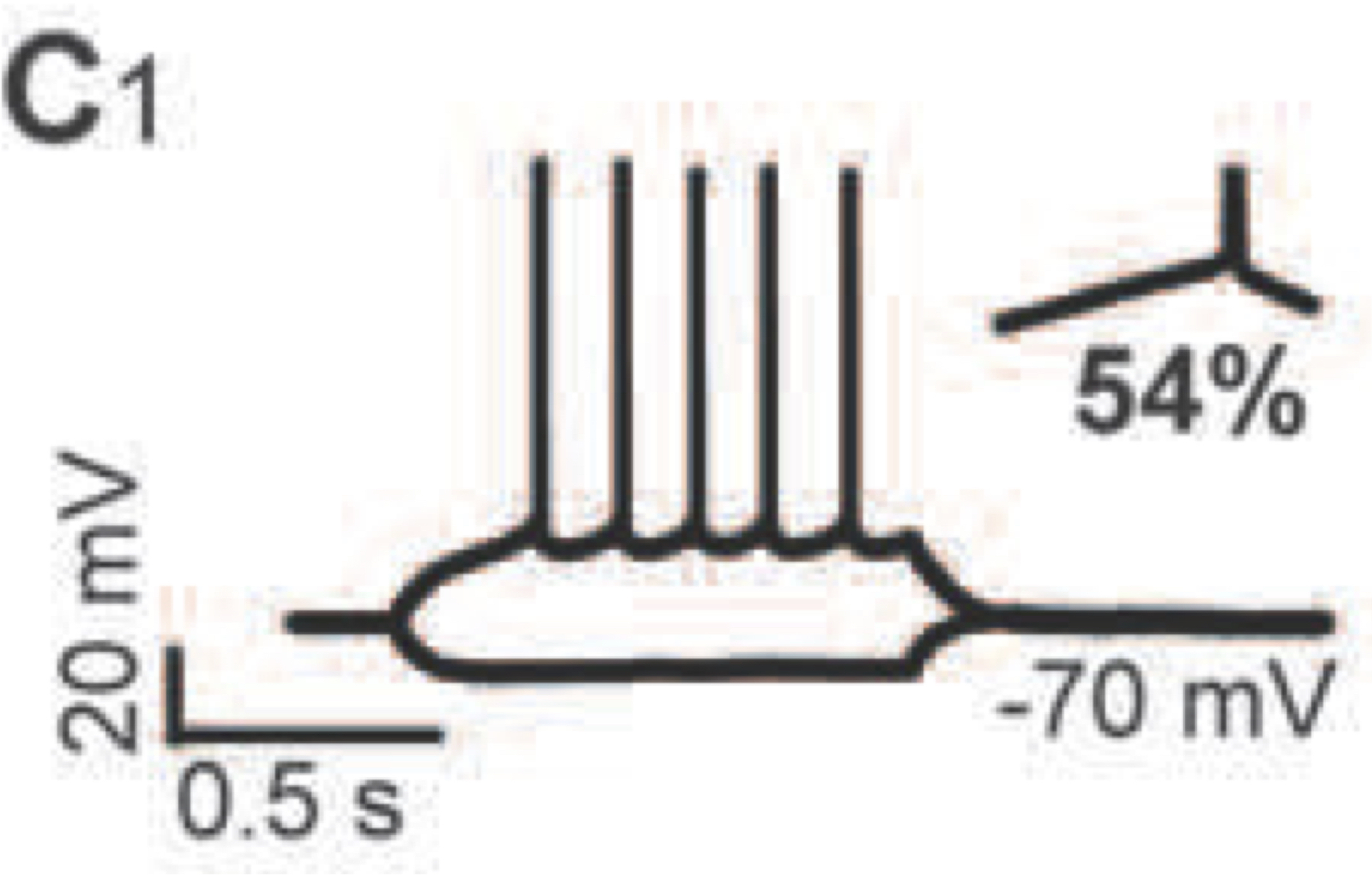
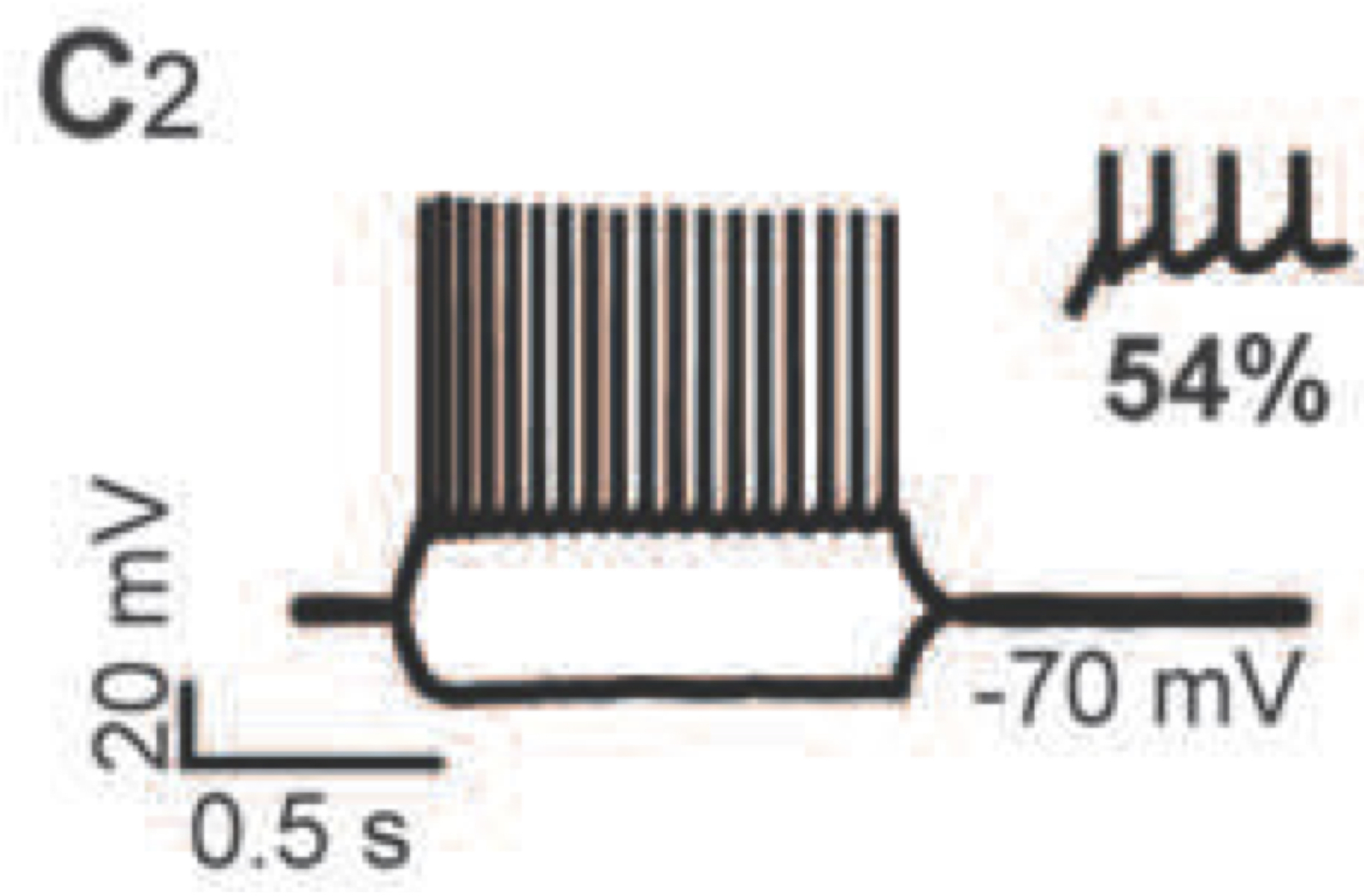
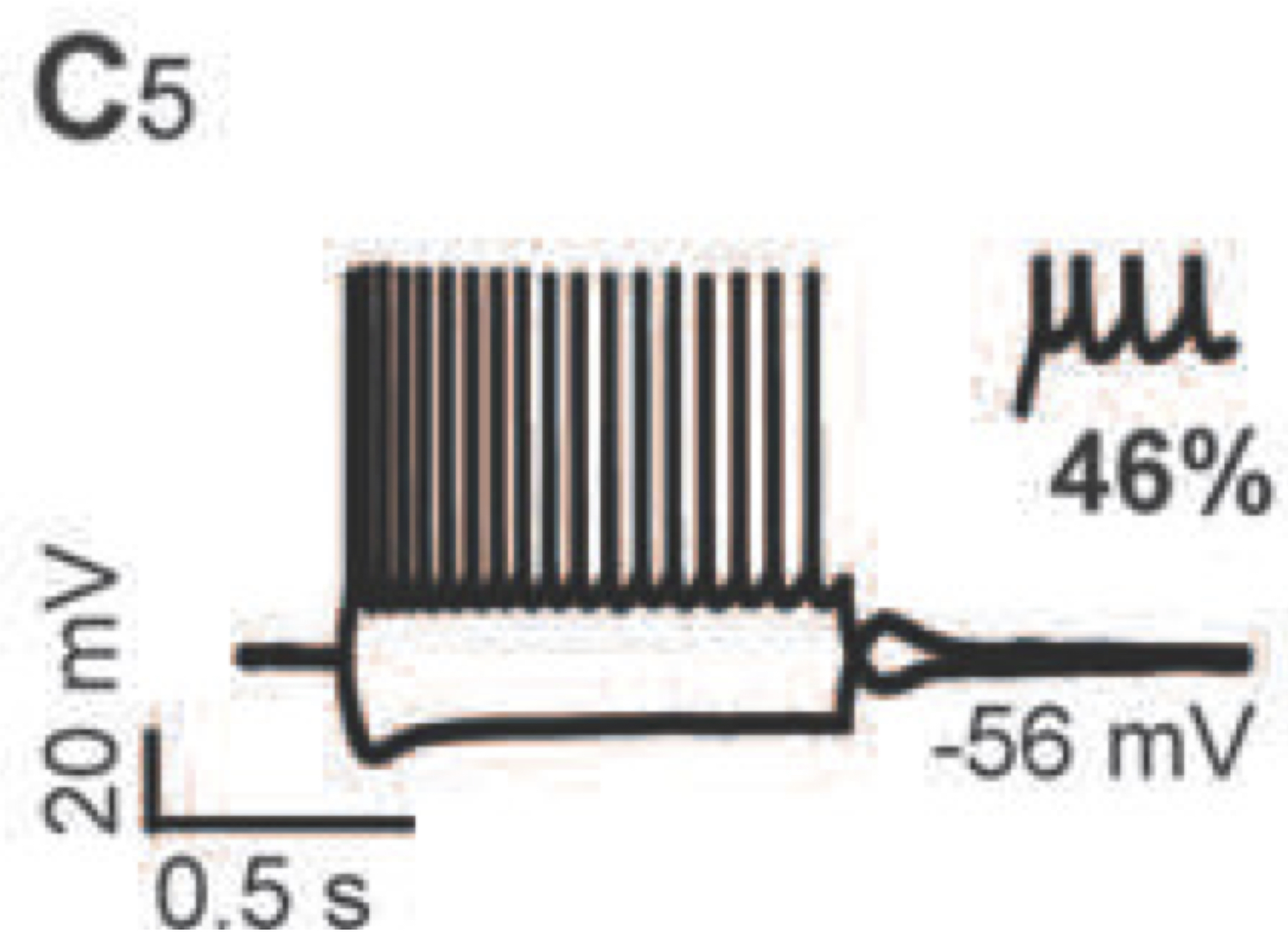
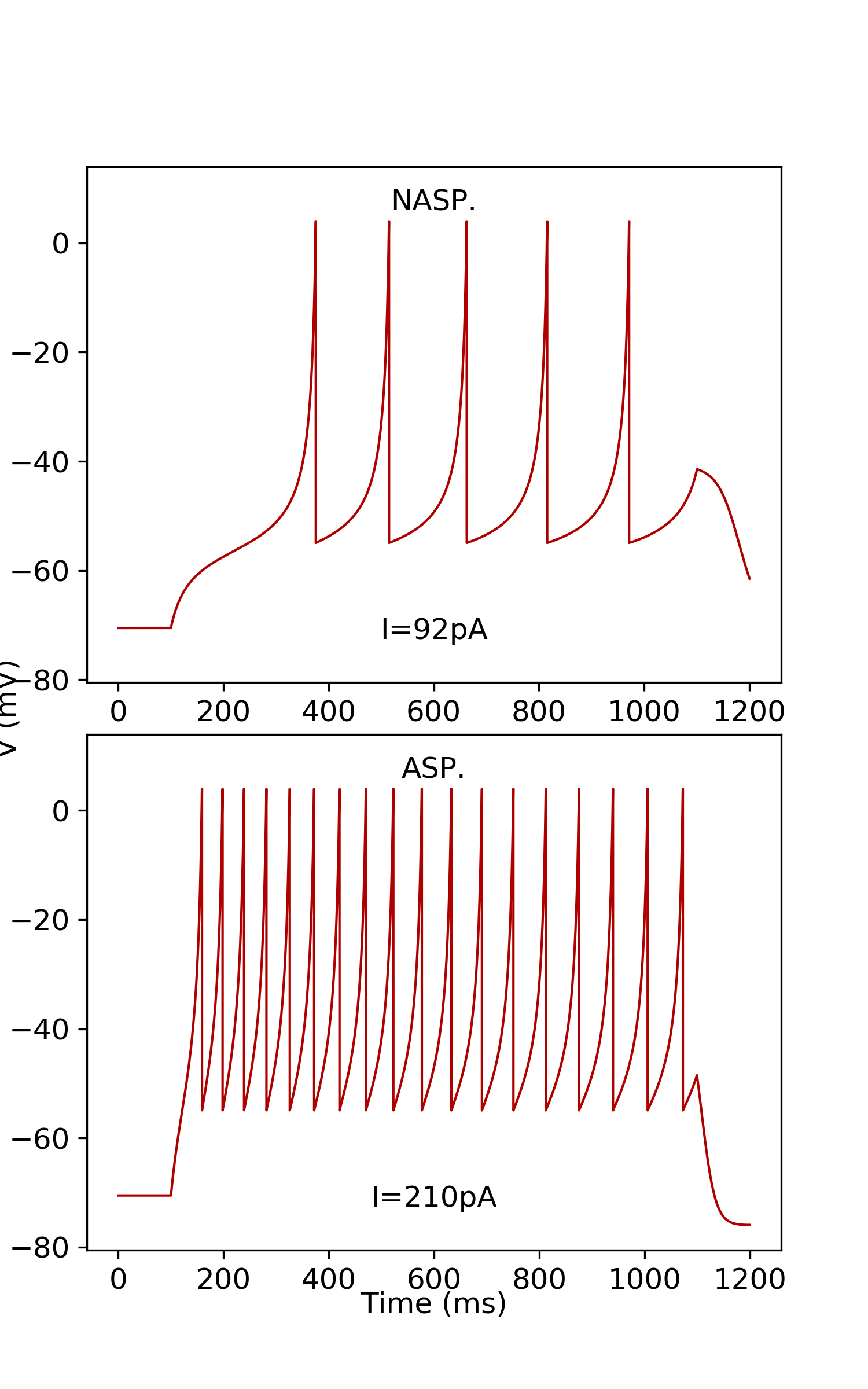
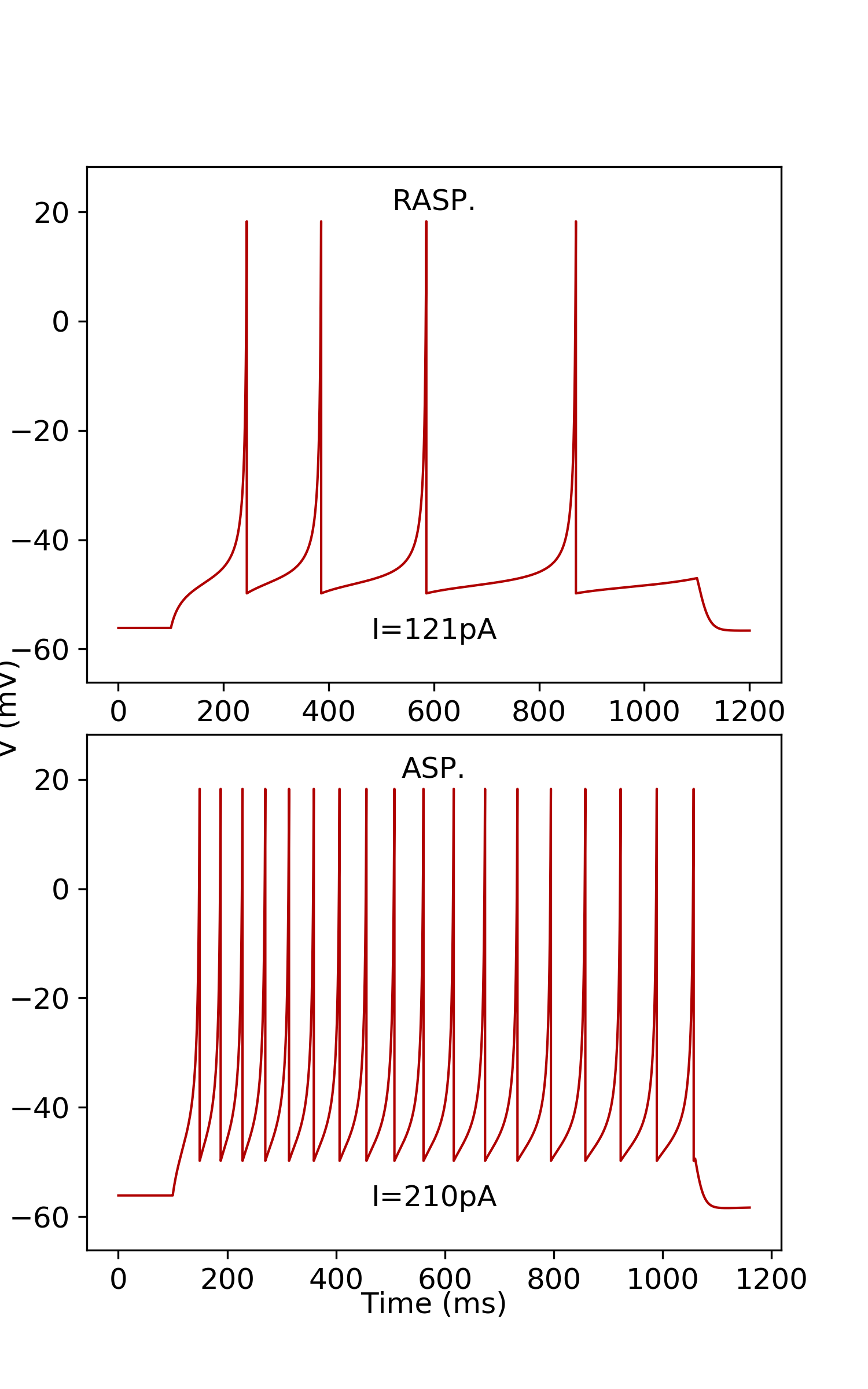
    ASP. [Evidence] [Firing Pattern]
    NASP [Evidence] [Firing Pattern]
    RASP. [Evidence] [Firing Pattern]
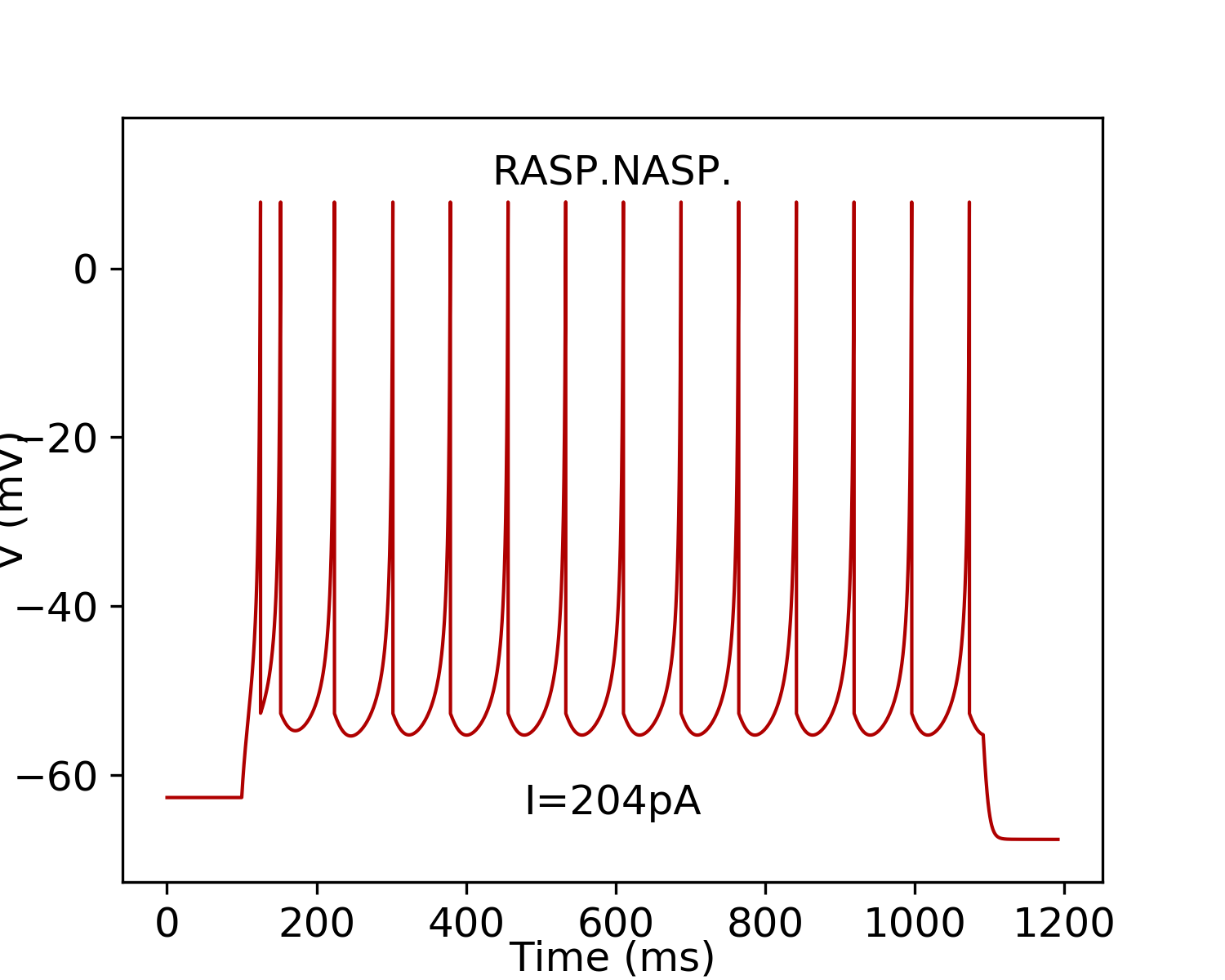
    RASP.NASP [Evidence] [Firing Pattern]

    Izhikevich Model
    Parameters Single Compartment Downloads Simulate
    subtype: 1 k=0.37;a= 0.001;b= -4.08;d= 13;C= 204;Vr= -70.53;Vt= -39.99;Vpeak= 3.96;Vmin= -54.95; Simulate
    subtype: 2 k=1.53;a= 0.001;b= 0.01;d= 7;C= 286;Vr= -56.14;Vt= -39.78;Vpeak= 18.27;Vmin= -49.81; Simulate
    subtype: 3 k=0.98;a= 0.004;b= -23.77;d= 119;C= 131;Vr= -62.65;Vt= -43.6;Vpeak= 7.85;Vmin= -52.68; Simulate
    Images
    Image MissingImage MissingImage Missing
    ModelDB Model
    Model Accession Number PubMed ID

    Sources of Input
    Known sources
    Excitatory or Inhibitory
    EC LII Basket-Neurogliaform

    Potential sources
    Excitatory or Inhibitory
    CA2 Pyramidal
    EC LI-II Multipolar-Pyramidal
    EC LI-II Pyramidal-Fan
    MEC LII Oblique Pyramidal
    MEC LII Stellate
    MEC LII-III Pyramidal-Multiform
    EC LII-III Pyramidal-Tripolar
    LEC LIII Multipolar Principal
    MEC LIII Multipolar Principal
    EC LIII Small Pyramidal
    LEC LIII Complex Pyramidal
    MEC LIII Complex Pyramidal
    MEC LIII Bipolar Complex Pyramidal
    EC LIII Pyramidal
    EC LIII Stellate
    EC LIII-V Bipolar Pyramidal
    MEC LV Multipolar-Pyramidal
    MEC LV Pyramidal
    MEC LV Superficial Pyramidal
    LEC LVI Multipolar-Pyramidal
    MEC LI-II Polar Interneuron*
    EC LII Axo-axonic
    MEC LII Basket
    EC LIII Bipolar Interneuron*
    LEC LIII Multipolar Interneuron
    MEC LIII Multipolar Interneuron
    MEC LIII Superficial Multipolar Interneuron
    MEC LI Neurogliaform*
    EC LII-III Superficial Polymorphic Interneuron*
    EC LIII Pyramidal-Looking Interneuron
    MEC LIII Superficial Trilayered Interneuron

    Potential sources known to be avoided
    Excitatory or Inhibitory
    none known

    Targets of Output
    Known targets
    Excitatory or Inhibitory
    DG Granule
    DG Mossy MOLDEN

    Potential targets
    Excitatory or Inhibitory
    DG Adult-Born Immature Granule*
    DG Hilar Ectopic Granule
    DG Semilunar Granule
    DG Cajal-Retzius*
    DG Local-Projecting Cajal-Retzius*
    DG AIPRIM
    DG Axo-axonic
    DG Granulosum-targeting Axo-axonic*
    DG Axo-axonic GRALDEN*
    DG Basket
    DG Basket GRALDEN*
    DG Basket CCK+
    DG Interneuron Specific COLTAR*
    DG COM-MOPP*
    DG HICAP
    DG Interneuron Specific IMOT*
    DG Interneuron Specific HIMOLD*
    DG Interneuron Specific HIPRO*
    DG MOLAX
    DG Molecular Layer*
    DG Outer Molecular Layer
    DG Total Molecular Layer
    DG MOPP
    DG Neurogliaform
    DG Wide-Arbor Neurogliaform*
    CA1 Neurogliaform Projecting
    Sub CA1-Projecting Pyramidal
    Sub EC-Projecting Pyramidal
    Sub Axo-axonic
    Sub Pyramidale Multipolar Interneuron*
    Sub Wide-arbor Polymorphic*
    Sub Recurrent Polymorphic-Moleculare*
    EC LI-II Multipolar-Pyramidal
    EC LI-II Pyramidal-Fan
    MEC LII Oblique Pyramidal
    MEC LII Stellate
    MEC LII-III Pyramidal-Multiform
    EC LII-III Pyramidal-Tripolar
    LEC LIII Multipolar Principal
    MEC LIII Multipolar Principal
    EC LIII Small Pyramidal
    LEC LIII Complex Pyramidal
    MEC LIII Complex Pyramidal
    MEC LIII Bipolar Complex Pyramidal
    EC LIII Pyramidal
    EC LIII Stellate
    EC LIII-V Bipolar Pyramidal
    EC LIV-V Pyramidal-Horizontal
    MEC LV Principal*
    MEC LV Pyramidal
    EC LV Deep Pyramidal
    MEC LV Superficial Pyramidal
    MEC LI-II Polar Interneuron*
    EC LII Axo-axonic
    MEC LII Basket
    EC LII Basket-Neurogliaform
    EC LIII Bipolar Interneuron*
    LEC LIII Multipolar Interneuron
    MEC LIII Multipolar Interneuron
    MEC LIII Superficial Multipolar Interneuron
    MEC LI Neurogliaform*
    EC LII-III Superficial Polymorphic Interneuron*
    EC LIII Pyramidal-Looking Interneuron
    MEC LIII Superficial Trilayered Interneuron

    Potential targets known to be avoided
    Excitatory or Inhibitory
    none known

    Oscillation Phase Locking
    Category
    Value