EC LII Basket-Neurogliaform
* indicates new v2.0 neuron type
Name Supertype (ID:Family:Type:Subregion)
EC (i)230000 LII Basket-Neurogliaform S110706:Perisomatic-targeting:Basket:EC

Name derivation
This name is a hybrid of the two most frequently cited names.

Synonym(s)
EC fast-spiking interneurones in layer II
EC layer II fast spiking basket-like cell
EC layer II fast spiking basket-like interneuron
EC layer II fast spiking basket-like neuron
EC layer II fast-spiking neurone
EC layer II MPN
LEC layer II basket cell
LEC layer II multipolar cell
LEC layer II multipolar neuron
MEC layer II basket cell
MEC layer II multipolar cell

List of articles
Click here to view the list
Canto CB  (2008) Neural Plast
What does the anatomical organization of the entorhinal cortex tell us?
Canto CB, Wouterlood FG, Witter MP.
Neural Plast, 2008, 2008, Pages: 381243 -
PMID: 18769556; DOI: 10.1155/2008/381243
Tags: morphology, marker, connectivity, synapse probabilities
Ferrante M  (2017) Cereb Cortex
Distinct Functional Groups Emerge from the Intrinsic Properties of Molecularly Identified Entorhinal Interneurons and Principal Cells.
Ferrante M, Tahvildari B, Duque A, Hadzipasic M, Salkoff D, Zagha EW, Hasselmo ME, McCormick DA.
Cereb Cortex, 2017 Jun 1, 27 (6), Pages: 3186 - 3207
PMID: 27269961; DOI: 10.1093/cercor/bhw143
Tags: morphology, membrane biophysics, synapse probabilities
Germroth P  (1991) J Comp Neurol
Ultrastructure and aspects of functional organization of pyramidal and nonpyramidal entorhinal projection neurons contributing to the perforant path.
Germroth P, Schwerdtfeger WK, Buhl EH.
J Comp Neurol, 1991 Mar 8, 305 (2), Pages: 215 - 231
PMID: 2026788; DOI: 10.1002/cne.903050205
Tags: morphology
Jones RS  (1993) Neurosci Lett
Basket-like interneurones in layer II of the entorhinal cortex exhibit a powerful NMDA-mediated synaptic excitation.
Jones RS, Buhl EH.
Neurosci Lett, 1993 Jan 4, 149 (1), Pages: 35 - 39
PMID: 8469376; DOI: 10.1016/0304-3940(93)90341-H
Tags: morphology, membrane biophysics
Tahvildari B  (2012) J Neurosci
Selective functional interactions between excitatory and inhibitory cortical neurons and differential contribution to persistent activity of the slow oscillation.
Tahvildari B, Wolfel M, Duque A, McCormick DA.
J Neurosci, 2012 Aug 29, 32 (35), Pages: 12165 - 79
PMID: 22933799; DOI: 10.1523/JNEUROSCI.1181-12.2012
Tags: connectivity, synapse probabilities
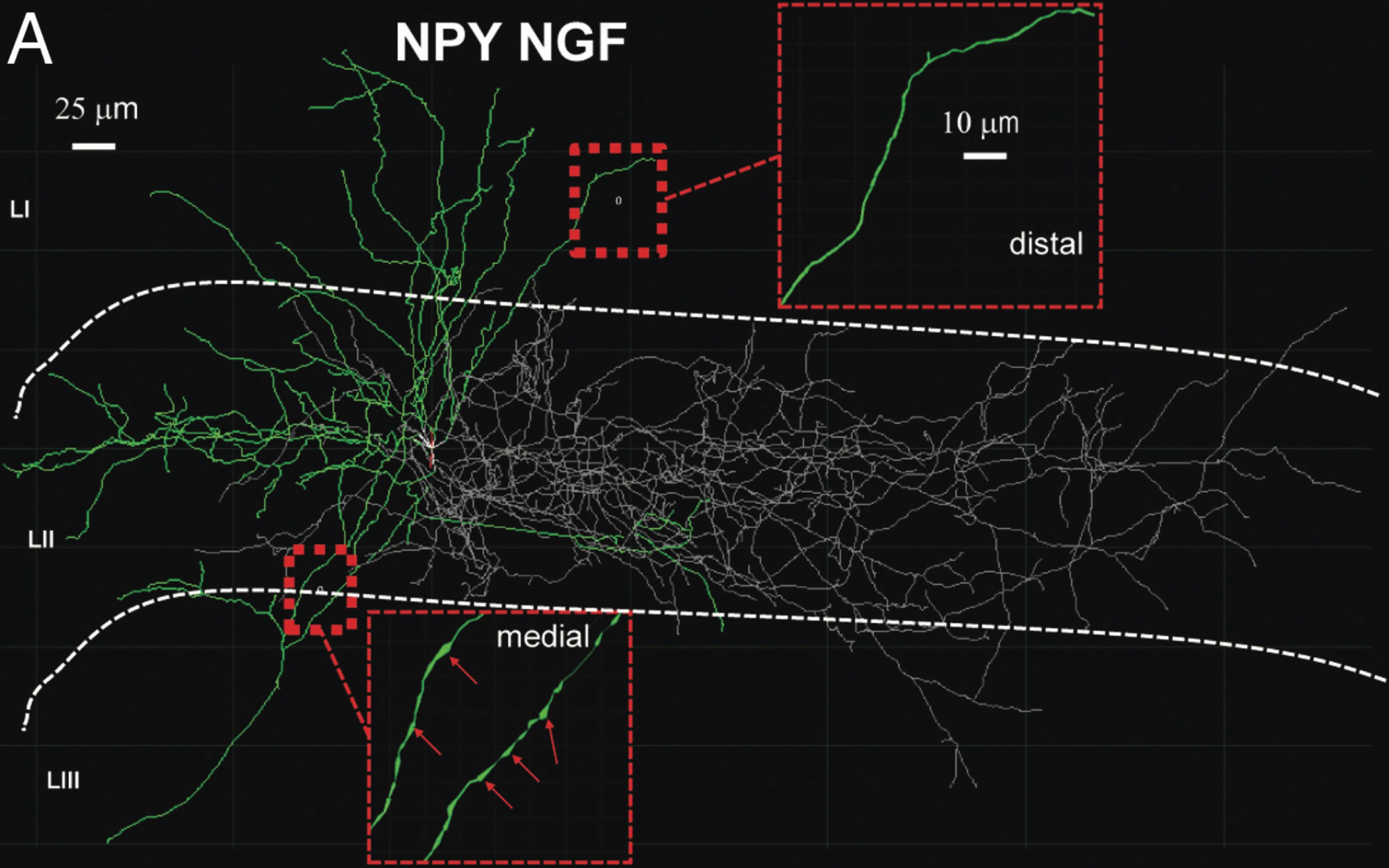

Morphology
Soma
EC:II
Axons
EC:II
Dendrites
EC:I
EC:II

Representative figure
Distinct Functional Groups Emerge from the Intrinsic Properties of Molecularly Identified Entorhinal Interneurons and Principal Cells.
Ferrante M, Tahvildari B, Duque A, Hadzipasic M, Salkoff D, Zagha EW, Hasselmo ME, McCormick DA
Cereb Cortex, 2017 Jun 1, 27 (6), pages: 3186 - 3207
PMID: 27269961; DOI: 10.1093/cercor/bhw143


"Figure 6. Intrinsic properties of NPY+ interneurons. (A1) Computer-aided 3D reconstruction of a NPY+-NGF interneuron color coded for soma (in white), dendrites (in green), and axon (in gray)."


Molecular markers
Positive
None known
Negative
GABAa\alpha 6 (inference)
Mixed expression
CCK (subtypes)
ENK (subtypes)
NPY (subtypes)
PV (subtypes)
SOM (subtypes)
Sub P (subtypes)
VIP (subtypes)

Electrophysiological properties
Key: [range] OR representative value±SD (measurements); Number of sources (total measurements): [min , max]

Resting membrane potential (Vrest): -75.5±0.8 mV (1); 2 sources (13): [-75.5 , -61.4]
Threshold potential (Vthresh): 32±1.4 mV (1); 2 sources (2): [3.8 , 32]
Fast afterhyperpolaziring potential amplitude (Fast AHP): 4.8 mV (1); 1 source
Action potential amplitude (APampl): 64.2±1.3 mV (1); 2 sources (13): [64.2 , 69.1]
Action potential width (APwidth): 0.99 ms (1); 2 sources (13): [0.51 , 0.99]
Input resistance (Rin): 206±11.0 MΩ (1); 1 source
Time constant (τm): 11.3±0.5 ms (1); 1 source

Notes
Merger approved with EC 230000 multipolar inhibitory (MPI) II neurons. Failed unofficial merger with MEC 333000 type 4 III and EC 233000 MPI 1 III. BC synapse somata of stellate II, pyramidal II, and other neurons MPI cells are inhibitory, since Germroth describes the cells as nearly spineless, which takes precedence over the fact that they are projecting (axons project to the white matter). Strong potential for future subclasses because of target specificity and because MPIs project to the hippocampus but there is no evidence that baskets do this.

Firing Pattern
Images
No image is associated with this neuron
Parameters
No parameter associated with this neuron
ModelDB Model
Model Accession Number PubMed ID

Sources of Input
Known sources
Excitatory or Inhibitory
none known

Potential sources
Excitatory or Inhibitory
CA2 Pyramidal
EC LI-II Multipolar-Pyramidal
EC LI-II Pyramidal-Fan
MEC LII Stellate
MEC LII-III Pyramidal-Multiform
EC LII-III Pyramidal-Tripolar
LEC LIII Multipolar Principal
LEC LIII Complex Pyramidal
MEC LIII Complex Pyramidal
MEC LIII Bipolar Complex Pyramidal
MEC LV Pyramidal
MEC LV Superficial Pyramidal
MEC LI-II Polar Interneuron*
MEC LII Basket
EC LII Basket-Neurogliaform
MEC LIII Multipolar Interneuron
MEC LIII Superficial Multipolar Interneuron
MEC LI Neurogliaform*
EC LII-III Superficial Polymorphic Interneuron*
MEC LIII Superficial Trilayered Interneuron

Potential sources known to be avoided
Excitatory or Inhibitory
EC LII Axo-axonic

Targets of Output
Known targets
Excitatory or Inhibitory
EC LI-II Pyramidal-Fan
MEC LII Stellate
EC LII-III Pyramidal-Tripolar

Potential targets
Excitatory or Inhibitory
EC LI-II Multipolar-Pyramidal
MEC LII Oblique Pyramidal
MEC LII-III Pyramidal-Multiform
EC LIII Small Pyramidal
LEC LIII Complex Pyramidal
MEC LIII Bipolar Complex Pyramidal
EC LIII Pyramidal
EC LIII Stellate
EC LIII-V Bipolar Pyramidal
EC LIV-V Pyramidal-Horizontal
MEC LV Principal*
MEC LV Pyramidal
EC LV Deep Pyramidal
MEC LI-II Polar Interneuron*
EC LII Axo-axonic
MEC LII Basket
EC LII Basket-Neurogliaform
EC LIII Bipolar Interneuron*
LEC LIII Multipolar Interneuron
MEC LIII Superficial Multipolar Interneuron
EC LII-III Superficial Polymorphic Interneuron*
EC LIII Pyramidal-Looking Interneuron
MEC LIII Superficial Trilayered Interneuron

Potential targets known to be avoided
Excitatory or Inhibitory
none known

Oscillation Phase Locking
Category
Value