MEC LIII Multipolar Interneuron
* indicates new v2.0 neuron type
Name Supertype (ID:Family:Type:Subregion)
MEC (i)113220 LIII Multipolar Interneuron S152006:GABAergic:iLIII:EC

Name derivation
"Interneuron" distinguishes this type from the multipolar pricipal cells. All sources indicate medial localization of the morphology. Multipolar is a descriptor in the cited literature and has the flavor of the standard EC naming scheme.

Synonym(s)
MEC layer III type II interneuron

List of articles
Click here to view the list
Kumar SS  (2006) J Neurosci
Hyperexcitability, interneurons, and loss of GABAergic synapses in entorhinal cortex in a model of temporal lobe epilepsy.
Kumar SS, Buckmaster PS.
J Neurosci, 2006 Apr 26, 26 (17), Pages: 4613 - 4623
PMID: 16641241; DOI: 10.1523/JNEUROSCI.0064-06.2006
Tags: morphology, membrane biophysics, firing patterns


Morphology
Soma
EC:III
Axons
EC:I
EC:II
EC:III
Dendrites
EC:III
EC:IV
EC:V

Representative figure
Hyperexcitability, interneurons, and loss of GABAergic synapses in entorhinal cortex in a model of temporal lobe epilepsy.
Kumar SS, Buckmaster PS
J Neurosci, 2006 Apr 26, 26 (17), pages: 4613 - 4623
PMID: 16641241; DOI: 10.1523/JNEUROSCI.0064-06.2006


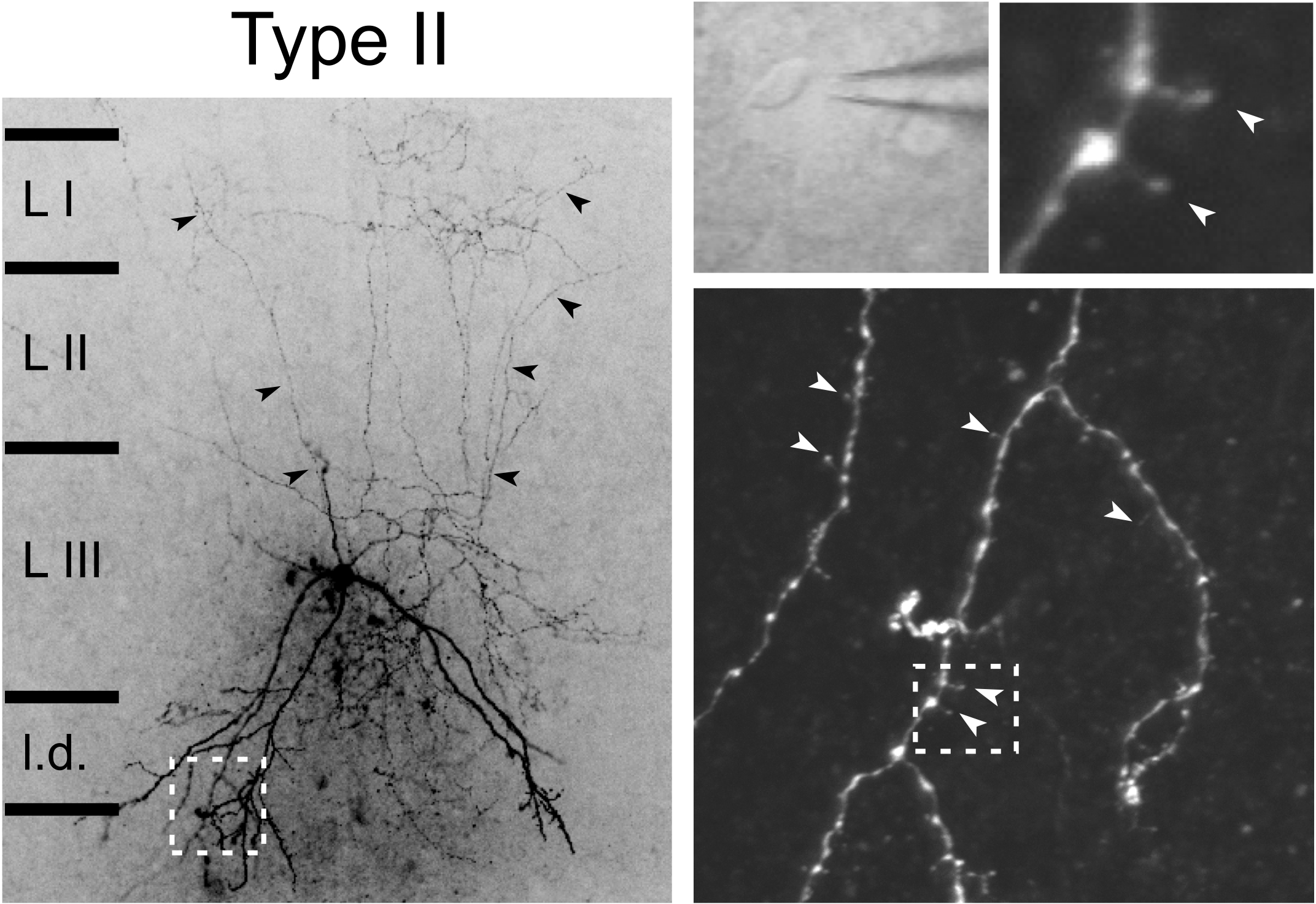
"Figure 4. Anatomical and electrophysiological features of the two dominant types of inhibitory interneurons in layer III of the medial entorhinal cortex and their excitatory synaptic drive. A, Typical biocytin-labeled type I {MEC LIII Superficial Multipolar Interneuron} and type II {MEC LIII Multipolar Interneuron} interneurons showing differences in the orientation of their dendrites (thicker branches). The axon projections (thinner branches) of the two cell types are different: confined to the vicinity of the cell body and extending into layer II for type I and projecting to and ramifying in layer I for type II (black arrowheads). Magnified views of the boxed regions are shown on the right and in insets (top) of the respective figures, illustrating dendritic spines (white arrowheads) on type II interneurons but not type I interneurons. Differences in the shape of the cell bodies are subtle but distinguishable when examined with infrared differential-interference contrast optics (top inset)."


Molecular markers
Positive
None known
Negative
GABAa\alpha 6 (inference)
Mixed expression
None known

Electrophysiological properties
Key: [range] OR representative value±SD (measurements); Number of sources (total measurements): [min , max]

Resting membrane potential (Vrest): -54±5.5 mV (25); 1 source
Input resistance (Rin): 382±235.0 MΩ (25); 1 source
Threshold potential (Vthresh): 27 mV (1); 1 source
Fast afterhyperpolaziring potential amplitude (Fast AHP): 38±5.0 mV (11); 1 source
Action potential amplitude (APampl): 87.8 mV (1); 1 source
Action potential width (APwidth): 0.4 ms (11); 1 source
Slow afterhyperpolarizing potential amplitude (Slow AHP): 3.5 mV (1); 1 source
Sag ratio: 0.8 (1); 1 source

Notes
Borderline Dend in L5

Firing Pattern
Images
Image Missing
Parameters View page
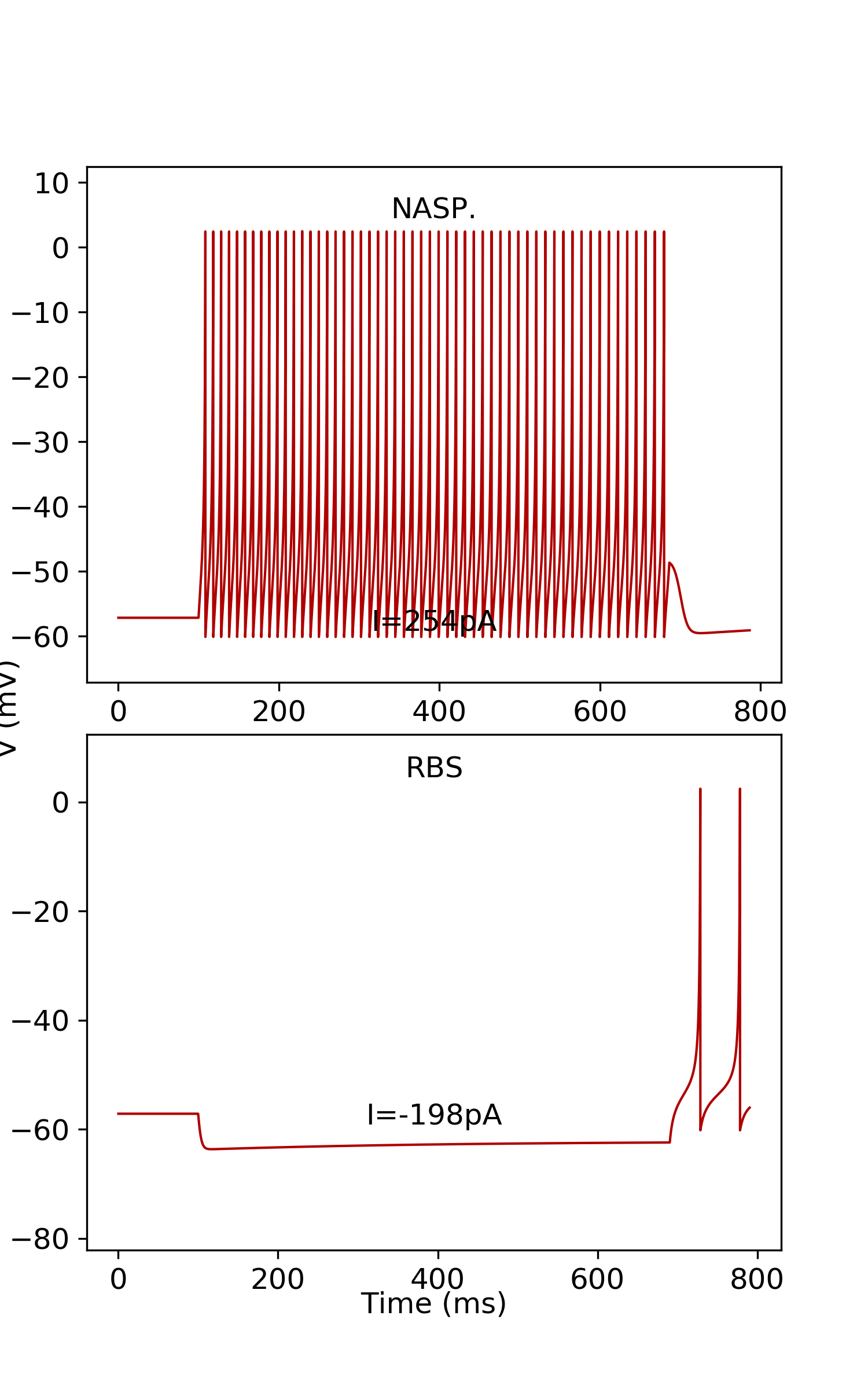
NASP [Evidence] [Firing Pattern]

Izhikevich Model
Parameters Single Compartment Downloads Simulate
subtype: 1 k=2.32;a= 0.003;b= 12.27;d= -2;C= 115;Vr= -57.15;Vt= -50.75;Vpeak= 2.43;Vmin= -60.23; Simulate
Images
Image Missing
ModelDB Model
Model Accession Number PubMed ID

Sources of Input
Known sources
Excitatory or Inhibitory
none known

Potential sources
Excitatory or Inhibitory
CA1 Pyramidal
CA1 Deep Pyramidal
CA1 Superficial Pyramidal
Sub EC-Projecting Pyramidal
EC LI-II Multipolar-Pyramidal
EC LI-II Pyramidal-Fan
MEC LII Oblique Pyramidal
MEC LII Stellate
MEC LII-III Pyramidal-Multiform
EC LII-III Pyramidal-Tripolar
MEC LIII Multipolar Principal
EC LIII Small Pyramidal
MEC LIII Complex Pyramidal
MEC LIII Bipolar Complex Pyramidal
EC LIII Pyramidal
EC LIII Stellate
EC LIII-V Bipolar Pyramidal
EC LIV-V Pyramidal-Horizontal
EC LIV-VI Deep Multipolar Principal
MEC LV Multipolar-Pyramidal
MEC LV Principal*
MEC LV Pyramidal
EC LV Deep Pyramidal
MEC LV Superficial Pyramidal
MEC LII Basket
EC LIII Bipolar Interneuron*
MEC LIII Multipolar Interneuron
MEC LIII Superficial Multipolar Interneuron
EC LIII Pyramidal-Looking Interneuron
MEC LIII Superficial Trilayered Interneuron

Potential sources known to be avoided
Excitatory or Inhibitory
LEC LIII Multipolar Principal
LEC LIII Complex Pyramidal
LEC LVI Multipolar-Pyramidal
LEC LIII Multipolar Interneuron

Targets of Output
Known targets
Excitatory or Inhibitory
none known

Potential targets
Excitatory or Inhibitory
EC LI-II Multipolar-Pyramidal
EC LI-II Pyramidal-Fan
MEC LII Oblique Pyramidal
MEC LII Stellate
MEC LII-III Pyramidal-Multiform
EC LII-III Pyramidal-Tripolar
MEC LIII Multipolar Principal
EC LIII Small Pyramidal
MEC LIII Complex Pyramidal
MEC LIII Bipolar Complex Pyramidal
EC LIII Pyramidal
EC LIII Stellate
EC LIII-V Bipolar Pyramidal
EC LIV-V Pyramidal-Horizontal
MEC LV Principal*
MEC LV Pyramidal
EC LV Deep Pyramidal
MEC LV Superficial Pyramidal
MEC LI-II Polar Interneuron*
EC LII Axo-axonic
MEC LII Basket
EC LII Basket-Neurogliaform
EC LIII Bipolar Interneuron*
MEC LIII Multipolar Interneuron
MEC LIII Superficial Multipolar Interneuron
MEC LI Neurogliaform*
EC LII-III Superficial Polymorphic Interneuron*
EC LIII Pyramidal-Looking Interneuron
MEC LIII Superficial Trilayered Interneuron

Potential targets known to be avoided
Excitatory or Inhibitory
LEC LIII Multipolar Principal
LEC LIII Complex Pyramidal
LEC LIII Multipolar Interneuron

Oscillation Phase Locking
Category
Value