|
| Morphology |
| Soma | |
| EC:III |
| Axons | |
| EC:III |
| Dendrites | |
| EC:I | |
| EC:II | |
| EC:III |
| Representative figure |
|
Morphology of identified entorhinal neurons projecting to the hippocampus. A light microscopical study combining retrograde tracing and intracellular injection. Germroth P, Schwerdtfeger WK, Buhl EH Neuroscience, 1989, 30 (3), pages: 683 - 691 PMID: 2771045; DOI: 10.1016/0306-4522(89)90161-9 |
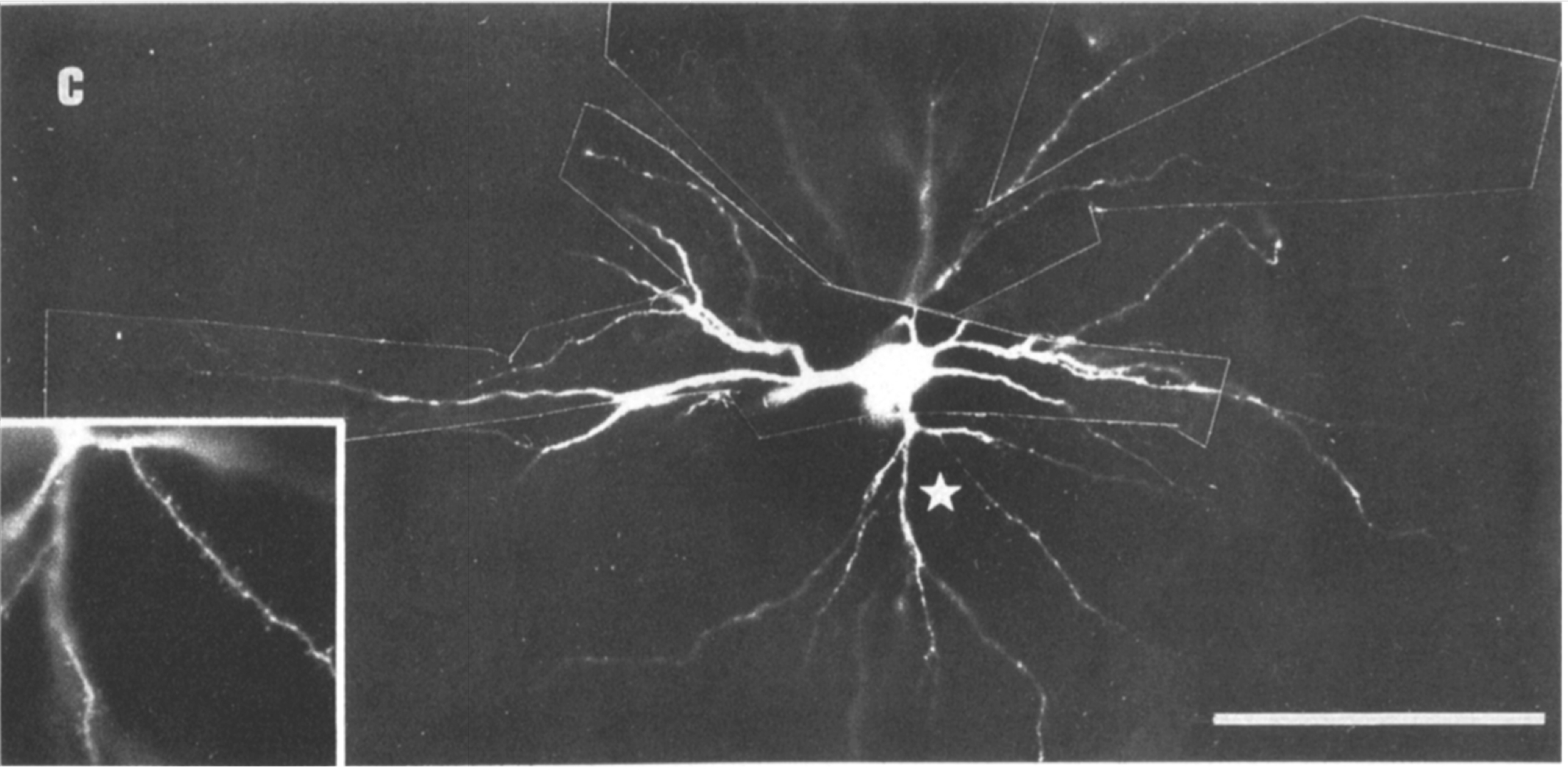 "Fig. 1. (a) Micrograph of LY[Lucifer Yellow]-filled layer (L) III pyramid {EC LIII Pyramidal} in the lateral entorhinal cortex. The arrowhead points to the descending axon. The star indicates the area enlarged in the insert at the lower left corner. Note the densely spined apical dendrite. ... c) Photomontage of L III spiny stellate cell {EC LIII Stellate}. The star marks the area enlarged in the insert. Note the spines visible on the descending dendrite. In (a) and (b) the cortical surface is parallel to the top of the figure. The position of cell (c) is close to the rhinal fissure; the cortical surface runs parallel to the top and bends down at the upper left comer of the figure." |
| Molecular markers |
| Positive | |
| None known |
| Negative | |
| GABAa\alpha 6 (inference) |
| Mixed expression | |
| None known |
| Electrophysiological properties |
| Key: [range] OR representative value±SD (measurements); Number of sources (total measurements): [min , max] | |
| Resting membrane potential (Vrest): [-63.0, -59.0] mV (2); 1 source | |
| Input resistance (Rin): 468±174.4 MΩ (76); 1 source | |
| Time constant (τm): 43.5±17.4 ms (76); 1 source | |
| Threshold potential (Vthresh): 19.5 mV (1); 1 source | |
| Fast afterhyperpolaziring potential amplitude (Fast AHP): 12.7 mV (1); 1 source | |
| Action potential amplitude (APampl): 76±8.7 mV (76); 1 source | |
| Action potential width (APwidth): 1.45±4.4 ms (76); 1 source | |
| Sag ratio: 0.86 (1); 1 source |
| Notes |
| Rejected merger with EC (+)223200p Pyramidal III due to clear presence of D:IV in pyramidal III and unclear in this class. Class is a merger of 223000 Stellate and 223100 Stellate 2, which had weak axonal presence in L4 |
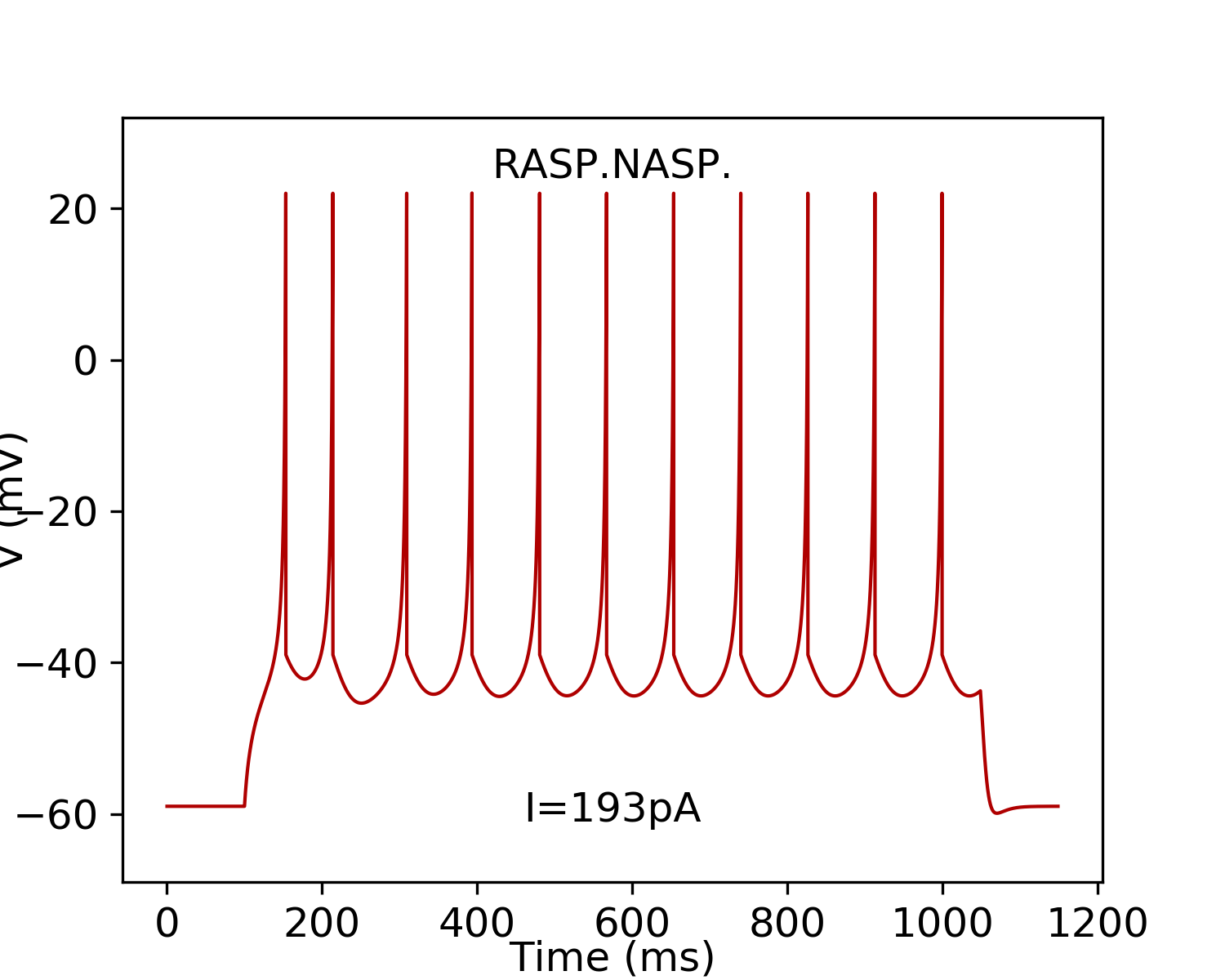
| Firing Pattern |
| Images | |
 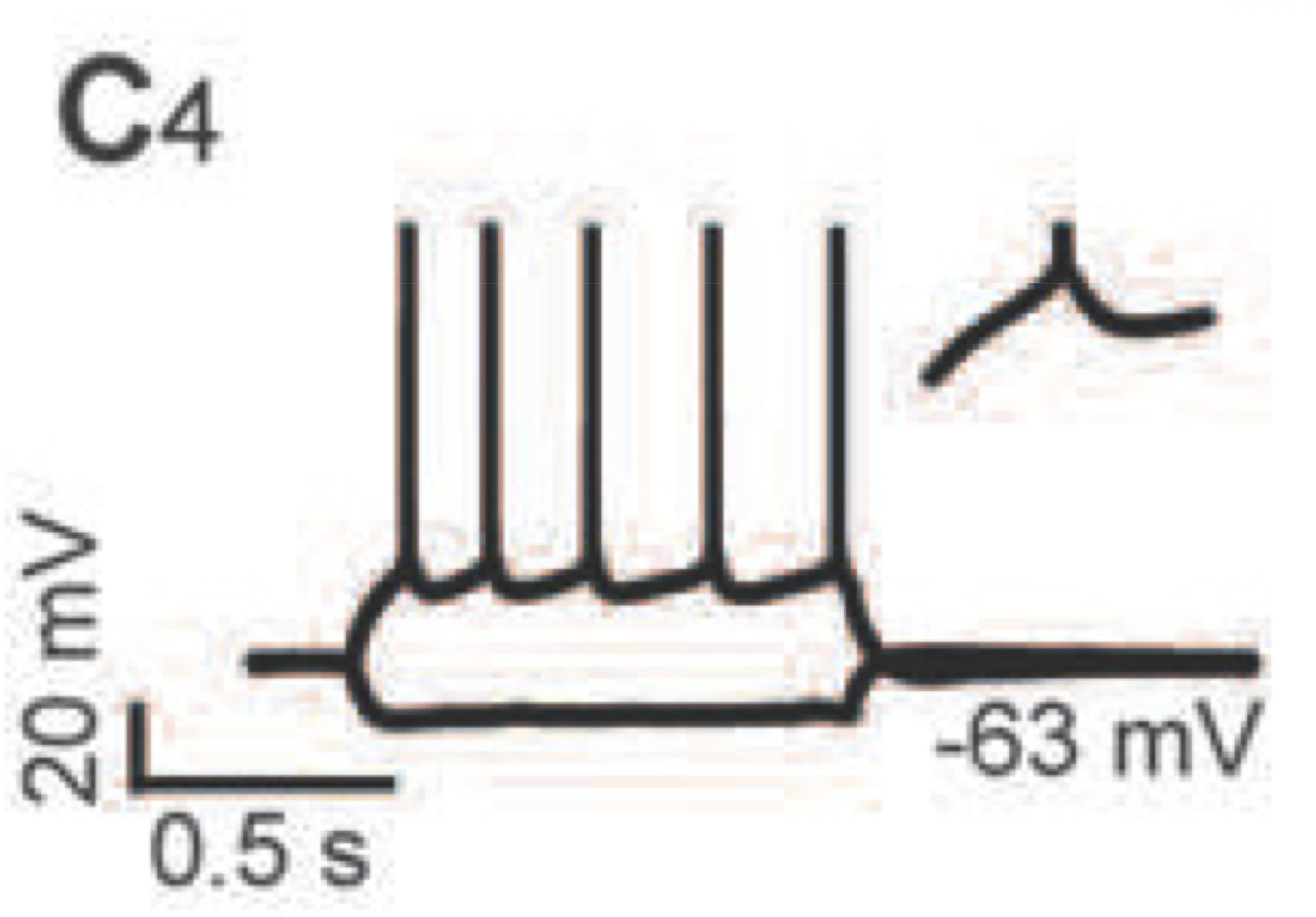 |
| Parameters | View page | |
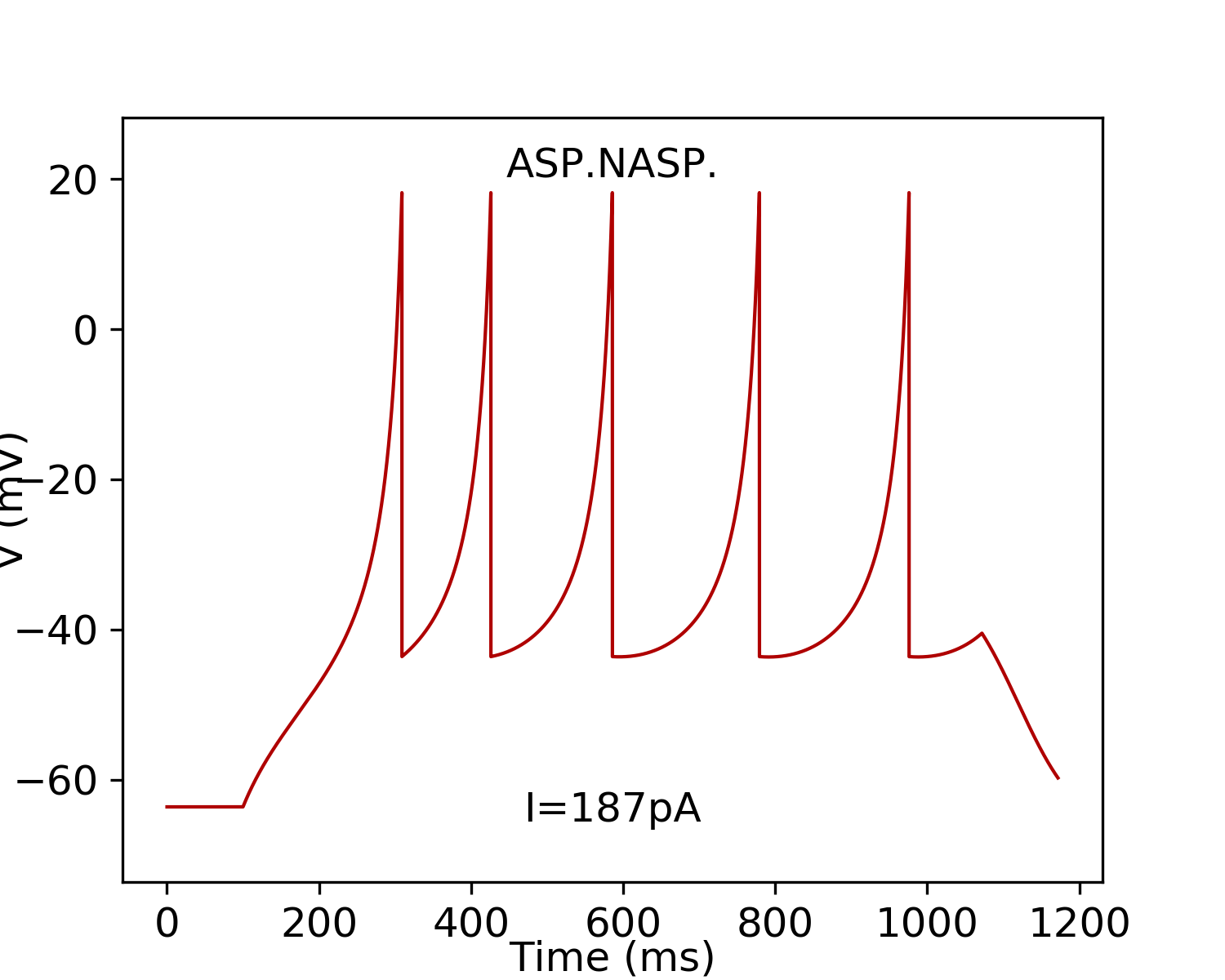
| ASP.NASP | [Evidence] [Firing Pattern] | |
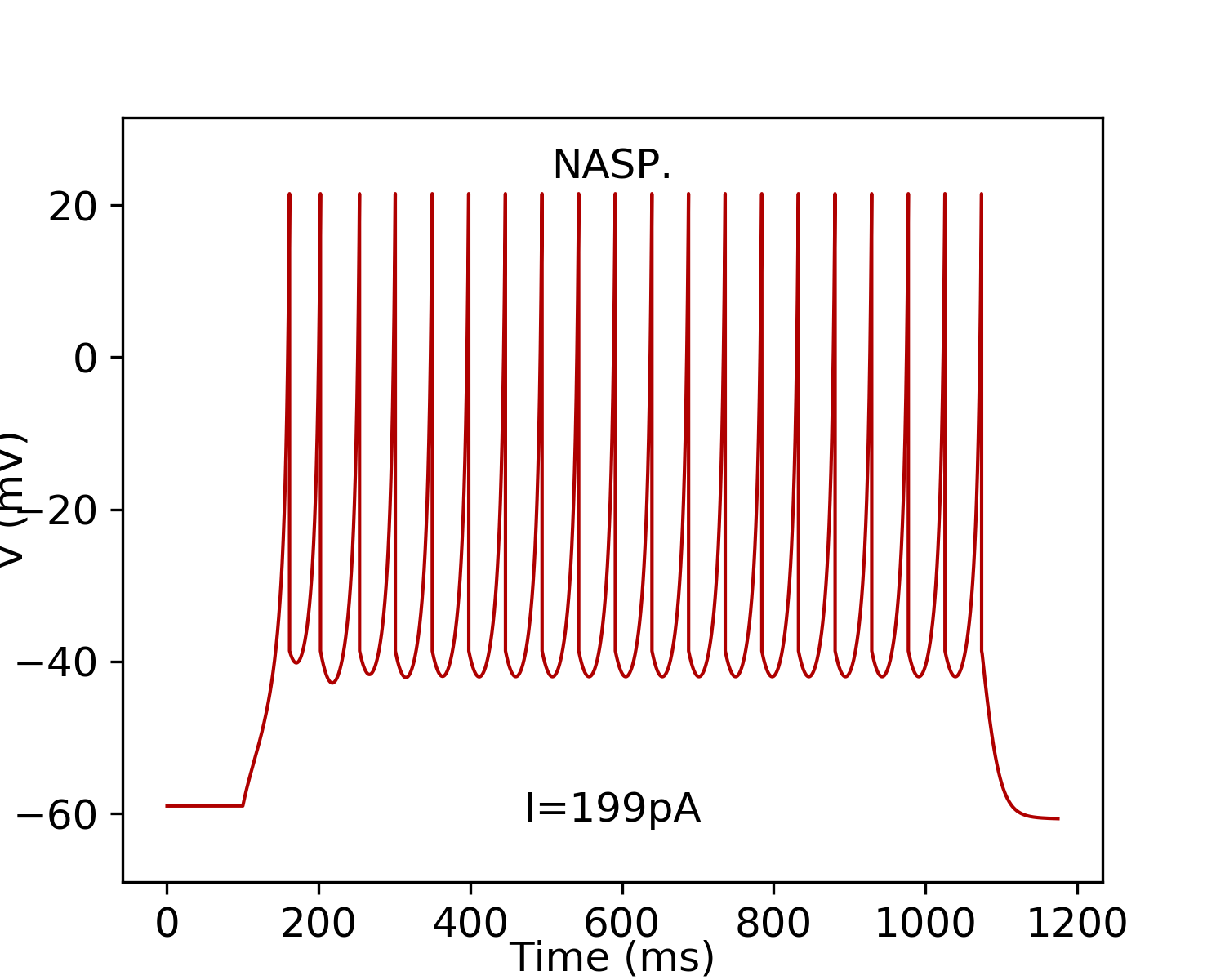
| NASP | [Evidence] [Firing Pattern] | |
| RASP.ASP. | [Evidence] [Firing Pattern] |
| Izhikevich Model |
| Parameters | Single Compartment | Downloads | Simulate |
| subtype: 1 k=0.95;a= 0.028;b= -21.99;d= 805;C= 407;Vr= -59.01;Vt= -39.01;Vpeak= 21.51;Vmin= -38.58; | Simulate | ||
| subtype: 2 k=0.53;a= 0.004;b= -0.58;d= 79;C= 749;Vr= -63.59;Vt= -38.65;Vpeak= 18.15;Vmin= -43.59; | Simulate | ||
| subtype: 3 k=0.91;a= 0.069;b= 4.08;d= 45;C= 115;Vr= -58.98;Vt= -35.21;Vpeak= 21.99;Vmin= -38.94; | Simulate |
| Images | |
   |
| ModelDB Model |
| Model Accession Number | PubMed ID |
| Sources of Input |
| Targets of Output |
|
|
|
| Oscillation Phase Locking |
 Browse
 Search
 Help