|
|
|
* indicates new v2.0 neuron type
|
|
Name
|
|
Supertype (ID:Family:Type:Subregion)
|
|
|
EC (e)223111p-CA1_1000-Sub_100 LIII Small Pyramidal
|
S071806:Glutamatergic III:LIII:EC
|
|
Name derivation
|
|
|
|
This is a canonical secondary cell of the entorhinal cortex circuitry. This is the simplest form of the core names in the cited literature that distinguishes it from EC (e)223200p LIII Pyramidal.
|
|
Synonym(s)
|
|
|
|
EC layer III pyramidal cell
|
|
|
EC layer III pyramidal neuron
|
|
|
LEC layer III pyramidal cell
|
|
|
MEC layer III pyramidal cell
|
|
|
MEC LIII small spiny pyramidal neuron
|
|
|
EC LIII Pyramidal [v1.x]
|
|
|
Click here to view the list
Burgalossi A (2011) Neuron
Microcircuits of functionally identified neurons in the rat medial entorhinal cortex. Burgalossi A, Herfst L, von Heimendahl M, Forste H, Haskic K, Schmidt M, Brecht M.
Neuron,
2011 May 26, 70 (4),
Pages: 773 - 86
PMID: 21609831; DOI: 10.1016/j.neuron.2011.04.003
Tags: phases, synapse probabilities
Canto CB (2012) Hippocampus
Cellular properties of principal neurons in the rat entorhinal cortex. II. The medial entorhinal cortex. Canto CB, Witter MP.
Hippocampus,
2012 Jun, 22 (6),
Pages: 1277 - 1299
PMID: 22161956; DOI: 10.1002/hipo.20993
Tags: morphology, membrane biophysics, firing patterns, synapse probabilities
Deller T (1996) Cell and Tissue Research
The alvear pathway of the rat hippocampus Deller T, Adelmann G, Nitsch R, Frotscher M.
Cell and Tissue Research,
1996, 286 (3),
Pages: 293 - 303
PMID: 8929332; DOI: 10.1007/s004410050699
Tags: morphology
Dickson CT (1997) Neuroscience
Electroresponsiveness of medial entorhinal cortex layer III neurons in vitro. Dickson CT, Mena AR, Alonso A.
Neuroscience,
1997 Dec, 81 (4),
Pages: 937 - 950
PMID: 9330357; DOI: 10.1016/S0306-4522(97)00263-7
Tags: morphology
Ferrante M (2017) Cereb Cortex
Distinct Functional Groups Emerge from the Intrinsic Properties of Molecularly Identified Entorhinal Interneurons and Principal Cells. Ferrante M, Tahvildari B, Duque A, Hadzipasic M, Salkoff D, Zagha EW, Hasselmo ME, McCormick DA.
Cereb Cortex,
2017 Jun 1, 27 (6),
Pages: 3186 - 3207
PMID: 27269961; DOI: 10.1093/cercor/bhw143
Tags: synapse probabilities
Germroth P (1991) J Comp Neurol
Ultrastructure and aspects of functional organization of pyramidal and nonpyramidal entorhinal projection neurons contributing to the perforant path. Germroth P, Schwerdtfeger WK, Buhl EH.
J Comp Neurol,
1991 Mar 8, 305 (2),
Pages: 215 - 231
PMID: 2026788; DOI: 10.1002/cne.903050205
Tags: morphology
Gloveli T (1997) Neuroscience
Morphological and electrophysiological characterization of layer III cells of the medial entorhinal cortex of the rat. Gloveli T, Schmitz D, Empson RM, Dugladze T, Heinemann U.
Neuroscience,
1997 Apr, 77 (3),
Pages: 629 - 648
PMID: 9070741; DOI: 10.1016/S0306-4522(96)00494-0
Tags: morphology, firing patterns
Mizuseki K (2009) Neuron
Theta oscillations provide temporal windows for local circuit computation in the entorhinal-hippocampal loop. Mizuseki K, Sirota A, Pastalkova E, Buzsaki G.
Neuron,
2009,
Pages: 267 - 280
PMID: 19874793
Tags: phases
Mizuseki K (2011) Nat Neurosci.
Hippocampal CA1 pyramidal cells form functionally distinct sublayers. Mizuseki K, Diba K, Pastalkova E, Buzsaki G.
Nat Neurosci.,
2011,
Pages: 1174 - 1181
PMID: 21822270
Tags: phases
Quilichini P (2010) J Neurosci
Intrinsic circuit organization and theta-gamma oscillation dynamics in the entorhinal cortex of the rat. Quilichini P, Sirota A, Buzsaki G.
J Neurosci,
2010 Aug 18, 30 (33),
Pages: 11128 - 11142
PMID: 20720120; DOI: 10.1523/JNEUROSCI.1327-10.2010
Tags: phases, synapse probabilities
Steward O (1976) J Comp Neurol
Cells of origin of entorhinal cortical afferents to the hippocampus and fascia dentata of the rat. Steward O, Scoville SA.
J Comp Neurol,
1976 Oct 1, 169 (3),
Pages: 347 - 370
PMID: 972204; DOI: 10.1002/cne.901690306
Tags: morphology
Steward O (1976) J Comp Neurol
Topographic organization of the projections from the entorhinal area to the hippocampal formation of the rat. Steward O.
J Comp Neurol,
1976 Jun 1, 167 (3),
Pages: 285 - 314
PMID: 1270625; DOI: 10.1002/cne.901670303
Tags: morphology
Tahvildari B (2005) J Comp Neurol
Morphological and electrophysiological properties of lateral entorhinal cortex layers II and III principal neurons. Tahvildari B, Alonso A.
J Comp Neurol,
2005 Oct 17, 491 (2),
Pages: 123 - 140
PMID: 16127693; DOI: 10.1002/cne.20706
Tags: morphology, synapse probabilities
Takacs VT (2012) Hippocampus
Extrinsic and local glutamatergic inputs of the rat hippocampal CA1 area differentially innervate pyramidal cells and interneurons Takacs VT, Klausberger T, Somogyi P, Freund TF, Gulyas AI.
Hippocampus,
2012, 22 (6),
Pages: 1379 - 1391
PMID: 21956752; DOI: 10.1002/hipo.20974
Tags: morphology
Tang Q (2015) J Neurosci.
Anatomical Organization and Spatiotemporal Firing Patterns of Layer 3 Neurons in the Rat Medial Entorhinal Cortex. Tang Q, Ebbesen CL, Sanguinetti-Scheck JI, Preston-Ferrer P, Gundlfinger A, Winterer J, Beed P, Ray S, Naumann R, Schmitz D, Brecht M, Burgalossi A..
J Neurosci.,
2015,
Pages: 12346 - 12354
PMID: 26354904
Tags: phases
|
|
List of Hippocampome.org to NeuroMorpho.Org mappings
|
|
|
Click here to view the list of mappings
|
|
|
Morphological and electrophysiological properties of lateral entorhinal cortex layers II and III principal neurons.
Tahvildari B, Alonso A
J Comp Neurol, 2005 Oct 17, 491 (2), pages: 123 - 140
PMID: 16127693; DOI: 10.1002/cne.20706
|
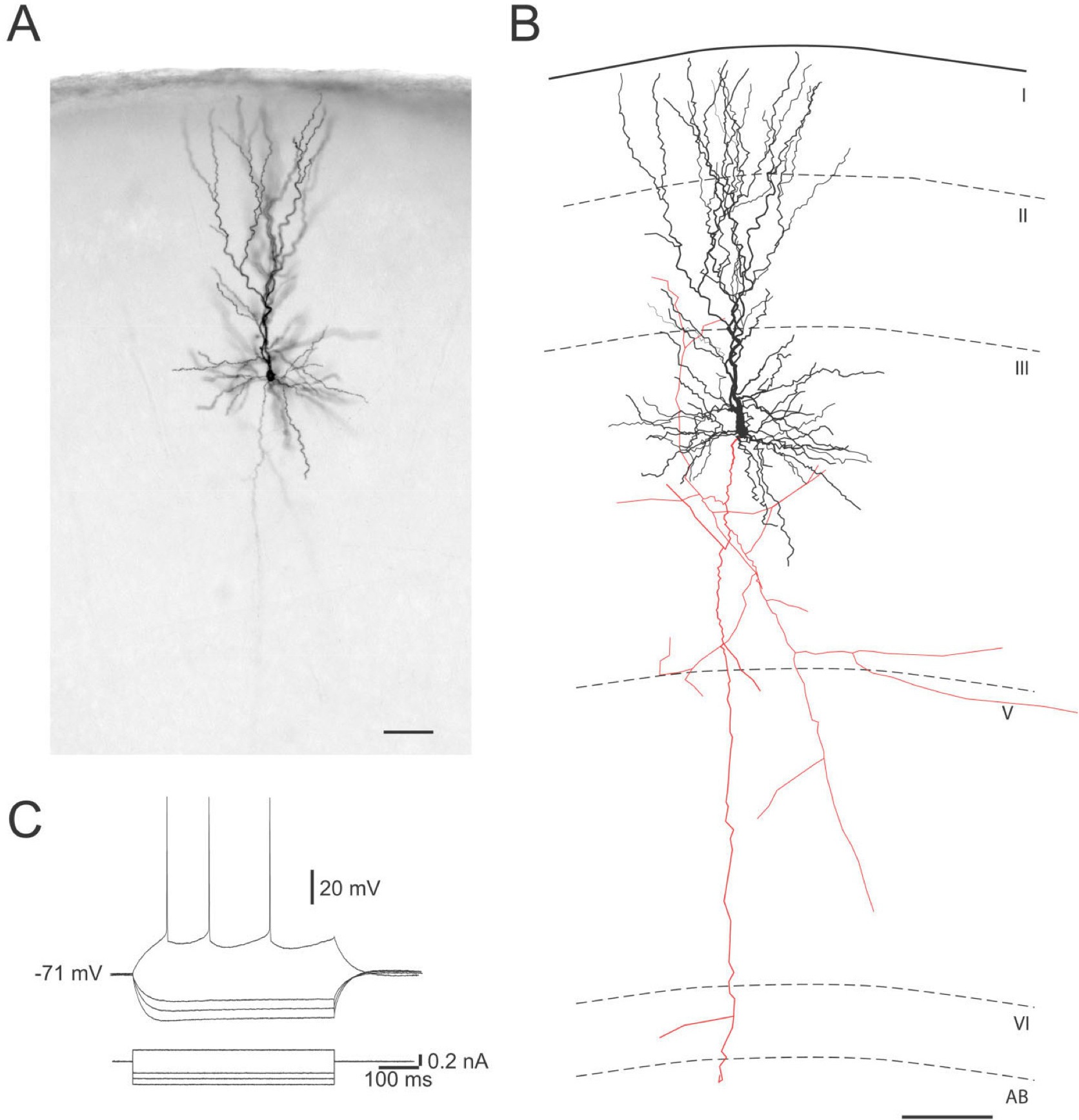
"Fig. 12. Layer III pyramidal cell {EC LIII Small Pyramidal} [of the entorhinal cortex] with axonal collaterals that descend to layer V. A,B: Photomicrograph and computer-aided reconstruction of a layer III pyramidal cell. The axon is shown in red. Note the axonal collaterals that branch at the level of layer III and that some ascend towards layer II, while others descend reaching layer V." |
| Mixed expression |
|
|
None known |
|
Electrophysiological properties
|
|
|
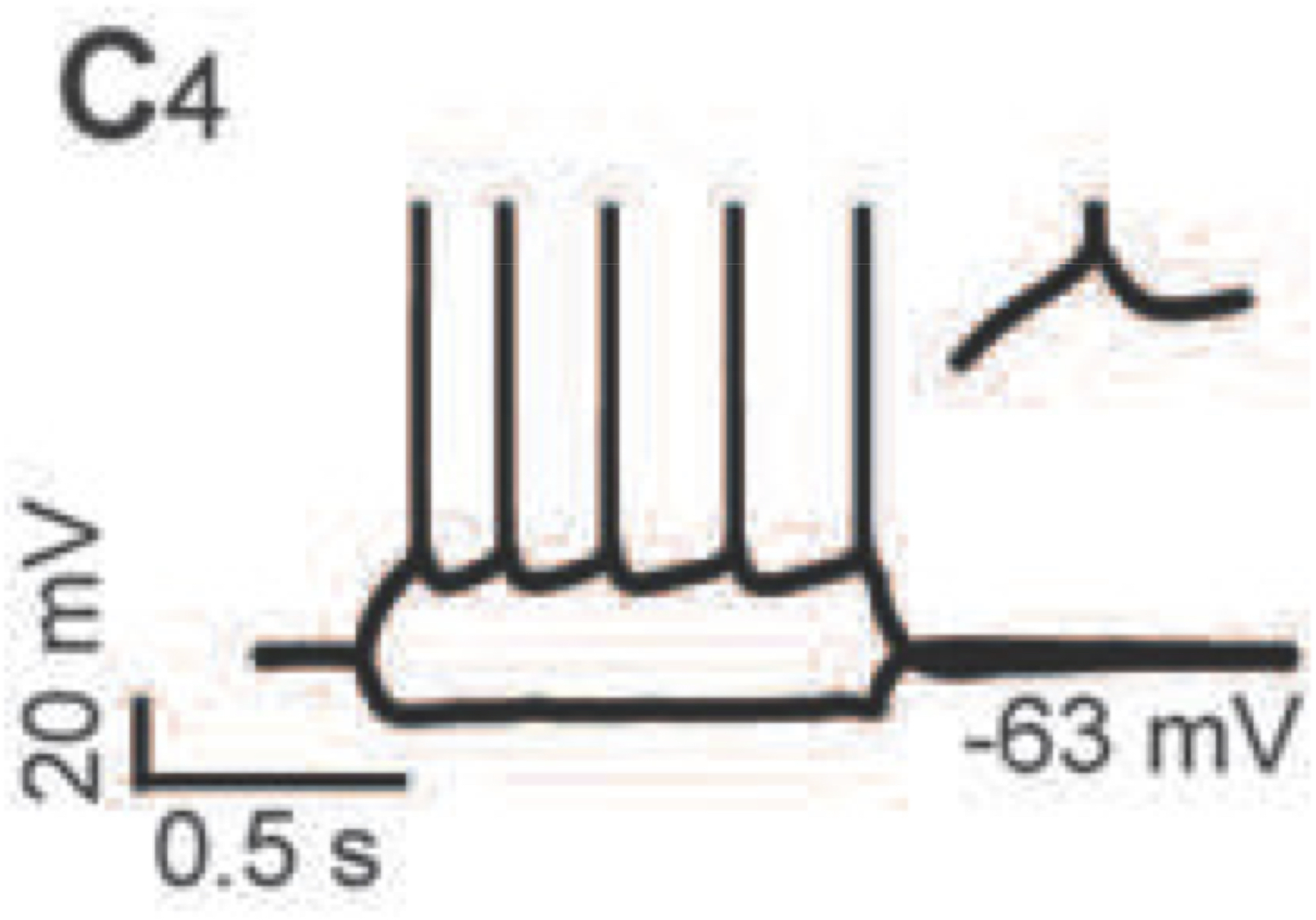
EC Small Pyramidal III neurons 223111-CA1 1000-Sub 100
|
Merger status:
|
None being considered
|
Notes:
excitatory because they have spiny dendrites and projecting axon
CW
|
Where do these [A:CA1:SLM; A:Sub:SM] come from? Closest is a schematic showing a link to CA1. - DWW
|
|
Add Steward 1976 to this packet - CW
|
|
Add note that layer IV not differentiated in this paper [Tahvildari and Alonso, 2005]
A:III_IV_V_VI [Tahvildari and Alonso, 2005, Fig. 12B] - CLR 08/11/2011
|
EC Small Pyramidal III neurons 223111-CA1 1000-Sub 100
|
Merger status:
|
None being considered
|
Notes:
excitatory because they have spiny dendrites and projecting axon
CW
|
Maybe need to note that Steward says LEC -> SUB:SM, MEC -> CA1:SLM
Do we need 2 different classes? - CLR 08/15/2011
|
|
Maybe need to note that Stweard says LEC -> SUB:SM, MEC -> CA1:SLM - CLR 08/15/2011
|
|
No, added new Steward 1976 that says both LEC + MEC have axon in Sub + CA1 - CW
|
|
Do we need 2 different classes? - CLR 08/15/2011
|
|
But we have not split the EC yet? - CW
|
|
"bifurcating at the top of layer II" suggests a maximum of two continuing branches in II. - CW
|
|
"sparsely." Dendrites? New class? - DWW 08/16/2011
|
EC Small Pyramidal III neurons 223111-CA1 1000-Sub 100
|
Merger status:
|
None being considered
|
Notes:
excitatory because they have sparsely spiny to spiny dendrites and projecting axon
CW
|
Interp is fine with me.
Maybe add notes about (1) why D:III (in spite of the words 'occasionally' and 'superficial') (2) why not A:II ("reaching isn;t enough") - CLR 08/25/2011
|
|
basal dendrites in many directions -> D:III - DWW 08/25/2011
|
|
I'm still not totally convinced we don't need 2 classes here. (i.e. I'm not sure all cells project to both CA1 + Sub -- there seems to be a continuum). However, based on [Stweard, 1976], I'm willing to concede + sign off on this. - CLR 08/25/2011
|
|
I would suggest splitting off the first 2 papers into a separate 223000 packet since no border line evidence for A:IV_V_VI - DWW 08/25/2011
|
|
The first two papers are Dickson 1997 + Germroth 1991, so >= 14 years old, and neither neither show a picture of axons. The later refs Tahvildari 2005 + Canto prpt show collaterals in other layers, so I am reluctant to create a packet just for the alder papers. - CW 08/29/2011
|
EC Small Pyramidal III neurons 223111-CA1 1000-Sub 100
|
Merger status:
|
None being considered
|
Notes:
excitatory because they have sparsely spiny to spiny dendrites, target dendritic spines, and have projecting axon
CW
EC (e)223111p-CA1_1000-Sub_100 LIII Small Pyramidal cells (LIII smPC) [6017]
|
Related types:
|
EC (e)223200p LIII Pyramidal (v1.0 active)
|
Notes: excitatory because they have sparsely spiny to spiny dendrites, target dendritic spines with asymmetric synapses, and have projecting axon
addendum to currently active EC (e)223111p LIII Pyramidal
|
* all point of origin evidence is indirect and inferential *
|
|
The only inferable sources of these axons are superficial layer EC neurons that already project to CA1, thus excluding, for example, EC (e)231000 LI-II Multipolar-Pyramidal.
|
|
injection into MEC:II_III. [Y:S:MEC:I_II_III].
|
|
A's branch & varicosities in CA1:SR_SP_SO.
|
|
A's form type 1 synapses on interneuron shafts and spines and on pyramidal spines.
|
|
type 1 synapse onto interneuronal dendritic shaft in CA1:SO.
|
|
type 1 synapse onto dendritic spine in CA1:SP.
|
|
no A's target pyramidal shafts.
|
How you can use this packet? - KM 11/29/2017
|
To clarify, based on the inferential evidence provided in the text (primarily in the last few sentences of the right paragraph on pg. 7), the already existing LIII Pyramidal neuron type would have its CA1 projection pattern updated from 1000 to 1111? - JDK 10/13/2021
|
|
Yes, the proposal is for the CA1 projection to change from 1000 to 1111. - DWW 10/14/2021
|
|
Then for both types (unique ID #6017 and #6092), I concur with updating the projection pattern for v2.0. - JDK 10/14/2021
|
Deller et al., 1996, added. - 12/06/2021
I have now reviewed both updated packets and I like what you have done with highlighting all pertinent details to the citation within Takacs et al. I approve of them in this new form. - JDK 12/08/2021
|
I approve. If I understand the logic, we assume that the only reasonably inferable sources of these axons are superficial layer EC neurons that *already* project to CA1, thus excluding, for example, EC (e)231000 LI-II Multipolar-Pyramidal. If this is right, thatâ??s ok with me but perhaps make the logic explicit on the cover of the packet. Also, on the cover it says "injection into MEC:II_III. [Y:A:MEC:I_II_III]" but I guess it should be "injection into MEC:II_III. [Y:S:MEC:I_II_III]" since this is an anterograde tracer. - GAA 02/02/2022
|
|
In updating the covers of these two packets, I have filled out the lists of synonyms at the tops of the front pages. In doing so, I have discovered that the EC (e)223200p LIII PC-SC packet contains no examples of stellate cells, so the name is not appropriate. However, if we remove "Stellate" from the name, then it would have the same name as the other packet. We could possibly append the adjective "small" to the EC (e)223111p LIII PC packet to distinguish the two packets, as at least Canto 2011 uses it in one of the references. - DWW 02/04/2022
|
|
That's ok with me. If/when we change names from v1 to v2, we'll need to keep the old names among the synonyms (ideally indicating 'v1.0' next to it) to alleviate possible confusionâ?¦ - GAA 02/04/2022
|
|
It is okay with me as well to use "small" if we remove "Stellate" for x_EC_(e)223111p_LIII_PC_addendum_new & x_EC_(e)223200p_LIII_PC-SC_addendum_new. - JDK 02/04/2022
|
Supplement notes: This neuron type and the related type share the same axonal projection pattern, but the distribution of neurites within EC differs.
|
Related types:
|
EC (e)223200p LIII Pyramidal (v1.0 active)
|
Vm, APampl, Rin, tau, APthresh, FP.
DWW 05/23/2023
We do not have layers 4 through 6 to go off for this reconstruction, but its AD pattern is spot on with the other reconstructions we have for this type. So I will assume that the AD pattern would match in layers 4 through 6, and will concur with the 223111 AD pattern. - JDK 05/23/2023
|
approved. - GAA 05/24/2023
|
|
| Parameters
|
Single Compartment
|
Downloads
|
Simulate
|
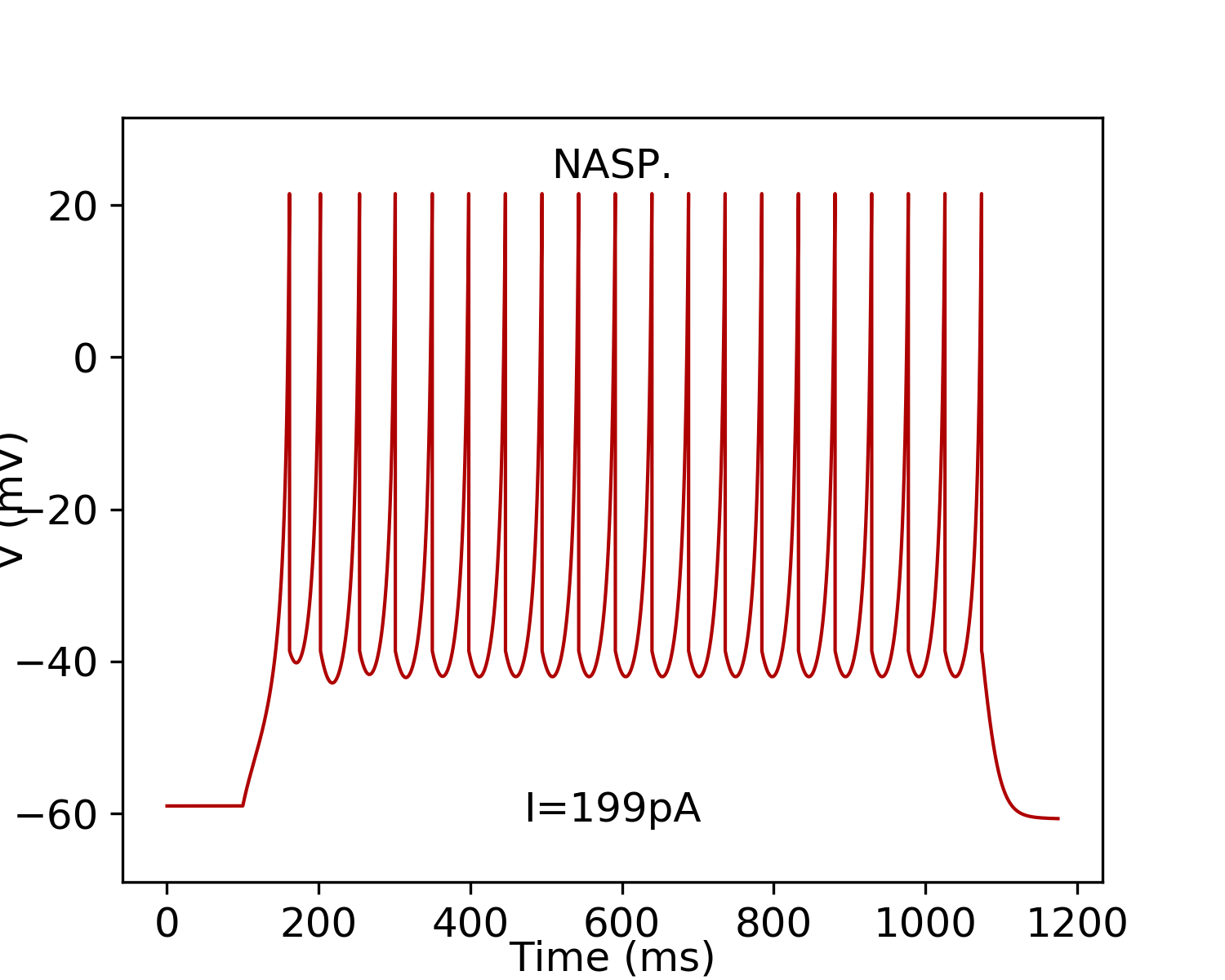
| subtype: 1 k=0.95;a= 0.028;b= -21.99;d= 805;C= 407;Vr= -59.01;Vt= -39.01;Vpeak= 21.51;Vmin= -38.58; | | Simulate
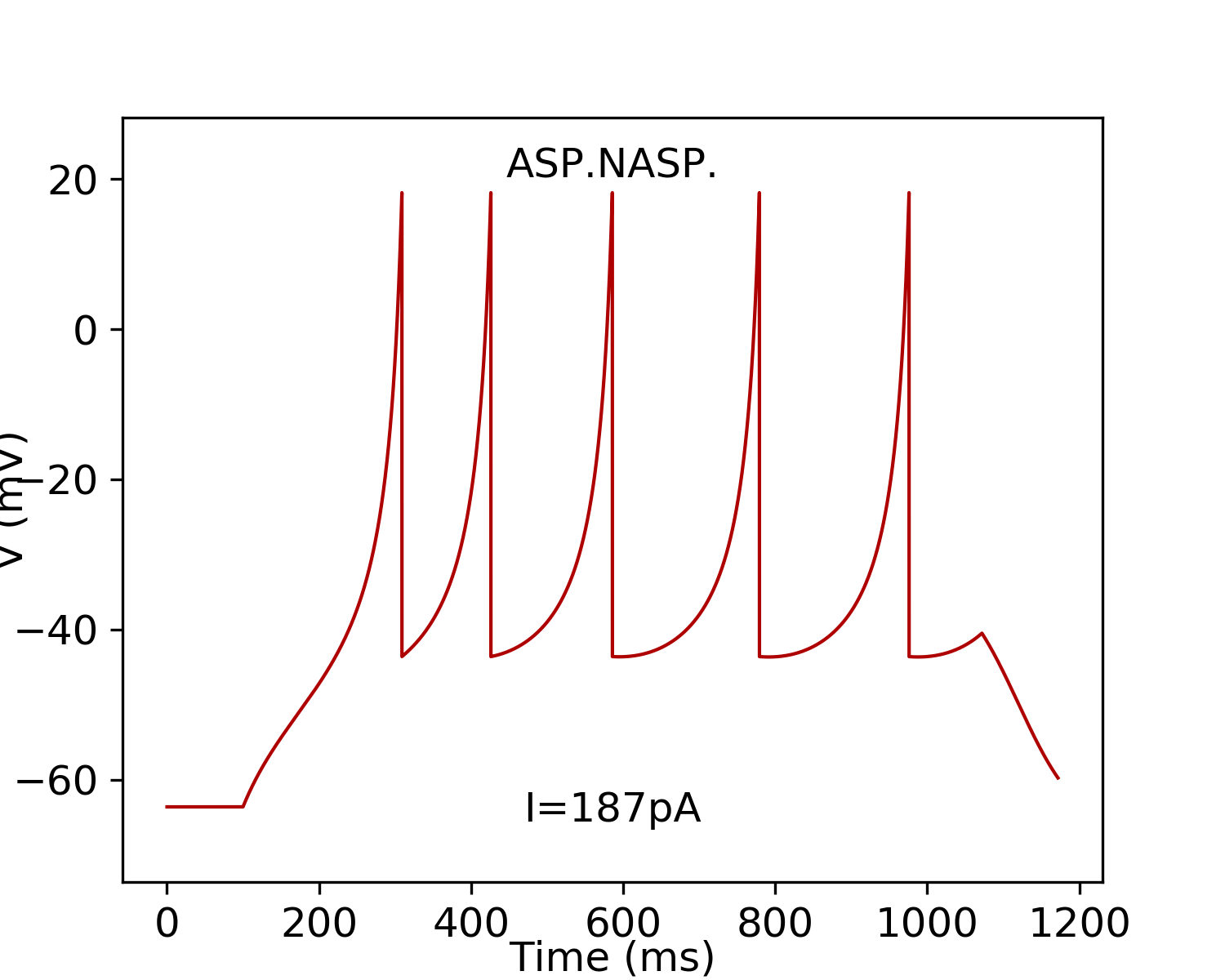
| | subtype: 2 k=0.53;a= 0.004;b= -0.58;d= 79;C= 749;Vr= -63.59;Vt= -38.65;Vpeak= 18.15;Vmin= -43.59; | | Simulate
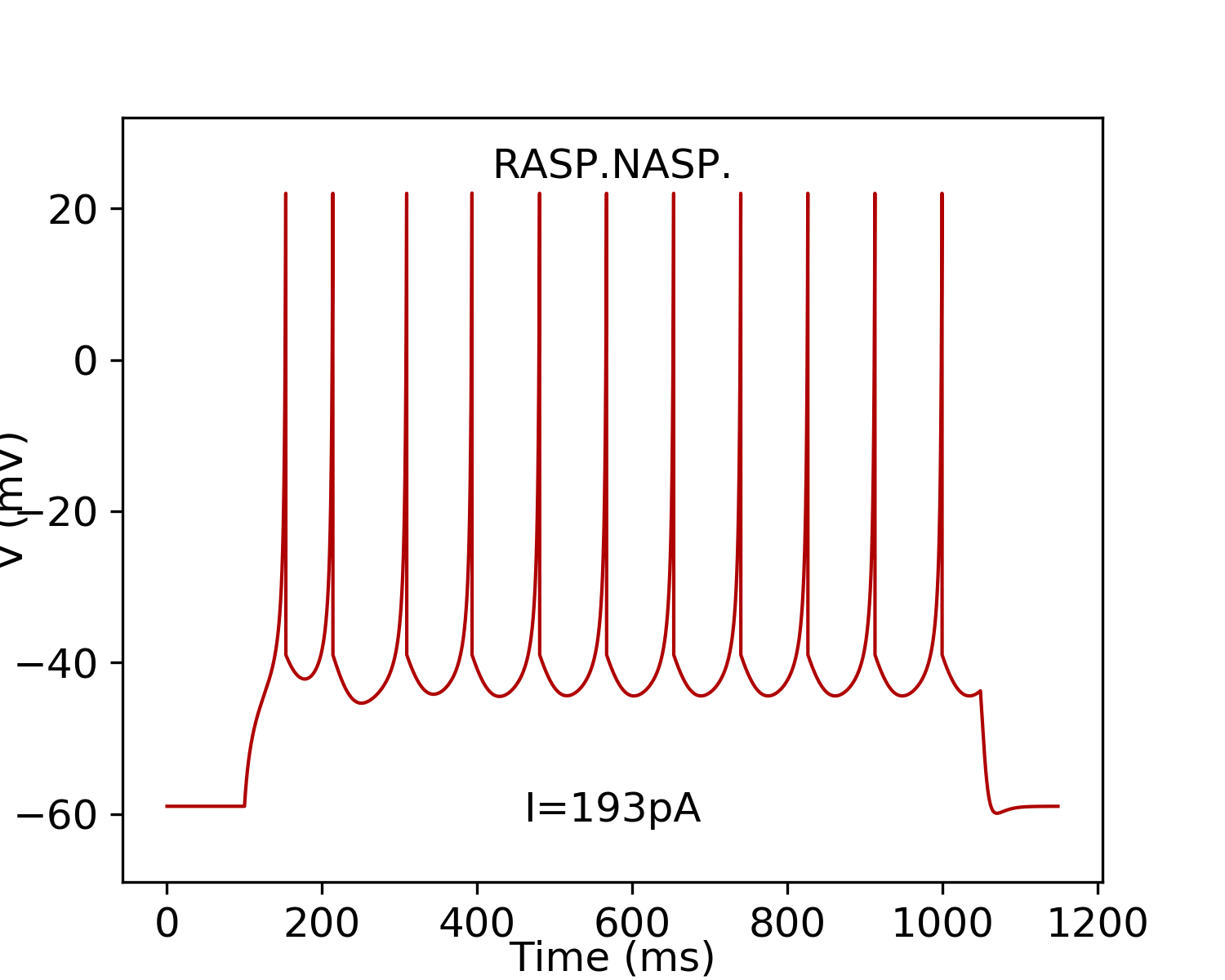
| | subtype: 3 k=0.91;a= 0.069;b= 4.08;d= 45;C= 115;Vr= -58.98;Vt= -35.21;Vpeak= 21.99;Vmin= -38.94; | | Simulate
|
|
|
|
|
Potential sources known to be avoided
|
|
|
|
|
|
Potential targets known to be avoided
|
|
| Oscillation Phase Locking |
| Category | Value | | Theta (deg): | 321.53 | | Theta range: | [321.53, 321.53] | | Theta measurements: | 1 | | Theta representative selection: | rats, adult, male,
juxtacellular, freely moving | | SWR ratio: | 1.64 | | SWR ratio range: | [1.64, 1.64] | | SWR ratio measurements: | 1 | | SWR ratio representative selection: | rats, adult, male,
tetrode, freely moving | | In vivo firing rate (Hz): | 3.55 | | Firing rate range: | [3.55, 3.55] | | Firing rate measurements: | 1 | | Firing rate representative selection: | rats, adult, unknown sex,
juxtacellular, freely moving | | Other: | firingRateNonBaseline | | Other representative selection: | rats, adult, male,
tetrode, freely moving |
|
 Browse
 Search
 Help