EC LI-II Pyramidal-Fan
* indicates new v2.0 neuron type
Name Supertype (ID:Family:Type:Subregion)
EC (e)331000p-DG_1000-Sub_101 LI-II Pyramidal-Fan S061706:Glutamatergic II:LI-II:EC

Name derivation
This name is a hybrid of the two most frequently cited names.

Synonym(s)
LEC layer 2 pyramidal-like cell
LEC layer II fan cell
LEC layer II fan neuron
LEC layer II spiny stellate neuron
LEC layer IIa stellate cell
LEC LI horizontal principal neuron
LEC LII oblique pyramidal neuron
LEC LII pyramidal neuron
MEC LII between pyramidal and SC
MEC LII pyramidal cell
MEC LII pyramidal neuron

List of articles
Click here to view the list
Amaral D  (2007) The Hippocampus Book
Hippocampal Neuroanatomy
Amaral D, Lavenex P.
The Hippocampus Book, 2007, Pages: 35 - 112
ISBN: 9780195100273
Tags: morphology, connectivity, synapse probabilities
Burgalossi A  (2011) Neuron
Microcircuits of functionally identified neurons in the rat medial entorhinal cortex.
Burgalossi A, Herfst L, von Heimendahl M, Forste H, Haskic K, Schmidt M, Brecht M.
Neuron, 2011 May 26, 70 (4), Pages: 773 - 86
PMID: 21609831; DOI: 10.1016/j.neuron.2011.04.003
Tags: phases, synapse probabilities
Canto CB  (2008) Neural Plast
What does the anatomical organization of the entorhinal cortex tell us?
Canto CB, Wouterlood FG, Witter MP.
Neural Plast, 2008, 2008, Pages: 381243 -
PMID: 18769556; DOI: 10.1155/2008/381243
Tags: morphology, connectivity, synapse probabilities
Canto CB  (2012) Hippocampus
Cellular properties of principal neurons in the rat entorhinal cortex. II. The medial entorhinal cortex.
Canto CB, Witter MP.
Hippocampus, 2012 Jun, 22 (6), Pages: 1277 - 1299
PMID: 22161956; DOI: 10.1002/hipo.20993
Tags: morphology, membrane biophysics, synapse probabilities
Canto CB  (2012) Hippocampus
Cellular properties of principal neurons in the rat entorhinal cortex. I. The lateral entorhinal cortex.
Canto CB, Witter MP.
Hippocampus, 2012 Jun, 22 (6), Pages: 1256 - 1276
PMID: 22162008; DOI: 10.1002/hipo.20997
Tags: morphology, membrane biophysics, firing patterns, synapse probabilities
Empson RM  (1995) Neurosci Lett
Electrophysiology and morphology of a new type of cell within layer II of the rat lateral entorhinal cortex in vitro.
Empson RM, Gloveli T, Schmitz D, Heinemann U.
Neurosci Lett, 1995 Jul 7, 193 (3), Pages: 149 - 152
PMID: 7478170; DOI: 10.1016/0304-3940(95)11684-O
Tags: morphology
Germroth P  (1991) J Comp Neurol
Ultrastructure and aspects of functional organization of pyramidal and nonpyramidal entorhinal projection neurons contributing to the perforant path.
Germroth P, Schwerdtfeger WK, Buhl EH.
J Comp Neurol, 1991 Mar 8, 305 (2), Pages: 215 - 231
PMID: 2026788; DOI: 10.1002/cne.903050205
Tags: morphology
Lingenhohl K  (1991) Exp Brain Res
Morphological characterization of rat entorhinal neurons in vivo: soma-dendritic structure and axonal domains.
Lingenhohl K, Finch DM.
Exp Brain Res, 1991, 84 (1), Pages: 57 - 74
PMID: 1713171; DOI: 10.1007/BF00231762
Tags: morphology
Tahvildari B  (2005) J Comp Neurol
Morphological and electrophysiological properties of lateral entorhinal cortex layers II and III principal neurons.
Tahvildari B, Alonso A.
J Comp Neurol, 2005 Oct 17, 491 (2), Pages: 123 - 140
PMID: 16127693; DOI: 10.1002/cne.20706
Tags: morphology, synapse probabilities

List of Hippocampome.org to NeuroMorpho.Org mappings
Click here to view the list of mappings
  • Peng

  • Morphology
    Soma
    EC:I
    EC:II
    Axons
    DG:SMo
    SUB:SM
    SUB:PL
    EC:I
    EC:II
    EC:III
    Dendrites
    EC:I
    EC:II

    Representative figure
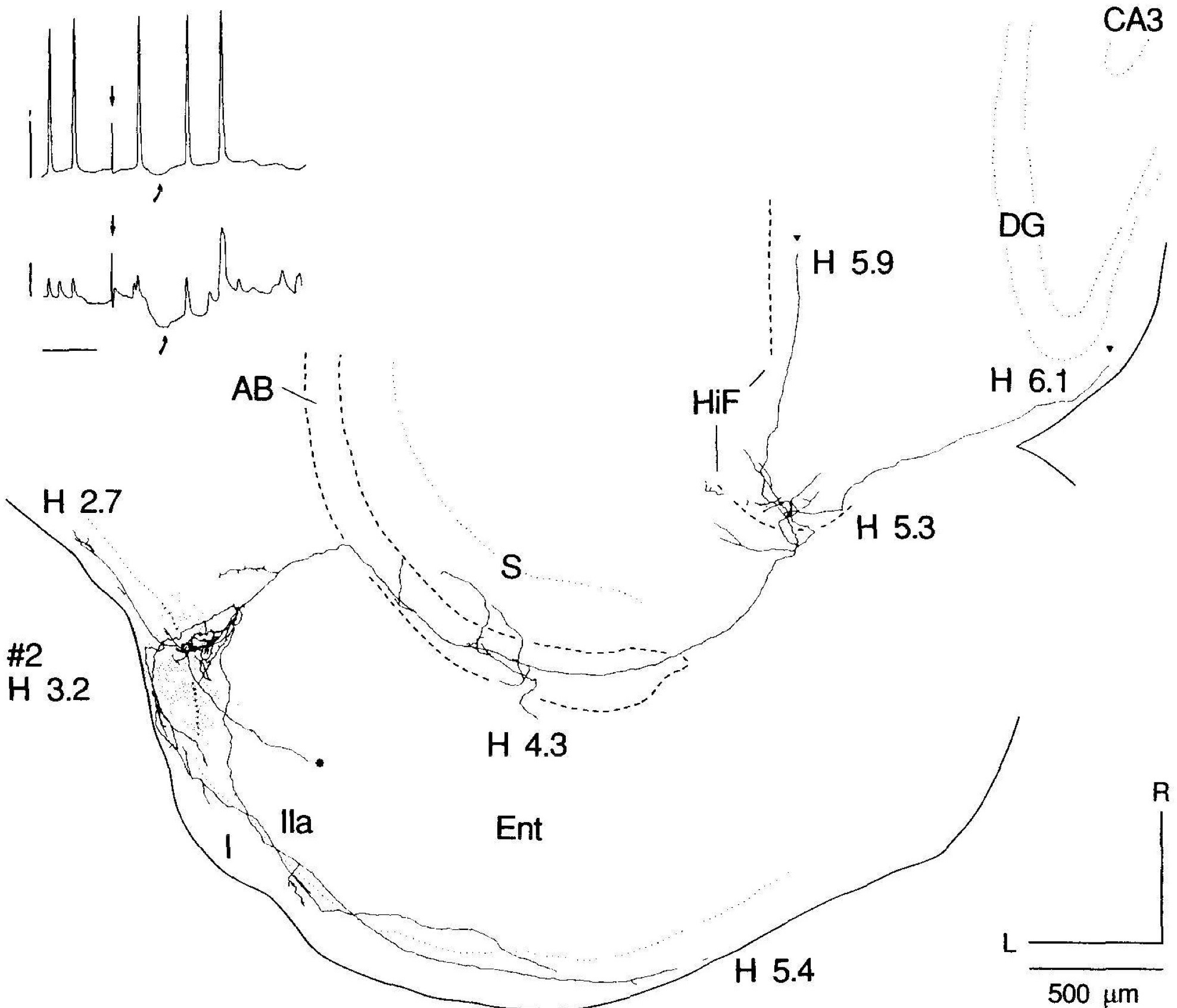
    Morphological characterization of rat entorhinal neurons in vivo: soma-dendritic structure and axonal domains.
    Lingenhohl K, Finch DM
    Exp Brain Res, 1991, 84 (1), pages: 57 - 74
    PMID: 1713171; DOI: 10.1007/BF00231762


    "Fig. 9. Intracellular recordings, and drawing tube reconstruction of the axonal projection pattern of the lateral entorhinal neuron no2 {EC LI-II Pyramidal-Fan} (layer IIa; see Fig. 2 for its soma-dendritic structure). . . . Axonal reconstruction: Note the direct projection to the outer molecular layer of the dentate gyrus, with additional axonal branches in the entorhinal cortex and subiculum."


    Molecular markers
    Positive
    None known
    Negative
    CR
    GABAa\alpha 6 (inference)
    PV (confirmed by inference)
    Mixed expression
    None known

    Electrophysiological properties
    Key: [range] OR representative value±SD (measurements); Number of sources (total measurements): [min , max]

    Resting membrane potential (Vrest): [-62, -59] mV (2); 2 sources (4): [-63 , -62]
    Input resistance (Rin): 400±98.0 MΩ (96); 2 sources (97): [400 , 430]
    Time constant (τm): 16 ms (96); 2 sources (97): [16 , 27]
    Threshold potential (Vthresh): [7.5, 8.4] mV (2); 2 sources (4): [7.5 , 8.5]
    Fast afterhyperpolaziring potential amplitude (Fast AHP): [7.1, 7.3] mV (2); 2 sources (4): [7.1 , 11]
    Action potential amplitude (APampl): 69±19.6 mV (96); 2 sources (97): [69 , 80]
    Action potential width (APwidth): 1.25±0.5 ms (96); 2 sources (97): [1.05 , 1.25]
    Max firing rate (Max F.R.): >90 Hz (1); 2 sources (2): [40 , 90]
    Slow afterhyperpolarizing potential amplitude (Slow AHP): [0.0, 6.0] mV (2); 2 sources (3): [0 , 6.7]
    Sag ratio: 0.71 (1); 2 sources (97): [0.66 , 0.71]

    Notes
    This class is composed of an amalgam of author-defined classes. Failed unofficial merger proposals with MEC 331111 stellate II, EC 231000 FOMP, and EC 221100 oblique pyramidal-stellate II. Sparsely spiny to spiny, projecting -> excitatory. The figure of the between pyramidal and stellate cell depicts an axon that dies off in L:VI, which is not substantial enough for an A:VI interpretation. - DWW C&W's LEC description of a pyramidal cell matches 331000. They also describe a second class (333000) that is n=2 (by itself an insufficient percentage to establish a separate class). However, since the 333000 class does exist, this evidence is included in that cell type. The Canto MEC pyramidal neuron from Figure 5 was added, even though it has borderline dendrites in VI. Borderline: A:IV (Canto 201X LEC preprint fan -- figure) A:V (Canto 201X LEC preprint fan -- text) A:VI (Canto 201X MEC preprint pyramidal) D:III (Tahvildari 2005 fan; Empson 1995 PLN)

    Firing Pattern
    Images
    Image MissingImage MissingImage Missing
    Parameters View page
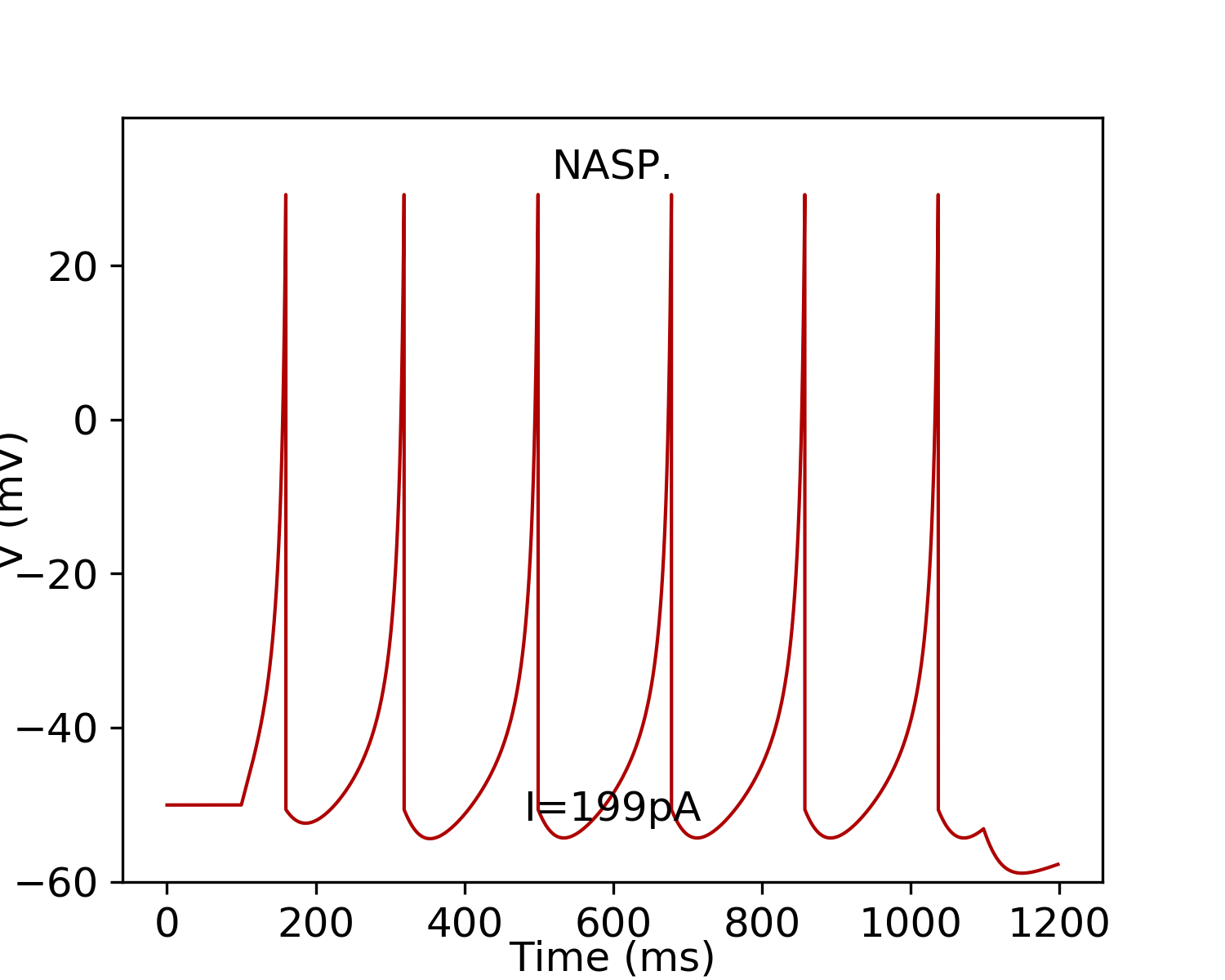
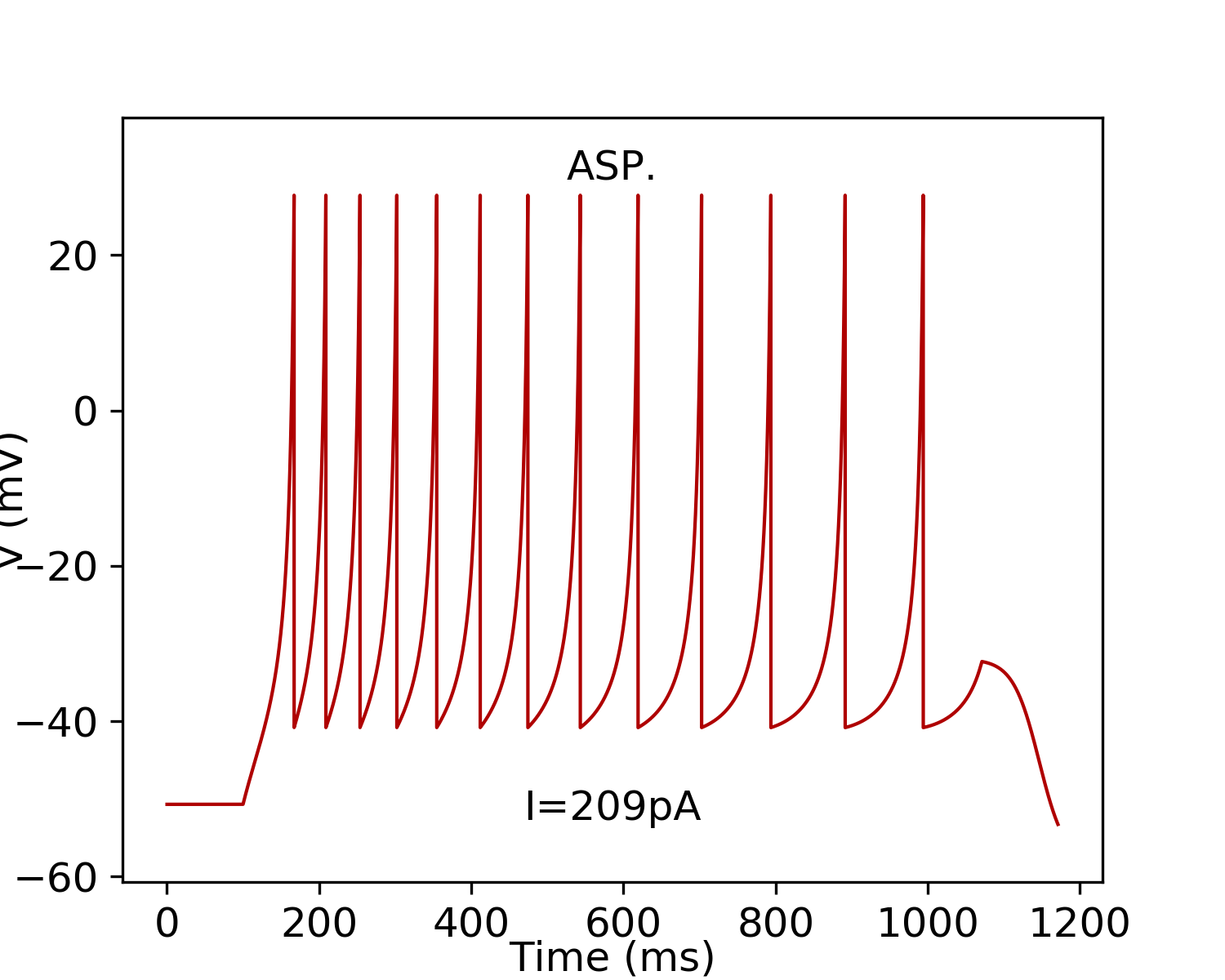
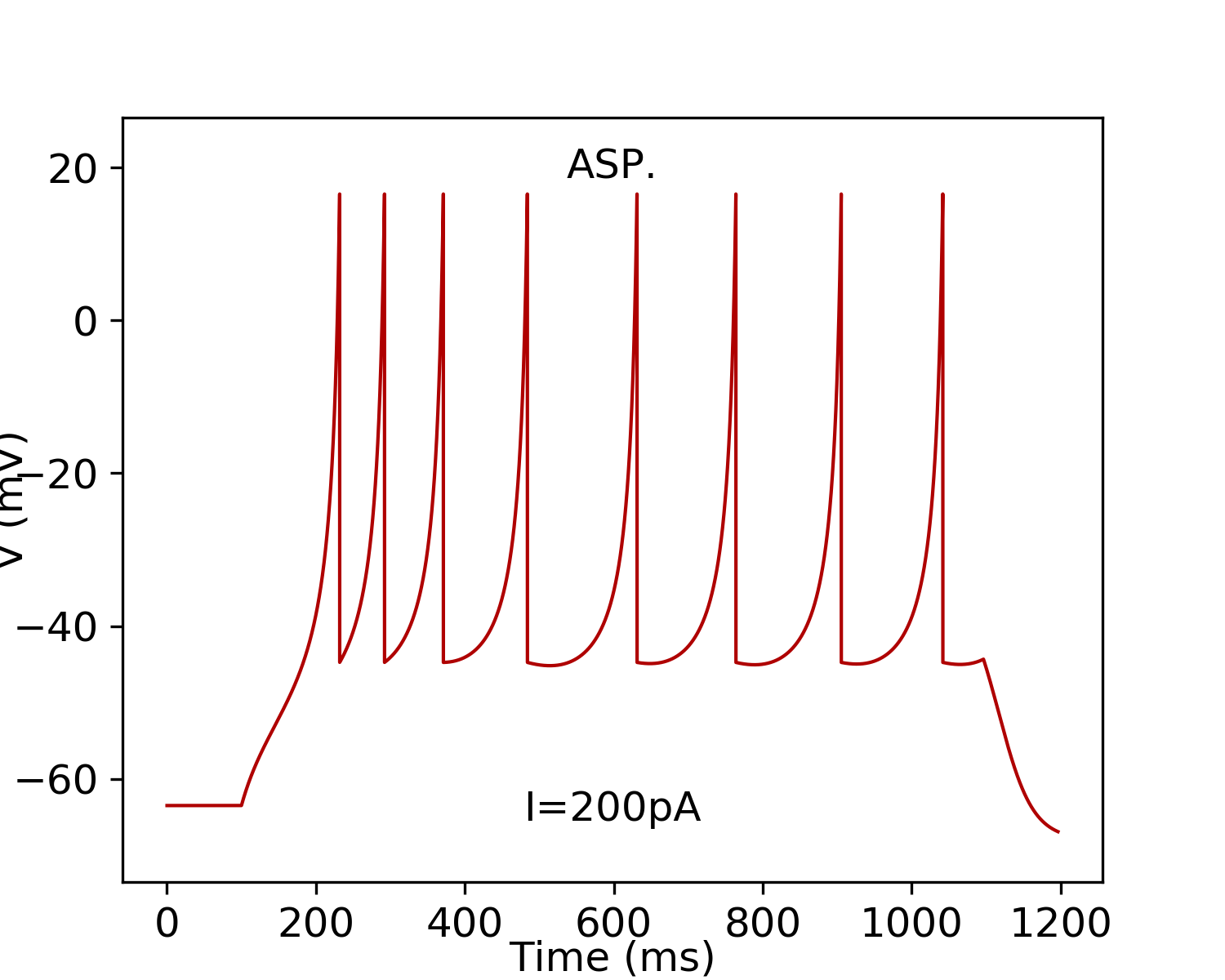
    ASP. [Evidence] [Firing Pattern]
    NASP [Evidence] [Firing Pattern]

    Izhikevich Model
    Parameters Single Compartment Downloads Simulate
    subtype: 1 k=0.94;a= 0.01;b= -0.32;d= 283;C= 539;Vr= -50.04;Vt= -46.54;Vpeak= 29.22;Vmin= -50.63; Simulate
    subtype: 2 k=1.15;a= 0.002;b= 9.39;d= 5;C= 528;Vr= -50.7;Vt= -40.34;Vpeak= 27.71;Vmin= -40.83; Simulate
    subtype: 3 k=0.78;a= 0;b= -62.84;d= 117;C= 567;Vr= -63.47;Vt= -40.47;Vpeak= 16.52;Vmin= -44.75; Simulate
    Images
    Image MissingImage MissingImage Missing
    ModelDB Model
    Model Accession Number PubMed ID

    Sources of Input
    Known sources
    Excitatory or Inhibitory
    EC LII Basket-Neurogliaform

    Potential sources
    Excitatory or Inhibitory
    CA2 Pyramidal
    EC LI-II Multipolar-Pyramidal
    EC LI-II Pyramidal-Fan
    MEC LII Stellate
    MEC LII-III Pyramidal-Multiform
    EC LII-III Pyramidal-Tripolar
    LEC LIII Multipolar Principal
    LEC LIII Complex Pyramidal
    MEC LIII Complex Pyramidal
    MEC LIII Bipolar Complex Pyramidal
    MEC LV Pyramidal
    MEC LV Superficial Pyramidal
    MEC LI-II Polar Interneuron*
    EC LII Axo-axonic
    MEC LII Basket
    MEC LIII Multipolar Interneuron
    MEC LIII Superficial Multipolar Interneuron
    MEC LI Neurogliaform*
    EC LII-III Superficial Polymorphic Interneuron*
    MEC LIII Superficial Trilayered Interneuron

    Potential sources known to be avoided
    Excitatory or Inhibitory
    none known

    Targets of Output
    Known targets
    Excitatory or Inhibitory
    DG Granule
    DG Mossy MOLDEN

    Potential targets
    Excitatory or Inhibitory
    DG Adult-Born Immature Granule*
    DG Hilar Ectopic Granule
    DG Semilunar Granule
    DG Cajal-Retzius*
    DG Local-Projecting Cajal-Retzius*
    DG AIPRIM
    DG Axo-axonic
    DG Granulosum-targeting Axo-axonic*
    DG Axo-axonic GRALDEN*
    DG Basket
    DG Basket GRALDEN*
    DG Basket CCK+
    DG Interneuron Specific COLTAR*
    DG COM-MOPP*
    DG HICAP
    DG Interneuron Specific IMOT*
    DG Interneuron Specific HIMOLD*
    DG Interneuron Specific HIPRO*
    DG MOLAX
    DG Molecular Layer*
    DG Outer Molecular Layer
    DG Total Molecular Layer
    DG MOPP
    DG Neurogliaform
    DG Wide-Arbor Neurogliaform*
    CA1 Neurogliaform Projecting
    Sub CA1-Projecting Pyramidal
    Sub EC-Projecting Pyramidal
    Sub Axo-axonic
    Sub Wide-arbor Polymorphic*
    Sub Recurrent Polymorphic-Moleculare*
    EC LI-II Multipolar-Pyramidal
    EC LI-II Pyramidal-Fan
    MEC LII Oblique Pyramidal
    MEC LII Stellate
    MEC LII-III Pyramidal-Multiform
    EC LII-III Pyramidal-Tripolar
    LEC LIII Multipolar Principal
    MEC LIII Multipolar Principal
    EC LIII Small Pyramidal
    LEC LIII Complex Pyramidal
    MEC LIII Complex Pyramidal
    MEC LIII Bipolar Complex Pyramidal
    EC LIII Pyramidal
    EC LIII Stellate
    EC LIII-V Bipolar Pyramidal
    EC LIV-V Pyramidal-Horizontal
    MEC LV Principal*
    MEC LV Pyramidal
    EC LV Deep Pyramidal
    MEC LV Superficial Pyramidal
    MEC LI-II Polar Interneuron*
    EC LII Axo-axonic
    MEC LII Basket
    EC LII Basket-Neurogliaform
    EC LIII Bipolar Interneuron*
    LEC LIII Multipolar Interneuron
    MEC LIII Multipolar Interneuron
    MEC LIII Superficial Multipolar Interneuron
    MEC LI Neurogliaform*
    EC LII-III Superficial Polymorphic Interneuron*
    EC LIII Pyramidal-Looking Interneuron
    MEC LIII Superficial Trilayered Interneuron

    Potential targets known to be avoided
    Excitatory or Inhibitory
    none known

    Oscillation Phase Locking
    Category
    Value