|
|
|
* indicates new v2.0 neuron type
|
|
Name
|
|
Supertype (ID:Family:Type:Subregion)
|
|
|
MEC (e)331111p-DG_1000-CA3_10000-CA2_1000-Sub_111 LII Stellate
|
S061706:Glutamatergic II:LI-II:EC
|
|
Name derivation
|
|
|
|
This is a canonical principal cell of the main hippocampal circuit. Most sources indicate medial localization of the morphology. This is the simplest form of the only core name in the cited literature.
|
|
Synonym(s)
|
|
|
|
EC layer II stellate
|
|
|
MEC L2S
|
|
|
MEC LII SC
|
|
|
MEC LII stellate cell
|
|
|
MEC layer II type I neuron
|
|
|
medial and intermediate EC layer II spiny stellate neuron
|
|
|
Click here to view the list
Amaral D (2007) The Hippocampus Book
Hippocampal Neuroanatomy Amaral D, Lavenex P.
The Hippocampus Book,
2007,
Pages: 35 - 112
ISBN: 9780195100273
Tags: morphology, connectivity, synapse probabilities
Beed P (2010) Neuron
Analysis of excitatory microcircuitry in the medial entorhinal cortex reveals cell-type-specific differences. Beed P, Bendels MH, Wiegand HF, Leibold C, Johenning FW, Schmitz D.
Neuron,
2010 Dec 22, 68 (6),
Pages: 1059 - 1066
PMID: 21172609; DOI: 10.1016/j.neuron.2010.12.009
Tags: morphology, connectivity, synapse probabilities
Burgalossi A (2011) Neuron
Microcircuits of functionally identified neurons in the rat medial entorhinal cortex. Burgalossi A, Herfst L, von Heimendahl M, Forste H, Haskic K, Schmidt M, Brecht M.
Neuron,
2011 May 26, 70 (4),
Pages: 773 - 86
PMID: 21609831; DOI: 10.1016/j.neuron.2011.04.003
Tags: phases, synapse probabilities
Canto CB (2012) Hippocampus
Cellular properties of principal neurons in the rat entorhinal cortex. II. The medial entorhinal cortex. Canto CB, Witter MP.
Hippocampus,
2012 Jun, 22 (6),
Pages: 1277 - 1299
PMID: 22161956; DOI: 10.1002/hipo.20993
Tags: morphology, membrane biophysics, firing patterns, synapse probabilities
Garden DL (2008) Neuron
Tuning of synaptic integration in the medial entorhinal cortex to the organization of grid cell firing fields. Garden DL, Dodson PD, O'Donnell C, White MD, Nolan MF.
Neuron,
2008 Dec 10, 60,
Pages: 875 - 89
PMID: 19081381
Tags: synapse probabilities
Jones RS (1994) Hippocampus
Synaptic and intrinsic properties of neurons of origin of the perforant path in layer II of the rat entorhinal cortex in vitro. Jones RS.
Hippocampus,
1994 Jun, 4 (3),
Pages: 335 - 353
PMID: 7842056; DOI: 10.1002/hipo.450040317
Tags: morphology, membrane biophysics
Mizuseki K (2009) Neuron
Theta oscillations provide temporal windows for local circuit computation in the entorhinal-hippocampal loop. Mizuseki K, Sirota A, Pastalkova E, Buzsaki G.
Neuron,
2009,
Pages: 267 - 280
PMID: 19874793
Tags: phases
Mizuseki K (2011) Nat Neurosci.
Hippocampal CA1 pyramidal cells form functionally distinct sublayers. Mizuseki K, Diba K, Pastalkova E, Buzsaki G.
Nat Neurosci.,
2011,
Pages: 1174 - 1181
PMID: 21822270
Tags: phases
Quilichini P (2010) J Neurosci
Intrinsic circuit organization and theta-gamma oscillation dynamics in the entorhinal cortex of the rat. Quilichini P, Sirota A, Buzsaki G.
J Neurosci,
2010 Aug 18, 30 (33),
Pages: 11128 - 11142
PMID: 20720120; DOI: 10.1523/JNEUROSCI.1327-10.2010
Tags: phases, synapse probabilities
Ray S (2014) Science
Grid-layout and theta-modulation of layer 2 pyramidal neurons in medial entorhinal cortex. Ray S, Naumann R, Burgalossi A, Tang Q, Schmidt H, Brecht M.
Science,
2014 Feb 21, 343 (6173),
Pages: 891 - 896
PMID: 24457213; DOI: 10.1126/science.1243028
Tags: phases
Schwartz SP (1981) Exp Neurol
Neurons of origin of the perforant path. Schwartz SP, Coleman PD.
Exp Neurol,
1981 Oct, 74 (1),
Pages: 305 - 312
PMID: 7286122; DOI: 10.1016/0014-4886(81)90169-2
Tags: morphology
Spruston N (2007) The Hippocampus Book
Chapter 5: Structural and functional properties of hippocampal neurons Spruston N, McBain C.
The Hippocampus Book,
2007,
Pages: 133 - 200
ISBN: 9780195100273
Tags: morphology, connectivity, synapse probabilities
Tamamaki N (1993) Hippocampus
Projection of the entorhinal layer II neurons in the rat as revealed by intracellular pressure-injection of neurobiotin. Tamamaki N, Nojyo Y.
Hippocampus,
1993 Oct, 3 (4),
Pages: 471 - 480
PMID: 8269038; DOI: 10.1002/hipo.450030408
Tags: morphology
Tang Q (2014) Neuron
Pyramidal and stellate cell specificity of grid and border representations in layer 2 of medial entorhinal cortex. Tang Q, Burgalossi A, Ebbesen CL, Ray S, Naumann R, Schmidt H, Spicher D, Brecht M..
Neuron,
2014,
Pages: 1191 - 1197
PMID: 25482025
Tags: phases
|
|
List of Hippocampome.org to NeuroMorpho.Org mappings
|
|
|
Click here to view the list of mappings
Ascoli
-
entho
(fits the general description of "EC LII Stellate" cells)
Buzsaki
Helmstaedter
Kononenko_Haucke
Nolan
Rice-Baylor
-
AR-1-20-04-A
(fits the general description of "MEC LV Pyramidal" or "EC LV Deep Pyramidal" or "MEC LV Superficial Pyramidal" or "MEC LV Multipolar-Pyramidal" or "MEC LV-VI Pyramidal-Polymorphic" or "EC LIV-V Pyramidal-Horizontal" based on the distribution of axons and dendrites)
|
|
|
Projection of the entorhinal layer II neurons in the rat as revealed by intracellular pressure-injection of neurobiotin.
Tamamaki N, Nojyo Y
Hippocampus, 1993 Oct, 3 (4), pages: 471 - 480
PMID: 8269038; DOI: 10.1002/hipo.450030408
|
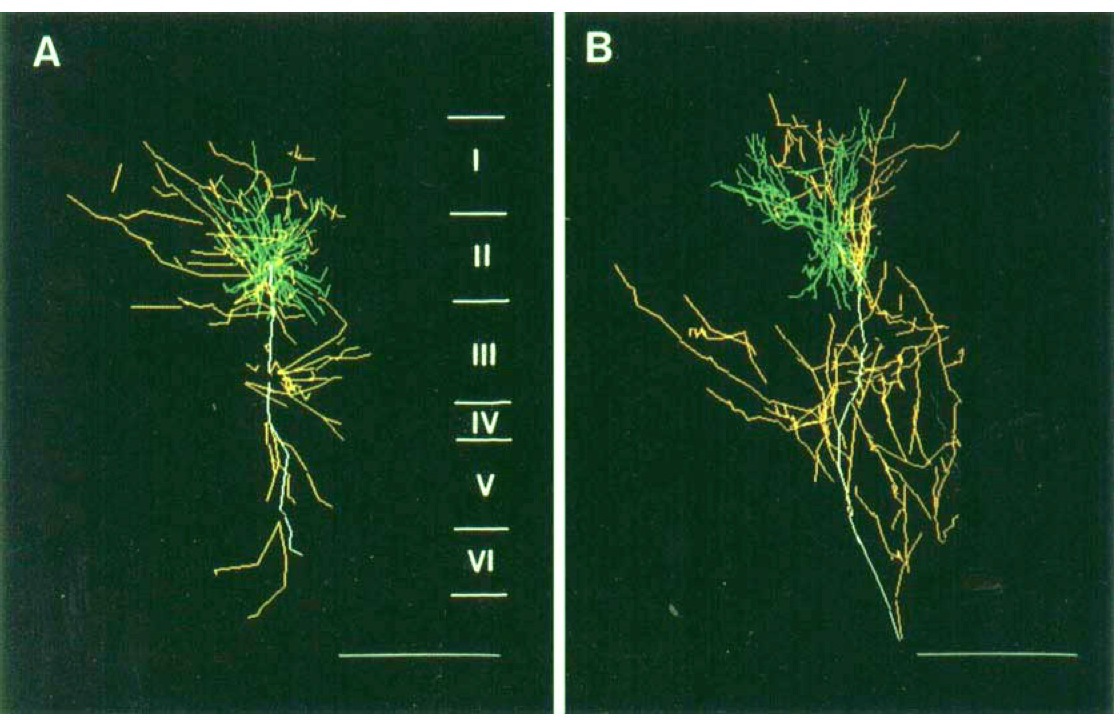
"Fig. 2. (A) Axon collaterals of a layer II spiny neuron {MEC LII Stellate} in the entorhinal cortex. (B) Axon collaterals of another spiny neuron in the entorhinal cortex. Calibration bars, 0.5 mm. Axon collaterals were rich in layers I-III. Collaterals were also found in layers IV-VI. Green lines, dendrites; white lines, stem axon; yellow lines, axon collaterals. Stratification in A also applies to B." |
|
Electrophysiological properties
|
| Key: [range] OR representative value±SD (measurements); Number of sources (total measurements): [min , max] | |
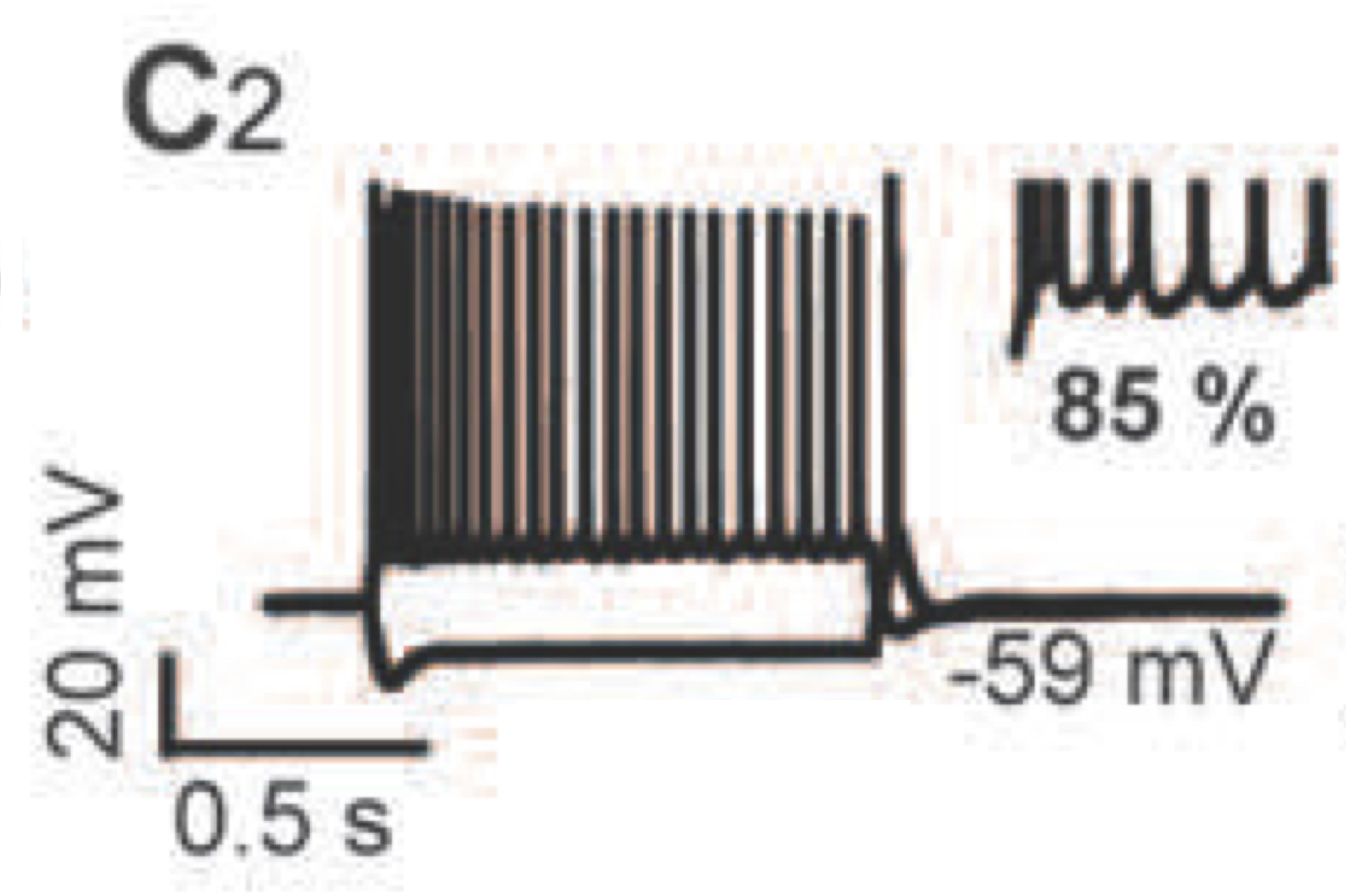
| | Resting membrane potential (Vrest): [-70.8, -59.0] mV (2); 2 sources (114): [-70.8 , -62] | | Input resistance (Rin): 30.2±12.5 MΩ (112); 2 sources (208): [30.2 , 400] | | Time constant (τm): 8.9±1.9 ms (112); 2 sources (208): [8.9 , 16] | | Threshold potential (Vthresh): [16.8, 8.4] mV (2); 2 sources (3): [7.5 , 16.8] | | Fast afterhyperpolaziring potential amplitude (Fast AHP): [8, 7.3] mV (2); 2 sources (3): [7.1 , 8] | | Action potential amplitude (APampl): 69±19.6 mV (96); 2 sources (97): [69 , 73.7] | | Action potential width (APwidth): 1.25±0.5 ms (96); 2 sources (208): [0.73 , 1.25] | | Max firing rate (Max F.R.): >40 Hz (1); 1 source | | Slow afterhyperpolarizing potential amplitude (Slow AHP): [0.0, 6.0] mV (2); 1 source | | Sag ratio: 0.79 (1); 2 sources (97): [0.66 , 0.79] |
|
|
Axonal presence in CA1 has been removed since it is below 15% and unsupported by the conclusions of the authors.
This cell type is defined by primary literature, in order of primacy from:
Tamamaki and Nojyo, 1993 (EC layer II stellate cells)
Canto and Witter, MEC prepreint (EC layer II stellate cells)
Jones, 1994 (EC layer II type I & II stellate cells)
Beed et al., 2010, (EC layer II stellate cells)
Schwartz and Coleman, 1981, (EC layer II stellate cells)
|
| Parameters
|
Single Compartment
|
Downloads
|
Simulate
|
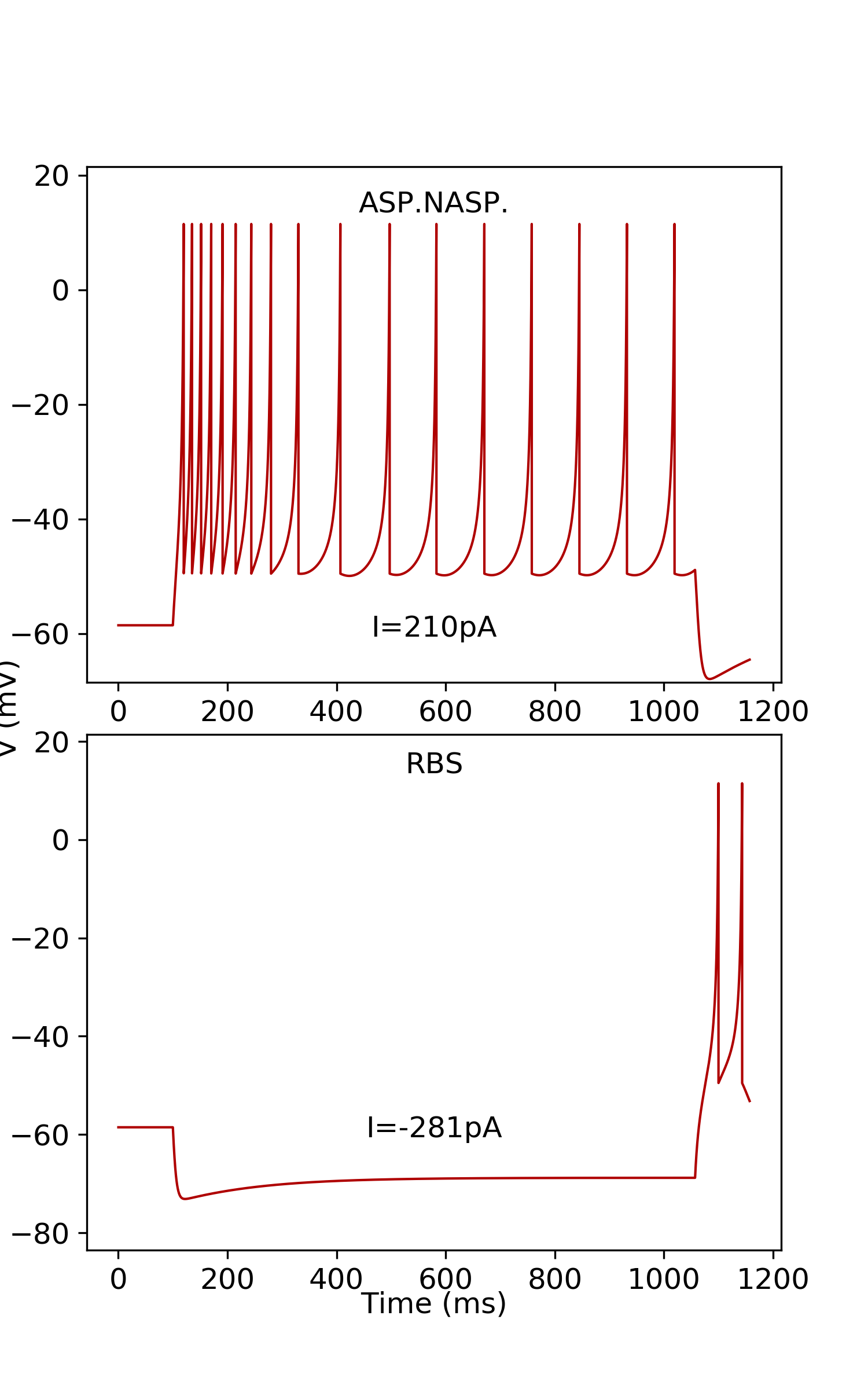
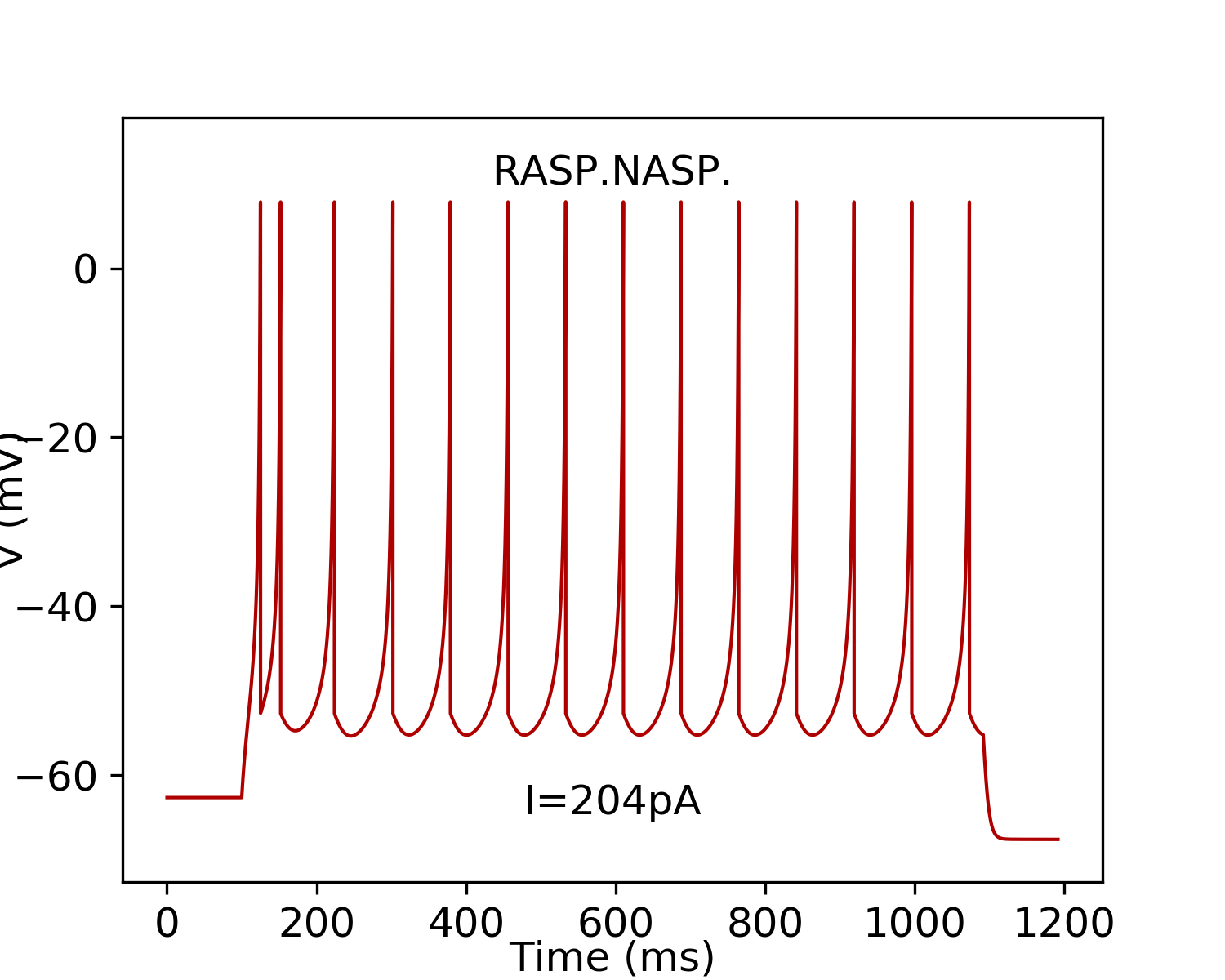
| subtype: 1 k=0.62;a= 0.005;b= 11.69;d= 3;C= 118;Vr= -58.53;Vt= -43.52;Vpeak= 11.48;Vmin= -49.52; | | Simulate
| | subtype: 2 k=0.98;a= 0.004;b= -23.77;d= 119;C= 131;Vr= -62.65;Vt= -43.6;Vpeak= 7.85;Vmin= -52.68; | | Simulate
|
|
|
|
|
Potential sources known to be avoided
|
|
|
|
|
|
Potential targets known to be avoided
|
|
| Oscillation Phase Locking |
| Category | Value | | Theta (deg): | 298.87 | | Theta range: | [298.87, 298.87] | | Theta measurements: | 1 | | Theta representative selection: | rats, adult, unknown sex,
juxtacellular, freely moving | | SWR ratio: | 1.26 | | SWR ratio range: | [1.26, 1.26] | | SWR ratio measurements: | 1 | | SWR ratio representative selection: | rats, adult, male,
tetrode, freely moving | | In vivo firing rate (Hz): | 2.04 | | Firing rate range: | [2.04, 2.04] | | Firing rate measurements: | 1 | | Firing rate representative selection: | rats, adult, unknown sex,
juxtacellular, freely moving | | Other: | gamma and 1 other | | Other representative selection: | rats, adult, male,
silicon probe, urethane plus supplemental doses of ketamine and xylazine |
|
 Browse
 Search
 Help