MEC LV Pyramidal
* indicates new v2.0 neuron type
Name Supertype (ID:Family:Type:Subregion)
MEC (e)331131p-DG_1100-Sub_101 LV Pyramidal S081906:Glutamatergic Deep:LIV-VI:EC

Name derivation
This is the simplest form of the only core name in the cited literature. All sources indicate medial localization of the morphology.

Synonym(s)
MEC deep layer V pyramidal neuron
MEC layer V pyramidal cell
MEC layer V pyramidal neuron
MEC LV bipolar pyramidal neuron

List of articles
Click here to view the list
Canto CB  (2012) Hippocampus
Cellular properties of principal neurons in the rat entorhinal cortex. II. The medial entorhinal cortex.
Canto CB, Witter MP.
Hippocampus, 2012 Jun, 22 (6), Pages: 1277 - 1299
PMID: 22161956; DOI: 10.1002/hipo.20993
Tags: morphology, membrane biophysics, firing patterns, synapse probabilities
Deller T  (1996) J Neurosci
A novel entorhinal projection to the rat dentate gyrus: direct innervation of proximal dendrites and cell bodies of granule cells and GABAergic neurons.
Deller T, Martinez A, Nitsch R, Frotscher M.
J Neurosci, 1996 May 15, 16 (10), Pages: 3322 - 3333
PMID: 8627369
Tags: morphology
Gloveli T  (2001) Eur J Neurosci
Properties of entorhinal cortex deep layer neurons projecting to the rat dentate gyrus.
Gloveli T, Dugladze T, Schmitz D, Heinemann U.
Eur J Neurosci, 2001 Jan, 13 (2), Pages: 413 - 420
PMID: 11168548; DOI: 10.1046/j.0953-816X.2000.01405.x
Tags: morphology, membrane biophysics, connectivity, synapse probabilities
van Haeften T  (2003) Hippocampus
Morphological and numerical analysis of synaptic interactions between neurons in deep and superficial layers of the entorhinal cortex of the rat.
van Haeften T, Baks-te-Bulte L, Goede PH, Wouterlood FG, Witter MP.
Hippocampus, 2003, 13 (8), Pages: 943 - 952
PMID: 14750656; DOI: 10.1002/hipo.10144
Tags: morphology


Morphology
Soma
EC:V
Axons
DG:SMo
DG:SMi
DG:SG
DG:H
SUB:SM
SUB:PL
EC:I
EC:II
EC:III
EC:IV
EC:V
EC:VI
Dendrites
EC:I
EC:II
EC:V

Representative figure
Properties of entorhinal cortex deep layer neurons projecting to the rat dentate gyrus.
Gloveli T, Dugladze T, Schmitz D, Heinemann U
Eur J Neurosci, 2001 Jan, 13 (2), pages: 413 - 420
PMID: 11168548; DOI: 10.1046/j.0953-816X.2000.01405.x


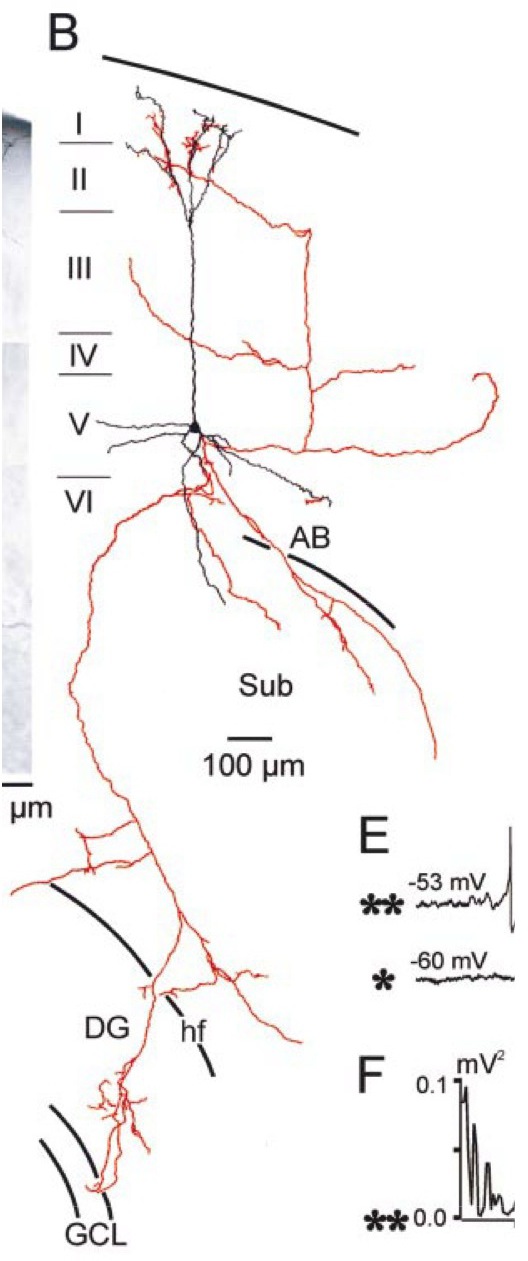
"The axons of all projection cells labelled with biocytin (n = 9) reached the DG [dentate gyrus] via the perforant path. After leaving the somata, the main axons of pyramidal (n = 4), bipolar {MEC LV Pyramidal} (n = 1) and multipolar (n = 1) neurons (6 neurons or 67% of all labelled cells) give rise to ascending collaterals to the superficial (II-III) layers of the EC [entorhinal cortex]. Reaching the angular bundle, the main axons started to emit collaterals which formed a small axon arbor in the subiculum. The axons perforated the subiculum, the hippocampal fissure and reached the molecular layer of the DG (Figs 2-4).


Molecular markers
Positive
None known
Negative
GABAa\alpha 6 (inference)
Mixed expression
None known

Electrophysiological properties
Key: [range] OR representative value±SD (measurements); Number of sources (total measurements): [min , max]

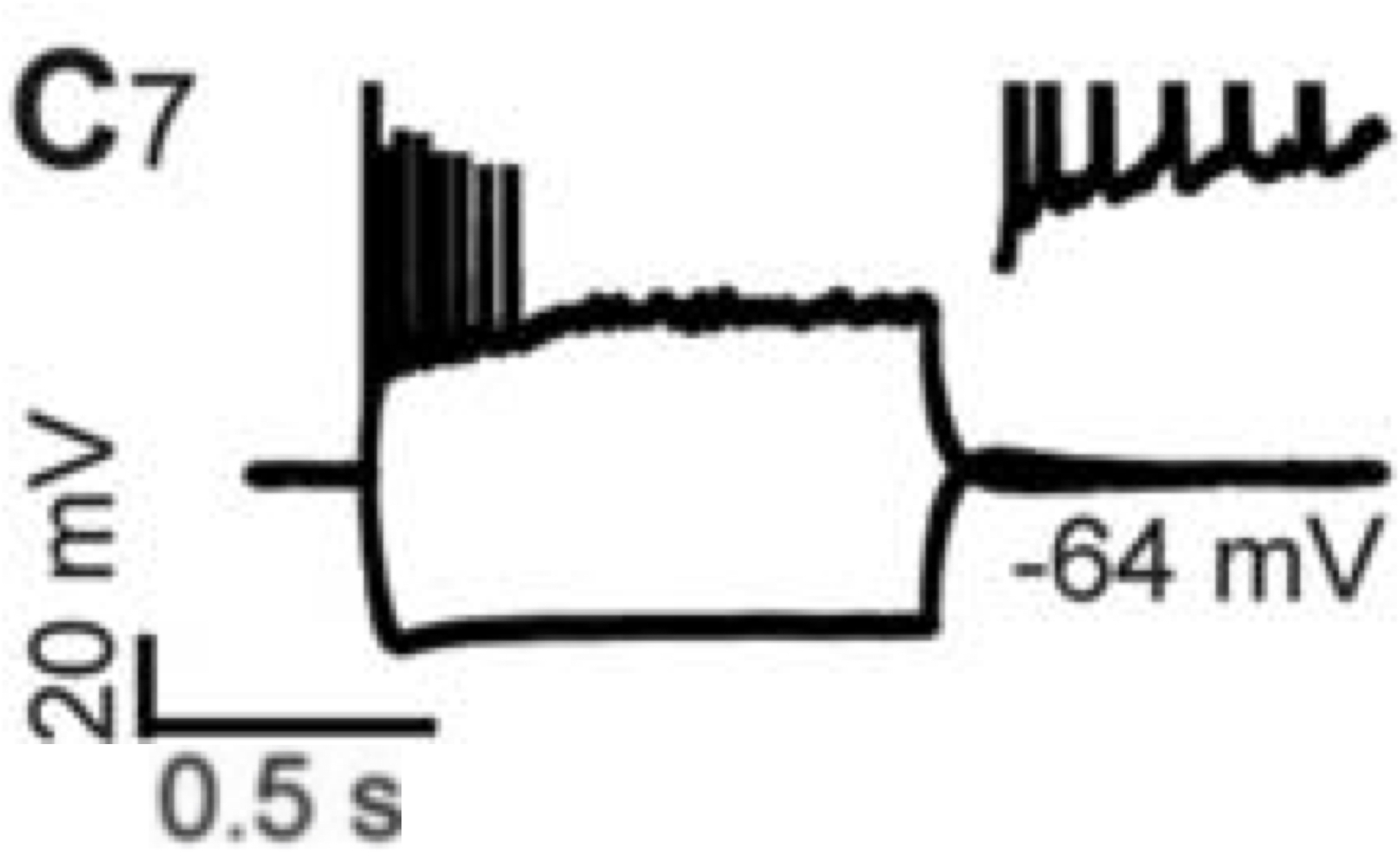
Resting membrane potential (Vrest): [-64, -69]±5.8 mV (17); 2 sources (19): [-64 , -61.8]
Input resistance (Rin): 605 MΩ (72); 2 sources (89): [333.4 , 605]
Time constant (τm): 37±17.0 ms (72); 2 sources (89): [25.6 , 37]
Threshold potential (Vthresh): 10 mV (1); 2 sources (2): [10 , 28.7]
Fast afterhyperpolaziring potential amplitude (Fast AHP): 11.6 mV (1); 2 sources (2): [7.75 , 11.6]
Action potential amplitude (APampl): 61 mV (72); 2 sources (73): [61 , 75]
Action potential width (APwidth): 1.8 ms (72); 2 sources (89): [1.41 , 1.8]
Sag ratio: 0.86 (72); 1 source

Notes
Likely excitatory cells (Gloveli -> GABA negative, projecting, EP characteristics similar to principal cells; van Haeften -> spiny; Canto & Witter -> projecting, "principal," sparsely spiny).

The van Haeften et al. paper does not include mention of projection to Sub or DG. Possibly lost to slicing or possibly outside the scope of their interest.

While this morphology appears in Canto's 201X MEC preprint, there is no mention of this morphology in the LEC preprint.

Status: addendum to currently active MEC (e)331131p LV Pyramidal cells added - 01/11/2016

Notes:

* all evidence for addendum is indirect and inferential *

axons are GABA-negative.

asymmetric synapses on dendritic shafts of GABA-positive and GABA-negative in SMi.

asymmetric synapses on dendritic shafts, soma, and somatic spines of GCs.

synapses on proximal dendrites of GABAergic neurons in or subjacent to SG.

asymmetric synapses on dendritic shafts in H.

Should this addendum also apply to the EC (e)220233p LIV-V Pyramidal-Horizontal cells which are a mixture of LEC and MEC subtypes? - DWW 12/08/2015

I agree with adding the addendum to the 331131 packet, which is currently just based on MEC types (we'll have to add lots of notes, and we probably can't merge any LEC cells into this type in the future - see my note below). Gloveli Fig 3 has borderline A:SG presence anyway. The rest of our evidence for a DG projection only goes as far as the AB.

As for the 220233 packet, which as you point out is a mixture of MEC and LEC, I don't know. Deller says, "Injections located exclusively in the deep layers of the lateral entorhinal cortex labeled only very few entorhinal fibers, and these fibers usually were found underneath the suprapyramidal blade." The obvious answer is to split the 220233 type into MEC and LEC types. I might lean this way.

Overall, this type of evidence is similar to the marker inferences. We'll need a way to trigger it (or at least notify ourselves) when it might apply to future types. - CLR 12/11/2015

I am not sure that we can use this information. (This would be a good time to have "inferential" morphology evidence.) But basically, we only have somata and axonal data, so how do we link the information? In addition, I do not have a sense that the projection is massive, which might indicate that all the projecting neurons in the deep layers contribute to it. Taking all of this into consideration, I lean toward freezing the data due to incomplete morphology. Although prior to doing that, we might do a search for additional information in papers that cite this one. - CW 12/13/2015

A citation search turned up no new evidence. - DWW 12/15/2015

GAA suggests that this addendum only be applied to the MEC (e)331131p cells and that we add a big note mentioning that this is indirect evidence. - DWW 01/11/2016


Firing Pattern
Images
Image MissingImage MissingImage MissingImage MissingImage Missing
Parameters View page
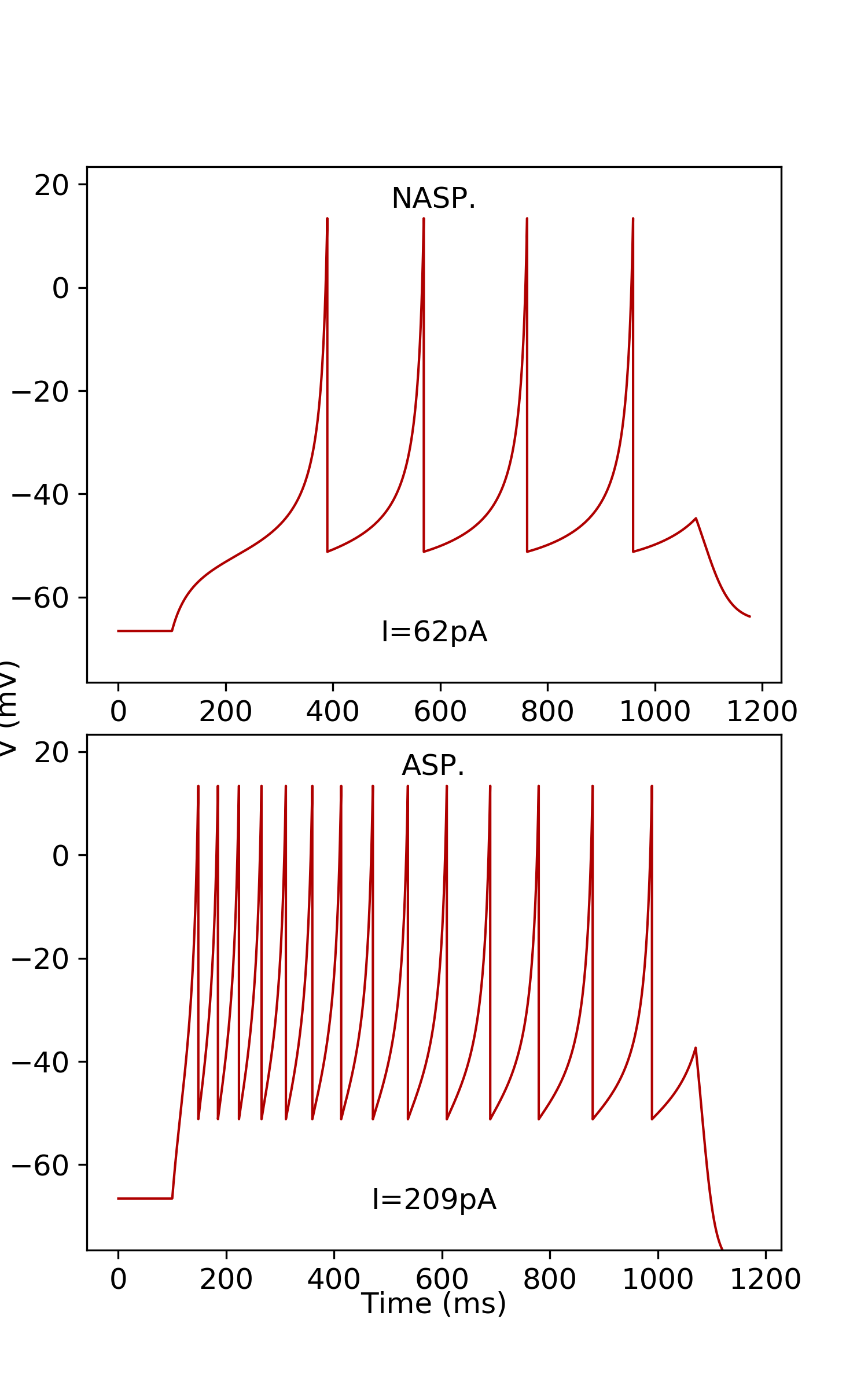
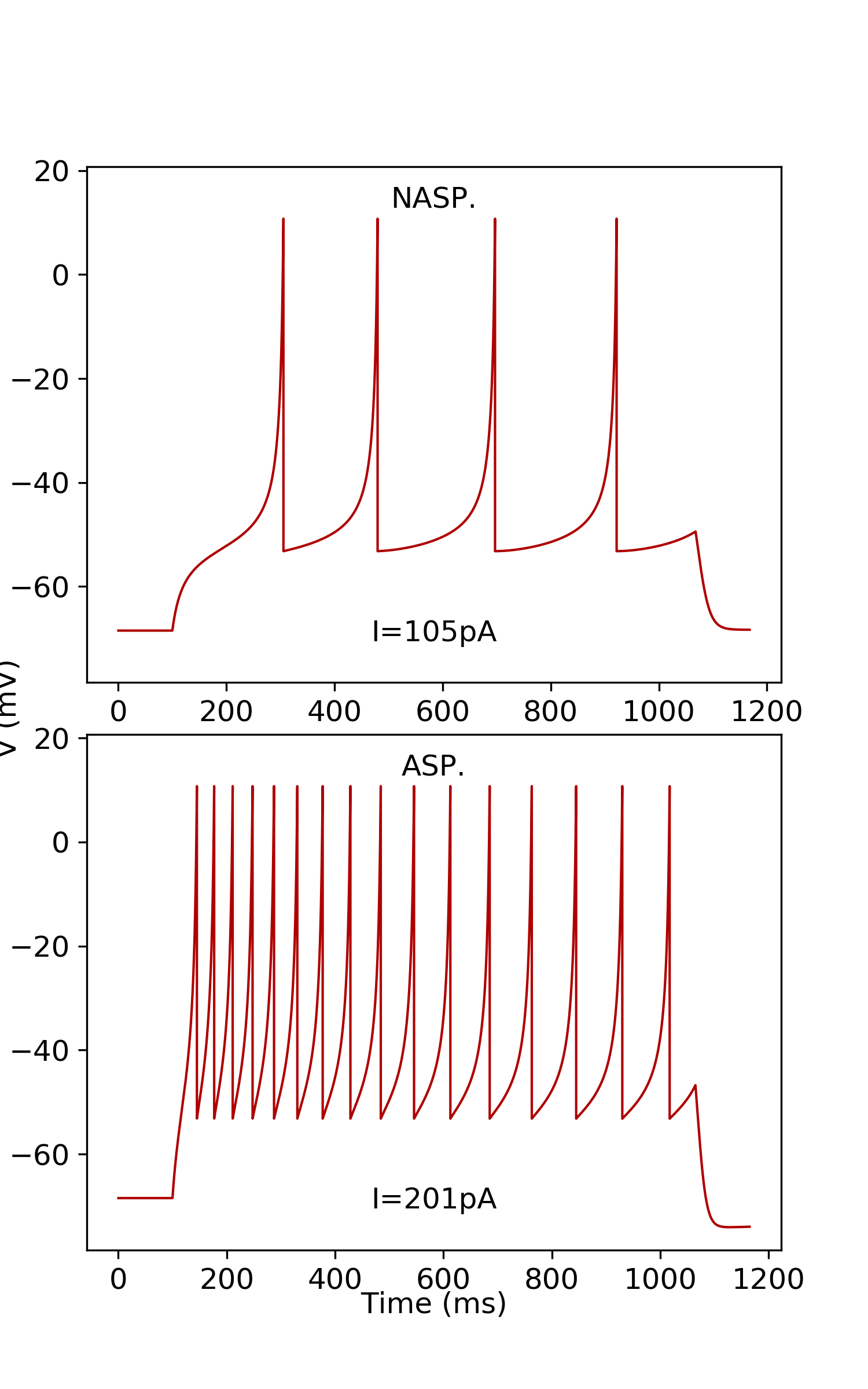
ASP. [Evidence] [Firing Pattern]
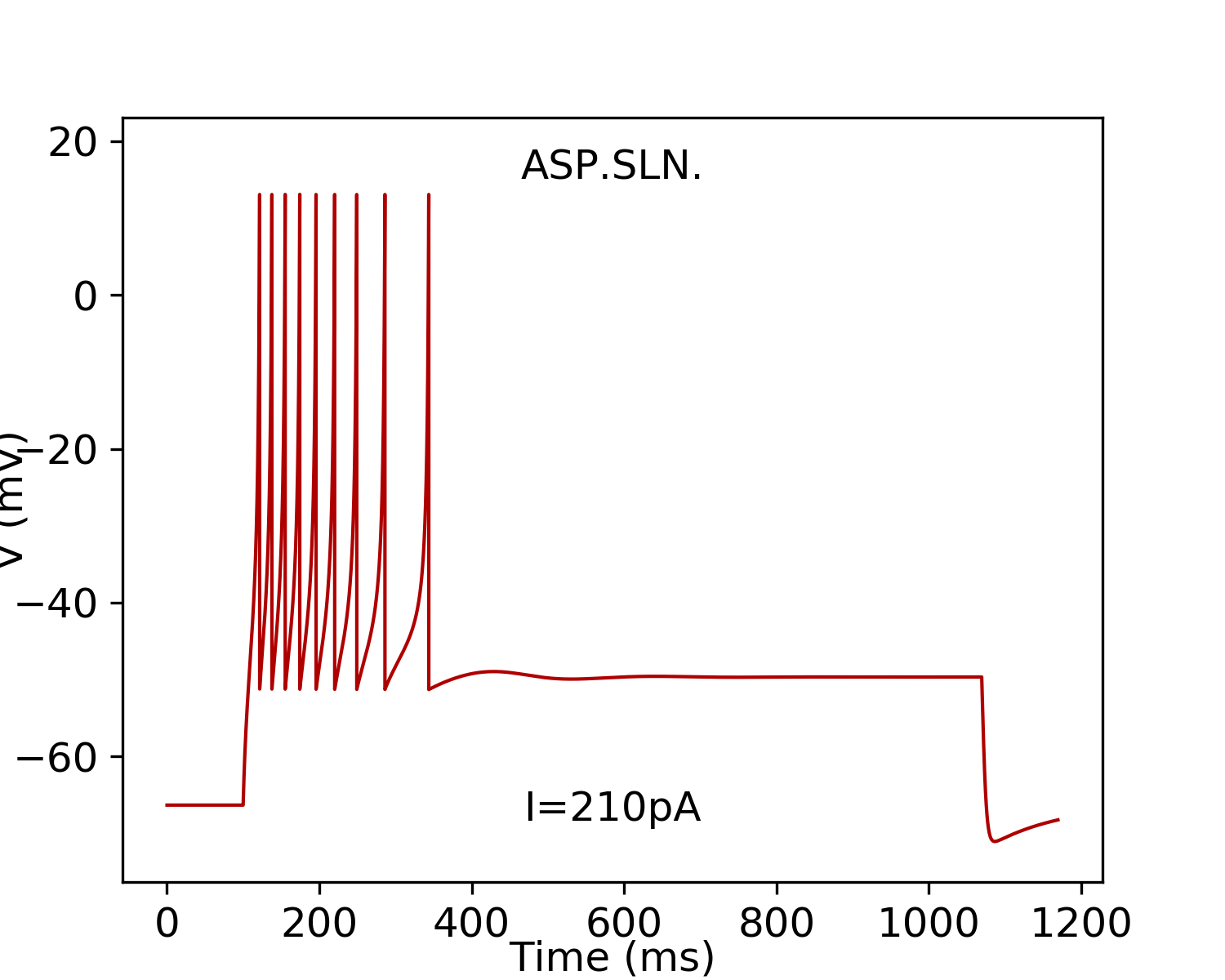
ASP.SLN [Evidence] [Firing Pattern]
NASP [Evidence] [Firing Pattern]

Izhikevich Model
Parameters Single Compartment Downloads Simulate
subtype: 1 k=0.21;a= 0;b= -16.14;d= 19;C= 157;Vr= -66.55;Vt= -32.89;Vpeak= 13.4;Vmin= -51.2; Simulate
subtype: 2 k=0.36;a= 0.001;b= -3.24;d= 13;C= 131;Vr= -68.47;Vt= -35.24;Vpeak= 10.74;Vmin= -53.2; Simulate
subtype: 3 k=0.4;a= 0.009;b= 5.29;d= -12;C= 56;Vr= -66.32;Vt= -31.51;Vpeak= 13.08;Vmin= -51.3; Simulate
Images
Image MissingImage MissingImage Missing
ModelDB Model
Model Accession Number PubMed ID

Sources of Input
Known sources
Excitatory or Inhibitory
MEC LV Pyramidal

Potential sources
Excitatory or Inhibitory
CA2 Pyramidal
CA1 Pyramidal
CA1 Deep Pyramidal
CA1 Superficial Pyramidal
Sub EC-Projecting Pyramidal
EC LI-II Multipolar-Pyramidal
EC LI-II Pyramidal-Fan
MEC LII Stellate
MEC LII-III Pyramidal-Multiform
EC LII-III Pyramidal-Tripolar
MEC LIII Multipolar Principal
EC LIII Small Pyramidal
MEC LIII Complex Pyramidal
MEC LIII Bipolar Complex Pyramidal
EC LIII-V Bipolar Pyramidal
EC LIV-V Pyramidal-Horizontal
EC LIV-VI Deep Multipolar Principal
MEC LV Multipolar-Pyramidal
MEC LV Principal*
EC LV Deep Pyramidal
MEC LV Superficial Pyramidal
MEC LI-II Polar Interneuron*
EC LII Axo-axonic
MEC LII Basket
EC LII Basket-Neurogliaform
EC LIII Bipolar Interneuron*
MEC LIII Multipolar Interneuron
MEC LIII Superficial Multipolar Interneuron
MEC LI Neurogliaform*
EC LII-III Superficial Polymorphic Interneuron*
MEC LIII Superficial Trilayered Interneuron

Potential sources known to be avoided
Excitatory or Inhibitory
LEC LIII Multipolar Principal
LEC LIII Complex Pyramidal
LEC LVI Multipolar-Pyramidal

Targets of Output
Known targets
Excitatory or Inhibitory
DG Granule
DG Mossy MOLDEN
MEC LV Pyramidal

Potential targets
Excitatory or Inhibitory
DG Adult-Born Immature Granule*
DG Hilar Ectopic Granule
DG Semilunar Granule
DG Cajal-Retzius*
DG Local-Projecting Cajal-Retzius*
DG Mossy
DG AIPRIM
DG Axo-axonic
DG Granulosum-targeting Axo-axonic*
DG Axo-axonic GRALDEN*
DG Basket
DG Basket GRALDEN*
DG Basket CCK+
DG Interneuron Specific COLTAR*
DG COM-MOPP*
DG HICAP
DG Interneuron Specific IMOT*
DG Hilus-Associated Interneuron*
DG Interneuron Specific HIMOLD*
DG HIPP
DG Recurrent HIPP*
DG HIPP-CAP*
DG Recurrent HIPP-CAP*
DG Interneuron Specific HIPRO*
DG HIPROM
DG Ivy*
DG MOCAP
DG MOLAX
DG Molecular Layer*
DG Outer Molecular Layer
DG Total Molecular Layer
DG MOPP
DG Neurogliaform
DG Wide-Arbor Neurogliaform*
CA3 Interneuron Specific Quad
CA1 Neurogliaform Projecting
Sub CA1-Projecting Pyramidal
Sub EC-Projecting Pyramidal
Sub Axo-axonic
Sub Wide-arbor Polymorphic*
Sub Recurrent Polymorphic-Moleculare*
EC LI-II Multipolar-Pyramidal
EC LI-II Pyramidal-Fan
MEC LII Oblique Pyramidal
MEC LII Stellate
MEC LII-III Pyramidal-Multiform
EC LII-III Pyramidal-Tripolar
MEC LIII Multipolar Principal
EC LIII Small Pyramidal
MEC LIII Complex Pyramidal
MEC LIII Bipolar Complex Pyramidal
EC LIII Pyramidal
EC LIII Stellate
EC LIII-V Bipolar Pyramidal
EC LIV-V Pyramidal-Horizontal
EC LIV-VI Deep Multipolar Principal
MEC LV Multipolar-Pyramidal
MEC LV Principal*
EC LV Deep Pyramidal
MEC LV Superficial Pyramidal
MEC LV-VI Pyramidal-Polymorphic
MEC LI-II Polar Interneuron*
EC LII Axo-axonic
MEC LII Basket
EC LII Basket-Neurogliaform
EC LIII Bipolar Interneuron*
MEC LIII Multipolar Interneuron
MEC LIII Superficial Multipolar Interneuron
MEC LI Neurogliaform*
EC LII-III Superficial Polymorphic Interneuron*
EC LIII Pyramidal-Looking Interneuron
MEC LIII Superficial Trilayered Interneuron

Potential targets known to be avoided
Excitatory or Inhibitory
LEC LIII Multipolar Principal
LEC LIII Complex Pyramidal
LEC LVI Multipolar-Pyramidal
LEC LIII Multipolar Interneuron

Oscillation Phase Locking
Category
Value