|
|
|
* indicates new v2.0 neuron type
|
|
Name
|
|
Supertype (ID:Family:Type:Subregion)
|
|
|
Sub (e)331p-EC_000111 EC-Projecting Pyramidal
|
S040405:Glutamatergic PC:Pyramidal:Sub
|
|
Name derivation
|
|
|
|
This is a canonical principal cell of the main hippocampal circuit. The modifier distinguishes it from the CA1-targeting variant. Sub distinguishes these cells from pyramidal cells in other subregions.
|
|
Synonym(s)
|
|
|
|
burst firing subicular neuron
|
|
|
deep subicular cell
|
|
|
regular spiking subicular neuron
|
|
|
subicular bursting cell
|
|
|
subicular IB cell
|
|
|
subicular intrinsic bursting neuron
|
|
|
subicular principal cell
|
|
|
subicular pyramidal cell
|
|
|
subicular pyramidal neuron
|
|
|
subicular RB cell
|
|
|
subicular regular spiking cell
|
|
|
superficial subicular cell
|
|
|
Click here to view the list
Amaral D (2007) The Hippocampus Book
Hippocampal Neuroanatomy Amaral D, Lavenex P.
The Hippocampus Book,
2007,
Pages: 35 - 112
ISBN: 9780195100273
Tags: morphology, connectivity, synapse probabilities
Chang EH (2012) Frontiers in Behavioral Neuroscience
Neurophysiological correlates of object recognition in the dorsal subiculum Chang EH, Huerta PT.
Frontiers in Behavioral Neuroscience,
2012, 9 (46),
Pages: 1 - 13
PMID: 22833721; DOI: 10.3389/fnbeh.2012.00046
Tags: phases
Chang EH (2012) Frontiers in Behavioral Neuroscience
Neurophysiological correlates of object recognition in the dorsal subiculum Chang EH, Huerta PT.
Frontiers in Behavioral Neuroscience,
2012, 9 (46),
Pages: 1 - 13
PMID: 22833721; DOI: 10.3389/fnbeh.2012.00046
Tags: phases
Harris E (2001) J Comp Neurol
Intrinsic connectivity of the rat subiculum: I. Dendritic morphology and patterns of axonal arborization by pyramidal neurons. Harris E, Witter MP, Weinstein G, Stewart M.
J Comp Neurol,
2001 Jul 9, 435 (4),
Pages: 490 - 505
PMID: 11406828
Tags: morphology, connectivity, synapse probabilities
Harris E (2001) J Comp Neurol
Intrinsic connectivity of the rat subiculum: II. Properties of synchronous spontaneous activity and a demonstration of multiple generator regions. Harris E, Stewart M.
J Comp Neurol,
2001 Jul 9, 435 (4),
Pages: 506 - 518
PMID: 11406829; DOI: 10.1002/cne.1047
Tags: morphology, membrane biophysics
O'Mara SM (2001) Prog Neurobiol
The subiculum: a review of form, physiology and function. O'Mara SM, Commins S, Anderson M, Gigg J.
Prog Neurobiol,
2001 Jun, 64 (2),
Pages: 129 - 155
PMID: 11240210; DOI: 10.1016/S0301-0082(00)00054-X
Tags: morphology
Spruston N (2007) The Hippocampus Book
Chapter 5: Structural and functional properties of hippocampal neurons Spruston N, McBain C.
The Hippocampus Book,
2007,
Pages: 133 - 200
ISBN: 9780195100273
Tags: morphology, connectivity, synapse probabilities
Witter MP (2006) Behav Brain Res
Connections of the subiculum of the rat: topography in relation to columnar and laminar organization. Witter MP.
Behav Brain Res,
2006 Nov 11, 174 (2),
Pages: 251 - 264
PMID: 16876886; DOI: 10.1016/j.bbr.2006.06.022
Tags: morphology, marker
|
|
List of Hippocampome.org to NeuroMorpho.Org mappings
|
|
|
Click here to view the list of mappings
|
|
|
Intrinsic connectivity of the rat subiculum: II. Properties of synchronous spontaneous activity and a demonstration of multiple generator regions.
Harris E, Stewart M
J Comp Neurol, 2001 Jul 9, 435 (4), pages: 506 - 518
PMID: 11406829; DOI: 10.1002/cne.1047
|
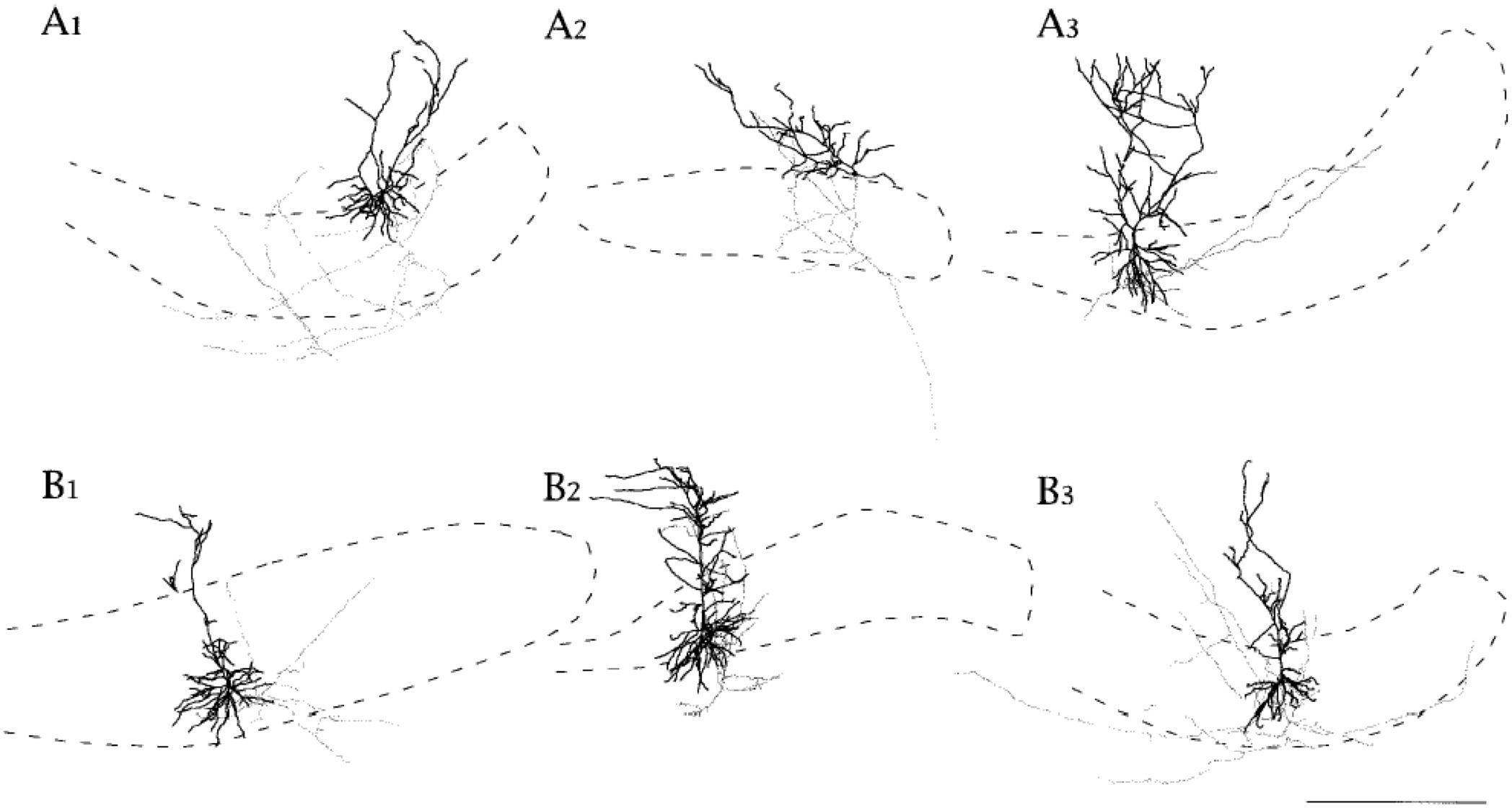
"Fig. 7. A,B: Neurolucida reconstructions of superficial and deep subicular [pyramidal] cells {Sub EC-Projecting Pyramidal}. Somata and dendrites are shown in black. Dendritic spines are not drawn. Axons are shown in gray. Axonal varicosities and axonal extensions are not drawn. Local collaterals tended to be longer in the cell layer for superficially located cells. Deep cells tended to have axon collaterals that ascended close to the primary dendrite. All cells shown had axon collaterals that reached into the deep white matter, and in some cells, there were collaterals that crossed obliquely back across the cell layer toward CA1 or presubiculum. For this reason, all cells were considered to be projection cells." |
| Mixed expression |
|
|
None known |
|
Electrophysiological properties
|
| Key: [range] OR representative value±SD (measurements); Number of sources (total measurements): [min , max] | |
| | Threshold potential (Vthresh): 18 mV (1); 1 source | | Action potential amplitude (APampl): 92 mV (1); 1 source |
|
|
Related classes: SUB (+)331-CA1 1100 back-projecting pyramidal neurons
Witter email correspondence: "Menno's recommendation is that we separate the subicular pyramids into two distinct classes, one projecting to EC and the other to CA1. The logic is weak, but here goes the argument: there's is enough evidence to define 2 classes based on the input connectivity anyway. The more superficial pyramids (within PC but towards ML) have longer & thinner dendrites that receive input from L3 EC pyramidal cells, and these cells do NOT project to EC. In contrast, the deeper subicular pyramids (within PC but towards PL) do NOT receive EC L3 perforant path projections, and they DO project to EC (L5+6). The less clear cut assumption is that the former subicular pyramids form the (less abundant) back-projection to CA1, and the latter cells do not. The reasoning is that in ALL extra-hippocampal projections subicular neurons exclusively target ONE region and do not collateralize to multiple regions.
Moreover, the two pyramidal subtypes also correspond to the bursting / regular firing phenotype. The evidence for the above is in Witter's paper in the subiculum special issue (2006?). He gave permission to quote him as "personal communication." |
|
Images
|
|
| |
No image is associated with this neuron |
|
Parameters
|
|
| | No parameter associated with this neuron |
|
|
|
|
Potential sources known to be avoided
|
|
|
|
|
|
Potential targets known to be avoided
|
|
| Oscillation Phase Locking |
| Category | Value | | Theta (deg): | 105.00 | | Theta range: | [105.00, 105.00] | | Theta measurements: | 1 | | Theta representative selection: | mice, adult, female,
tetrode, ketamine, xylazine, and acepromazine | | In vivo firing rate (Hz): | 1.24 | | Firing rate range: | [1.24, 1.24] | | Firing rate measurements: | 1 | | Firing rate representative selection: | mice, adult, female,
tetrode, ketamine, xylazine, and acepromazine |
|
 Browse
 Search
 Help