|
|
|
* indicates new v2.0 neuron type
|
|
Name
|
|
Supertype (ID:Family:Type:Subregion)
|
|
|
CA1 (i)0012 Horizontal Basket CCK+*
|
S110804:Perisomatic-targeting:Basket CCK+:CA1
|
|
Name derivation
|
|
|
|
This straightforward name derives from the more common name in the cited literature and is the basket cell variant of the literature-based CA1 Horizontal Axo-Axonic. CA1 clarifies the subregion of origin, since the name is otherwise generic. These cells are known to be CCK+. "CCK+" was selected as being more compact than "CCK-positive" or "cholecystokinin-positive."
|
|
Synonym(s)
|
|
|
|
CA1 non-fast spiking basket cell
|
|
|
CA1 CCK-expressing basket cell
|
|
|
Click here to view the list
Chittajallu R (2013) Nat Neurosci
Dual origins of functionally distinct O-LM interneurons revealed by differential 5-HT(3A)R expression. Chittajallu R, Craig MT, McFarland A, Yuan X, Gerfen S, Tricoire L, Erkkila B, Barron SC, Lopez CM, Liang BJ, Jeffries BW, Pelkey KA, McBain CJ.
Nat Neurosci,
2013 Nov, 16 (11),
Pages: 1598 - 1607
PMID: 24097043; DOI: 10.1038/nn.3538
Tags: morphology
Klausberger T (2005) J Neurosci
Complementary roles of cholecystokinin- and parvalbumin-expressing GABAergic neurons in hippocampal network oscillations. Klausberger T, Marton LF, O'Neill J, Huck JH, Dalezios Y, Fuentealba P, Suen WY, Papp E, Kaneko T, Watanabe M, Csicsvari J, Somogyi P.
J Neurosci,
2005 Oct 19, 25 (42),
Pages: 9782 - 9793
PMID: 16237182; DOI: 10.1523/JNEUROSCI.3269-05.2005
Tags: morphology, marker, connectivity, phases, synapse probabilities
|
|
Supplemental PMIDs
|
|
|
|
Click here to view the list of PMIDs
|
|
List of Hippocampome.org to NeuroMorpho.Org mappings
|
|
|
Click here to view the list of mappings
Bacci
-
B091130
(fits the general description of "CA1 Horizontal Basket CCK+" based on the distribution of axons and dendrites)
-
E100616
-
F100616
Scanziani
-
3117000
(fits the general description of "CA1 Basket CCK+" or "CA1 Trilayer Basket CCK+" or "CA1 Horizontal Basket CCK+" based on the distribution of axons)
-
3919002
-
40503009
|
|
|
Dual origins of functionally distinct O-LM interneurons revealed by differential 5-HT(3A)R expression.
Chittajallu R, Craig MT, McFarland A, Yuan X, Gerfen S, Tricoire L, Erkkila B, Barron SC, Lopez CM, Liang BJ, Jeffries BW, Pelkey KA, McBain CJ
Nat Neurosci, 2013 Nov, 16 (11), pages: 1598 - 1607
PMID: 24097043; DOI: 10.1038/nn.3538
|
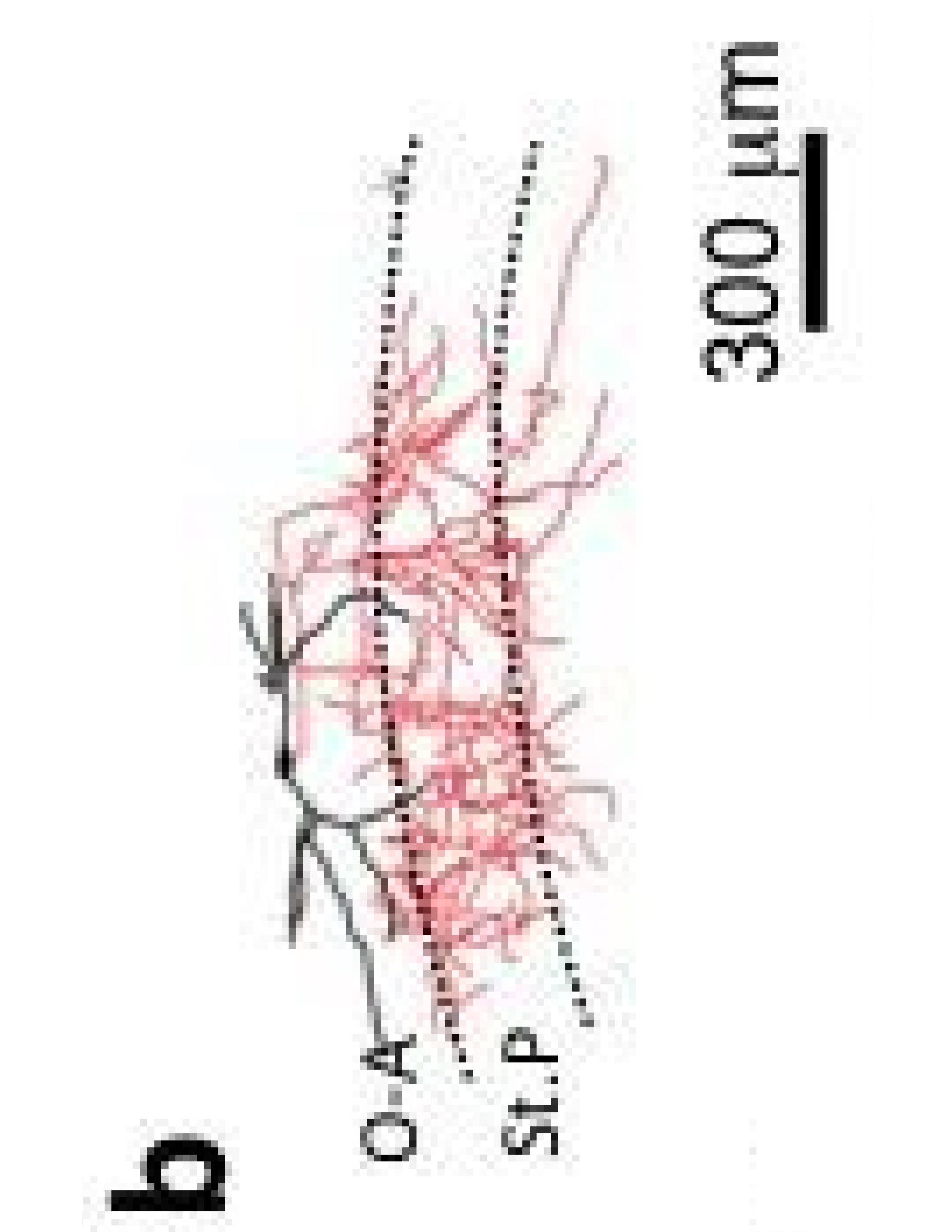
"Figure S2. ... (b,c) Single example of morphology and corresponding firing pattern of a GFP+ non-fast spiking basket cell {CA1 Horizontal Basket CCK+*} and O-LM interneuron cell located in O-A of the Mash1CreER:RCE mouse." |
| Mixed expression |
|
|
None known |
|
Electrophysiological properties
|
|
|
CA1 (i)0012 Horizontal Basket CCK+ (Horiz BC CCK+) cells [4139]
|
Related types:
|
CA1 (i)2232 Basket CCK+ (v1.0 active)
|
|
CA1 (i)0232 Trilayer Basket CCK+ (v2.0 active)
|
|
CA1 (i)0012 Basket (v1.0 active)
|
Notes: CCK+. Firing pattern.
The Chittajallu figure is listed under Supplementary Evidence.
The Klausberger figure is listed under On-hold Types.
Approved as active. - CLR 09/27/2016
|
I agree with the packet content. - KM 10/15/2016
|
|
I approve this as an active type. - CW 10/17/2016
|
|
Out of curiosity, what can be inferred about marker profile of neurons based on data in paper 1 of this packet. Are all 5HT+ neurons have the same marker profile with respect to CR, VIP, reelin, and CCK? - KM 10/15/2016
|
|
To address KM's point about biomarker expression in the Chittajallu et al., 2013 CA10012 neuron, from the information in the packet, I cannot say anything about the marker expression of that neuron. In the notes we should state that it is presumed CCK+ because it is not fast-spiking. If it is 5HT3 positive (I will need to read more to know), inferential data suggests that it is probably PV-negative. This supports that it is CCK+, but the bottom line is that we do not have proof that it is CCK+. - CW 10/17/2016
|
|
From the evidence provided in the packet, I approve the 0012 and CCK+ designation and of the new proposed type for v2.0. - JDK 02/09/2022
|
|
I have now reviewed them and happy to approve all except for the only 0232 AAC which I still feel is a borderline case and perhaps we should keep frozen or merge with the regular AAC packet. - GAA 02/14/2022
|
|
|
Images
|
|
| |
No image is associated with this neuron |
|
Parameters
|
|
| | No parameter associated with this neuron |
|
Model Accession Number
|
PubMed ID
|
|
|
|
|
Potential sources known to be avoided
|
|
|
|
|
|
Potential targets known to be avoided
|
|
| Oscillation Phase Locking |
| Category | Value | | Theta (deg): | -28.00 | | Theta range: | [-61.00, 67.00] | | Theta measurements: | 6 | | Theta representative selection: | rats, adult, unknown sex,
juxtacellular, urethane plus supplemental doses of ketamine and xylazine | | SWR ratio: | 1.60 | | SWR ratio range: | [1.47, 4.00] | | SWR ratio measurements: | 8 | | SWR ratio representative selection: | rats, adult, unknown sex,
juxtacellular, urethane plus supplemental doses of ketamine and xylazine | | In vivo firing rate (Hz): | 0.40 | | Firing rate range: | [0.30, 4.00] | | Firing rate measurements: | 4 | | Firing rate representative selection: | rats, adult, unknown sex,
juxtacellular, urethane plus supplemental doses of ketamine and xylazine | | Other: | firingRateNonBaseline | | Other representative selection: | rats, adult, unknown sex,
juxtacellular, urethane plus supplemental doses of ketamine and xylazine |
|
 Browse
 Search
 Help