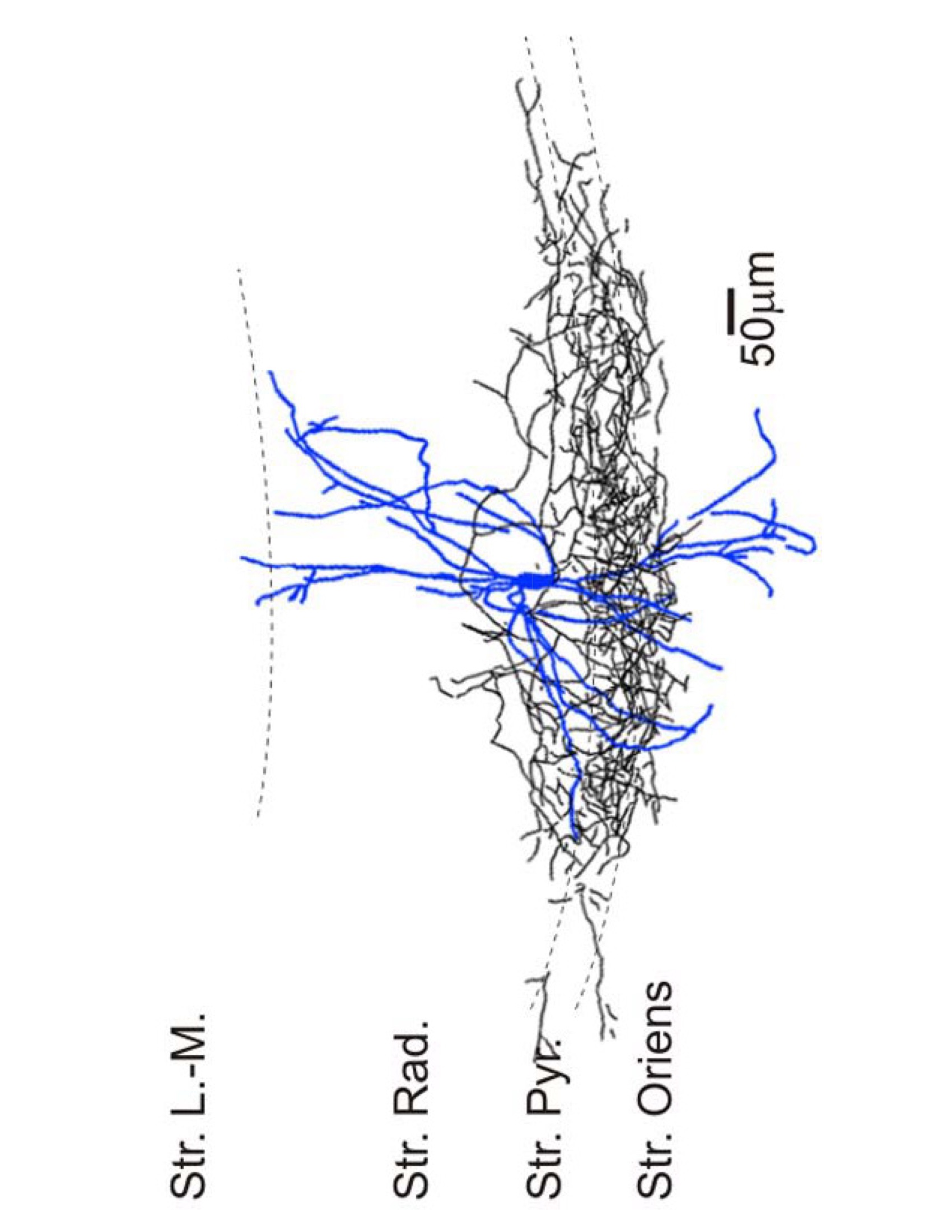
CA1 Trilayer Basket CCK+*
* indicates new v2.0 neuron type
Name Supertype (ID:Family:Type:Subregion)
CA1 (i)0232 Trilayer Basket CCK+* S110804:Perisomatic-targeting:Basket CCK+:CA1

Name derivation
These cells are known to be CCK+. CA1 distinguishes these cells from basket CCK+ cells in other subregions. "CCK+" was selected as being more compact than "CCK-positive" or "cholecystokinin-positive." The phrase "trilayer" describes the fact that the dendrites do not reach into SLM.

Synonym(s)
CA1 CCK+ BC
CA1 CCK+ basket cell
CA1 CCK BC
CA1 CCK-BC

List of articles
Click here to view the list
Cea-del Rio CA  (2011) J Physiol
Cholinergic modulation amplifies the intrinsic oscillatory properties of CA1 hippocampal cholecystokinin-positive interneurons.
Cea-del Rio CA, Lawrence JJ, Erdelyi F, Szabo G, McBain CJ.
J Physiol, 2011 Feb 1, 589 (Pt 3), Pages: 609 - 627
PMID: 21115639; DOI: 10.1113/jphysiol.2010.199422
Tags: morphology, marker
Lee SH  (2010) J Neurosci
Distinct endocannabinoid control of GABA release at perisomatic and dendritic synapses in the hippocampus.
Lee SH, Foldy C, Soltesz I.
J Neurosci, 2010 Jun 9, 30 (23), Pages: 7993 - 8000
PMID: 20534847; DOI: 10.1523/JNEUROSCI.6238-09.2010
Tags: morphology, marker, connectivity, synapse probabilities
Lee SY  (2011) J Neurosci
Cell-type-specific CCK2 receptor signaling underlies the cholecystokinin-mediated selective excitation of hippocampal parvalbumin-positive fast-spiking basket cells.
Lee SY, Foldy C, Szabadics J, Soltesz I.
J Neurosci, 2011 Jul 27, 31 (30), Pages: 10993 - 11002
PMID: 21795548; DOI: 10.1523/JNEUROSCI.1970-11.2011
Tags: morphology, marker, synapse probabilities

Supplemental PMIDs
Click here to view the list of PMIDs

List of Hippocampome.org to NeuroMorpho.Org mappings
Click here to view the list of mappings
  • Bacci
    • A090622 (fits the general description of "CA1 Basket CCK+" or "CA1 Trilayer Basket CCK+" based on the distribution of axons and dendrites)
    • A090909 (Fig 4B)
    • D090910 (fits the general description of "CA1 Basket CCK+" or "CA1 Trilayer Basket CCK+" based on the distribution of axons and dendrites)
    • more ...
  • Scanziani

  • Morphology
    Soma
    CA1:SR
    CA1:SP
    Axons
    CA1:SP
    Dendrites
    CA1:SR
    CA1:SP
    CA1:SO

    Representative figure
    Distinct endocannabinoid control of GABA release at perisomatic and dendritic synapses in the hippocampus.
    Lee SH, Foldy C, Soltesz I
    J Neurosci, 2010 Jun 9, 30 (23), pages: 7993 - 8000
    PMID: 20534847; DOI: 10.1523/JNEUROSCI.6238-09.2010


    "Figure 1. Distinct axonal arborizations of CCK+ BCs and SCAs in the CA1 region of the rat hippocampus. A, B, Example traces of current-clamp recordings of a CCK+ BC (in A) {CA1 Trilayer Basket CCK+*} and an SCA (in B) in response to current steps (-100 and 80 or 160 pA, from resting membrane potential); note the spike frequency adaptation in both cells. Calibration: 50 mV, 0.2 s. The photomicrographs show the immunopositivity of the cells for CCK but not for PV. The camera lucida drawings of the two cells reveal sharp differences in the axonal layer specificity."


    Molecular markers
    Positive
    CB1 (inference)
    CCK (confirmed by inference)
    Negative
    AR-beta1 (multiple confirming inferences)
    CR (multiple confirming inferences)
    ENK (inference)
    GABAa\alpha 6 (inference)
    Gaba-a-alpha (inference)
    MOR (multiple confirming inferences)
    PV (confirmed by inference)
    Mixed expression
    None known

    Electrophysiological properties
    None known

    Notes

    CA1 (i)0232 trilayer basket CCK+ (triBC CCK+) cells [4105]

    Related types: CA1 (i)0232 Basket (v2.0 active)
    CA1 (i)2232 Basket CCK+ (v1.0 active)

    Notes:

    N = 3

    PV-, CB1R+

    spike frequency adaptation

    from Soltesz: "There may be some BCs that invade the LM more than others, but we do not have enough data to say whether this reflects two distinct PVBC classes."

    DWW 02/18/2015

    CLR 02/18/2015

    I am not ready to approve this neuron type. - CW 02/20/2015

    Is this disapproval due to a general stand on principle or do you have problems with the interpretations? Do you approve of them as supplements to the already active 2232 Baskets? - DWW 09/10/2015

    My hesitation was because we may need to re-evaluate 2232 neuron types if we create this type, but perhaps the time has come. I approve 0232. - CW 09/16/2015

    I'm still okay with 0232. - CLR 10/10/15

    "may need to re-evaluate 2232" -> I agree
    OK - GAA 11/29/2015

    2232 BC CCK+ were evaluated and none were reinterpreted. - 04/07/2016


    Firing Pattern
    Images
    No image is associated with this neuron
    Parameters
    No parameter associated with this neuron
    ModelDB Model
    Model Accession Number PubMed ID

    Sources of Input
    Known sources
    Excitatory or Inhibitory
    none known

    Potential sources
    Excitatory or Inhibitory
    CA3 Pyramidal
    CA3c Pyramidal
    CA3c Umbrella Pyramidal*
    CA3 Trilaminar
    CA2 Pyramidal
    CA2 Wide-Arbor Basket
    CA2 Bistratified
    CA1 Pyramidal
    CA1 Deep Pyramidal
    CA1 Superficial Pyramidal
    CA1 Radiatum Giant
    CA1 Back-Projection
    CA1 Basket
    CA1 Horizontal Basket
    CA1 R-P Basket*
    CA1 Trilayer Basket*
    CA1 Vertical Basket*
    CA1 Basket CCK+
    CA1 Horizontal Basket CCK+*
    CA1 Trilayer Basket CCK+*
    CA1 Bistratified
    CA1 Hippocampo-subicular Projecting ENK+
    CA1 Ivy
    CA1 Interneuron Specific LM-R
    CA1 Interneuron Specific LMO-O
    CA1 LMR
    CA1 Interneuron Specific LMR-O*
    CA1 LMR-R*
    CA1 Interneuron Specific LMR-R
    CA1 LMR Projecting
    CA1 Recurrent O-LM
    CA1 O-LMR
    CA1 Recurrent O-LMR*
    CA1 Interneuron Specific O-R
    CA1 O-RP*
    CA1 Interneuron Specific O-Targeting QuadD
    CA1 Oriens/Alveus
    CA1 Oriens-Bistratified
    CA1 Oriens-QuadA Projecting
    CA1 O-RPO*
    CA1 QuadD-RP*
    CA1 Quadrilaminar
    CA1 Interneuron Specific R-O
    CA1 R-Receiving Apical-Targeting
    CA1 R-RO*
    CA1 R-RP*
    CA1 Radiatum
    CA1 Interneuron Specific RO-O
    CA1 Interneuron Specific RO-R*
    CA1 RO-RP*
    CA1 RP-RPO*
    CA1 Schaffer Collateral-Associated
    CA1 Schaffer Collateral-Correlated*
    CA1 Schaffer Collateral-Receiving R-Targeting
    CA1 SO-SO
    CA1 SO-SO Projecting*
    CA1 Trilaminar
    CA1 Radial Trilaminar
    Sub CA1-Projecting Pyramidal
    EC LIII Small Pyramidal
    EC LIII Pyramidal

    Potential sources known to be avoided
    Excitatory or Inhibitory
    CA1 Axo-axonic
    CA1 Horizontal Axo-axonic

    Targets of Output
    Known targets
    Excitatory or Inhibitory
    none known

    Potential targets
    Excitatory or Inhibitory
    CA2 Wide-Arbor Basket
    CA1 Pyramidal
    CA1 Deep Pyramidal
    CA1 Superficial Pyramidal
    CA1 Axo-axonic
    CA1 Back-Projection
    CA1 Basket
    CA1 Trilayer Basket*
    CA1 Vertical Basket*
    CA1 Basket CCK+
    CA1 Trilayer Basket CCK+*
    CA1 Bistratified
    CA1 Ivy
    CA1 Interneuron Specific O-Targeting QuadD
    CA1 Oriens/Alveus
    CA1 Perforant Path-Associated QuadD
    CA1 QuadD-RP*
    CA1 Quadrilaminar
    CA1 Interneuron Specific R-O
    CA1 RP-RPO*
    CA1 Radial Trilaminar

    Potential targets known to be avoided
    Excitatory or Inhibitory
    none known

    Oscillation Phase Locking
    Category
    Value