CA1 Oriens-Bistratified
* indicates new v2.0 neuron type
Name Supertype (ID:Family:Type:Subregion)
CA1 (i)0103 Oriens-Bistratified S091204:Interneuron Specific:IS:CA1

Name derivation
This name appears most often in the cited literature and fits better than the O-R name that invokes an ambiguous O-LM-type name. CA1 clarifies the subregion of origin, since the name is otherwise generic.

Synonym(s)
CA1 interneurons with horizontal cell bodies in SO
CA1 m2 muscarinic acetylcholine receptor-immunoreactive interneurons
CA1 oriens-bistratified cells
CA1 oriens-radiatum cells

List of articles
Click here to view the list
Bell LA  (2013) Neuropharmacology
Synaptic muscarinic response types in hippocampal CA1 interneurons depend on different levels of presynaptic activity and different muscarinic receptor subtypes.
Bell LA, Bell KA, McQuiston AR.
Neuropharmacology, 2013 Oct, 73, Pages: 160 - 73
PMID: 23747570; DOI: 10.1016/j.neuropharm.2013.05.026
Tags: morphology, synapse probabilities
Chittajallu R  (2013) Nat Neurosci
Dual origins of functionally distinct O-LM interneurons revealed by differential 5-HT(3A)R expression.
Chittajallu R, Craig MT, McFarland A, Yuan X, Gerfen S, Tricoire L, Erkkila B, Barron SC, Lopez CM, Liang BJ, Jeffries BW, Pelkey KA, McBain CJ.
Nat Neurosci, 2013 Nov, 16 (11), Pages: 1598 - 1607
PMID: 24097043; DOI: 10.1038/nn.3538
Tags: morphology, marker, membrane biophysics, firing patterns
Cossart R  (2006) Hippocampus
Interneurons targeting similar layers receive synaptic inputs with similar kinetics
Cossart R, Petanjek Z, Dumitriu D, Hirsch JC, Ben-Ari Y, Esclapez M, Bernard C.
Hippocampus, 2006, 16 (4), Pages: 408 - 420
PMID: 16435315; DOI: 10.1002/hipo.20169
Tags: morphology
Craig MT  (2015) J Neurosci
Fast gamma oscillations are generated intrinsically in CA1 without the involvement of fast-spiking basket cells.
Craig MT, McBain CJ.
J Neurosci, 2015 Feb 25, 35 (8), Pages: 3616 - 24
PMID: 25716860; DOI: 10.1523/JNEUROSCI.4166-14.2015
Tags: morphology, firing patterns, synapse probabilities
Hajos N  (1998) Neuroscience
Distinct interneuron types express m2 muscarinic receptor immunoreactivity on their dendrites or axon terminals in the hippocampus.
Hajos N, Papp EC, Acsady L, Levey AI, Freund TF.
Neuroscience, 1998 Jan, 82 (2), Pages: 355 - 376
PMID: 9466448
Tags: morphology, marker, synapse probabilities
Maccaferri G  (2000) J Physiol
Cell surface domain specific postsynaptic currents evoked by identified GABAergic neurones in rat hippocampus in vitro.
Maccaferri G, Roberts JD, Szucs P, Cottingham CA, Somogyi P.
J Physiol, 2000 Apr 1, 524 Pt 1, Pages: 91 - 116
PMID: 10747186; DOI: 10.1111/j.1469-7793.2000.t01-3-00091.x
Tags: morphology, marker, connectivity, synapse probabilities
McQuiston AR  (1999) J Neurosci
Muscarinic receptor activity has multiple effects on the resting membrane potentials of CA1 hippocampal interneurons.
McQuiston AR, Madison DV.
J Neurosci, 1999 Jul 15, 19 (14), Pages: 5693 - 702
PMID: 10407010
Tags: synapse probabilities
McQuiston AR  (1999) J Neurosci
Muscarinic receptor activity induces an afterdepolarization in a subpopulation of hippocampal CA1 interneurons.
McQuiston AR, Madison DV.
J Neurosci, 1999 Jul 15, 19 (14), Pages: 5703 - 5710
PMID: 10407011
Tags: morphology
Svoboda KR  (1999) J Neurosci
Opioid receptor subtype expression defines morphologically distinct classes of hippocampal interneurons.
Svoboda KR, Adams CE, Lupica CR.
J Neurosci, 1999 Jan 1, 19 (1), Pages: 85 - 95
PMID: 9870941
Tags: morphology, connectivity, synapse probabilities
Tricoire L  (2011) J Neurosci
A blueprint for the spatiotemporal origins of mouse hippocampal interneuron diversity.
Tricoire L, Pelkey KA, Erkkila BE, Jeffries BW, Yuan X, McBain CJ.
J Neurosci, 2011 Jul 27, 31 (30), Pages: 10948 - 10970
PMID: 21795545; DOI: 10.1523/JNEUROSCI.0323-11.2011
Tags: morphology, marker, firing patterns, synapse probabilities
Tyan L  (2014) J Neurosci
Dendritic inhibition provided by interneuron-specific cells controls the firing rate and timing of the hippocampal feedback inhibitory circuitry.
Tyan L, Chamberland S, Magnin E, Camire O, Francavilla R, David LS, Deisseroth K, Topolnik L.
J Neurosci, 2014 Mar, 34 (13), Pages: 4534 - 4547
PMID: 24671999; DOI: 10.1523/JNEUROSCI.3813-13.2014
Tags: morphology, synapse probabilities
Zemankovics R  (2010) J Physiol
Differences in subthreshold resonance of hippocampal pyramidal cells and interneurons: the role of h-current and passive membrane characteristics.
Zemankovics R, Kali S, Paulsen O, Freund TF, Hajos N.
J Physiol, 2010 Jun 15, 588 (Pt 12), Pages: 2109 - 2132
PMID: 20421280; DOI: 10.1113/jphysiol.2009.185975
Tags: morphology, synapse probabilities

Supplemental PMIDs
Click here to view the list of PMIDs

List of Hippocampome.org to NeuroMorpho.Org mappings
Click here to view the list of mappings
  • Esclapez
  • McBain
  • McQuiston
  • Topolnik

  • Morphology
    Soma
    CA1:SO
    Axons
    CA1:SR
    CA1:SO
    Dendrites
    CA1:SO

    Molecular markers
    Positive
    5HT-3
    CR
    Mus2R
    SOM
    Negative
    AR-beta2 (multiple confirming inferences)
    CB1 (multiple confirming inferences)
    CCK (confirmed by inference)
    CoupTF II
    ENK (confirmed by inference)
    ErbB4 (multiple confirming inferences)
    GABAa\alpha 6 (inference)
    mGluR1a
    MOR (multiple confirming inferences)
    nNOS
    NPY
    vGluT3 (confirmed by inference)
    VIP
    Mixed expression
    AR-beta1 (unresolved inferential conflict)
    PV (subtypes)

    Electrophysiological properties
    Key: [range] OR representative value±SD (measurements); Number of sources (total measurements): [min , max]

    Resting membrane potential (Vrest): -66±2 mV (29); 1 source
    Input resistance (Rin): 364±43 MΩ (29); 1 source
    Time constant (τm): 38±3 ms (29); 1 source
    Threshold potential (Vthresh): 26 mV (1); 1 source
    Fast afterhyperpolaziring potential amplitude (Fast AHP): 21.4±1.2 mV (29); 1 source
    Action potential amplitude (APampl): 63±2 mV (29); 1 source
    Sag ratio: 0.85±0.02 (29); 1 source

    Notes

    CA1 0103 oriens-radiatum (O-R) neurons

    Unspecified projection to the subiculum.

    AKA oriens-bistratified.

    Does Zemonkovics belong to the oriens-bistratified class, which is strictly located within CA1, or should it be folded into ORP or DP, since it has unspecified projections to the subiculum? - DWW

    I would keep this paper where it is (with oriens-bistratified), mostly because it is an unspecified projection and there's no way to know whether to fold it into DP or ORP. also, it's possible that the O-bi in Maccaferri's [et al., 2000] Fig 4 projects to Sub, too, and is just unspecified. The axonal arbor there is very wide. I like the current grouping. - CLR 05/05/2011

    Agree w. including Zemonkovics cell with O-bi. - CW 05/05/2011

    Could absence in SP (and subiculum) be due to slicing? Possible merger with 0113 oriens-trilaminar?? To be discussed ... - GAA

    If the lack of axons in SP is due to slicing, what are the odds that this would happen all 7 times? I would wager low. That being said, I would not interpret N:A:SP. In directly compsing Ferraguti's [et al., 2005] 0113 trilaminar with Maccaferri's 0103 oriens-bistrat, it looks like Ferraguti's 2nd slice matches the axonal density in the other fig; however, that slice lacks any dendrites or the soma. Ferraguti used [65] [micro]m-thick slices and Maccaferri used 300 [micro]m-thick slices, so 4 of Ferraguti's slice would compare to the 1 of Maccaferri. - DWW

    Maccaferri: "Recovered cell were reconstructed from the serial 60 [micro] thick sections" - CW

    CA1 0103 oriens-radiatum (O-R) neurons

    Unspecified projection to the subiculum.

    Synonyms:

    oriens-bistratified (Maccaferri et al., 2000)
    O-R (Zemankovics et al., 2010)

    Axons in SP may be lost here due to slicing?
    At GAA's request, this class is up for merger consideration with CA1 trilaminar 0113, CA1 0113 oriens-retrohippocampal projection (ORP) (axons are now being counted in SP for this class), and CA1 0103 double projection (DP) cells (axons are now being counted in SP for this class, too).
    Strong potential exists for future subclasses, possibly based on septal projections.

    IMHO either we merge (with cautionary notes & subclassification) or we state explicitly N:A:SP! - GAA

    CA1 0113 ORP-DP-trilaminar horizontal (fully approved)
    CA1 0103 O-R (fully approved)

    Do you approve of merging these two cell classes under the hyphenated meganame, CA1 0113 trilaminar horizontal-ORP-DP-OR (aka TO-DO cells)? The combined class would have [A:SUB:SM_SP_PL].

    Yes - CLR 08/09/2011

    Merger notes:

    Axons in SP - the CA1 0103 O-R packet has borderline evidence (Maccaferri et al., 2000) or no evidence (Zemankovics et al., 2010), but neither paper has convincing evidence that there is no SP presence. Therefore, under hippocampome rules, when compressing classes we leave axons in PCL because of the issue of target specificity. Possible subclasses will exist in a future release once the data is quantified.

    Projection to SUB - the ORP-DP-trilaminar horizontal packet has been approved with [A:SUB:SM_SP_PL] (horiz trilaminar cells match this; ORP cells have clear axons in SUB:SM_SP and borderline axons in PL; DP cell axons could not be followed to terminals so could not be traced further than SUB:SP). The O-R 0103 packet has an unspecified projection to SUB.

    Septal projection - potential for subclasses. DP cells project into the septal area and ORP cells do not. Unknown for trilaminar-horizontal and O-R.

    CA1 0113 oriens retrohippocampal projection (ORP) cells (axons now counted in SP)
    CA1 0113 double projection (DP) cells (axons now counted in SP)
    CA1 0103 oriens-radiatum (O-R) cells (aka oriens-bistratified, axonal difference in SP may be due to slicing)
    CA1 0113 trilaminar horizontal

    There is a strong potential for subclasses, possibly based on septal projections. DP cells project into the septal area, ORP cells do not, and there is no mention either way for O-R cells or trilaminar.

    The two issues are A:CA1:SP and the projection to the subiculum.

    I suggest combining with [A:SUB:SM_SP_PL], which seems to be the case in the trilaminar cells. For the ORP class, we have panel F [from Jinno et al., 2007] on p. 5 [of the packet] (with clear axons in SUB:SM_SP and borderline axons in PL). The SUB evidence for the DP class appears to come solely from the schematic [from Jinno et al., 2007] on p. 6 [of the packet] (but the authors state that the axons could not be followed to the terminals). Evidence for CA1 0103 O-R contains an unspecified projection to the SUB. - CLR

    I would merge ORP, DP, y tri into 0113-SUB111, but I would leave O-R as 0103 with a note of possible future merger if we decide SP doesn't count unless somata are targeted.
    I would merge ISI-I 0103 with DP 0103. - DWW 07/14/2011

    I approve merger of O-R, ORP, DP, + trilaminar and suspension of IS 0103. - CW

    CA1 (-)0103 oriens-radiatum (O-R) neurons

    These cells remind me of Maccaferri (2000) Fig 4, which we placed in CA1 (-)0113 TH-ORP-DP-OR. Also Zemankovics (2010) Fig 1. I think I would put them there.

    The M2R story would work with the TH-ORP-DP-OR packet, too. - CLR 01/16/2013

    Since the Maccaferri and Zemankovics cells have no clear evidence of projection to the subiculum, I would lean towards extracting them from the TH-ORP-DP-OR packet and merging them with these cells as 0103. - DWW 01/16/2013

    CLR

    CW 01/17/2013

    Yes, (O-BI!) 7 clean up! - GAA

    CA1 (i)0103 oriens-bistratified cells (O-BiC) [4083]

    Related types: CA1 (i)0113 O-RPO (v2.0 on-hold)

    Notes:

    Maccaferri 2000 and Zemankovics 2010 have been transferred from CA1 (i)0113p Trilaminar neurons to this packet.

    I am in agreement with keeping these two types (CA1 X-OPR and O-BiC) separated based on Cossart et al.'s determination. - JDK 11/03/2021

    After re-review, I still support these two neuron types be separated based on Cossart et al.ā??s determination. - JDK 11/22/2021

    Principal cell layer invoked rule: record axons in the PCL when boutons are present or when axons are branching and ostensibly targeting the PCL and not just passing through, but discount dendrites.

    Reassessment of merger of CA1 (i)0113 O-RPO into CA1 (i)0103 Oriens-Bistratified.

    I agree to have at least one more packet out of this material, and I can go with either pattern [CA1 (i)0102 vs. CA1 (i)0112], but Iā??m frankly not convinced that we want two distinct neuron types. I believe that in v1.0 we have systematically merged all these cases. Do we have any example of 2 types that only differ in axonal presence in PCL? Unless thereā??s direct evidence that one of the two makes synapses with the soma and the other does not, Iā??d probably just merge them. If you agree, I suggest 0112, but am also happy with 0102. If there are other similar cases in v2.0, please consider merging. - GAA 02/01/2022

    Tough call. The Cossart neuron has en passant boutons in the PCL vs. an original v1.0 neuron type. - DWW 02/03/2022

    So in re-reviewing each potential merger within the packet Diek has kindly provided, I had a few questions arise pertinent to favoring merging unless there is direct evidence that one neuron type makes synapses with the soma and the other does not:
    1. How does this impact the new invoked rule defined in the provided packet, namely that we will "record axons in the PCL when boutons are present or when axons are branching and ostensibly targeting the PCL and not just passing through, but discount dendrites?" Shall we disregard it?
    2. If we favor the route of merging unless we have direct evidence of one neuron type establishing synapses with the soma while the other does not, which AD pattern should be preferred? The AD pattern exhibited by the majority of the reconstructions or the AD pattern of a single reconstruction that shows axonal presence (e.g. the 0102 & 0112 case that led to this discussion)? Perhaps this should be a case by case basis depending on what evidence makes the most sense to us? - JDK 02/06/2022

    I would suggest that we utilize the PCL invoked rule as our fallback position, when we do not have overriding motivation to merge two or more neuron types. As to which way to merge, I would suggest, since we have not been consistent in the past, that we evaluate on a case-by-case basis. - DWW 02/07/2022

    I concur. - GAA 02/07/2022

    Thank you for answering my questions and this route sounds good to me. In light of utilizing the PCL invoked rule as a fallback position, I am okay with merging in all cases in the "Axons in the PCL" packet except for the 0103 and 0113 merger where we have a text description directly stating that the X-OPR (0113 O-RPO) axons display en passant boutons in SP whereas the X-OR (0103 O-BiC) do not. - JDK 02/07/2022

    I agree with Jeffrey and would keep separate. - GAA 02/13/2022

    It was agreed by GAA, JDK, and DWW to void the potential merger. - 02/15/2022

    Supplement notes:

    Related types: CA1 (i)0103p O-RO Projecting (v2.0 on-hold)
    CA1 (i)0113 X-OPR (v2.0 on-hold)
    CA1 (i)0113p Trilaminar (v1.0 active)

    Firing patterns, Assorted markers

    DWW 05/23/2023

    I concur with the 0103 AD pattern. - JDK 05/23/2023

    approved. - GAA 05/24/2023

    Firing Pattern
    Images
    Image MissingImage MissingImage MissingImage Missing
    Parameters View page
    ASP. [Evidence] [Firing Pattern]
    NASP [Evidence] [Firing Pattern]
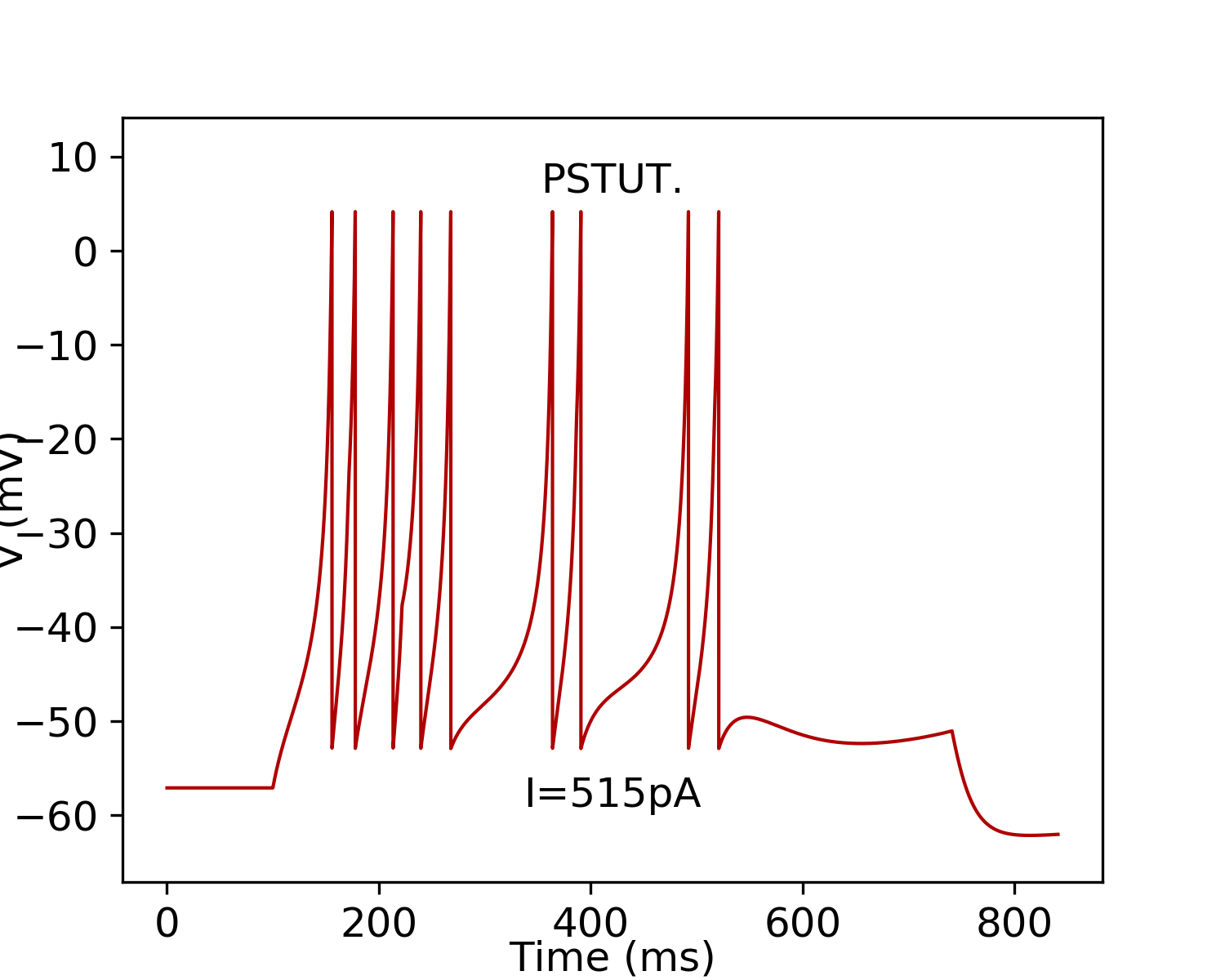
    PSTUT [Evidence] [Firing Pattern]
    TSTUT.SLN [Evidence] [Firing Pattern]

    Izhikevich Model
    Parameters Single Compartment Downloads Simulate
    subtype: 1 k=2.91;a= 0.002;b= 13.67;d= 35;C= 841;Vr= -57.08;Vt= -48.47;Vpeak= 4.15;Vmin= -52.91; Simulate
    Images
    Image Missing
    ModelDB Model
    Model Accession Number PubMed ID

    Sources of Input
    Known sources
    Excitatory or Inhibitory
    CA1 Pyramidal

    Potential sources
    Excitatory or Inhibitory
    CA3 Pyramidal
    CA3c Pyramidal
    CA3 Trilaminar
    CA2 Pyramidal
    CA2 Bistratified
    CA1 Deep Pyramidal
    CA1 Superficial Pyramidal
    CA1 Radiatum Giant
    CA1 Back-Projection
    CA1 Bistratified
    CA1 Hippocampo-subicular Projecting ENK+
    CA1 Ivy
    CA1 Interneuron Specific LMO-O
    CA1 Interneuron Specific LMR-O*
    CA1 Recurrent O-LM
    CA1 Recurrent O-LMR*
    CA1 Interneuron Specific O-Targeting QuadD
    CA1 Oriens/Alveus
    CA1 Oriens-Bistratified
    CA1 Oriens-QuadA Projecting
    CA1 O-RPO*
    CA1 Quadrilaminar
    CA1 Interneuron Specific R-O
    CA1 R-RO*
    CA1 Interneuron Specific RO-O
    CA1 RP-RPO*
    CA1 Schaffer Collateral-Associated
    CA1 Schaffer Collateral-Correlated*
    CA1 SO-SO
    CA1 SO-SO Projecting*
    CA1 Trilaminar
    CA1 Radial Trilaminar
    EC LIII Small Pyramidal
    EC LIII Pyramidal

    Potential sources known to be avoided
    Excitatory or Inhibitory
    none known

    Targets of Output
    Known targets
    Excitatory or Inhibitory
    CA1 Pyramidal

    Potential targets
    Excitatory or Inhibitory
    CA1 Axo-axonic
    CA1 Horizontal Axo-axonic
    CA1 Back-Projection
    CA1 Basket
    CA1 Horizontal Basket
    CA1 R-P Basket*
    CA1 Trilayer Basket*
    CA1 Vertical Basket*
    CA1 Basket CCK+
    CA1 Horizontal Basket CCK+*
    CA1 Trilayer Basket CCK+*
    CA1 Bistratified
    CA1 RO-receiving CA3-targeting*
    CA1 Hippocampo-subicular Projecting ENK+
    CA1 Ivy
    CA1 Interneuron Specific LMO-O
    CA1 LMR
    CA1 LMR-LM*
    CA1 Interneuron Specific LMR-O*
    CA1 LMR-R*
    CA1 Interneuron Specific LMR-R
    CA1 LMR Projecting
    CA1 O-LM
    CA1 Recurrent O-LM
    CA1 O-LMR
    CA1 Recurrent O-LMR*
    CA1 Interneuron Specific O-R
    CA1 O-RP*
    CA1 Interneuron Specific O-Targeting QuadD
    CA1 Oriens/Alveus
    CA1 Oriens-Bistratified
    CA1 Oriens-QuadA Projecting
    CA1 OR-LM
    CA1 O-RPO*
    CA1 Perforant Path-Associated
    CA1 Perforant Path-Associated QuadD
    CA1 QuadD-RP*
    CA1 Quadrilaminar
    CA1 Interneuron Specific R-O
    CA1 R-Receiving Apical-Targeting
    CA1 R-RO*
    CA1 R-RP*
    CA1 Radiatum
    CA1 Interneuron Specific RO-O
    CA1 Interneuron Specific RO-R*
    CA1 RO-RP*
    CA1 RP-RPO*
    CA1 Schaffer Collateral-Associated
    CA1 Schaffer Collateral-Correlated*
    CA1 Schaffer Collateral-Receiving R-Targeting
    CA1 SO-SO
    CA1 SO-SO Projecting*
    CA1 Trilaminar
    CA1 Radial Trilaminar

    Potential targets known to be avoided
    Excitatory or Inhibitory
    CA1 Deep Pyramidal
    CA1 Superficial Pyramidal
    CA1 Radiatum Giant

    Oscillation Phase Locking
    Category
    Value