CA1 Ivy
* indicates new v2.0 neuron type
Name Supertype (ID:Family:Type:Subregion)
CA1 (i)0333 Ivy S101304:Ivy/Neurogliaform Family:Ivy/Neurogliaform:CA1

Name derivation
This is the canonical CA1 ivy cell. CA1 distinguishes these cells from ivy cells in other subregions.

Synonym(s)
CA1 ivy cell
CA1 ivy interneuron

List of articles
Click here to view the list
Fuentealba P  (2008) Neuron
Ivy cells: a population of nitric-oxide-producing, slow-spiking GABAergic neurons and their involvement in hippocampal network activity.
Fuentealba P, Begum R, Capogna M, Jinno S, Marton LF, Csicsvari J, Thomson A, Somogyi P, Klausberger T.
Neuron, 2008 Mar 27, 57 (6), Pages: 917 - 929
PMID: 18367092; DOI: 10.1016/j.neuron.2008.01.034
Tags: morphology, marker, membrane biophysics, connectivity, firing patterns, phases, synapse probabilities
Gloveli T  (2010) Hippocampal Microcircuits: A Computational Modeler's Resource Book
Neuronal Activity Patterns During Hippocampal Network Oscillations In Vitro
Gloveli T, Kopell N, Dugladze T.
Hippocampal Microcircuits: A Computational Modeler's Resource Book, 2010, Pages: 247 - 276
ISBN: 9781441909954
Tags: morphology, connectivity, synapse probabilities
Hajos N  (1997) J Neurosci
Synaptic communication among hippocampal interneurons: properties of spontaneous IPSCs in morphologically identified cells.
Hajos N, Mody I.
J Neurosci, 1997 Nov 1, 17 (21), Pages: 8427 - 8442
PMID: 9334415
Tags: morphology, connectivity, synapse probabilities
Klausberger T  (2008) Science
Neuronal diversity and temporal dynamics: the unity of hippocampal circuit operations.
Klausberger T, Somogyi P.
Science, 2008 Jul 4, 321 (5885), Pages: 53 - 57
PMID: 18599766; DOI: 10.1126/science.1149381
Tags: morphology, marker, connectivity, synapse probabilities
Klausberger T  (2009) Eur J Neurosci
GABAergic interneurons targeting dendrites of pyramidal cells in the CA1 area of the hippocampus.
Klausberger T.
Eur J Neurosci, 2009 Sep, 30 (6), Pages: 947 - 957
PMID: 19735288; DOI: 10.1111/j.1460-9568.2009.06913.x
Tags: morphology, marker, connectivity, synapse probabilities
Lapray D  (2012) Nat Neurosci
Behavior-dependent specialization of identified hippocampal interneurons.
Lapray D, Lasztoczi B, Lagler M, Viney TJ, Katona L, Valenti O, Hartwich K, Borhegyi Z, Somogyi P, Klausberger T.
Nat Neurosci, 2012 Sep, 15 (9), Pages: 1265 - 1271
PMID: 22864613; DOI: 10.1038/nn.3176
Tags: phases, synapse probabilities
Somogyi P  (2010) Handbook of Brain Microcircuits
Chapter: Hippocampus: Intrinsic organisation
Somogyi P.
Handbook of Brain Microcircuits, 2010, Pages: 148 - 164
ISBN: 9780195389883
Tags: morphology, connectivity, synapse probabilities
Vida I  (2010) Hippocampal Microcircuits: A Computational Modeler's Resource Book
Morphology of Hippocampal Neurons
Vida I.
Hippocampal Microcircuits: A Computational Modeler's Resource Book, 2010, Pages: 27 - 68
ISBN: 9781441909954
Tags: morphology, marker, connectivity, synapse probabilities

Supplemental PMIDs
Click here to view the list of PMIDs

List of Hippocampome.org to NeuroMorpho.Org mappings
Click here to view the list of mappings
  • McBain
    • 2009-12-11-9 (fits the general description of "CA1 Ivy" based on the distribution of axons and dendrites)

  • Morphology
    Soma
    CA1:SR
    CA1:SP
    CA1:SO
    Axons
    CA1:SR
    CA1:SP
    CA1:SO
    Dendrites
    CA1:SR
    CA1:SP
    CA1:SO

    Representative figure
    Ivy cells: a population of nitric-oxide-producing, slow-spiking GABAergic neurons and their involvement in hippocampal network activity.
    Fuentealba P, Begum R, Capogna M, Jinno S, Marton LF, Csicsvari J, Thomson A, Somogyi P, Klausberger T
    Neuron, 2008 Mar 27, 57 (6), pages: 917 - 929
    PMID: 18367092; DOI: 10.1016/j.neuron.2008.01.034


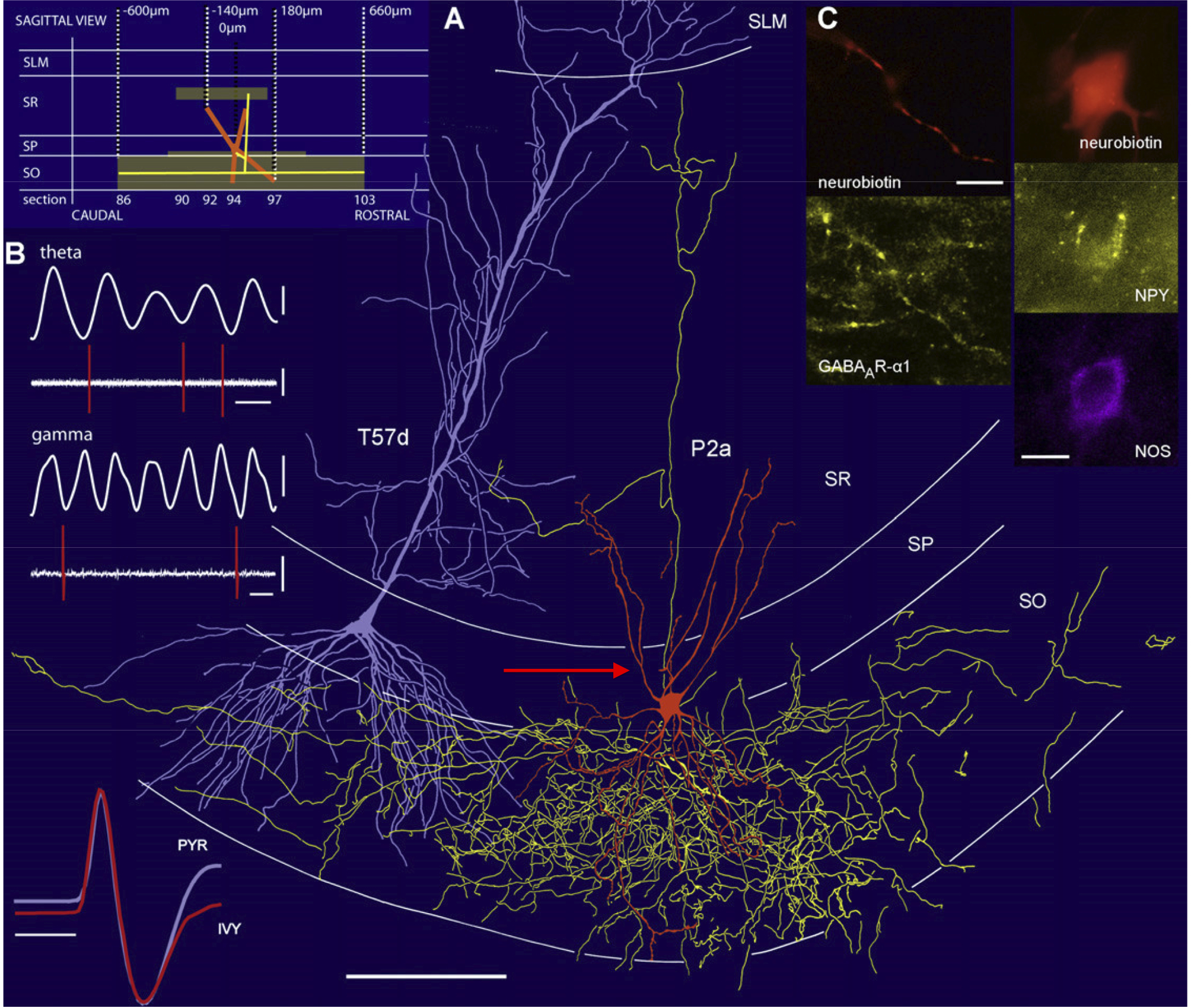
    "Figure 2. Firing Patterns, Molecular Characteristics, and Spatial Distribution of an Ivy Cell {CA1 Ivy} [in CA1] Recorded In Vivo (A) Schematic sagittal view (top left) of the axonal (yellow) and dendritic (orange) fields and reconstruction in the coronal plane of a neurobiotin-labeled Ivy cell (P2a). The soma and dendrites are shown from all sections; the axon is presented only from three 70-[micro]m-thick sections for clarity. Note the very dense axon in stratum oriens. A pyramidal cell (T57d, blue) recorded in another animal is added for illustrating spatial relationships."


    Molecular markers
    Positive
    Gaba-a-alpha
    nNOS
    NPY
    Negative
    alpha-actinin-2
    AR-beta2 (multiple confirming inferences)
    CB1 (confirmed by inference)
    CCK (confirmed by inference)
    CR
    ENK (multiple confirming inferences)
    GABAa\alpha 6 (inference)
    Kv3.1
    mGluR1a
    mGluR8a
    MOR
    Mus2R
    NKB
    PPTA
    PV (confirmed by inference)
    SATB1 (inference)
    vGluT3 (inference)
    VIP (confirmed by inference)
    Mixed expression
    CB (subtypes)
    SOM (unresolved)

    Electrophysiological properties
    Key: [range] OR representative value±SD (measurements); Number of sources (total measurements): [min , max]

    Resting membrane potential (Vrest): -71 mV (1); 1 source
    Input resistance (Rin): 72.8±53.6 MΩ (5); 1 source
    Time constant (τm): 7.6±4.1 ms (5); 1 source
    Threshold potential (Vthresh): 30.1 mV (1); 1 source
    Fast afterhyperpolaziring potential amplitude (Fast AHP): 13.6±3.8 mV (5); 1 source
    Action potential amplitude (APampl): 44 mV (1); 1 source
    Action potential width (APwidth): 0.8±0.2 ms (5); 1 source
    Slow afterhyperpolarizing potential amplitude (Slow AHP): 3 mV (1); 1 source
    Sag ratio: 0.98 (1); 1 source


    Firing Pattern
    Images
    Image MissingImage Missing
    Parameters View page
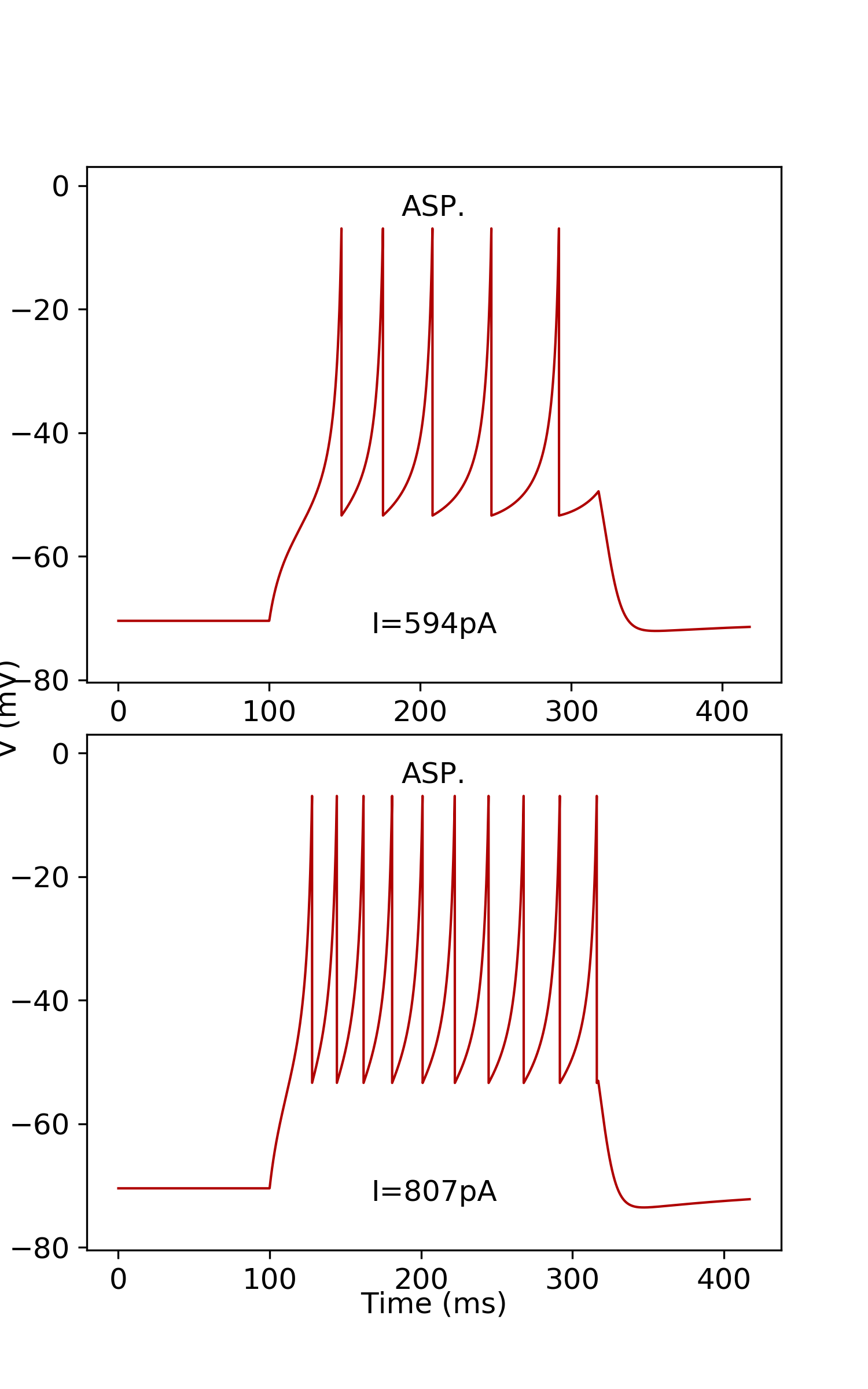
    ASP. [Evidence] [Firing Pattern]

    Izhikevich Model
    Parameters Single Compartment Downloads Simulate
    subtype: 1 k=1.92;a= 0.009;b= 1.91;d= 45;C= 364;Vr= -70.43;Vt= -40.86;Vpeak= -6.92;Vmin= -53.4; Simulate
    Images
    Image Missing
    ModelDB Model
    Model Accession Number PubMed ID
    187604 28009257

    Sources of Input
    Known sources
    Excitatory or Inhibitory
    CA1 Pyramidal

    Potential sources
    Excitatory or Inhibitory
    CA3 Pyramidal
    CA3c Pyramidal
    CA3c Umbrella Pyramidal*
    CA3 Trilaminar
    CA2 Pyramidal
    CA2 Wide-Arbor Basket
    CA2 Bistratified
    CA1 Deep Pyramidal
    CA1 Superficial Pyramidal
    CA1 Radiatum Giant
    CA1 Back-Projection
    CA1 Basket
    CA1 Horizontal Basket
    CA1 R-P Basket*
    CA1 Trilayer Basket*
    CA1 Vertical Basket*
    CA1 Basket CCK+
    CA1 Horizontal Basket CCK+*
    CA1 Trilayer Basket CCK+*
    CA1 Bistratified
    CA1 Hippocampo-subicular Projecting ENK+
    CA1 Ivy
    CA1 Interneuron Specific LM-R
    CA1 Interneuron Specific LMO-O
    CA1 LMR
    CA1 Interneuron Specific LMR-O*
    CA1 LMR-R*
    CA1 Interneuron Specific LMR-R
    CA1 LMR Projecting
    CA1 Recurrent O-LM
    CA1 O-LMR
    CA1 Recurrent O-LMR*
    CA1 Interneuron Specific O-R
    CA1 O-RP*
    CA1 Interneuron Specific O-Targeting QuadD
    CA1 Oriens/Alveus
    CA1 Oriens-Bistratified
    CA1 Oriens-QuadA Projecting
    CA1 O-RPO*
    CA1 QuadD-RP*
    CA1 Quadrilaminar
    CA1 Interneuron Specific R-O
    CA1 R-Receiving Apical-Targeting
    CA1 R-RO*
    CA1 R-RP*
    CA1 Radiatum
    CA1 Interneuron Specific RO-O
    CA1 Interneuron Specific RO-R*
    CA1 RO-RP*
    CA1 RP-RPO*
    CA1 Schaffer Collateral-Associated
    CA1 Schaffer Collateral-Correlated*
    CA1 Schaffer Collateral-Receiving R-Targeting
    CA1 SO-SO
    CA1 SO-SO Projecting*
    CA1 Trilaminar
    CA1 Radial Trilaminar
    Sub CA1-Projecting Pyramidal
    EC LIII Small Pyramidal
    EC LIII Pyramidal

    Potential sources known to be avoided
    Excitatory or Inhibitory
    CA1 Axo-axonic
    CA1 Horizontal Axo-axonic

    Targets of Output
    Known targets
    Excitatory or Inhibitory
    CA1 Pyramidal

    Potential targets
    Excitatory or Inhibitory
    CA2 Wide-Arbor Basket
    CA1 Deep Pyramidal
    CA1 Superficial Pyramidal
    CA1 Radiatum Giant
    CA1 Axo-axonic
    CA1 Horizontal Axo-axonic
    CA1 Back-Projection
    CA1 Basket
    CA1 Horizontal Basket
    CA1 R-P Basket*
    CA1 Trilayer Basket*
    CA1 Vertical Basket*
    CA1 Basket CCK+
    CA1 Horizontal Basket CCK+*
    CA1 Trilayer Basket CCK+*
    CA1 Bistratified
    CA1 RO-receiving CA3-targeting*
    CA1 Hippocampo-subicular Projecting ENK+
    CA1 Ivy
    CA1 Interneuron Specific LMO-O
    CA1 LMR
    CA1 LMR-LM*
    CA1 Interneuron Specific LMR-O*
    CA1 LMR-R*
    CA1 Interneuron Specific LMR-R
    CA1 LMR Projecting
    CA1 O-LM
    CA1 Recurrent O-LM
    CA1 O-LMR
    CA1 Recurrent O-LMR*
    CA1 Interneuron Specific O-R
    CA1 O-RP*
    CA1 Interneuron Specific O-Targeting QuadD
    CA1 Oriens/Alveus
    CA1 Oriens-Bistratified
    CA1 Oriens-QuadA Projecting
    CA1 OR-LM
    CA1 O-RPO*
    CA1 Perforant Path-Associated
    CA1 Perforant Path-Associated QuadD
    CA1 QuadD-RP*
    CA1 Quadrilaminar
    CA1 Interneuron Specific R-O
    CA1 R-Receiving Apical-Targeting
    CA1 R-RO*
    CA1 R-RP*
    CA1 Radiatum
    CA1 Interneuron Specific RO-O
    CA1 Interneuron Specific RO-R*
    CA1 RO-RP*
    CA1 RP-RPO*
    CA1 Schaffer Collateral-Associated
    CA1 Schaffer Collateral-Correlated*
    CA1 Schaffer Collateral-Receiving R-Targeting
    CA1 SO-SO
    CA1 SO-SO Projecting*
    CA1 Trilaminar
    CA1 Radial Trilaminar

    Potential targets known to be avoided
    Excitatory or Inhibitory
    none known

    Oscillation Phase Locking
    Category
    Value
    Theta (deg):230.22
    Theta range:[177.84, 266.63]
    Theta measurements:3
    Theta representative selection:   rats, adult, unknown sex,
    juxtacellular, freely moving
    SWR ratio:0.17
    SWR ratio range:[0.00, 0.21]
    SWR ratio measurements:3
    SWR ratio representative selection:   rats, adult, unknown sex,
    juxtacellular, urethane plus supplemental doses of ketamine and xylazine
    In vivo firing rate (Hz):3.81
    Firing rate range:[1.84, 5.60]
    Firing rate measurements:3
    Firing rate representative selection:   rats, adult, unknown sex,
    juxtacellular, freely moving
    Other:gamma and 2 others
    Other representative selection:   rats, adult, unknown sex,
    juxtacellular, urethane plus supplemental doses of ketamine and xylazine