CA1 Basket
* indicates new v2.0 neuron type
Name Supertype (ID:Family:Type:Subregion)
CA1 (i)2232 Basket S110704:Perisomatic-targeting:Basket:CA1

Name derivation
This name omits any descriptive adjectives because not all of the subtypes are clearly known to be PV+. CA1 distinguishes these cells from basket cells in other subregions.

Synonym(s)
CA1 basket cell
CA1 fast spiking cell
CA1 fast-spiking BC
CA1 fast-spiking parvalbumin-positive basket cell
CA1 fusiform-shaped basket cell
CA1 narrow-arbour basket cell
CA1 PV-BC
CA1 PV-IR basket cell
CA1 PV-positive basket cell
CA1 PV+ basket cell
CA1 pyramidal basket cell
CA1 stellate-shaped basket cell

List of articles
Click here to view the list
Amaral D  (2007) The Hippocampus Book
Hippocampal Neuroanatomy
Amaral D, Lavenex P.
The Hippocampus Book, 2007, Pages: 35 - 112
ISBN: 9780195100273
Tags: morphology, connectivity, synapse probabilities
Buhl EH  (1994) Nature
Diverse sources of hippocampal unitary inhibitory postsynaptic potentials and the number of synaptic release sites.
Buhl EH, Halasy K, Somogyi P.
Nature, 1994 Apr 28, 368 (6474), Pages: 823 - 828
PMID: 8159242; DOI: 10.1038/368823a0
Tags: morphology, connectivity, synapse probabilities
Canto CB  (2012) Hippocampus
Cellular properties of principal neurons in the rat entorhinal cortex. II. The medial entorhinal cortex.
Canto CB, Witter MP.
Hippocampus, 2012 Jun, 22 (6), Pages: 1277 - 1299
PMID: 22161956; DOI: 10.1002/hipo.20993
Tags: morphology, synapse probabilities
Forro T  (2015) Cerebral Cortex
Temporal Organization of GABAergic Interneurons in the Intermediate CA1 Hippocampus During Network Oscillations
Forro T, Valenti O, Lasztoczi B, Klausberger T.
Cerebral Cortex, 2015, Pages: 1228 - 1240
PMID: 24275828
Tags: phases
Freund TF  (1996) Hippocampus
Interneurons of the hippocampus.
Freund TF, Buzsaki G.
Hippocampus, 1996, 6 (4), Pages: 347 - 470
PMID: 8915675; DOI: 10.1002/(SICI)1098-1063(1996)6:4<347::AID-HIPO1>3.0.CO;2-I
Tags: morphology, connectivity, synapse probabilities
Fuentealba P  (2010) J Neurosci
Expression of COUP-TFII nuclear receptor in restricted GABAergic neuronal populations in the adult rat hippocampus.
Fuentealba P, Klausberger T, Karayannis T, Suen WY, Huck J, Tomioka R, Rockland K, Capogna M, Studer M, Morales M, Somogyi P.
J Neurosci, 2010 Feb 3, 30 (5), Pages: 1595 - 1609
PMID: 20130170; DOI: 10.1523/JNEUROSCI.4199-09.2010
Tags: connectivity, phases, synapse probabilities
Gloveli T  (2005) J Physiol
Differential involvement of oriens/pyramidale interneurones in hippocampal network oscillations in vitro.
Gloveli T, Dugladze T, Saha S, Monyer H, Heinemann U, Traub RD, Whittington MA, Buhl EH.
J Physiol, 2005 Jan 1, 562 (Pt 1), Pages: 131 - 147
PMID: 15486016; DOI: 10.1113/jphysiol.2004.073007
Tags: connectivity, synapse probabilities
Gloveli T  (2010) Hippocampal Microcircuits: A Computational Modeler's Resource Book
Neuronal Activity Patterns During Hippocampal Network Oscillations In Vitro
Gloveli T, Kopell N, Dugladze T.
Hippocampal Microcircuits: A Computational Modeler's Resource Book, 2010, Pages: 247 - 276
ISBN: 9781441909954
Tags: morphology, connectivity, synapse probabilities
Katona L  (2014) Neuron
Sleep and movement differentiates actions of two types of somatostatin-expressing GABAergic interneuron in rat hippocampus.
Katona L, Lapray D, Viney TJ, Oulhaj A, Borhegyi Z, Micklem BR, Klausberger T, Somogyi P..
Neuron, 2014, Pages: 872 - 886
PMID: 24794095
Tags: phases
Klausberger T  (2003) Nature
Brain-state- and cell-type-specific firing of hippocampal interneurons in vivo.
Klausberger T, Magill PJ, Marton LF, Roberts JD, Cobden PM, Buzsaki G, Somogyi P.
Nature, 2003 Feb 20, 421 (6925), Pages: 844 - 848
PMID: 12594513; DOI: 10.1038/nature01374
Tags: phases
Klausberger T  (2008) Science
Neuronal diversity and temporal dynamics: the unity of hippocampal circuit operations.
Klausberger T, Somogyi P.
Science, 2008 Jul 4, 321 (5885), Pages: 53 - 57
PMID: 18599766; DOI: 10.1126/science.1149381
Tags: morphology, marker, connectivity, synapse probabilities
Lapray D  (2012) Nat Neurosci
Behavior-dependent specialization of identified hippocampal interneurons.
Lapray D, Lasztoczi B, Lagler M, Viney TJ, Katona L, Valenti O, Hartwich K, Borhegyi Z, Somogyi P, Klausberger T.
Nat Neurosci, 2012 Sep, 15 (9), Pages: 1265 - 1271
PMID: 22864613; DOI: 10.1038/nn.3176
Tags: marker, phases, synapse probabilities
Lee SY  (2011) J Neurosci
Cell-type-specific CCK2 receptor signaling underlies the cholecystokinin-mediated selective excitation of hippocampal parvalbumin-positive fast-spiking basket cells.
Lee SY, Foldy C, Szabadics J, Soltesz I.
J Neurosci, 2011 Jul 27, 31 (30), Pages: 10993 - 11002
PMID: 21795548; DOI: 10.1523/JNEUROSCI.1970-11.2011
Tags: marker, membrane biophysics, firing patterns, synapse probabilities
Lopez-Pigozzi D  (2016) eNeuro
Altered Oscillatory Dynamics of CA1 Parvalbumin Basket Cells During Theta-Gamma Rhythmopathies of Temporal Lobe Epilepsy
Lopez-Pigozzi D, Laurent F, Brotons-Mas JR, Valderrama M, Valero M, Fernandez-Lamo I, Cid E, Gomez-Dominguez D, Gal B, Lde la Prida LM.
eNeuro, 2016, Pages: 0 - 0
PMID: 27896315
Tags: phases
Maccaferri G  (1996) J Neurosci
Long-term potentiation in distinct subtypes of hippocampal nonpyramidal neurons.
Maccaferri G, McBain CJ.
J Neurosci, 1996 Sep 1, 16 (17), Pages: 5334 - 5343
PMID: 8757246
Tags: morphology, synapse probabilities
Pawelzik H  (2002) J Comp Neurol
Physiological and morphological diversity of immunocytochemically defined parvalbumin- and cholecystokinin-positive interneurones in CA1 of the adult rat hippocampus.
Pawelzik H, Hughes DI, Thomson AM.
J Comp Neurol, 2002 Feb 18, 443 (4), Pages: 346 - 367
PMID: 11807843; DOI: 10.1002/cne.10118
Tags: morphology, marker, membrane biophysics, connectivity, firing patterns, synapse probabilities
Royer S  (2020) Nature Neuroscience
Control of Timing, Rate and Bursts of Hippocampal Place Cells by Dendritic and Somatic Inhibition
Royer S, Zemelman BV, Losonczy A, Kim J, Chance F, Magee JC, Buzsaki G.
Nature Neuroscience, 2020, Pages: 769 - 775
PMID: 22446878
Tags: phases
Sanchez-Aguilera A  (2021) PLoS Biology
An update to Hippocampome.org by integrating single-cell phenotypes with circuit function in vivo
Sanchez-Aguilera A, Wheeler DW, Jurado-Parras T, Valero M, Nokia MS, Cid E, Fernandez-Lamo I, Sutton N, Garcia-Rincon D, de la Prida LM, Ascoli GA.
PLoS Biology, 2021, 19 (5), Pages: 1 - 28
PMID: 33956790; DOI: 10.1371/journal.pbio.3001213
Tags: phases
Somogyi P  (2005) J Physiol
Defined types of cortical interneurone structure space and spike timing in the hippocampus.
Somogyi P, Klausberger T.
J Physiol, 2005 Jan 1, 562 (Pt 1), Pages: 9 - 26
PMID: 15539390; DOI: 10.1113/jphysiol.2004.078915
Tags: morphology, marker, connectivity, synapse probabilities
Somogyi P  (2010) Handbook of Brain Microcircuits
Chapter: Hippocampus: Intrinsic organisation
Somogyi P.
Handbook of Brain Microcircuits, 2010, Pages: 148 - 164
ISBN: 9780195389883
Tags: morphology, connectivity, synapse probabilities
Tukker JJ  (2007) Journal of Neuroscience
Cell Type-Specific Tuning of Hippocampal Interneuron Firing During Gamma Oscillations in Vivo
Tukker JJ, Fuentealba P, Hartwich K, Somogyi P, Klausberger T.
Journal of Neuroscience, 2007, Pages: 8184 - 8189
PMID: 17670965
Tags: phases
Varga C  (2012) Proc Natl Acad Sci U S A
Frequency-invariant temporal ordering of interneuronal discharges during hippocampal oscillations in awake mice.
Varga C, Golshani P, Soltesz I.
Proc Natl Acad Sci U S A, 2012, Pages: 2726 - 2734
PMID: 23010933
Tags: phases
Varga C  (2014) Elife
Functional fission of parvalbumin interneuron classes during fast network events. LID - 10.7554/eLife.04006 [doi]
Varga C, Oijala M, Lish J, Szabo GG, Bezaire M, Marchionni I, Golshani P, Soltesz I.
Elife, 2014 Nov 06, 3, Pages: -
PMID: 25375253; DOI: 10.7554/eLife.04006
Tags: phases, synapse probabilities
Vida I  (2010) Hippocampal Microcircuits: A Computational Modeler's Resource Book
Morphology of Hippocampal Neurons
Vida I.
Hippocampal Microcircuits: A Computational Modeler's Resource Book, 2010, Pages: 27 - 68
ISBN: 9781441909954
Tags: morphology, marker, connectivity, synapse probabilities

Supplemental PMIDs

List of Hippocampome.org to NeuroMorpho.Org mappings
Click here to view the list of mappings
  • Bacci
    • A091109 (fits the general description of "CA1 Basket" or "CA1 Trilayer Basket" based on the distribution of axons and dendrites)
    • C101118 (fits the general description of "CA1 Basket" based on the distribution of axons and dendrites)
    • D90203 (fits the general description of "CA1 R-P Basket" or "CA1 Basket" or "CA1 Trilayer Basket" or "CA1 Horizontal Basket" based on the distribution of axons and dendrites)
    • more ...
  • Esclapez
  • Gulyas
  • Klausberger
  • McBain
    • 120117-01 (fits the general description of "CA1 Basket" based on the distribution of axons and dendrites)
    • 2010-01-14-1 (Fig 7A)
    • 2010-01-15-2 (fits the general description of "CA1 Basket" based on the distribution of axons and dendrites and marker expression)
  • McQuiston
  • Scanziani
  • Schmitz
  • Soltesz
    • cvi30soma4 (fits the general description of "CA1 Basket" or "CA1 Trilayer Basket" based on the distribution of axons and dendrites)
  • Somogyi
  • Topolnik

  • Morphology
    Soma
    CA1:SR
    CA1:SP
    CA1:SO
    Axons
    CA1:SP
    Dendrites
    CA1:SLM
    CA1:SR
    CA1:SP
    CA1:SO

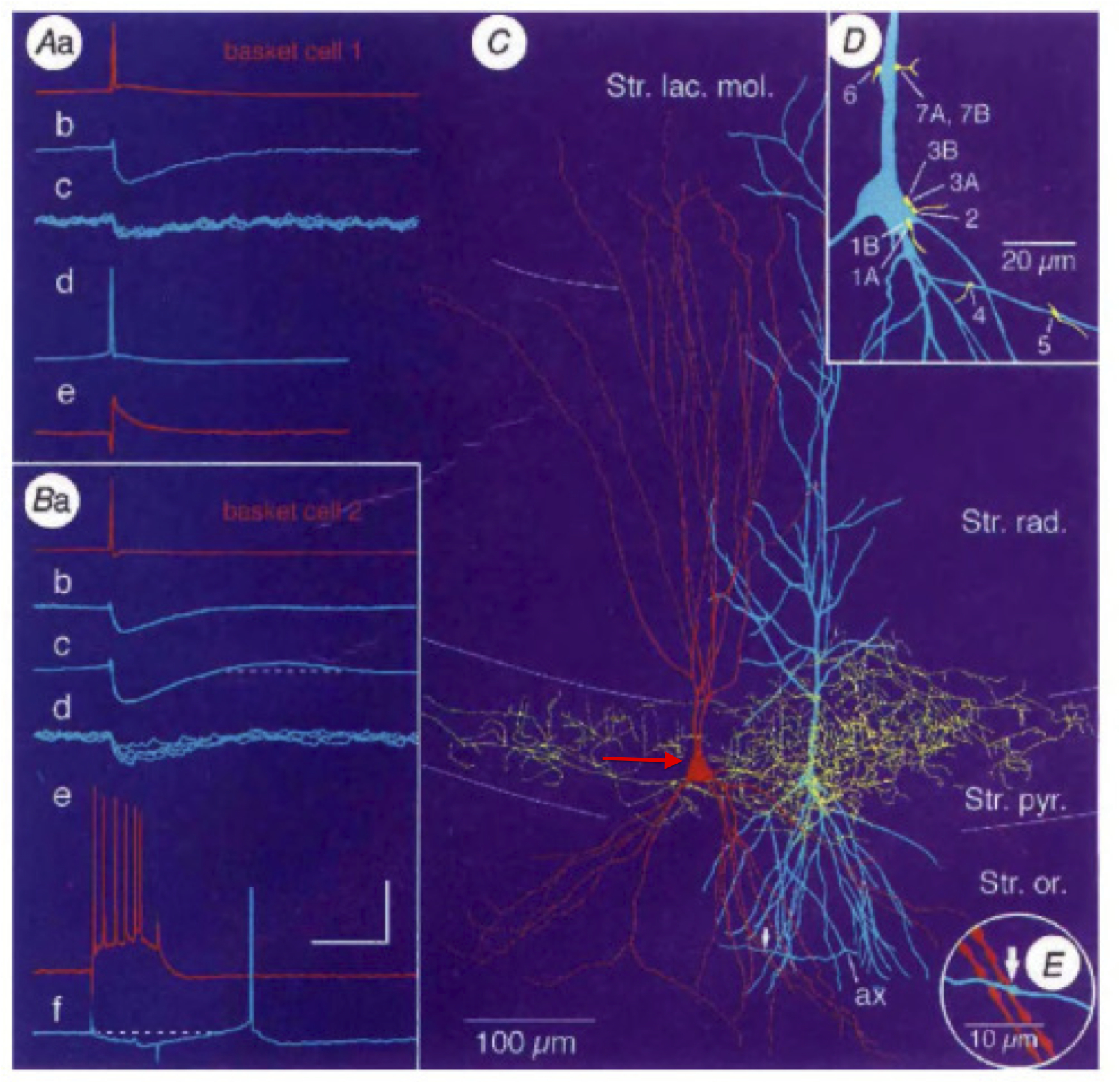
    Representative figure
    Diverse sources of hippocampal unitary inhibitory postsynaptic potentials and the number of synaptic release sites.
    Buhl EH, Halasy K, Somogyi P
    Nature, 1994 Apr 28, 368 (6474), pages: 823 - 828
    PMID: 8159242; DOI: 10.1038/368823a0


    "FIG. 1 Postsynaptic effect of basket cells {CA1 Basket} and location of synaptic release sites on a pyramidal cell in the CA1 area. In Figs 1-3, the soma, dendrites and intracellularly recorded membrane potential of presynaptic inhibitory cells is shown in red, their axon in yellow, and the synaptically coupled postsynaptic principal cell and its membrane potential in blue."


    Molecular markers
    Positive
    Cx36
    ErbB4
    Gaba-a-alpha (confirmed by inference)
    mGluR5
    MOR
    PV
    Negative
    5HT-3 (confirmed by inference)
    AR-beta2 (multiple confirming inferences)
    CB (confirmed by inference)
    CB1 (confirmed by inference)
    CCK (confirmed by inference)
    Chrna2 (inference)
    CoupTF II
    CR (confirmed by inference)
    ENK (confirmed by inference)
    GABAa\alpha 6 (inference)
    mGluR1
    mGluR1a (confirmed by inference)
    nNOS
    NPY (confirmed by inference)
    SOM (confirmed by inference)
    Sub P Rec
    vGluT3 (confirmed by inference)
    VIP (confirmed by inference)
    Mixed expression
    None known

    Electrophysiological properties
    Key: [range] OR representative value±SD (measurements); Number of sources (total measurements): [min , max]

    Resting membrane potential (Vrest): -57±5 mV (15); 2 sources (16): [-68 , -57]
    Threshold potential (Vthresh): 19 mV (1); 3 sources (3): [19 , 25]
    Fast afterhyperpolaziring potential amplitude (Fast AHP): 10 mV (1); 3 sources (17): [10 , 25]
    Action potential amplitude (APampl): 62 mV (1); 3 sources (17): [48 , 62]
    Slow afterhyperpolarizing potential amplitude (Slow AHP): 2 mV (1); 2 sources (2): [1.5 , 2]
    Input resistance (Rin): 116±63 MΩ (15); 1 source
    Time constant (τm): 13±8 ms (15); 1 source
    Action potential width (APwidth): 0.54±0.11 ms (15); 1 source
    Sag ratio: 0.84±0.06 (15); 1 source
    Max firing rate (Max F.R.): >60 Hz (1); 1 source

    Notes
    Axo-axonic cells exclusively target pyramidal cells while basket cells are also known to target other interneurons.

    Other classes of CA1 basket cells: - basket 0012 cells are in the 0012 PTI cell type - basket 2113 neurons mentioned by Fuentealba (2010) are n=1 - basket PV wide-arbour neurons mentioned by Pawelzik (2002) are considered ivy-like cells and are included in the 0333 celltype - basket 0232 neurons mentioned by Freund & Buzsaki (1996) likely also have dendritic invasion in SLM (evidence based on Pawelzik (2002), meaning they are really basket 2232

    perisomatic axonal targeting interpreted as PCL

    extended interpretation of SP in apical and basal directions

    supplement to CA1 (i)2232 Basket cells added - 11/29/2015


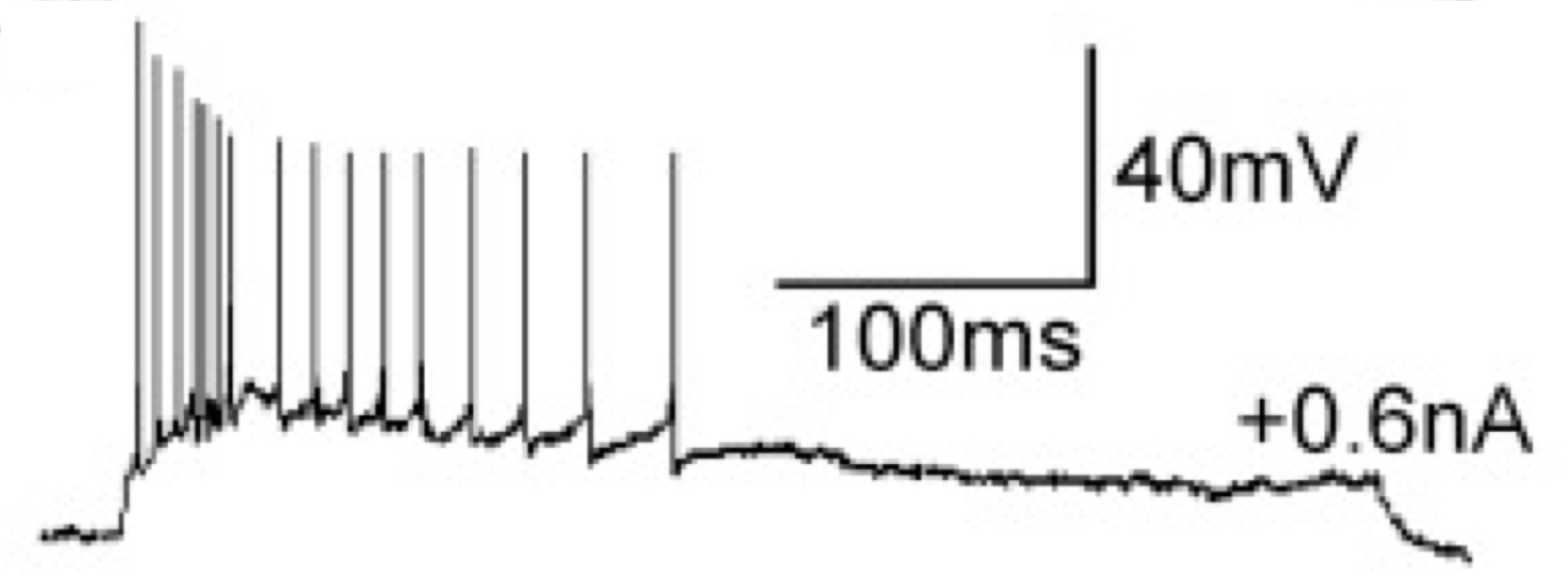
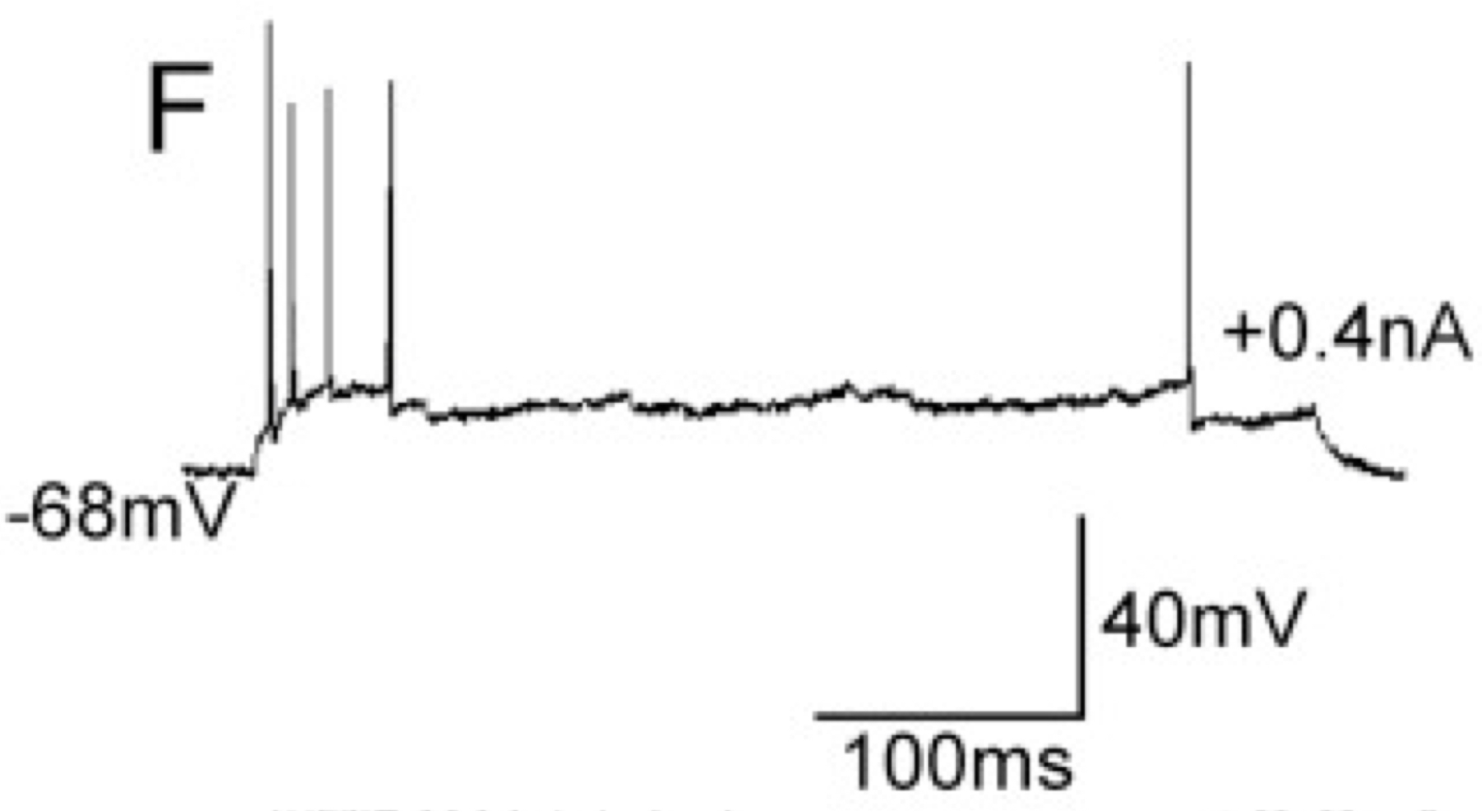
    Firing Pattern
    Images
    Image MissingImage MissingImage MissingImage Missing
    Parameters View page
    ASP.SLN [Evidence] [Firing Pattern]
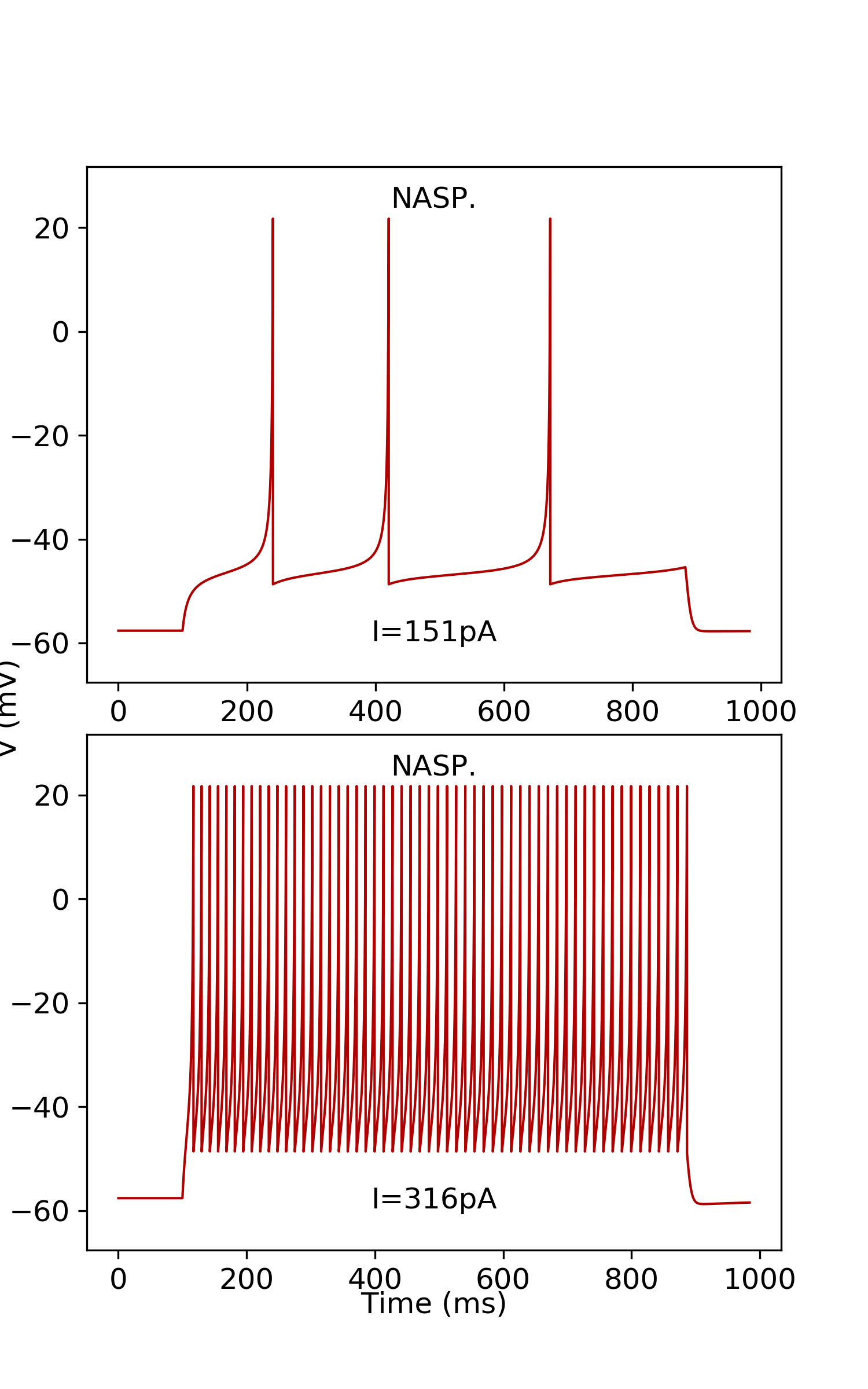
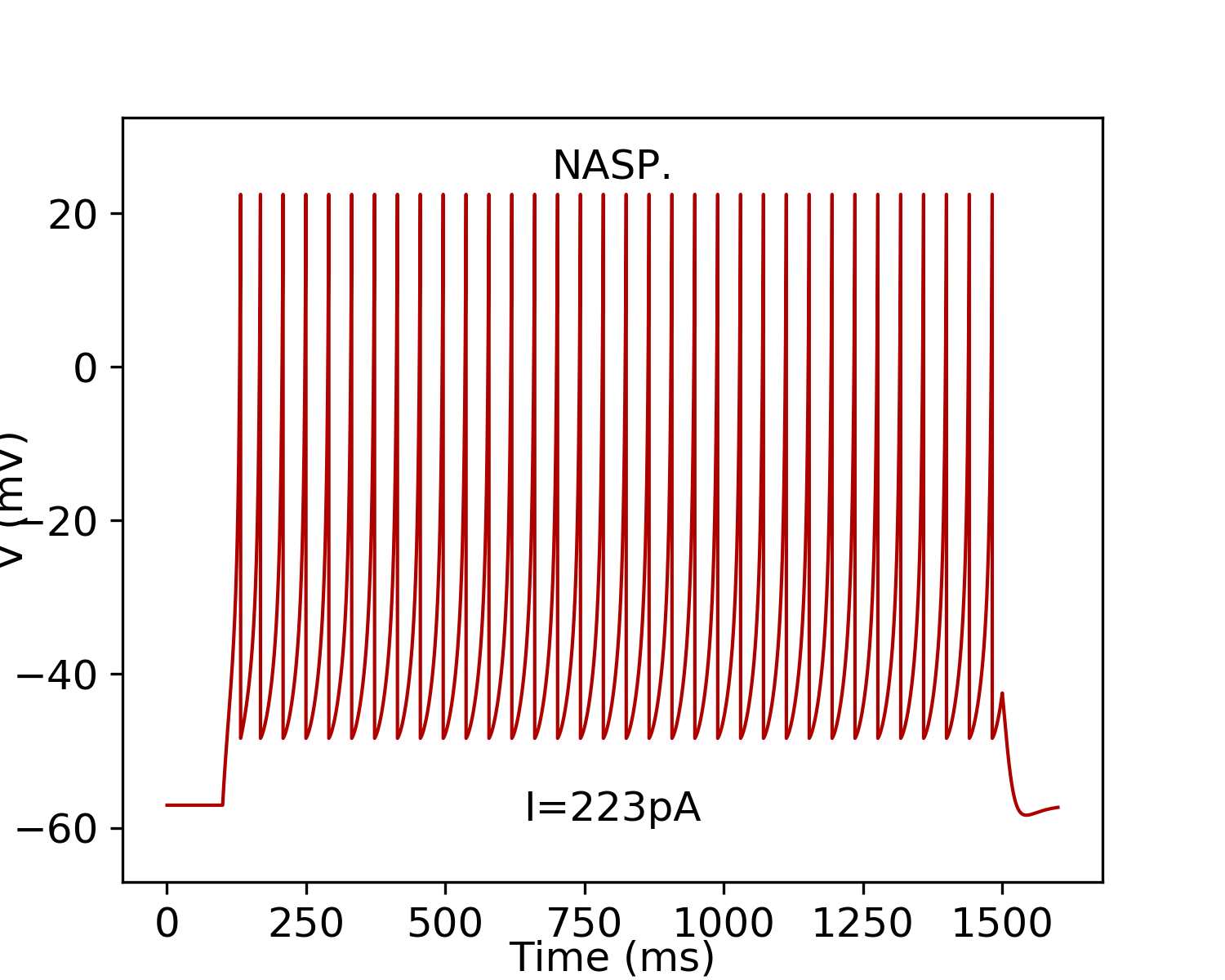
    NASP [Evidence] [Firing Pattern]
    TSTUT. [Evidence] [Firing Pattern]

    Izhikevich Model
    Parameters Single Compartment Downloads Simulate
    subtype: 1 k=1.19;a= 0.005;b= 0.22;d= 2;C= 114;Vr= -57.63;Vt= -35.53;Vpeak= 21.72;Vmin= -48.7; Simulate
    subtype: 2 k=0.61;a= 0.036;b= 0.67;d= 96;C= 164;Vr= -57.06;Vt= -36.4;Vpeak= 22.47;Vmin= -48.36; Simulate
    Images
    Image MissingImage Missing
    ModelDB Model
    Model Accession Number PubMed ID
    246546 30713030
    182843 24155715
    230861 28915251
    123815 19489002
    206378 26594151
    135902 19657077
    187604 28009257
    116567 15183510
    135903 21273309
    182134 26146658
    153280 24836505

    Sources of Input
    Known sources
    Excitatory or Inhibitory
    CA3 Pyramidal
    CA1 Pyramidal
    CA1 Basket
    CA1 Basket CCK+
    CA1 Bistratified
    CA1 Interneuron Specific LM-R
    CA1 O-LM

    Potential sources
    Excitatory or Inhibitory
    DG Local-Projecting Cajal-Retzius*
    CA3c Pyramidal
    CA3c Umbrella Pyramidal*
    CA3 Trilaminar
    CA2 Pyramidal
    CA2 Wide-Arbor Basket
    CA2 Bistratified
    CA1 Deep Pyramidal
    CA1 Superficial Pyramidal
    CA1 Cajal-Retzius
    CA1 Local-Projecting Cajal-Retzius*
    CA1 Radiatum Giant
    CA1 Back-Projection
    CA1 Horizontal Basket
    CA1 R-P Basket*
    CA1 Trilayer Basket*
    CA1 Vertical Basket*
    CA1 Horizontal Basket CCK+*
    CA1 Trilayer Basket CCK+*
    CA1 Hippocampo-subicular Projecting ENK+
    CA1 Ivy
    CA1 Interneuron Specific LMO-O
    CA1 LMR
    CA1 LMR-LM*
    CA1 Interneuron Specific LMR-O*
    CA1 LMR-R*
    CA1 Interneuron Specific LMR-R
    CA1 LMR Projecting
    CA1 Neurogliaform
    CA1 Neurogliaform Projecting
    CA1 Recurrent O-LM
    CA1 O-LMR
    CA1 Recurrent O-LMR*
    CA1 Interneuron Specific O-R
    CA1 O-RP*
    CA1 Interneuron Specific O-Targeting QuadD
    CA1 Oriens/Alveus
    CA1 Oriens-Bistratified
    CA1 Oriens-QuadA Projecting
    CA1 OR-LM
    CA1 O-RPO*
    CA1 Perforant Path-Associated
    CA1 Perforant Path-Associated QuadD
    CA1 QuadD-RP*
    CA1 Quadrilaminar
    CA1 Interneuron Specific R-O
    CA1 R-Receiving Apical-Targeting
    CA1 R-RO*
    CA1 R-RP*
    CA1 Radiatum
    CA1 Interneuron Specific RO-O
    CA1 Interneuron Specific RO-R*
    CA1 RO-RP*
    CA1 RP-RPO*
    CA1 Schaffer Collateral-Associated
    CA1 Schaffer Collateral-Correlated*
    CA1 Schaffer Collateral-Receiving R-Targeting
    CA1 SO-SO
    CA1 SO-SO Projecting*
    CA1 Trilaminar
    CA1 Radial Trilaminar
    Sub CA1-Projecting Pyramidal
    EC LIII Small Pyramidal
    EC LIII Pyramidal

    Potential sources known to be avoided
    Excitatory or Inhibitory
    CA1 Axo-axonic
    CA1 Horizontal Axo-axonic

    Targets of Output
    Known targets
    Excitatory or Inhibitory
    CA1 Pyramidal
    CA1 Basket
    CA1 Basket CCK+
    CA1 Bistratified
    CA1 Radial Trilaminar

    Potential targets
    Excitatory or Inhibitory
    CA2 Wide-Arbor Basket
    CA1 Deep Pyramidal
    CA1 Superficial Pyramidal
    CA1 Axo-axonic
    CA1 Back-Projection
    CA1 Trilayer Basket*
    CA1 Vertical Basket*
    CA1 Trilayer Basket CCK+*
    CA1 Ivy
    CA1 Interneuron Specific O-Targeting QuadD
    CA1 Oriens/Alveus
    CA1 Perforant Path-Associated QuadD
    CA1 QuadD-RP*
    CA1 Quadrilaminar
    CA1 Interneuron Specific R-O
    CA1 RP-RPO*

    Potential targets known to be avoided
    Excitatory or Inhibitory
    none known

    Oscillation Phase Locking
    Category
    Value
    Theta (deg):112.33
    Theta range:[52.85, 165.99]
    Theta measurements:5
    Theta representative selection:   rats, adult, male,
    juxtacellular, freely moving
    SWR ratio:9.15
    SWR ratio range:[9.15, 9.15]
    SWR ratio measurements:1
    SWR ratio representative selection:   mice, adult, unknown sex,
    juxtacellular, head-fixed awake
    In vivo firing rate (Hz):18.59
    Firing rate range:[10.07, 26.35]
    Firing rate measurements:5
    Firing rate representative selection:   rats, adult, unknown sex,
    juxtacellular, freely moving
    Other:DS_ratio and 10 others
    Other representative selection:   rats, adult, male and female,
    sharp pipette, urethane