CA1 Radiatum Giant
* indicates new v2.0 neuron type
Name Supertype (ID:Family:Type:Subregion)
CA1 (e)2201 Radiatum Giant S050504:Glutamatergic non-PC:Giant:CA1

Name derivation
This is the preferred cited name. Poolos et al. in two articles speculate that PLPs are a subset of the RGC superclass

Synonym(s)
CA1 PLP neuron
CA1 pyramidal-like principal neuron
CA1 radiatum giant cell
CA1 RG
CA1 RGC

List of articles
Click here to view the list
Bullis JB  (2007) J Physiol
Reversed somatodendritic I(h) gradient in a class of rat hippocampal neurons with pyramidal morphology.
Bullis JB, Jones TD, Poolos NP.
J Physiol, 2007 Mar 1, 579 (Pt 2), Pages: 431 - 443
PMID: 17185334; DOI: 10.1113/jphysiol.2006.123836
Tags: morphology, marker, membrane biophysics, firing patterns
Gulyas AI  (1998) Eur J Neurosci
Stratum radiatum giant cells: a type of principal cell in the rat hippocampus.
Gulyas AI, Toth K, McBain CJ, Freund TF.
Eur J Neurosci, 1998 Dec, 10 (12), Pages: 3813 - 3822
PMID: 9875359; DOI: 10.1046/j.1460-9568.1998.00402.x
Tags: morphology, marker
Kirson ED  (2000) J Neurosci
Unique properties of NMDA receptors enhance synaptic excitation of radiatum giant cells in rat hippocampus.
Kirson ED, Yaari Y.
J Neurosci, 2000 Jul 1, 20 (13), Pages: 4844 - 4854
PMID: 10864941
Tags: morphology, membrane biophysics, firing patterns, synapse probabilities
Klausberger T  (2008) Science
Neuronal diversity and temporal dynamics: the unity of hippocampal circuit operations.
Klausberger T, Somogyi P.
Science, 2008 Jul 4, 321 (5885), Pages: 53 - 57
PMID: 18599766; DOI: 10.1126/science.1149381
Tags: morphology, connectivity, synapse probabilities
Maccaferri G  (1996) J Neurosci
Long-term potentiation in distinct subtypes of hippocampal nonpyramidal neurons.
Maccaferri G, McBain CJ.
J Neurosci, 1996 Sep 1, 16 (17), Pages: 5334 - 5343
PMID: 8757246
Tags: morphology, synapse probabilities
Poolos NP  (2006) J Neurosci
Modulation of h-channels in hippocampal pyramidal neurons by p38 mitogen-activated protein kinase.
Poolos NP, Bullis JB, Roth MK.
J Neurosci, 2006 Jul 26, 26 (30), Pages: 7995 - 8003
PMID: 16870744; DOI: 10.1523/JNEUROSCI.2069-06.2006
Tags: morphology
Somogyi P  (2005) J Physiol
Defined types of cortical interneurone structure space and spike timing in the hippocampus.
Somogyi P, Klausberger T.
J Physiol, 2005 Jan 1, 562 (Pt 1), Pages: 9 - 26
PMID: 15539390; DOI: 10.1113/jphysiol.2004.078915
Tags: morphology, connectivity, synapse probabilities
Somogyi P  (2010) Handbook of Brain Microcircuits
Chapter: Hippocampus: Intrinsic organisation
Somogyi P.
Handbook of Brain Microcircuits, 2010, Pages: 148 - 164
ISBN: 9780195389883
Tags: morphology, connectivity, synapse probabilities
Vida I  (2010) Hippocampal Microcircuits: A Computational Modeler's Resource Book
Morphology of Hippocampal Neurons
Vida I.
Hippocampal Microcircuits: A Computational Modeler's Resource Book, 2010, Pages: 27 - 68
ISBN: 9781441909954
Tags: morphology, connectivity, synapse probabilities


Morphology
Soma
CA1:SR
CA1:SP
Axons
CA1:SO
Dendrites
CA1:SLM
CA1:SR

Representative figure
Stratum radiatum giant cells: a type of principal cell in the rat hippocampus.
Gulyas AI, Toth K, McBain CJ, Freund TF
Eur J Neurosci, 1998 Dec, 10 (12), pages: 3813 - 3822
PMID: 9875359; DOI: 10.1046/j.1460-9568.1998.00402.x


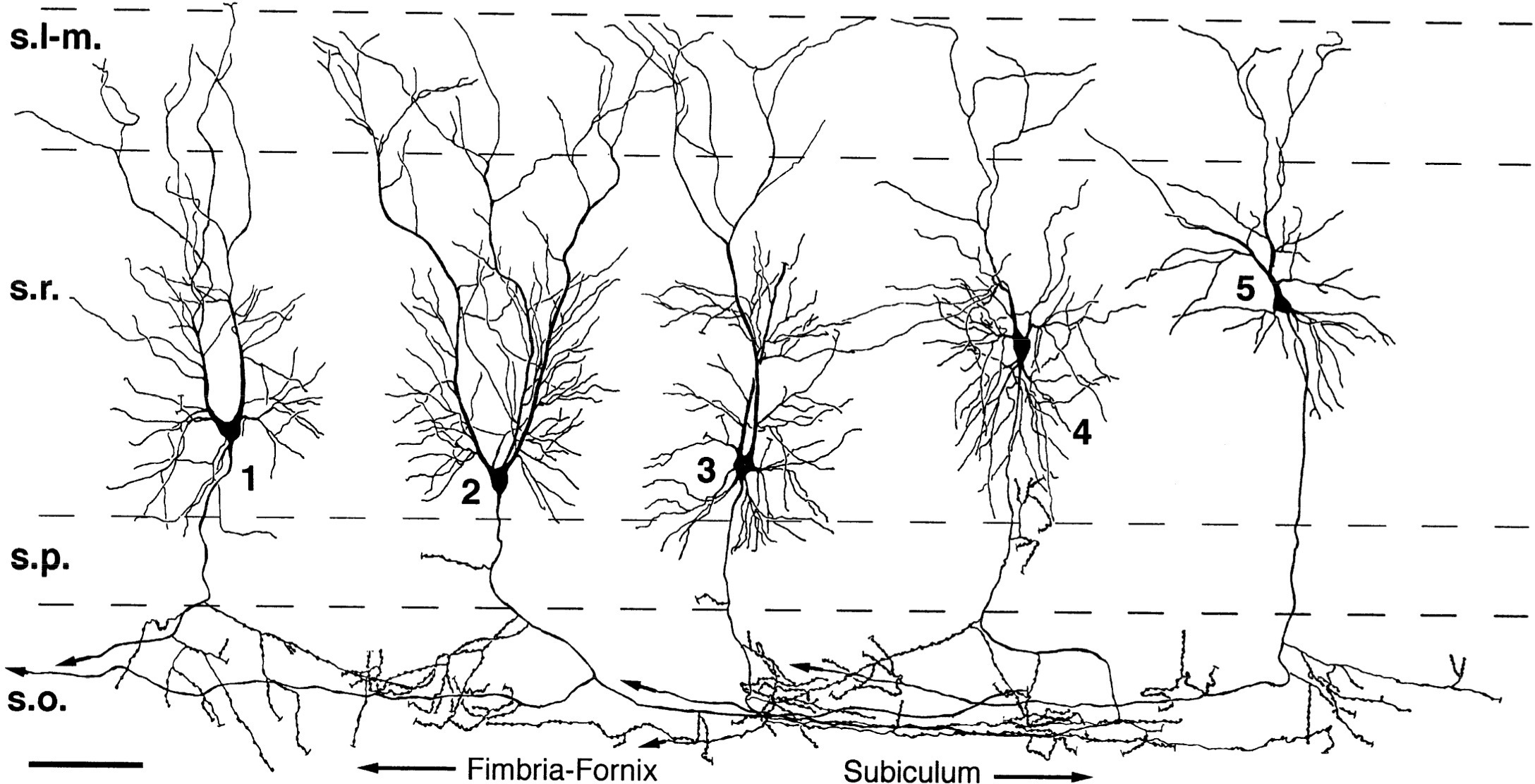
"FIG. 2. Morphological features of RGCs [radiatum giant cells] {CA1 Radiatum Giant} [of CA1]. The dendritic morphology of RGCs {CA1 Radiatum Giant} changes gradually from its most characteristic form (no. 1) to morphology resembling pyramidal cells (no. 5), although far away from stratum pyramidale. Most often (nos 1-2) two thick primary apical dendrites and no basal dendrites arise from the soma. The dendrites ascend and reach the hippocampal fissure emitting numerous fine secondary branches in stratum radiatum and considerably less in stratum lacunosum-moleculare. A smaller number of cells with numerous thin basal dendrites (nos. 3-5) can also be observed. The axons, like those of pyramidal cells arise from the basal pole of the soma, descend to stratum oriens where they emit local collaterals restricted to stratum oriens, while their main myelinated branches penetrate the alveus and invariably turn towards the fimbria (arrows label the cut main axons in stratum oriens). Scale: 100 [micro]m. Abbreviations: s.l-m.: stratum lacunosum-moleculare; s.r.: stratum radiatum; s.p.: stratum pyramidale; s.o.: stratum oriens."


Molecular markers
Positive
EAAT3
GluA2/3
Negative
CB1 (multiple confirming inferences)
CCK (confirmed by inference)
CR
ENK (inference)
GABAa\alpha 6 (inference)
PV
vGluT3 (inference)
Mixed expression
None known

Electrophysiological properties
Key: [range] OR representative value±SD (measurements); Number of sources (total measurements): [min , max]

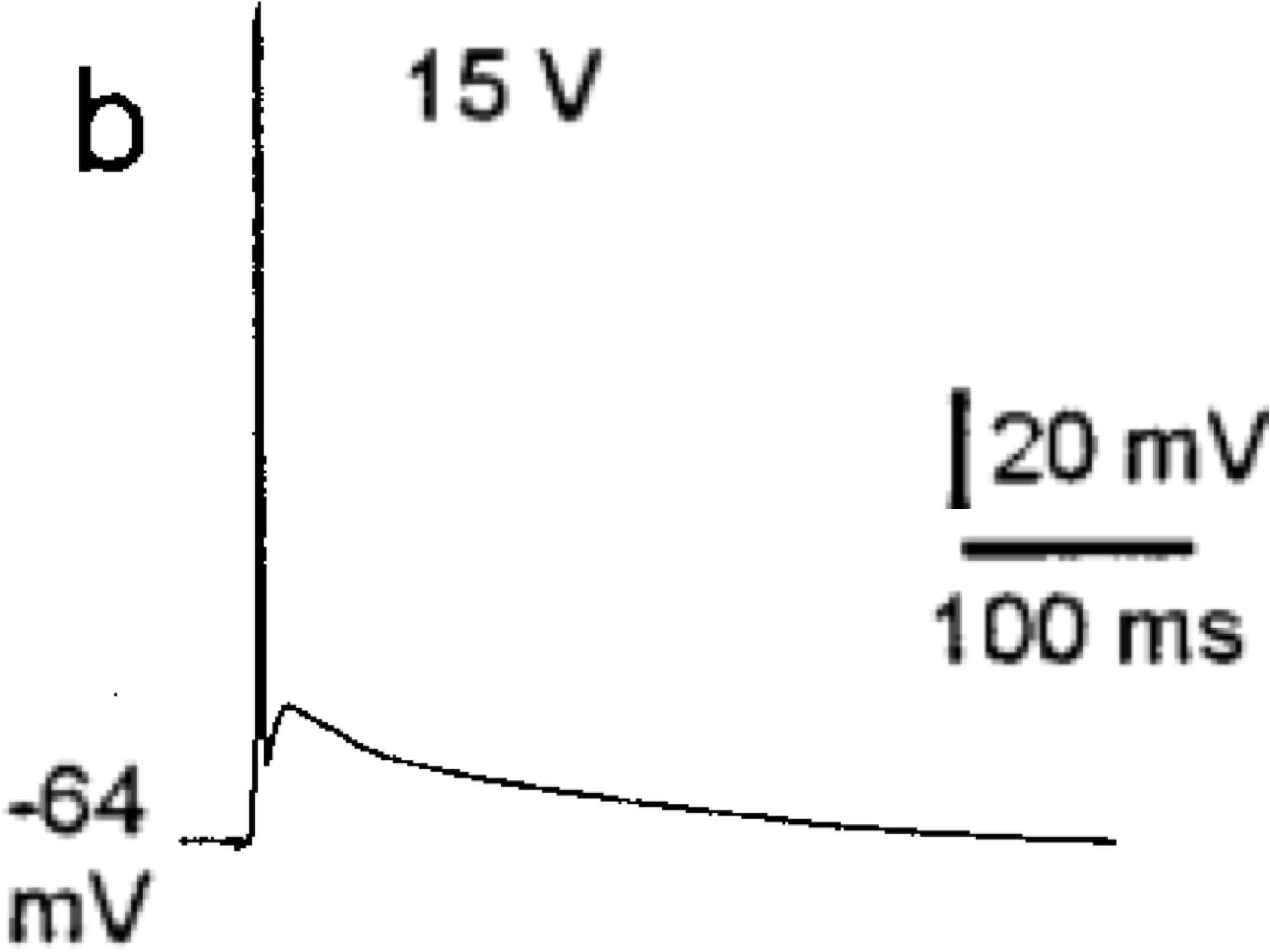
Resting membrane potential (Vrest): -66±3.6 mV (16); 2 sources (23): [-66 , -63]
Input resistance (Rin): 56±14.0 MΩ (25); 2 sources (32): [56 , 86]
Threshold potential (Vthresh): 30 mV (1); 2 sources (2): [30 , 32]
Fast afterhyperpolaziring potential amplitude (Fast AHP): 6 mV (1); 2 sources (2): [6 , 15.4]
Action potential amplitude (APampl): 69 mV (1); 2 sources (2): [69 , 107]
Sag ratio: 0.61 (1); 1 source
Time constant (τm): 50±3 ms (7); 1 source
Action potential width (APwidth): 1.9±0.09 ms (7); 1 source
Max firing rate (Max F.R.): >26 Hz (1); 1 source
Slow afterhyperpolarizing potential amplitude (Slow AHP): 8.3 mV (1); 1 source

Notes

CA1 (e)2201 Radiatum Giant Cells (CA1 RGC) [4054]

Merger status:

Merger of CA1 (+)2221 pyramidal-like principal (PLP) cells and CA1 (+)2201 radiatum giant cells (RGC).

Notes:

CA1 PLP 2221 cell type contains unverified connections to SUB and EC.

There is no CLEAR evidence for dendrites in SP in either cell type.

The PLP cell type text mentions "soma located approximately 50 microm from the SP." Based on the scale bar, basal dendrites are located near the SR/SP border and just within fuzzy boundaries for the principal layer.

The RGC cell type has Gulyas (1998) Fig 2, which shows the soma of cells 1-3 also located about 50-100 microm from the SR/SP border, and it looks like the dendrites have similar extent to PLP cells. Cell #5 does not have dendrites near SP, so it likely will NOT fit into a 2221 interpretation.

In the PLP cell type, Poolos et al declare PLPs to be a subset of RGCs based on bifurcation patterns of the apical dendrites and soma shape. However, there appears to be no current basis for hippocampome subclasses.

CLR

DWW

CW

GAA

Supplement Notes:

Rin, tau, Vm, APthresh, APampl, Apwidth, FP.

DWW 05/23/2022

I concur with the 2201 AD pattern. - JDK 05/23/2022

approved. - GAA 05/24/2023

Firing Pattern
Images
Image MissingImage Missing
Parameters View page
NASP [Evidence] [Firing Pattern]
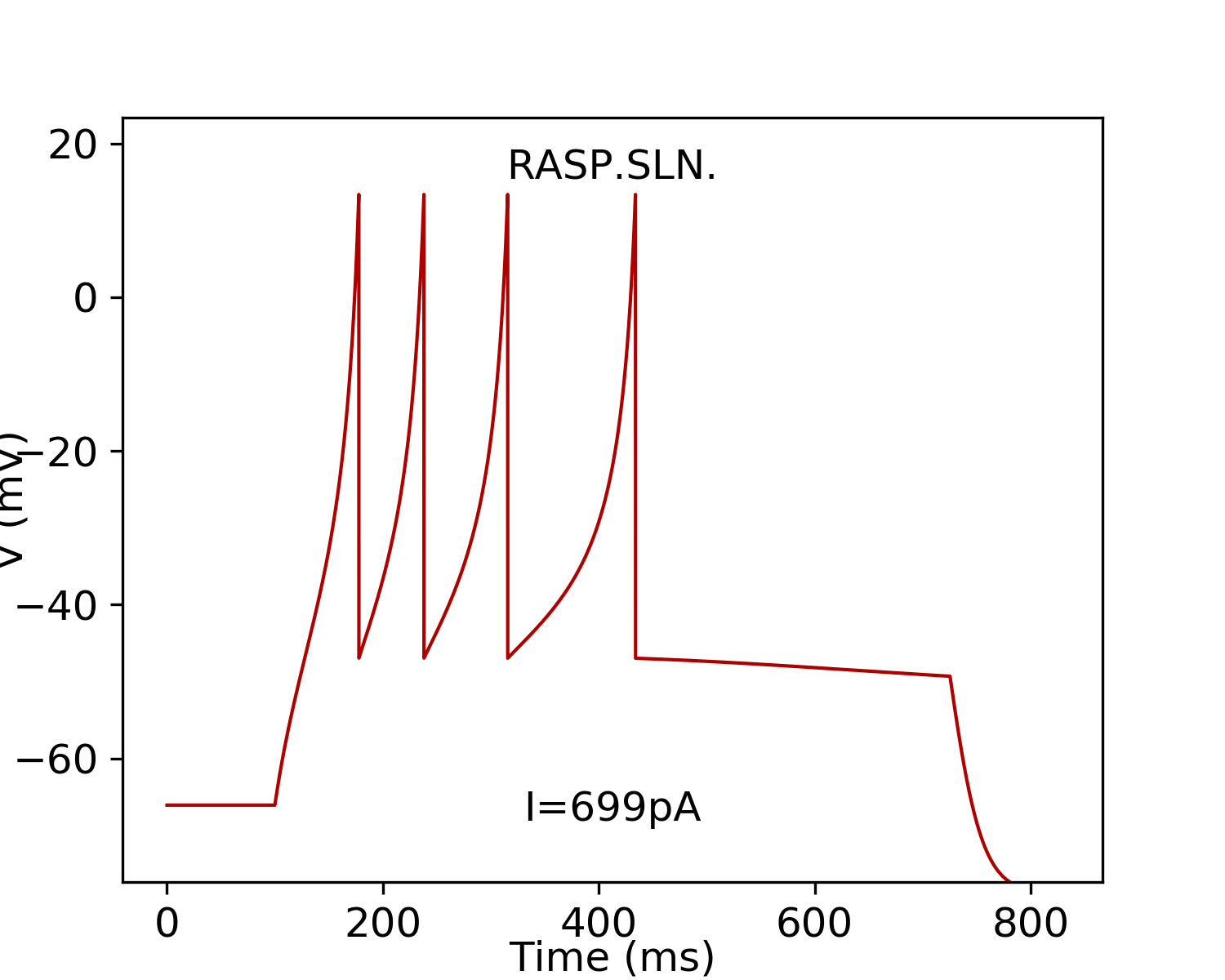
RASP.SLN [Evidence] [Firing Pattern]
TSTUT. [Evidence] [Firing Pattern]

Izhikevich Model
Parameters Single Compartment Downloads Simulate
subtype: 1 k=0.73;a= 0;b= 91.37;d= 100;C= 725;Vr= -66.09;Vt= -27.01;Vpeak= 13.37;Vmin= -46.97; Simulate
Images
Image Missing
ModelDB Model
Model Accession Number PubMed ID

Sources of Input
Known sources
Excitatory or Inhibitory
none known

Potential sources
Excitatory or Inhibitory
DG Local-Projecting Cajal-Retzius*
CA3 Pyramidal
CA3c Pyramidal
CA3c Umbrella Pyramidal*
CA3 Trilaminar
CA2 Pyramidal
CA2 Bistratified
CA1 Cajal-Retzius
CA1 Local-Projecting Cajal-Retzius*
CA1 Back-Projection
CA1 Bistratified
CA1 Hippocampo-subicular Projecting ENK+
CA1 Ivy
CA1 LMR
CA1 LMR-LM*
CA1 LMR-R*
CA1 LMR Projecting
CA1 Neurogliaform
CA1 Neurogliaform Projecting
CA1 O-LM
CA1 Recurrent O-LM
CA1 O-LMR
CA1 Recurrent O-LMR*
CA1 O-RP*
CA1 Oriens-QuadA Projecting
CA1 OR-LM
CA1 O-RPO*
CA1 Perforant Path-Associated
CA1 QuadD-RP*
CA1 R-Receiving Apical-Targeting
CA1 R-RO*
CA1 R-RP*
CA1 Radiatum
CA1 Interneuron Specific RO-R*
CA1 RO-RP*
CA1 RP-RPO*
CA1 Schaffer Collateral-Associated
CA1 Schaffer Collateral-Correlated*
CA1 Trilaminar
CA1 Radial Trilaminar
Sub CA1-Projecting Pyramidal
EC LIII Small Pyramidal
EC LIII Pyramidal

Potential sources known to be avoided
Excitatory or Inhibitory
CA1 Interneuron Specific LM-R
CA1 Interneuron Specific LMR-R
CA1 Interneuron Specific O-R
CA1 Oriens-Bistratified
CA1 Perforant Path-Associated QuadD
CA1 Quadrilaminar
CA1 Schaffer Collateral-Receiving R-Targeting

Targets of Output
Known targets
Excitatory or Inhibitory
none known

Potential targets
Excitatory or Inhibitory
CA1 Pyramidal
CA1 Deep Pyramidal
CA1 Superficial Pyramidal
CA1 Axo-axonic
CA1 Horizontal Axo-axonic
CA1 Back-Projection
CA1 Basket
CA1 Horizontal Basket
CA1 Trilayer Basket*
CA1 Basket CCK+
CA1 Horizontal Basket CCK+*
CA1 Trilayer Basket CCK+*
CA1 Bistratified
CA1 RO-receiving CA3-targeting*
CA1 Hippocampo-subicular Projecting ENK+
CA1 Ivy
CA1 Interneuron Specific LMO-O
CA1 O-LM
CA1 Recurrent O-LM
CA1 O-LMR
CA1 Recurrent O-LMR*
CA1 Interneuron Specific O-R
CA1 O-RP*
CA1 Interneuron Specific O-Targeting QuadD
CA1 Oriens/Alveus
CA1 Oriens-Bistratified
CA1 Oriens-QuadA Projecting
CA1 OR-LM
CA1 O-RPO*
CA1 Perforant Path-Associated QuadD
CA1 QuadD-RP*
CA1 Quadrilaminar
CA1 Interneuron Specific RO-O
CA1 Interneuron Specific RO-R*
CA1 RO-RP*
CA1 Schaffer Collateral-Correlated*
CA1 Schaffer Collateral-Receiving R-Targeting
CA1 SO-SO
CA1 SO-SO Projecting*
CA1 Trilaminar
CA1 Radial Trilaminar

Potential targets known to be avoided
Excitatory or Inhibitory
none known

Oscillation Phase Locking
Category
Value