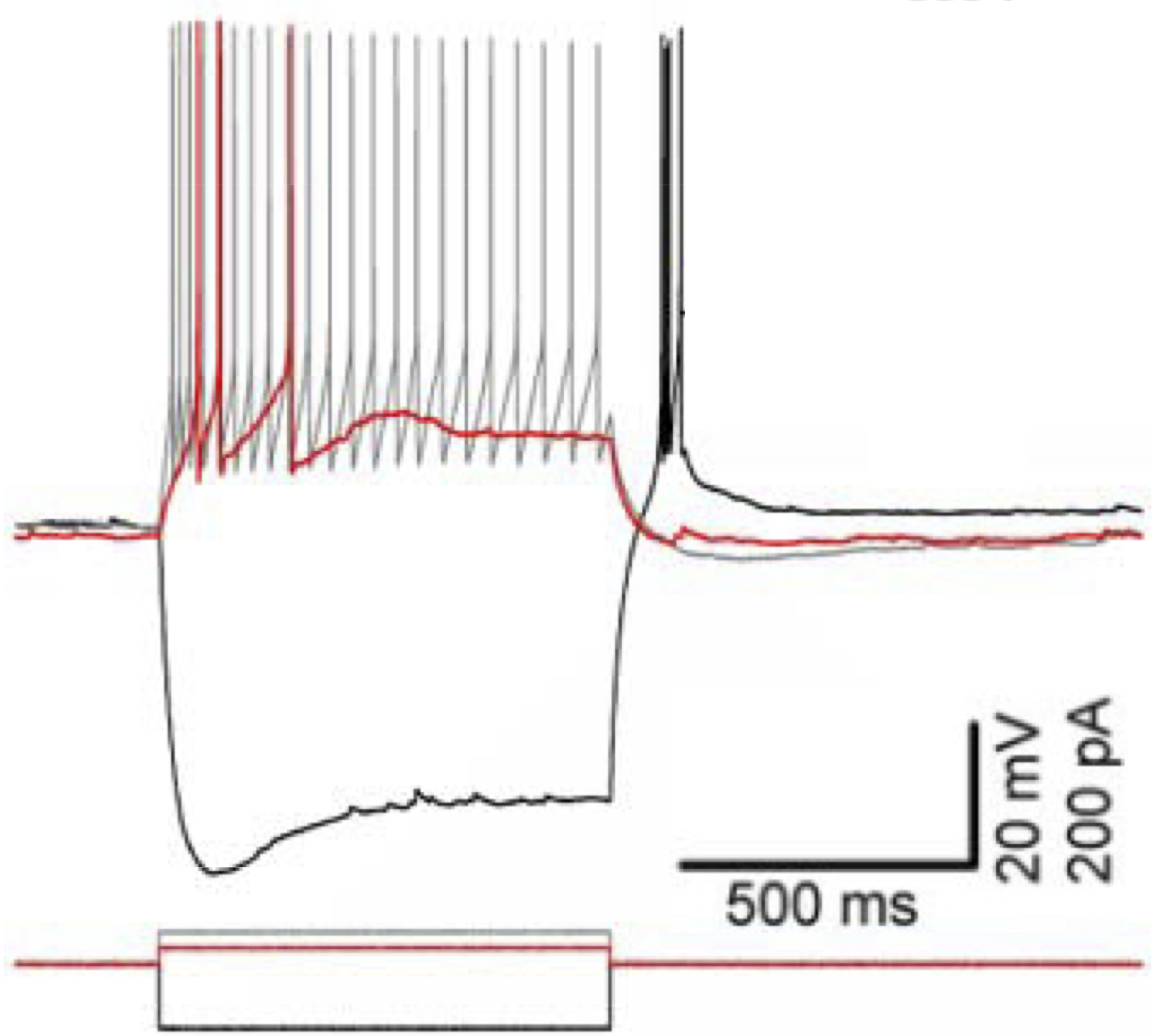
|
|
|
* indicates new v2.0 neuron type
|
|
Name
|
|
Supertype (ID:Family:Type:Subregion)
|
|
|
CA1 (i)0113p-Sub_111 Trilaminar
|
S131504:Collateral-related:RO-targeting:CA1
|
|
Name derivation
|
|
|
|
This is the canonical Somogyi cell type. CA1 clarifies the subregion of origin, since the name is otherwise generic.
|
|
Synonym(s)
|
|
|
|
CA1 double projecting cell
|
|
|
CA1 double projection cell
|
|
|
CA1 double-projection cell
|
|
|
CA1 double-projection neuron
|
|
|
CA1 hippocampo-subicular projection cell
|
|
|
CA1 horizontal trilaminar cell
|
|
|
CA1 horizontal trilaminar interneuron
|
|
|
CA1 horizontal trilaminar neuron
|
|
|
CA1 nonpyramidal projection neuron
|
|
|
CA1 oriens retrohippocampal projection cell
|
|
|
CA1 oriens-retrohippocampal cell
|
|
|
CA1 oriens-retrohippocampal nonpyramidal neuron
|
|
|
CA1 oriens-retrohippocampal projection neuron
|
|
|
CA1 septal-projecting GABAergic cell
|
|
|
CA1 TL cell
|
|
|
CA1 trilaminar cell
|
|
|
CA1 trilaminar interneuron
|
|
|
Click here to view the list
Acsady L (1996) Neuroscience
Correlated morphological and neurochemical features identify different subsets of vasoactive intestinal polypeptide-immunoreactive interneurons in rat hippocampus. Acsady L, Arabadzisz D, Freund TF.
Neuroscience,
1996 Jul, 73 (2),
Pages: 299 - 315
PMID: 8783251; DOI: 10.1016/0306-4522(95)00610-9
Tags: morphology, connectivity, synapse probabilities
Amaral D (2007) The Hippocampus Book
Hippocampal Neuroanatomy Amaral D, Lavenex P.
The Hippocampus Book,
2007,
Pages: 35 - 112
ISBN: 9780195100273
Tags: morphology, connectivity, synapse probabilities
Chamberland S (2010) Front Cell Neurosci
Synapse-specific inhibitory control of hippocampal feedback inhibitory circuit. Chamberland S, Salesse C, Topolnik D, Topolnik L.
Front Cell Neurosci,
2010, 4,
Pages: 130 -
PMID: 21060720; DOI: 10.3389/fncel.2010.00130
Tags: morphology, connectivity, synapse probabilities
Ferraguti F (2005) J Neurosci
Metabotropic glutamate receptor 8-expressing nerve terminals target subsets of GABAergic neurons in the hippocampus. Ferraguti F, Klausberger T, Cobden P, Baude A, Roberts JD, Szucs P, Kinoshita A, Shigemoto R, Somogyi P, Dalezios Y.
J Neurosci,
2005 Nov 9, 25 (45),
Pages: 10520 - 10536
PMID: 16280590; DOI: 10.1523/JNEUROSCI.2547-05.2005
Tags: morphology, marker, connectivity, phases, synapse probabilities
Freund TF (1996) Hippocampus
Interneurons of the hippocampus. Freund TF, Buzsaki G.
Hippocampus,
1996, 6 (4),
Pages: 347 - 470
PMID: 8915675; DOI: 10.1002/(SICI)1098-1063(1996)6:4<347::AID-HIPO1>3.0.CO;2-I
Tags: morphology, connectivity, synapse probabilities
Jinno S (2007) J Neurosci
Neuronal diversity in GABAergic long-range projections from the hippocampus. Jinno S, Klausberger T, Marton LF, Dalezios Y, Roberts JD, Fuentealba P, Bushong EA, Henze D, Buzsaki G, Somogyi P.
J Neurosci,
2007 Aug 15, 27 (33),
Pages: 8790 - 8804
PMID: 17699661; DOI: 10.1523/JNEUROSCI.1847-07.2007
Tags: morphology, marker, connectivity, phases, synapse probabilities
Katona L (2020) Brain Structure and Function
Synaptic Organisation and Behaviour-Dependent Activity of mGluR8a-innervated GABAergic Trilaminar Cells Projecting From the Hippocampus to the Subiculum Katona L, Hartwich K, Tomioka R, Somogyi J, Roberts JDB, Wagner K, Joshi A, Klausberger T, Rockland KS, Somogyi P.
Brain Structure and Function,
2020,
Pages: 705 - 734
PMID: 32016558
Tags: phases
Klausberger T (2008) Science
Neuronal diversity and temporal dynamics: the unity of hippocampal circuit operations. Klausberger T, Somogyi P.
Science,
2008 Jul 4, 321 (5885),
Pages: 53 - 57
PMID: 18599766; DOI: 10.1126/science.1149381
Tags: morphology, connectivity, synapse probabilities
Klausberger T (2009) Eur J Neurosci
GABAergic interneurons targeting dendrites of pyramidal cells in the CA1 area of the hippocampus. Klausberger T.
Eur J Neurosci,
2009 Sep, 30 (6),
Pages: 947 - 957
PMID: 19735288; DOI: 10.1111/j.1460-9568.2009.06913.x
Tags: morphology, marker, connectivity, synapse probabilities
Losonczy A (2002) J Physiol
Cell type dependence and variability in the short-term plasticity of EPSCs in identified mouse hippocampal interneurones. Losonczy A, Zhang L, Shigemoto R, Somogyi P, Nusser Z.
J Physiol,
2002 Jul 1, 542 (Pt 1),
Pages: 193 - 210
PMID: 12096061; DOI: 10.1113/jphysiol.2002.020024
Tags: morphology, marker, connectivity, synapse probabilities
Sik A (1995) J Neurosci
Hippocampal CA1 interneurons: an in vivo intracellular labeling study. Sik A, Penttonen M, Ylinen A, Buzsaki G.
J Neurosci,
1995 Oct, 15 (10),
Pages: 6651 - 6665
PMID: 7472426
Tags: morphology, marker, membrane biophysics, connectivity, firing patterns, synapse probabilities
Somogyi P (2005) J Physiol
Defined types of cortical interneurone structure space and spike timing in the hippocampus. Somogyi P, Klausberger T.
J Physiol,
2005 Jan 1, 562 (Pt 1),
Pages: 9 - 26
PMID: 15539390; DOI: 10.1113/jphysiol.2004.078915
Tags: morphology, marker, connectivity, synapse probabilities
Somogyi P (2010) Handbook of Brain Microcircuits
Chapter: Hippocampus: Intrinsic organisation Somogyi P.
Handbook of Brain Microcircuits,
2010,
Pages: 148 - 164
ISBN: 9780195389883
Tags: morphology, connectivity, synapse probabilities
Vida I (2010) Hippocampal Microcircuits: A Computational Modeler's Resource Book
Morphology of Hippocampal Neurons Vida I.
Hippocampal Microcircuits: A Computational Modeler's Resource Book,
2010,
Pages: 27 - 68
ISBN: 9781441909954
Tags: morphology, connectivity, synapse probabilities
|
|
List of Hippocampome.org to NeuroMorpho.Org mappings
|
|
|
Click here to view the list of mappings
McQuiston
-
2011-11-17-cell-1
(fits the general description of "CA1 Trilaminar" or "CA1 Oriens-Bistratified" based on the distribution of dendrites and being Mus2R+)
|
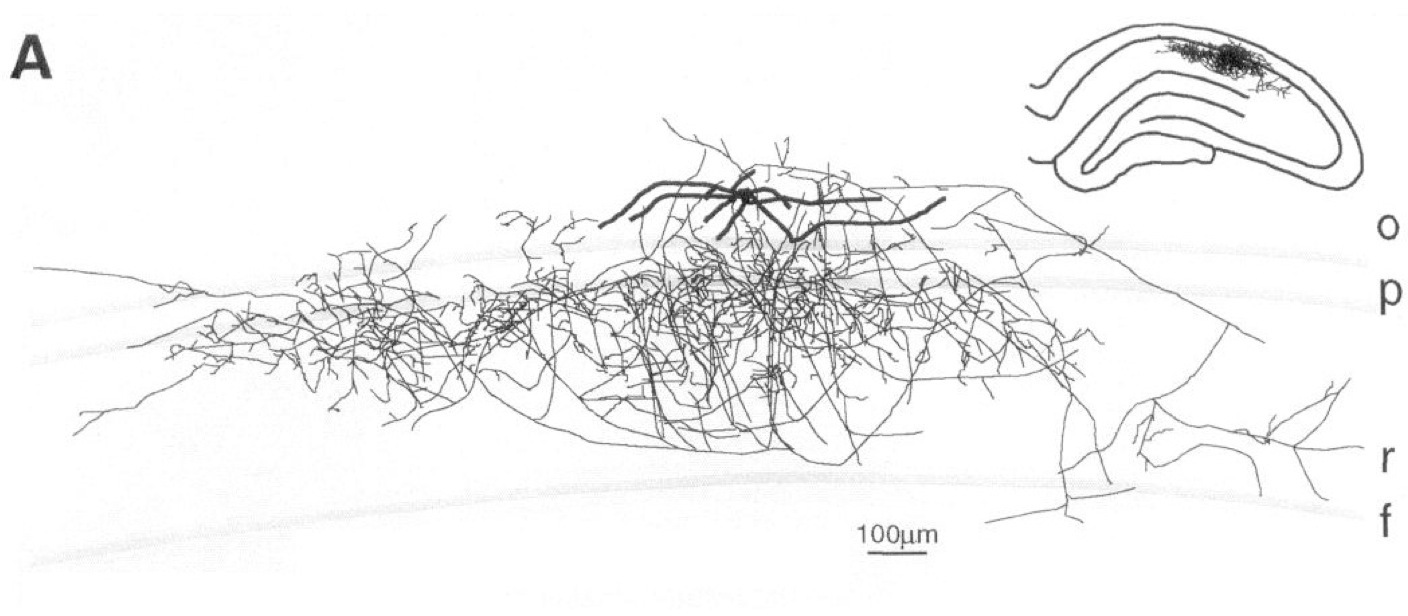
"Figure 7. Trilaminar interneuron {CA1 Trilaminar} (M96). A, Reconstruction of the axon collaterals and dendrites of the interneuron. Axon collaterals from all sections were collapsed into a two-dimensional display. o, stratum oriens; p, CA1 pyramidal layer; r, stratum radiatum; j hippocampal fissure. Some collaterals falsely appear in the stratum lacunosum-moleculare because of the two-dimensional projection of curving layer boundaries." |
|
Electrophysiological properties
|
|
|
Merger approved between four classes: CA1 0113 ORP, CA1 0113 DP, CA1 0113 trilaminar horizontal, CA1 0113 O-R
Projection to SUB - the ORP-DP-trilaminar horizontal cell type has been approved with [A:SUB:SM_SP_PL] (horiz trilaminar cells match this; ORP cells have clear axons in SUB:SM_SP and borderline axons in PL; DP cell axons could not be followed to terminals so could not be traced further than SUB:SP). The O-R 0113 cell type has clear axons in SUB:SP_PL, and Losonczy admits that the axons may have been severely truncated.
Septal projection - potential for subclasses. DP cells project into the septal area and ORP cells do not. Unknown for trilaminar-horizontal and O-R.
Targets - according to Somogyi (2010), up to half of the postsynaptic targets of trilaminar (horizontal) cells are other interneurons. Possible potential for subclasses.
|
| Parameters
|
Single Compartment
|
Downloads
|
Simulate
|
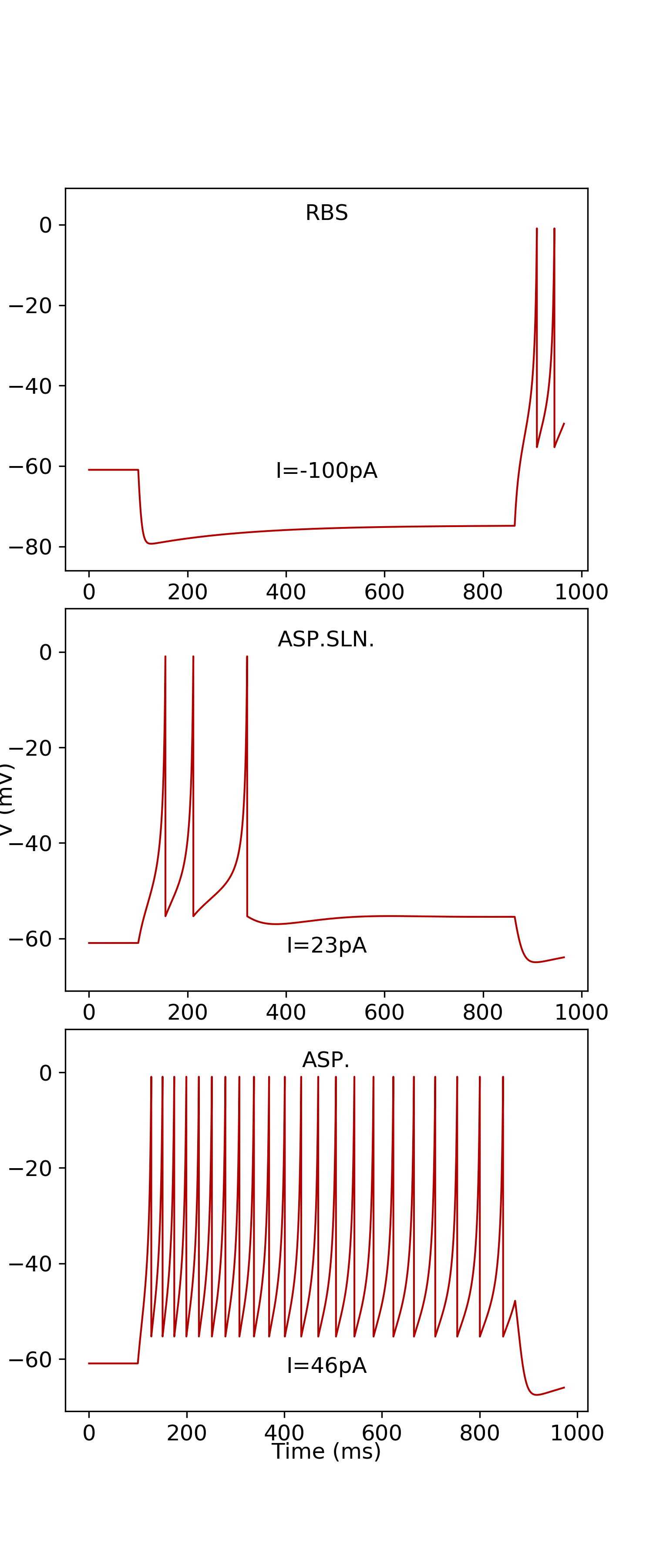
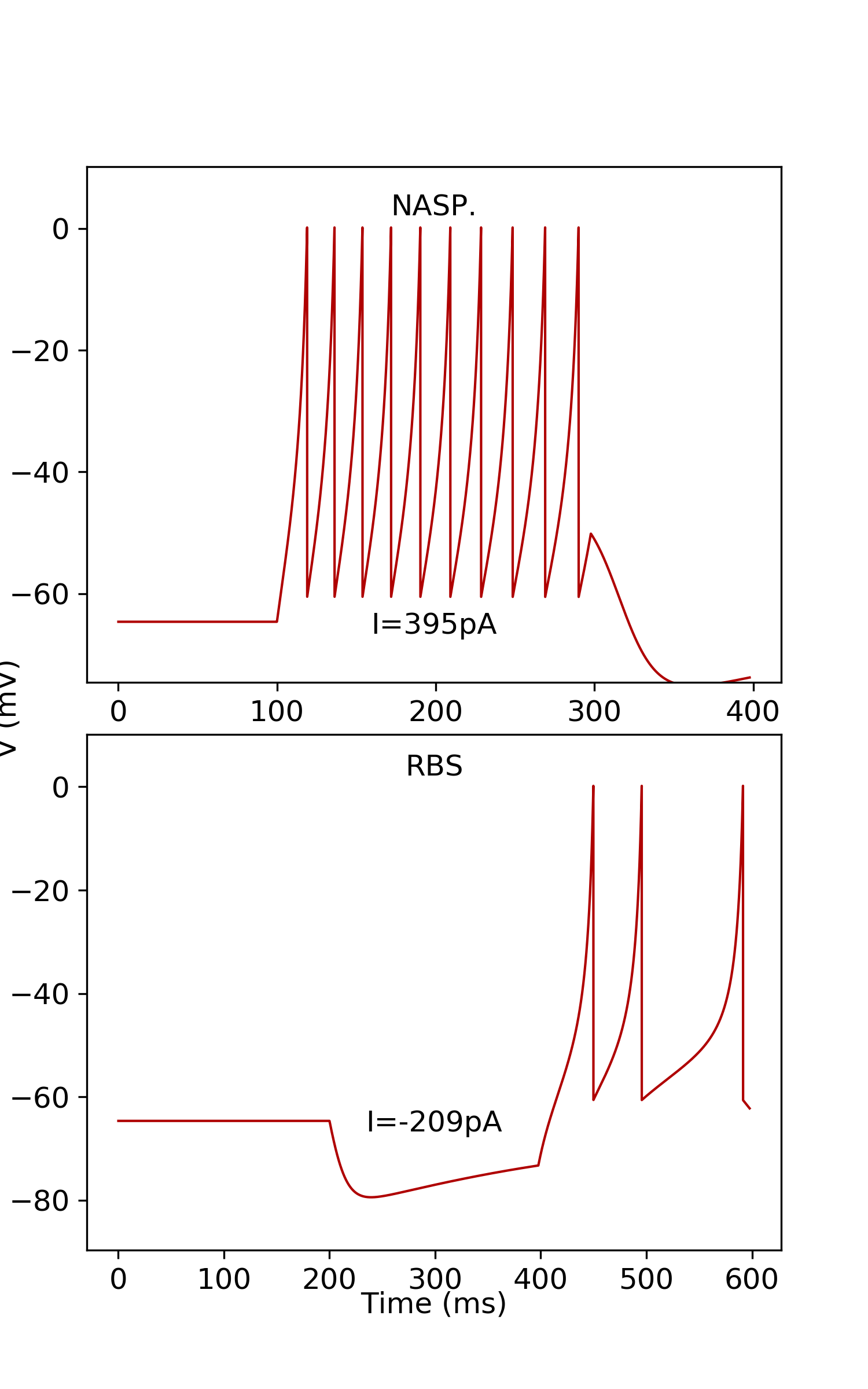
| subtype: 1 k=0.16;a= 0.004;b= 2.72;d= -3;C= 38;Vr= -60.94;Vt= -46.19;Vpeak= -0.92;Vmin= -55.34; | | Simulate
| | subtype: 2 k=0.52;a= 0.002;b= 42.24;d= -19;C= 205;Vr= -64.64;Vt= -56.25;Vpeak= 0.17;Vmin= -60.62; | | Simulate
|
|
Model Accession Number
|
PubMed ID
|
|
|
|
|
Potential sources known to be avoided
|
|
|
|
|
|
Potential targets known to be avoided
|
|
| Oscillation Phase Locking |
| Category | Value | | Theta (deg): | 264.00 | | Theta range: | [264.00, 264.00] | | Theta measurements: | 1 | | Theta representative selection: | rats, adult, male,
juxtacellular, freely moving | | SWR ratio: | 431.00 | | SWR ratio range: | [431.00, 690.00] | | SWR ratio measurements: | 2 | | SWR ratio representative selection: | rats, adult, unknown sex,
juxtacellular, urethane plus supplemental doses of ketamine and xylazine | | In vivo firing rate (Hz): | 19.00 | | Firing rate range: | [19.00, 19.00] | | Firing rate measurements: | 1 | | Firing rate representative selection: | rats, adult, male,
juxtacellular, freely moving | | Other: | ripple and 3 others | | Other representative selection: | rats, adult, unknown sex,
juxtacellular, urethane plus supplemental doses of ketamine and xylazine |
|
 Browse
 Search
 Help