CA1 Radiatum
* indicates new v2.0 neuron type
Name Supertype (ID:Family:Type:Subregion)
CA1 (i)0300 Radiatum S101304:Ivy/Neurogliaform Family:Ivy/Neurogliaform:CA1

Name derivation
This simple and compact name captures the presence of axons and dendrites all in SR. CA1 distinguishes these cells from R cells in other subregions.

Synonym(s)
CA1 type II nonpyramidal cell
CA1 neurons with axons and dendrites in stratum radiatum
CA1 Schaffer-associated interneuron
CA1 Schaffer collateral associated
CA1 Schaffer associated
CA1 Type II cells
CA1 CaBP-LI (CaBP-like immunoreactivity)
CA1 CaBP-ir
CA1 CaBP-positive neurons

List of articles
Click here to view the list
Cope DW  (2002) Neuroscience
Cholecystokinin-immunopositive basket and Schaffer collateral-associated interneurones target different domains of pyramidal cells in the CA1 area of the rat hippocampus.
Cope DW, Maccaferri G, Marton LF, Roberts JD, Cobden PM, Somogyi P.
Neuroscience, 2002, 109 (1), Pages: 63 - 80
PMID: 11784700; DOI: 10.1016/S0306-4522(01)00440-7
Tags: morphology, marker
Freund TF  (1996) Hippocampus
Interneurons of the hippocampus.
Freund TF, Buzsaki G.
Hippocampus, 1996, 6 (4), Pages: 347 - 470
PMID: 8915675; DOI: 10.1002/(SICI)1098-1063(1996)6:4<347::AID-HIPO1>3.0.CO;2-I
Tags: morphology, marker, connectivity, synapse probabilities
Gulyas AI  (1991) J Comp Neurol
Subpopulations of GABAergic neurons containing parvalbumin, calbindin D28k, and cholecystokinin in the rat hippocampus.
Gulyas AI, Toth K, Danos P, Freund TF.
J Comp Neurol, 1991 Oct 15, 312 (3), Pages: 371 - 378
PMID: 1721075; DOI: 10.1002/cne.903120305
Tags: morphology
Gulyas AI  (1996) Hippocampus
Pyramidal cell dendrites are the primary targets of calbindin D28k-immunoreactive interneurons in the hippocampus.
Gulyas AI, Freund TF.
Hippocampus, 1996, 6 (5), Pages: 525 - 534
PMID: 8953305; DOI: 10.1002/(SICI)1098-1063(1996)6:5<525::AID-HIPO5>3.0.CO;2-H
Tags: morphology, marker, connectivity, synapse probabilities
Kawaguchi Y  (1988) Exp Brain Res
Physiological heterogeneity of nonpyramidal cells in rat hippocampal CA1 region.
Kawaguchi Y, Hama K.
Exp Brain Res, 1988, 72 (3), Pages: 494 - 502
PMID: 3234499; DOI: 10.1007/BF00250594
Tags: morphology
Pawelzik H  (2002) J Comp Neurol
Physiological and morphological diversity of immunocytochemically defined parvalbumin- and cholecystokinin-positive interneurones in CA1 of the adult rat hippocampus.
Pawelzik H, Hughes DI, Thomson AM.
J Comp Neurol, 2002 Feb 18, 443 (4), Pages: 346 - 367
PMID: 11807843; DOI: 10.1002/cne.10118
Tags: morphology, marker, membrane biophysics, connectivity, firing patterns, synapse probabilities
Sloviter RS  (1989) J Comp Neurol
Calcium-binding protein (calbindin-D28k) and parvalbumin immunocytochemistry: localization in the rat hippocampus with specific reference to the selective vulnerability of hippocampal neurons to seizure activity.
Sloviter RS.
J Comp Neurol, 1989 Feb 8, 280 (2), Pages: 183 - 196
PMID: 2925892; DOI: 10.1002/cne.902800203
Tags: morphology
Toth K  (1992) Neuroscience
Calbindin D28k-containing nonpyramidal cells in the rat hippocampus: their immunoreactivity for GABA and projection to the medial septum.
Toth K, Freund TF.
Neuroscience, 1992 Aug, 49 (4), Pages: 793 - 805
PMID: 1279455; DOI: 10.1016/0306-4522(92)90357-8
Tags: morphology, marker
Vida I  (1998) J Physiol
Unitary IPSPs evoked by interneurons at the stratum radiatum-stratum lacunosum-moleculare border in the CA1 area of the rat hippocampus in vitro.
Vida I, Halasy K, Szinyei C, Somogyi P, Buhl EH.
J Physiol, 1998 Feb 1, 506 ( Pt 3), Pages: 755 - 773
PMID: 9503336; DOI: 10.1111/j.1469-7793.1998.755bv.x
Tags: morphology, membrane biophysics, connectivity, firing patterns, synapse probabilities
Vida I  (2010) Hippocampal Microcircuits: A Computational Modeler's Resource Book
Morphology of Hippocampal Neurons
Vida I.
Hippocampal Microcircuits: A Computational Modeler's Resource Book, 2010, Pages: 27 - 68
ISBN: 9781441909954
Tags: morphology, marker, connectivity, synapse probabilities

Supplemental PMIDs
Click here to view the list of PMIDs

List of Hippocampome.org to NeuroMorpho.Org mappings
Click here to view the list of mappings

Morphology
Soma
CA1:SLM
CA1:SR
Axons
CA1:SR
Dendrites
CA1:SR

Representative figure
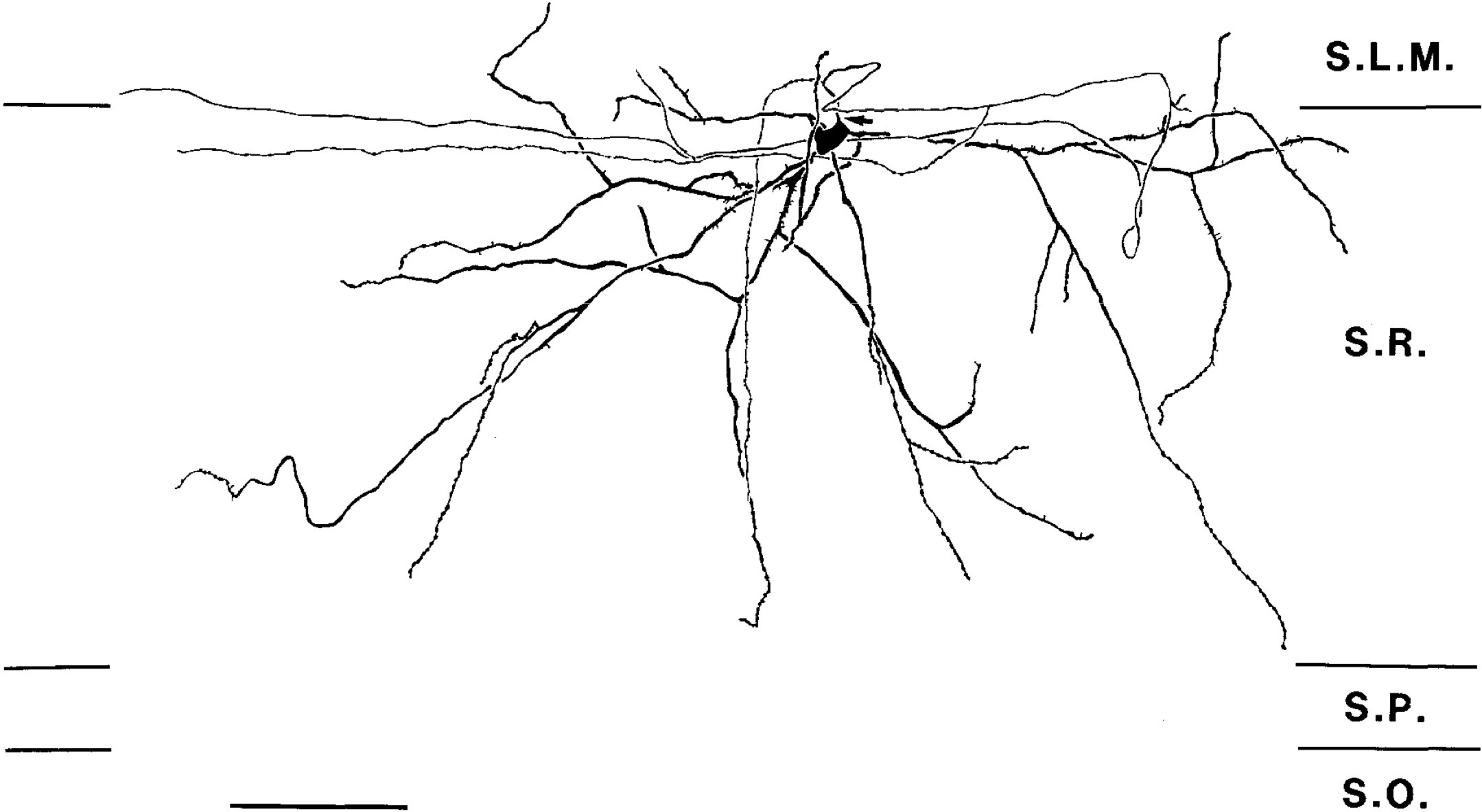
Physiological heterogeneity of nonpyramidal cells in rat hippocampal CA1 region.
Kawaguchi Y, Hama K
Exp Brain Res, 1988, 72 (3), pages: 494 - 502
PMID: 3234499; DOI: 10.1007/BF00250594


"Fig. 4. Camera lucida reconstruction of a [CA1] type II nonpyramidal cell {CA1 Radiatum} in the border area of the stratum radiatum and the stratum lacunosum- moleculare. Arrow indicates the axonal origin. Lines indicate the border between adjacent layers. S.L.M., stratum lacunosum-moleculare; S.O., stratum oriens; S.P., stratum pyramidale; S.R., stratum radiatum. Scale bar on the left bottom, 100 microm"


Molecular markers
Positive
CB
CCK
mGluR1a (inference)
SOM (confirmed by inference)
Negative
5HT-3 (confirmed by inference)
AR-beta1 (multiple confirming inferences)
CB1
CoupTF II
CR (confirmed by inference)
ENK (confirmed by inference)
ErbB4 (multiple confirming inferences)
GABAa\alpha 6 (inference)
Gaba-a-alpha (multiple confirming inferences)
MOR (multiple confirming inferences)
PV (confirmed by inference)
vGluT3 (confirmed by inference)
VIP (confirmed by inference)
Mixed expression
nNOS (unresolved)
NPY (subtypes)

Electrophysiological properties
Key: [range] OR representative value±SD (measurements); Number of sources (total measurements): [min , max]

Resting membrane potential (Vrest): -55.8±2.8 mV (10); 3 sources (12): [-70 , -55.8]
Input resistance (Rin): 96.3±36 MΩ (10); 2 sources (11): [79.2 , 96.3]
Time constant (τm): 16.2±8.9 ms (10); 2 sources (11): [10 , 16.2]
Threshold potential (Vthresh): 19.35 mV (2); 3 sources (4): [14.8 , 17.2]
Fast afterhyperpolaziring potential amplitude (Fast AHP): 16.3 mV (2); 3 sources (4): [12 , 14.4]
Action potential amplitude (APampl): 68.4 mV (2); 3 sources (4): [52 , 73.5]
Slow afterhyperpolarizing potential amplitude (Slow AHP): 4.2 mV (1); 3 sources (3): [4 , 8]
Sag ratio: 0.88 (1); 2 sources (2): [0.48 , 0.88]

Notes

CA1 SR

I would x-out S:SP and combine these 2 classes into a single CA1 SR combo-class. - DWW

Agree soma in SR only - CW
Are you including SCA in this group? - CW

On this (esp. terminology) let's discuss post-summary - GAA

S:SP removed. To be eventually combined with SC 0300 class - CLR 02/25/2011

CA1 Schaffer collateral-associated 0300 neurons

Propose combining with SR 0300 and large calbindin 0300.

CLR

CW 03/08/2011

I would remove citations that mention neurites in SLM and SO. These are generous interpretations by the authors but do not qualify under our rules. - DWW

OK - to review with all packets pertaining to CLR's CA1 summary (and with the summary itself) - GAA

CA1 Schaffer collateral-associated 0300 cells (fully approved)
CA1 SR 0300 cells (fully approved)

1) Do you approve of merging these two cell classes?

Yes - DWW, CW, CLR, GAA

2) Assuming merger, what unified class name?

SR: stratum radiatum? - DWW, CW, CLR

SC: Schaffer collateral-associated? *? Not sure yet - GAA

CA1 0300 Schaffer collateral-associated--stratum radiatum (SCA-SR) neurons

This class is a merger of

CA1 0300 Schaffer collateral-associated (SCA) cells
CA1 0300 stratum radiatum (SR) cells

CLR 07/23/2011

DWW, CW, GAA

CA1 calbindin SR 0300 neuron

Axons or dendrites may extend to SO in some cases.
Also exist in CA3.
Note: these may or may not be the "large" calbindin cells referred to by Klausberger & Somogyi.

CW

All 4 cells taken together from Gulyas [et al., 1991] Fig. 1B would conform to the K&S [Klausberger & Somogyi] patterning. - DWW

Other 0300 neurons?! (Freund IS perhaps) - GAA

CA1 calbindin SR 0300 neuron

This is my attempt at compiling a packet for the calbindin class. I believe there is enough evidence for an 0300 class (other classes appear to be sub-threshold).

Note: I found evidence for the "large calbindin" cells referred to in the Klausberger & Somogyi series (included at the end of the packet). It's possible that these cells originate from a "lumping together" of the evidence in Gulyas and Freund's Figure 2 (see pg 5). An email to Klausberger or Somogyi may be the next step. - CLR 07/05/2011

CA1 calbindin SR 0300 neuron

There are also calbindin SLM 3000 and calbindin SO 0003 packets.

Note: I found evidence for the "large calbindin" cells referred to in the Klausberger & Somogyi series (included at the end of the packet). It's possible that these cells originate from a "lumping together" of the evidence in Gulyas and Freund's Figure 2 (see pg 5). An email to Klausberger or Somogyi may be the next step. - CLR 07/20/2011

Propose combining with SR-SCA 0300.

Yes. - DWW 07/21/2011

Agree - CW 07/21/2011

Excellent! - GAA

CA1 (i)0300 Radiatum (R) neurons [4028]

Related types: CA1 (i)0310 L-H-RP (v2.0 on-hold)

Merger status: This packet is a result of a merger between CA1 (i)0300 SCA-SR and CA1 (i)0300 calbindin SR.
Rejected merger with CA1 (i)1300 SLM-SR due to strength of A:SLM.
Rejected merger proposal with CA1 2300 IS1 due to target specificity.

Notes:

Possible future subclasses based on expression of chemical markers (SCA-SR type appears to be CCK+; CB-SR cell type is CB+)

CA1 0300 SCA-SR notes:

Language of various authors indicates that dendrites can enter SLM or SO, but they do so "rarely" (Freund & Buzsaki, 1996).

CA1 0300 calbindin SR notes:

Other CA1 calbindin cell types exist:

CA1 calbindin 3100
CA1 calbindin 0303
CA1 calbindin-IS-1 0302
CA1 calbindin-SO-SO 0003

CA3 calbindin cell types also exist.

Principal cell layer invoked rule: record axons in the PCL when boutons are present or when axons are branching and ostensibly targeting the PCL and not just passing through, but discount dendrites.

Assessment of merger of CA1 (i)0310 L-H-RP into CA1 (i)0300 Radiatum.

I agree to have at least one more packet out of this material, and I can go with either pattern [CA1 (i)0102 vs. CA1 (i)0112], but Iā??m frankly not convinced that we want two distinct neuron types. I believe that in v1.0 we have systematically merged all these cases. Do we have any example of 2 types that only differ in axonal presence in PCL? Unless thereā??s direct evidence that one of the two makes synapses with the soma and the other does not, Iā??d probably just merge them. If you agree, I suggest 0112, but am also happy with 0102. If there are other similar cases in v2.0, please consider merging. - GAA 02/01/2022

Proposal: merge 0310 into 0300 - DWW 02/03/2022

So in re-reviewing each potential merger within the packet Diek has kindly provided, I had a few questions arise pertinent to favoring merging unless there is direct evidence that one neuron type makes synapses with the soma and the other does not:
1. How does this impact the new invoked rule defined in the provided packet, namely that we will "record axons in the PCL when boutons are present or when axons are branching and ostensibly targeting the PCL and not just passing through, but discount dendrites?" Shall we disregard it?
2. If we favor the route of merging unless we have direct evidence of one neuron type establishing synapses with the soma while the other does not, which AD pattern should be preferred? The AD pattern exhibited by the majority of the reconstructions or the AD pattern of a single reconstruction that shows axonal presence (e.g. the 0102 & 0112 case that led to this discussion)? Perhaps this should be a case by case basis depending on what evidence makes the most sense to us? - JDK 02/06/2022

I would suggest that we utilize the PCL invoked rule as our fallback position, when we do not have overriding motivation to merge two or more neuron types. As to which way to merge, I would suggest, since we have not been consistent in the past, that we evaluate on a case-by-case basis. - DWW 02/07/2022

I concur. - GAA 02/07/2022

Thank you for answering my questions and this route sounds good to me. In light of utilizing the PCL invoked rule as a fallback position, I am okay with merging in all cases in the "Axons in the PCL" packet except for the 0103 and 0113 merger where we have a text description directly stating that the X-OPR (0113 O-RPO) axons display en passant boutons in SP whereas the X-OR (0103 O-BiC) do not. - JDK 02/07/2022

This is the same scenario as that of CA1 (i)2311 Schaffer Collateral-Associated & CA1 (i)2301 R-S-RO (v2.0 on-hold), so for coherence I would keep that separate. - GAA 02/13/2022

It was agreed by GAA, JDK, and DWW to adhere to the interpretations of the authors of schematics and void the potential merger. - 02/15/2022


Firing Pattern
Images
Image MissingImage MissingImage Missing
Parameters View page
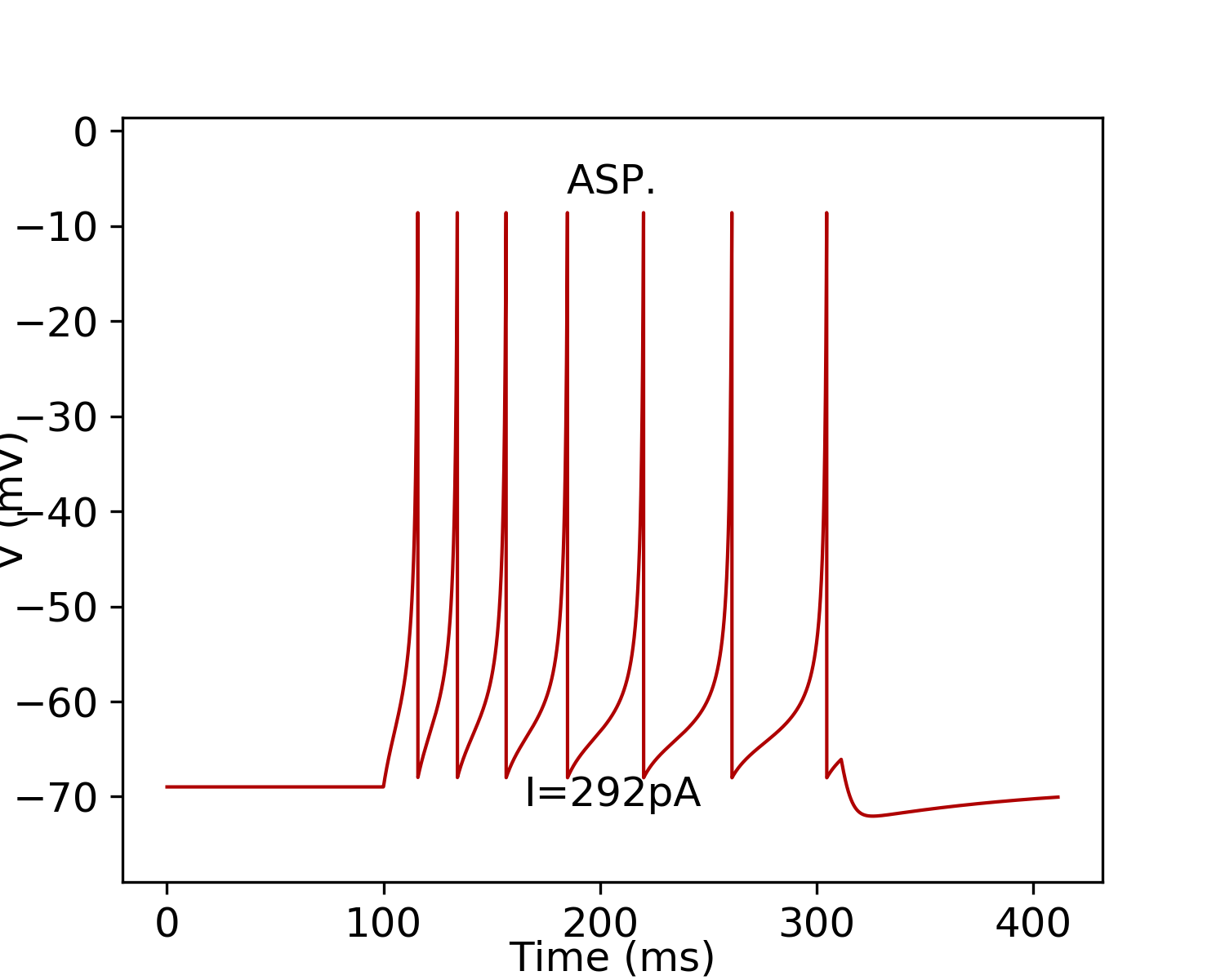
ASP. [Evidence] [Firing Pattern]
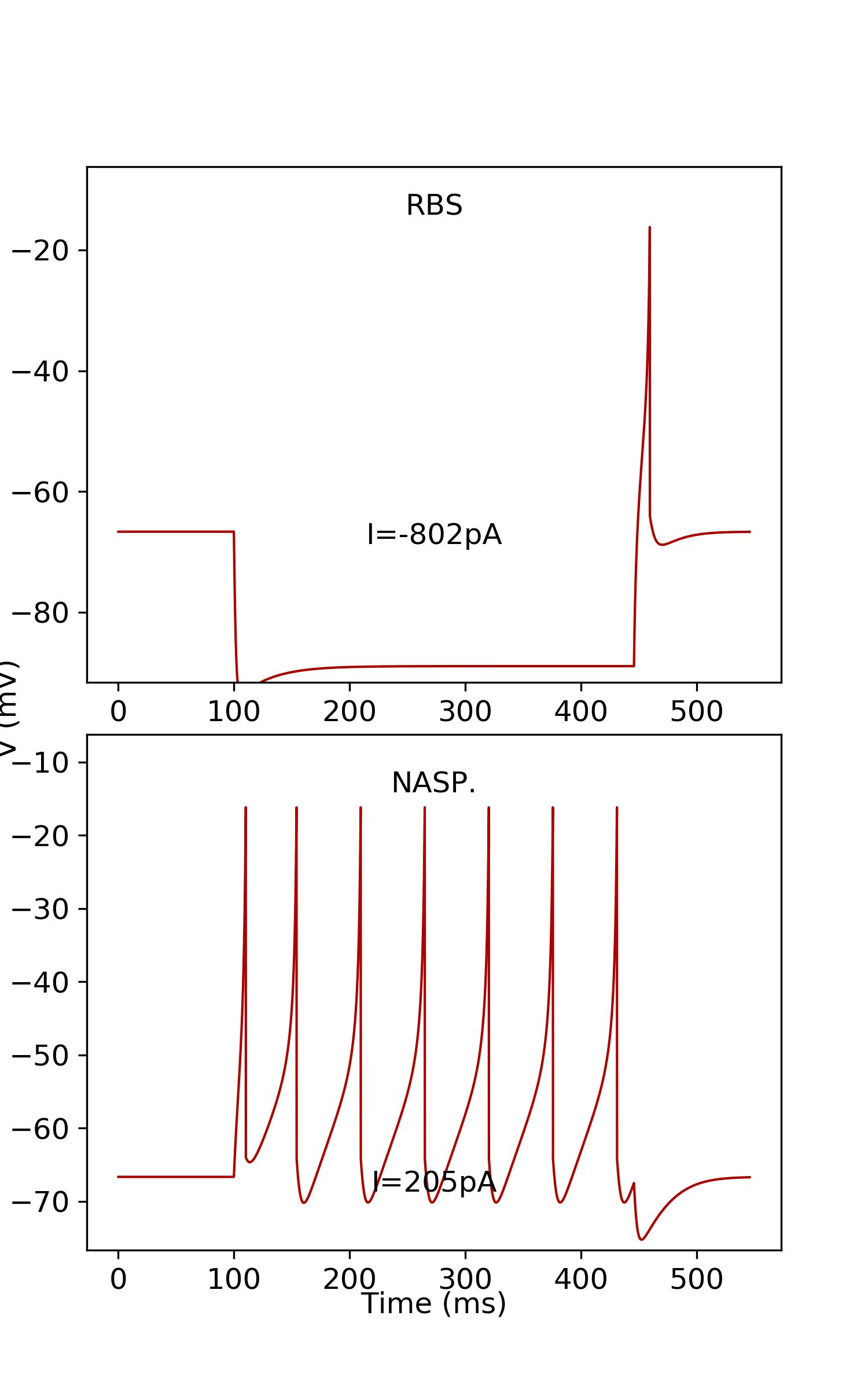
NASP [Evidence] [Firing Pattern]
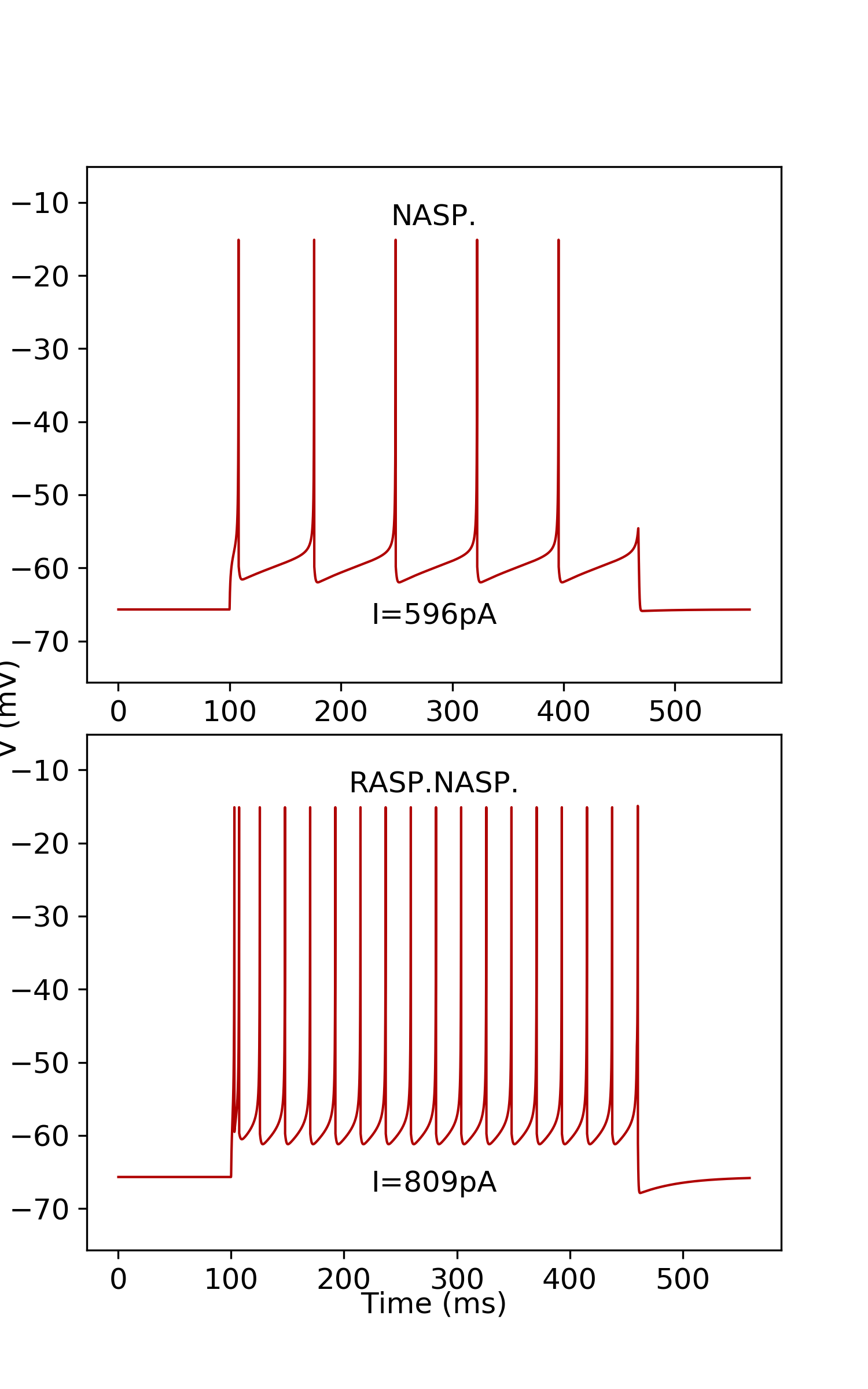
RASP.ASP. [Evidence] [Firing Pattern]

Izhikevich Model
Parameters Single Compartment Downloads Simulate
subtype: 1 k=3.34;a= 0.011;b= 14.89;d= 20;C= 194;Vr= -68.98;Vt= -58.15;Vpeak= -8.59;Vmin= -68.03; Simulate
subtype: 2 k=0.62;a= 0.03;b= 10.62;d= 150;C= 54;Vr= -66.66;Vt= -48.02;Vpeak= -16.2;Vmin= -63.97; Simulate
subtype: 3 k=9.29;a= 0.029;b= 1.16;d= 180;C= 59;Vr= -65.68;Vt= -50.29;Vpeak= -15.12;Vmin= -59.6; Simulate
Images
Image MissingImage MissingImage Missing
ModelDB Model
Model Accession Number PubMed ID

Sources of Input
Known sources
Excitatory or Inhibitory
CA1 Interneuron Specific LM-R
CA1 Radiatum

Potential sources
Excitatory or Inhibitory
CA3 Pyramidal
CA3c Pyramidal
CA3c Umbrella Pyramidal*
CA3 Trilaminar
CA2 Pyramidal
CA2 Bistratified
CA1 Back-Projection
CA1 Bistratified
CA1 Hippocampo-subicular Projecting ENK+
CA1 Ivy
CA1 LMR
CA1 LMR-R*
CA1 Interneuron Specific LMR-R
CA1 LMR Projecting
CA1 O-LMR
CA1 Recurrent O-LMR*
CA1 Interneuron Specific O-R
CA1 O-RP*
CA1 Oriens-Bistratified
CA1 Oriens-QuadA Projecting
CA1 O-RPO*
CA1 QuadD-RP*
CA1 Quadrilaminar
CA1 R-Receiving Apical-Targeting
CA1 R-RO*
CA1 R-RP*
CA1 Interneuron Specific RO-R*
CA1 RO-RP*
CA1 RP-RPO*
CA1 Schaffer Collateral-Associated
CA1 Schaffer Collateral-Correlated*
CA1 Schaffer Collateral-Receiving R-Targeting
CA1 Trilaminar
CA1 Radial Trilaminar
Sub CA1-Projecting Pyramidal
EC LIII Small Pyramidal
EC LIII Pyramidal

Potential sources known to be avoided
Excitatory or Inhibitory
none known

Targets of Output
Known targets
Excitatory or Inhibitory
CA1 Pyramidal
CA1 Radiatum

Potential targets
Excitatory or Inhibitory
CA1 Deep Pyramidal
CA1 Superficial Pyramidal
CA1 Radiatum Giant
CA1 Axo-axonic
CA1 Basket
CA1 R-P Basket*
CA1 Trilayer Basket*
CA1 Vertical Basket*
CA1 Basket CCK+
CA1 Trilayer Basket CCK+*
CA1 Bistratified
CA1 RO-receiving CA3-targeting*
CA1 Hippocampo-subicular Projecting ENK+
CA1 Ivy
CA1 LMR
CA1 LMR-LM*
CA1 Interneuron Specific LMR-O*
CA1 LMR-R*
CA1 Interneuron Specific LMR-R
CA1 LMR Projecting
CA1 Interneuron Specific O-Targeting QuadD
CA1 Oriens/Alveus
CA1 OR-LM
CA1 Perforant Path-Associated
CA1 Perforant Path-Associated QuadD
CA1 QuadD-RP*
CA1 Quadrilaminar
CA1 Interneuron Specific R-O
CA1 R-Receiving Apical-Targeting
CA1 R-RO*
CA1 R-RP*
CA1 Interneuron Specific RO-O
CA1 Interneuron Specific RO-R*
CA1 RO-RP*
CA1 RP-RPO*
CA1 Schaffer Collateral-Associated
CA1 Schaffer Collateral-Correlated*
CA1 Schaffer Collateral-Receiving R-Targeting
CA1 Radial Trilaminar

Potential targets known to be avoided
Excitatory or Inhibitory
none known

Oscillation Phase Locking
Category
Value