|
|
|
* indicates new v2.0 neuron type
|
|
Name
|
|
Supertype (ID:Family:Type:Subregion)
|
|
|
CA1 (i)2311 Schaffer Collateral-Associated
|
S131504:Collateral-related:RO-targeting:CA1
|
|
Name derivation
|
|
|
|
This is a canonical Klausberger and Somogyi name that does not misuse "trilaminar" and is more well-known than "apical dendrite-innervating."
|
|
Synonym(s)
|
|
|
|
CA1 Schaffer-associated interneurons
|
|
|
CA1 CCK+ SCA
|
|
|
CA1 Schaffer collateral-associated
|
|
|
CA1 CCK-IR trilaminar cell
|
|
|
CA1 CCK-expressing, apical dendrite-innervating cell
|
|
|
CA1 apical dendrite innervating
|
|
|
Click here to view the list
Bell LA (2013) Neuropharmacology
Synaptic muscarinic response types in hippocampal CA1 interneurons depend on different levels of presynaptic activity and different muscarinic receptor subtypes. Bell LA, Bell KA, McQuiston AR.
Neuropharmacology,
2013 Oct, 73,
Pages: 160 - 73
PMID: 23747570; DOI: 10.1016/j.neuropharm.2013.05.026
Tags: synapse probabilities
Cossart R (1998) Nat Neurosci
GluR5 kainate receptor activation in interneurons increases tonic inhibition of pyramidal cells. Cossart R, Esclapez M, Hirsch JC, Bernard C, Ben-Ari Y.
Nat Neurosci,
1998 Oct, 1 (6),
Pages: 470 - 478
PMID: 10196544; DOI: 10.1038/2185
Tags: morphology
Klausberger T (2005) J Neurosci
Complementary roles of cholecystokinin- and parvalbumin-expressing GABAergic neurons in hippocampal network oscillations. Klausberger T, Marton LF, O'Neill J, Huck JH, Dalezios Y, Fuentealba P, Suen WY, Papp E, Kaneko T, Watanabe M, Csicsvari J, Somogyi P.
J Neurosci,
2005 Oct 19, 25 (42),
Pages: 9782 - 9793
PMID: 16237182; DOI: 10.1523/JNEUROSCI.3269-05.2005
Tags: morphology, marker, connectivity, phases, synapse probabilities
Lee SH (2010) J Neurosci
Distinct endocannabinoid control of GABA release at perisomatic and dendritic synapses in the hippocampus. Lee SH, Foldy C, Soltesz I.
J Neurosci,
2010 Jun 9, 30 (23),
Pages: 7993 - 8000
PMID: 20534847; DOI: 10.1523/JNEUROSCI.6238-09.2010
Tags: morphology, marker, connectivity, synapse probabilities
Pawelzik H (2002) J Comp Neurol
Physiological and morphological diversity of immunocytochemically defined parvalbumin- and cholecystokinin-positive interneurones in CA1 of the adult rat hippocampus. Pawelzik H, Hughes DI, Thomson AM.
J Comp Neurol,
2002 Feb 18, 443 (4),
Pages: 346 - 367
PMID: 11807843; DOI: 10.1002/cne.10118
Tags: morphology, marker, membrane biophysics, connectivity, firing patterns, synapse probabilities
Somogyi P (2010) Handbook of Brain Microcircuits
Chapter: Hippocampus: Intrinsic organisation Somogyi P.
Handbook of Brain Microcircuits,
2010,
Pages: 148 - 164
ISBN: 9780195389883
Tags: morphology, connectivity, synapse probabilities
Vida I (1998) J Physiol
Unitary IPSPs evoked by interneurons at the stratum radiatum-stratum lacunosum-moleculare border in the CA1 area of the rat hippocampus in vitro. Vida I, Halasy K, Szinyei C, Somogyi P, Buhl EH.
J Physiol,
1998 Feb 1, 506 ( Pt 3),
Pages: 755 - 773
PMID: 9503336; DOI: 10.1111/j.1469-7793.1998.755bv.x
Tags: morphology, connectivity, synapse probabilities
|
|
Supplemental PMIDs
|
|
|
|
Click here to view the list of PMIDs
|
|
List of Hippocampome.org to NeuroMorpho.Org mappings
|
|
|
Click here to view the list of mappings
|
|
|
Distinct endocannabinoid control of GABA release at perisomatic and dendritic synapses in the hippocampus.
Lee SH, Foldy C, Soltesz I
J Neurosci, 2010 Jun 9, 30 (23), pages: 7993 - 8000
PMID: 20534847; DOI: 10.1523/JNEUROSCI.6238-09.2010
|
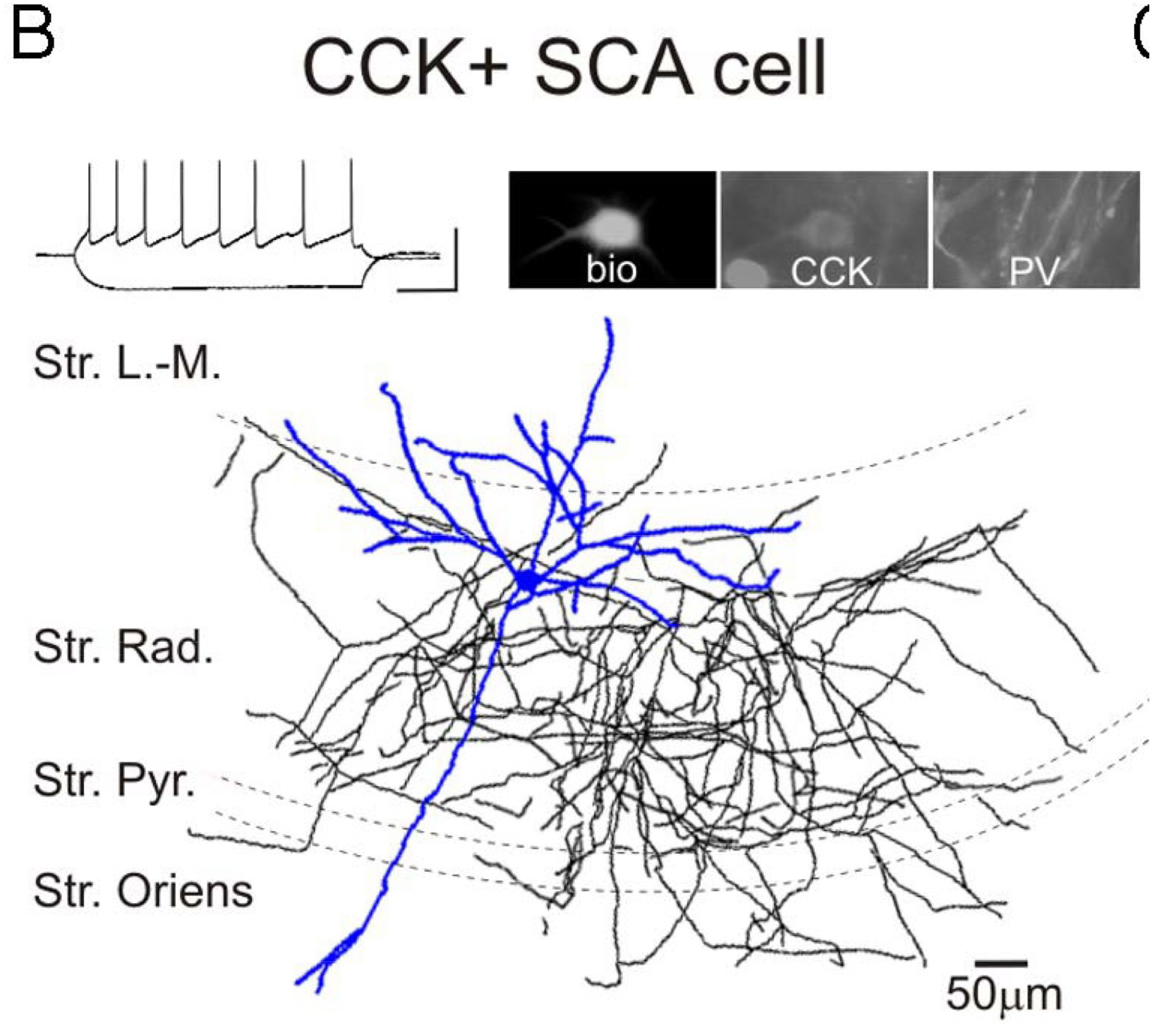
"Figure 1. Distinct axonal arborizations of CCK BCs [cholecystokinin basket cells] and SCAs [Schaffer collateral-associated cells] {CA1 Schaffer Collateral-Associated} in the CA1 region of the rat hippocampus. ... The camera lucida drawings of the two cells reveal sharp differences in the axonal layer specificity. C, Schematic diagram indicating the somatic position of the recorded CCK BCs (n = 46) and SCA interneurons (n = 58) in the stratum radiatum. Str. L.-M., Stratum lacunosum-moleculare; Str. Rad., stratum radiatum; Str. Pyr., stratum pyramidale; Str. Oriens, stratum oriens." |
| Mixed expression |
|
|
None known |
|
Electrophysiological properties
|
|
|
CA1 apical dendritic innervating 2333 neuron
|
Preferentially target main apical shaft of CA1 pyramidal cells, but do target other interneurons.
|
2333 -> 2311 - CLR, CW
|
Cell T46d [from Klausberger et al., 2005] might have AX presence in SO. Cell T159a has AX in SR-SP-SO but no mention of DE's. Therefore, T46d cannot by itself establish a class. - DWW
|
|
The axons of cell T46d in fig. 2 are not complete. The statement "apical dendrite innervating cells mainly terminate in stratum raidatum and oriens ..." seems clear, though. - CW
|
CA1 apical dendritic innervating 0311 neuron
removed dendritic presence in all CA1 layers except SR. weak evidence (1 orig sec) - CLR
|
I would say 2310. The axonal presence in SO for the one neuron is below 15% and is not a main termination point. If we use the 2310 definition based on Fig 2 and table 2, then I would omit the SO quote on p9791 and all of the K&S [Klausberger & Somogyi] schematics, since they do not jibe with 2310. - DWW 03/14/2011
|
|
My call is 2310. And agree with the omissions D[WW] mentioned. - CW 03/14/2011
|
|
CLR correctly points out my math was wrong so T159a does have significant axons in SO. In Fig 2, there is a hint of axons in SO. Since they only used 3 65-[micro]m-thick slices and do not present the axon in its entirety, I propose a 2311 interpretation to encompass both cells. I would still omit all K&S citations. - DWW 03/14/2011
|
|
Boutons in SO, so back to 2311. - CW
|
|
D [a member of] SLM? 2311? - GAA
|
CA1 apical dendritic innervating 2311 neuron
|
In Klausberger et al., 2005 (Figure 2), there is a hint of axons in SO. Since they only used 3 65-micrometer slices and do not present the axon in its entirety, DWW proposes a 2311 interpretation to encompass both cells.
|
I would omit K&S citations since they describe 2333. - DWW 03/24/2011
|
No change, but propose combining w/ SC 2311 during collapsing phase. - CLR 04/04/2011
|
|
Want to check with CLR's summary schematic + chemicals (subclasses?) + temp joint name. - GAA
|
Under consideration for merger with CA1 Schaffer collateral-associated 2311 cells, which has sub-threshold evidence for axons in Sub:SM. (This packet contains no evidence for axons in SM.)
CA1 Schaffer collateral-associated 2311 neurons
Added Vida's Fig 3. - CLR
|
DWW would omit K+S citations since they describe 2333. - DWW 03/24/2011
|
|
To be combined w/ ADI 2311 during collapsing phase.
|
CA1 Schaffer collateral-associated 2311-SUB000 neurons
|
This packet arises from a splitting of the CA1 SC 2311 class into those with a subiculum projection and those that remain in CA1.
|
|
This packet combines Schaffer collateral 2311 cells with Pawelzik's trilaminar 2311 cell.
|
I agree with packet split. also with SC 2311 + Pawelzik trilaminar 2311 merger. - CLR 04/27/2011
|
Check dendritic interpretation on p. 7. Other than that it's good, and I agree w. split. - CW 04/28/2011
|
|
Do these include ADI 2311? (pls mark synonyms)
|
|
Is the subicular evidence string enough? (>15%?) And is the basis of each evidence compelling enough in the SUB000 packet? I'm on the fence - perhaps more parsimonious to have 1 class with weak (subthreshold?) subicular evidence. - GAA
|
CA1 Schaffer collateral-associated 2311 neurons
|
Sub-threshold evidence for axons in Sub:SM.
|
|
Note: this packet combines "Schaffer collateral" 2311 neurons with Pawelzik's "trilaminar" 2311 neuron.
|
|
When last we saw this packet, it was split into two classes based on evidence for axons in Sub:SM. It has since been ruled that any presence in the subiculum is sub-threshold; this is being noted for future reference, but the presence is discounted based on the current rules and interpretation. Further, those cells without presence in subiculum do not present compelling enough evidence for packet separation.
|
|
This packet has now been re-merged into a single SC 2311 packet (which was actually approved previously) with added notes.
|
|
Under consideration for merger with ADI 2311.
|
CLR, DWW, CW
Do you approve of merging these two cell classes [CA1 ADI 2311 cells and CA1 Schaffer collateral 2311 cells] into a CA1 2311 SCA-ADI cell class?
Yes - DWW, CLR, CW
CA1 (-)2311 Schaffer collateral associated-apical dendrite innervating (SCA-ADI) neurons
|
This class is a merger of
|
|
CA1 2311 Schaffer collateral-associated (SCA) cells (earliest citations by Cossart et al., 1998, and Vida et al., 1998)
|
|
CA1 2311 trilaminar cells (in Pawelzik et al., 2002)
|
|
CA1 2311 apical dendrite-innervating (ADI) cells (in Klausberger et al., 2005)
|
CA1 (i)2311 Schaffer Collateral-Associated (SCA) neurons [4015]
|
Related types:
|
CA1 (i)2301 R-S-RO (v2.0 on-hold)
|
Notes:
Principal cell layer invoked rule: record axons in the PCL when boutons are present or when axons are branching and ostensibly targeting the PCL and not just passing through, but discount dendrites.
Reassessment of merger of CA1 (i)2301 R-S-RO into CA1 (i)2311 Schaffer Collateral-Associated.
I agree to have at least one more packet out of this material, and I can go with either pattern [CA1 (i)0102 vs. CA1 (i)0112], but Iâ??m frankly not convinced that we want two distinct neuron types. I believe that in v1.0 we have systematically merged all these cases. Do we have any example of 2 types that only differ in axonal presence in PCL? Unless thereâ??s direct evidence that one of the two makes synapses with the soma and the other does not, Iâ??d probably just merge them. If you agree, I suggest 0112, but am also happy with 0102. If there are other similar cases in v2.0, please consider merging. - GAA 02/01/2022
|
Proposal: merge 2301 into 2311 - DWW 02/03/2022
|
|
So in re-reviewing each potential merger within the packet Diek has kindly provided, I had a few questions arise pertinent to favoring merging unless there is direct evidence that one neuron type makes synapses with the soma and the other does not:
|
|
1. How does this impact the new invoked rule defined in the provided packet, namely that we will "record axons in the PCL when boutons are present or when axons are branching and ostensibly targeting the PCL and not just passing through, but discount dendrites?" Shall we disregard it?
|
|
2. If we favor the route of merging unless we have direct evidence of one neuron type establishing synapses with the soma while the other does not, which AD pattern should be preferred? The AD pattern exhibited by the majority of the reconstructions or the AD pattern of a single reconstruction that shows axonal presence (e.g. the 0102 & 0112 case that led to this discussion)? Perhaps this should be a case by case basis depending on what evidence makes the most sense to us? - JDK 02/06/2022
|
|
I would suggest that we utilize the PCL invoked rule as our fallback position, when we do not have overriding motivation to merge two or more neuron types. As to which way to merge, I would suggest, since we have not been consistent in the past, that we evaluate on a case-by-case basis. - DWW 02/07/2022
|
|
I concur. - GAA 02/07/2022
|
|
Thank you for answering my questions and this route sounds good to me. In light of utilizing the PCL invoked rule as a fallback position, I am okay with merging in all cases in the "Axons in the PCL" packet except for the 0103 and 0113 merger where we have a text description directly stating that the X-OPR (0113 O-RPO) axons display en passant boutons in SP whereas the X-OR (0103 O-BiC) do not. - JDK 02/07/2022
|
|
I find CW's argument convincing and would lean towards not merging. - GAA 02/13/2022
|
|
OK, I, too, am now swayed by CW's argument: "I am going to stick to my opinion that schematics should be interpreted as the authors' decided in the absence of additional information; so no, I do not agree to add this neuron [CA1 (i)2301 R-S-RO] to 2311. --CW 9/16/15" - DWW 02/14/2022
|
It was agreed by GAA, JDK, and DWW to adhere to the interpretations of the authors of schematics. - 02/15/2022
|
| Parameters
|
Single Compartment
|
Downloads
|
Simulate
|
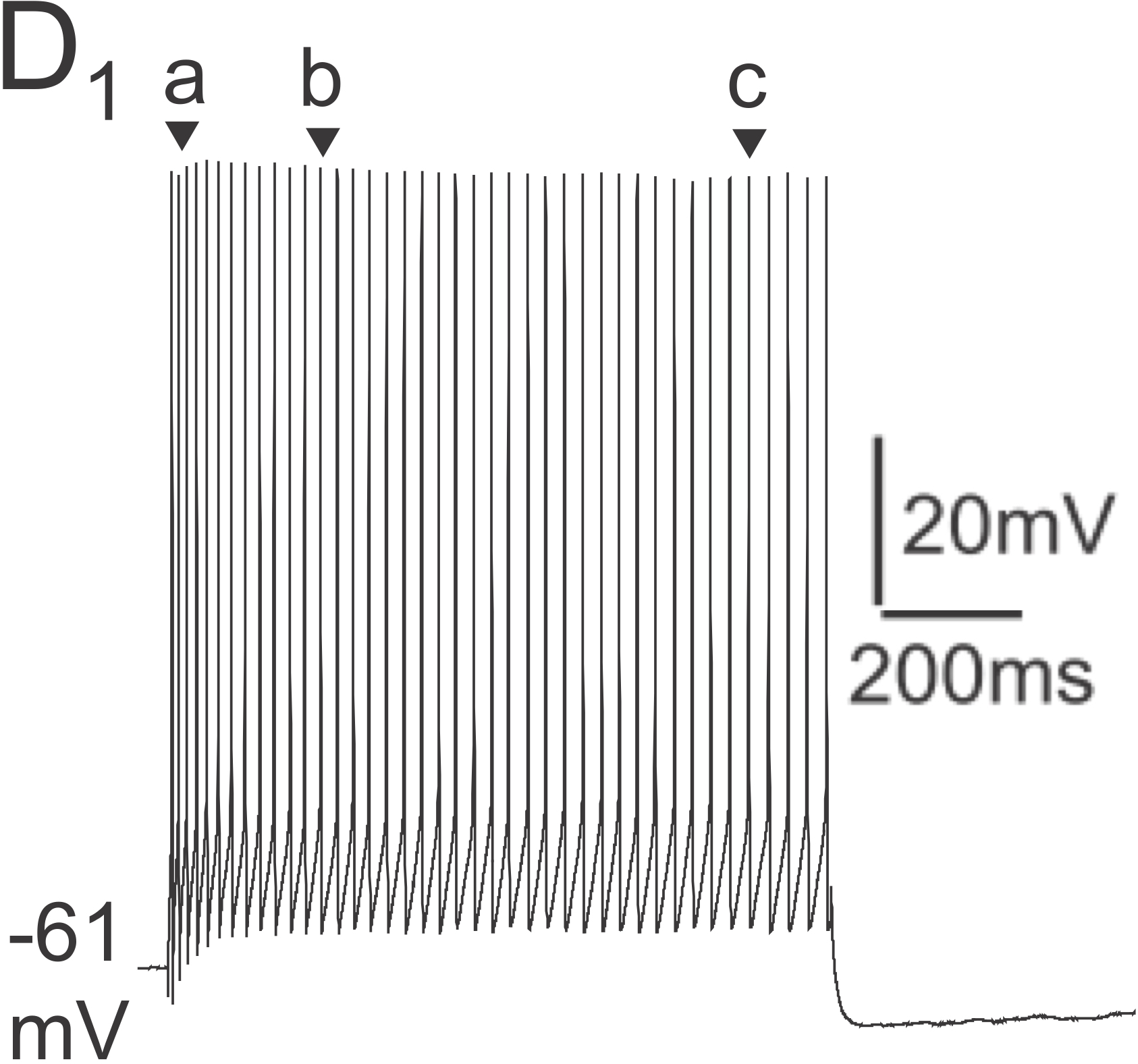
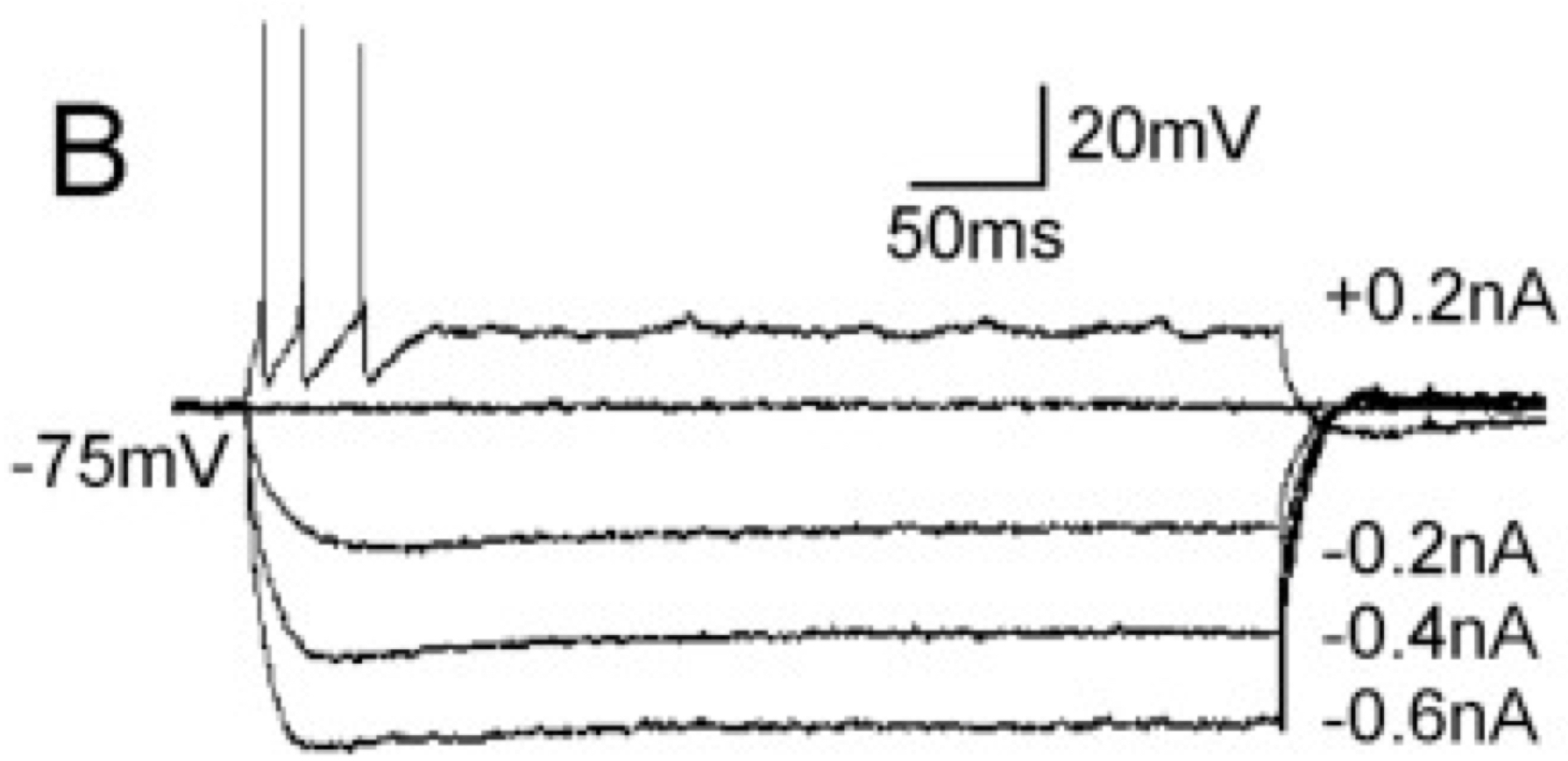
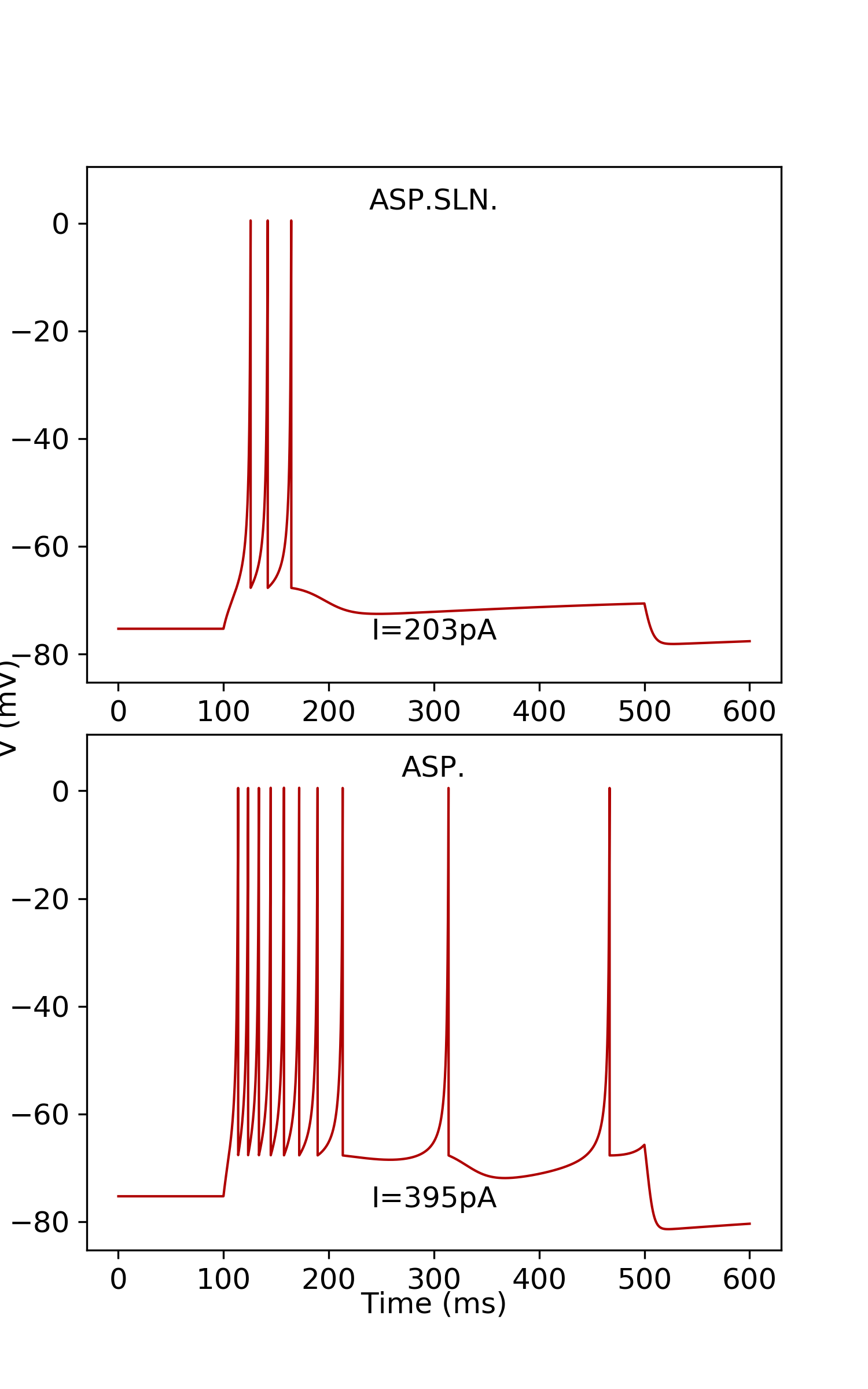
| subtype: 1 k=2.99;a= 0.002;b= 24.81;d= 34;C= 224;Vr= -75.31;Vt= -64.86;Vpeak= 0.53;Vmin= -67.72; | | Simulate
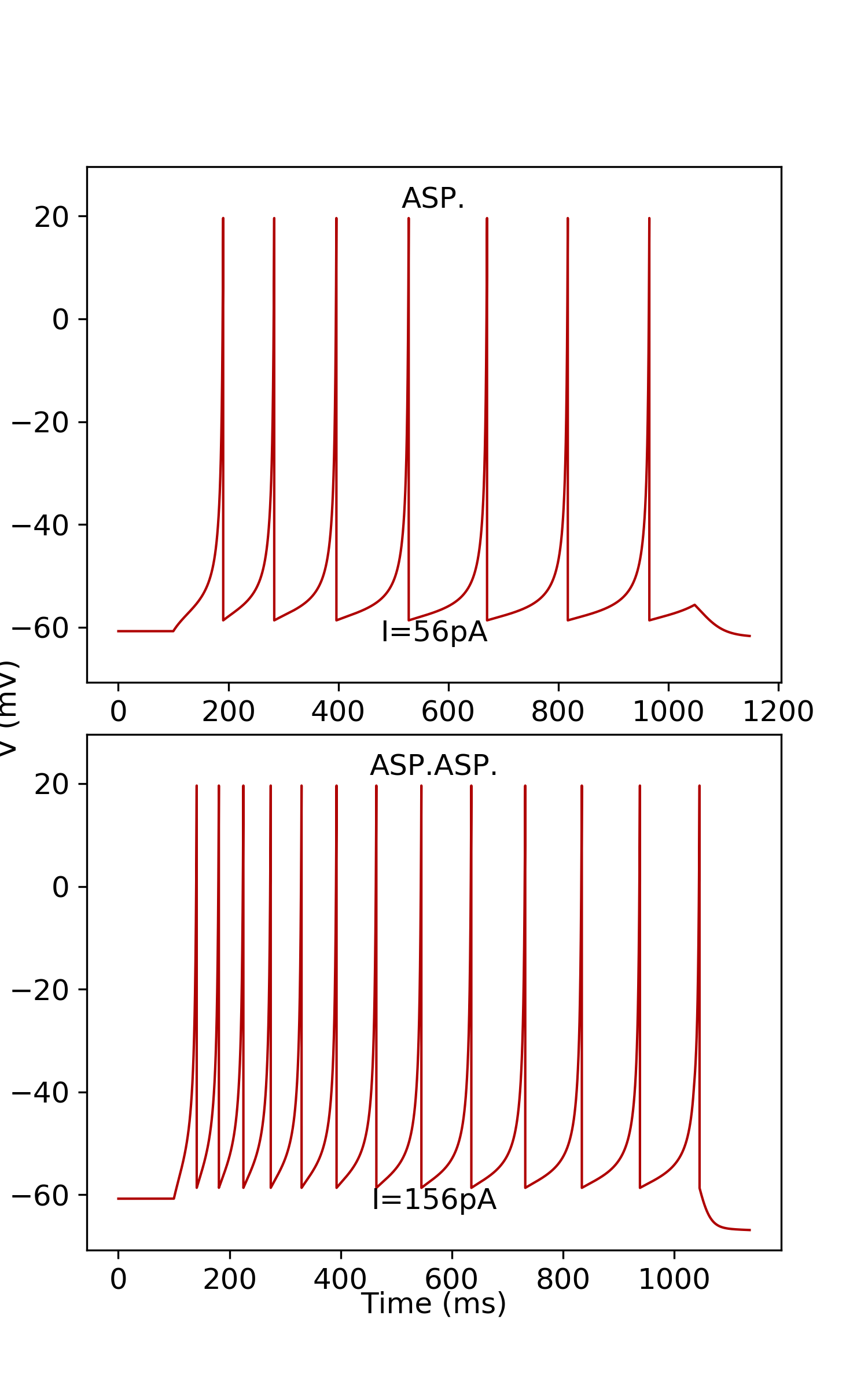
| | subtype: 2 k=1.52;a= 0.001;b= -52.68;d= 39;C= 328;Vr= -60.75;Vt= -53.44;Vpeak= 19.6;Vmin= -58.65; | | Simulate
|
|
|
|
|
Potential sources known to be avoided
|
|
|
|
|
|
Potential targets known to be avoided
|
|
| Oscillation Phase Locking |
| Category | Value | | Theta (deg): | -43.00 | | Theta range: | [-43.00, -43.00] | | Theta measurements: | 1 | | Theta representative selection: | rats, adult, unknown sex,
juxtacellular, urethane plus supplemental doses of ketamine and xylazine | | SWR ratio: | 0.00 | | SWR ratio range: | [0.00, 0.00] | | SWR ratio measurements: | 1 | | SWR ratio representative selection: | rats, adult, unknown sex,
juxtacellular, urethane plus supplemental doses of ketamine and xylazine | | In vivo firing rate (Hz): | 0.10 | | Firing rate range: | [0.10, 0.10] | | Firing rate measurements: | 1 | | Firing rate representative selection: | rats, adult, unknown sex,
juxtacellular, urethane plus supplemental doses of ketamine and xylazine | | Other: | firingRateNonBaseline | | Other representative selection: | rats, adult, unknown sex,
juxtacellular, urethane plus supplemental doses of ketamine and xylazine |
|
 Browse
 Search
 Help