CA1 Radial Trilaminar
* indicates new v2.0 neuron type
Name Supertype (ID:Family:Type:Subregion)
CA1 (i)2333 Radial Trilaminar S131504:Collateral-related:RO-targeting:CA1

Name derivation
This is the most frequently cited name and the modifier distinguishes it from the canonical CA1 Trilaminar. CA1 clarifies the subregion of origin, since the name is otherwise generic.

Synonym(s)
CA1 bistratified cell
CA1 radial trilaminar cell
CA1 ivy

List of articles
Click here to view the list
Daw MI  (2009) J Neurosci
Asynchronous transmitter release from cholecystokinin-containing inhibitory interneurons is widespread and target-cell independent.
Daw MI, Tricoire L, Erdelyi F, Szabo G, McBain CJ.
J Neurosci, 2009 Sep 9, 29 (36), Pages: 11112 - 11122
PMID: 19741117; DOI: 10.1523/JNEUROSCI.5760-08.2009
Tags: morphology, marker, membrane biophysics, connectivity, firing patterns, synapse probabilities
Freund TF  (1996) Hippocampus
Interneurons of the hippocampus.
Freund TF, Buzsaki G.
Hippocampus, 1996, 6 (4), Pages: 347 - 470
PMID: 8915675; DOI: 10.1002/(SICI)1098-1063(1996)6:4<347::AID-HIPO1>3.0.CO;2-I
Tags: morphology, connectivity, synapse probabilities
Glickfeld LL  (2006) Nat Neurosci
Distinct timing in the activity of cannabinoid-sensitive and cannabinoid-insensitive basket cells.
Glickfeld LL, Scanziani M.
Nat Neurosci, 2006 Jun, 9 (6), Pages: 807 - 815
PMID: 16648849; DOI: 10.1038/nn1688
Tags: connectivity, synapse probabilities
Hajos N  (1997) J Neurosci
Synaptic communication among hippocampal interneurons: properties of spontaneous IPSCs in morphologically identified cells.
Hajos N, Mody I.
J Neurosci, 1997 Nov 1, 17 (21), Pages: 8427 - 8442
PMID: 9334415
Tags: morphology, connectivity, synapse probabilities
Szabo GG  (2014) Hippocampus
Anatomically heterogeneous populations of CB1 cannabinoid receptor-expressing interneurons in the CA3 region of the hippocampus show homogeneous input-output characteristics.
Szabo GG, Papp OI, Mate Z, Szabo G, Hajos N.
Hippocampus, 2014 Dec, 24 (12), Pages: 1506 - 1523
PMID: 25044969; DOI: 10.1002/hipo.22330
Tags: morphology, connectivity, synapse probabilities

Supplemental PMIDs

List of Hippocampome.org to NeuroMorpho.Org mappings
Click here to view the list of mappings
  • Esclapez
  • Katona
    • C182_dendritic (fits the general description of "CA1 Radial Trilaminar" based on the distribution of axons and dendrites)
  • McBain
  • Scanziani

  • Morphology
    Soma
    CA1:SR
    CA1:SP
    Axons
    CA1:SR
    CA1:SP
    CA1:SO
    Dendrites
    CA1:SLM
    CA1:SR
    CA1:SP
    CA1:SO

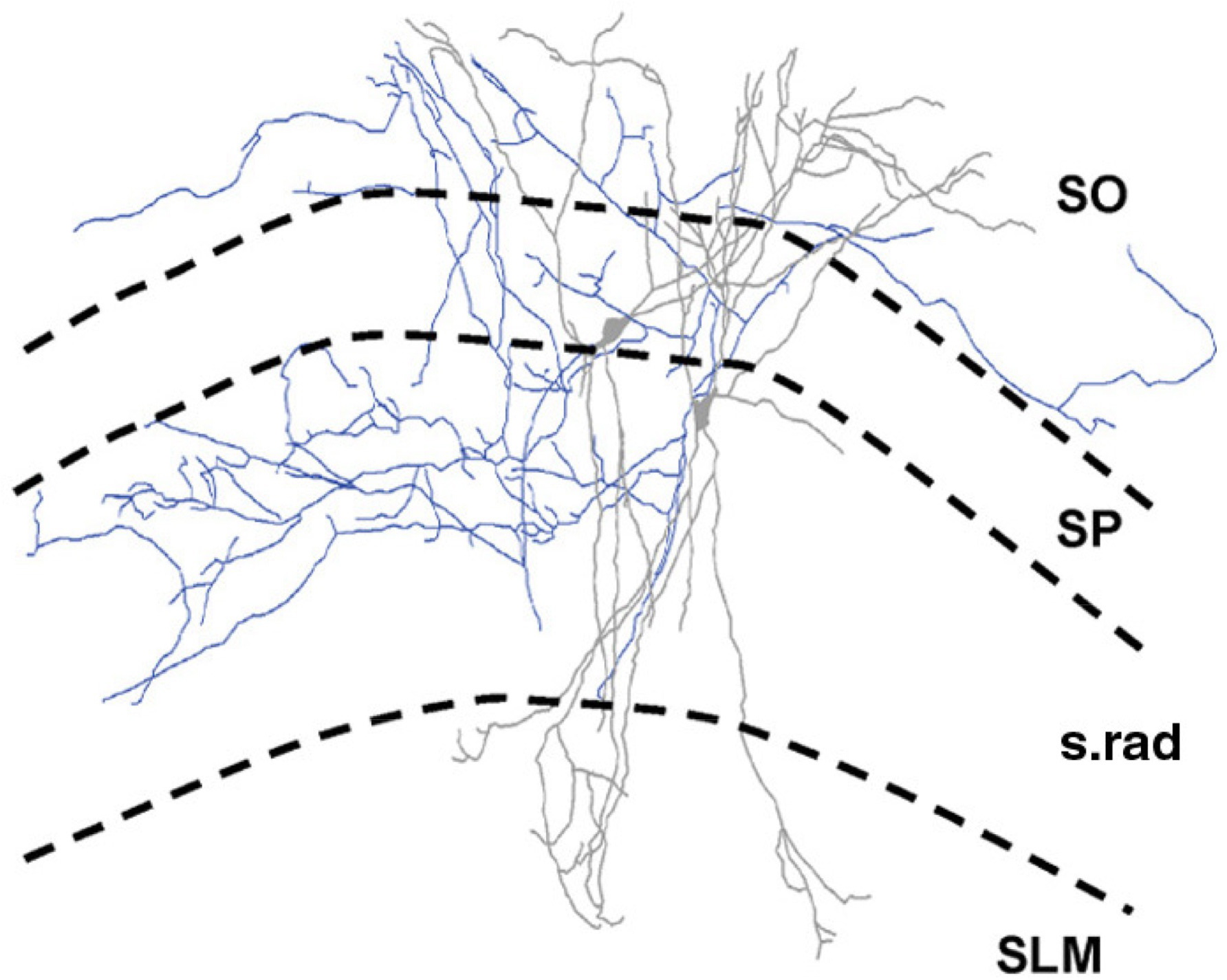
    Representative figure
    Asynchronous transmitter release from cholecystokinin-containing inhibitory interneurons is widespread and target-cell independent.
    Daw MI, Tricoire L, Erdelyi F, Szabo G, McBain CJ
    J Neurosci, 2009 Sep 9, 29 (36), pages: 11112 - 11122
    PMID: 19741117; DOI: 10.1523/JNEUROSCI.5760-08.2009


    "Figure 1. Four classes of interneuron [in CA1] ... B, Example bistratified cell {CA1 Radial Trilaminar} pair; dendrites and soma shown in gray, axons in blue, presynaptic soma to the left. Traces show responses to a 500 ms depolarizing current of double action potential threshold amplitude; presynaptic upper, postsynaptic lower trace."


    Molecular markers
    Positive
    CB1
    NPY
    Negative
    AR-beta2 (multiple confirming inferences)
    Chrna2 (inference)
    CR
    ENK (confirmed by inference)
    GABAa\alpha 6 (inference)
    mGluR1a (inference)
    nNOS
    SOM (confirmed by inference)
    VIP
    Mixed expression
    5HT-3 (subtypes)
    CCK (subtypes)
    CoupTF II (subtypes)
    PV (subtypes)
    vGluT3 (subtypes)

    Electrophysiological properties
    Key: [range] OR representative value±SD (measurements); Number of sources (total measurements): [min , max]

    Threshold potential (Vthresh): 27 mV (1); 3 sources (3): [20.2 , 29]
    Fast afterhyperpolaziring potential amplitude (Fast AHP): 25±4 mV (15); 3 sources (17): [11 , 25]
    Action potential amplitude (APampl): 48±8 mV (15); 3 sources (17): [48 , 56]
    Max firing rate (Max F.R.): >145 Hz (1); 1 source
    Slow afterhyperpolarizing potential amplitude (Slow AHP): 0.82 mV (1); 3 sources (3): [0.82 , 6]
    Resting membrane potential (Vrest): -57±5 mV (15); 1 source
    Input resistance (Rin): 116±63 MΩ (15); 1 source
    Time constant (τm): 13±8 ms (15); 1 source
    Action potential width (APwidth): 0.54±0.11 ms (15); 1 source
    Sag ratio: 0.89 (1); 1 source

    Notes

    Do you approve of merging these two cell classes?

    CA1 bistratified 2333 cells (fully approved)
    CA1 radial trilaminar 2333 cells (fully approved)

    Yes - DWW, CW, CLR

    Yes to merger. We'll need actually to decide whether to keep 2 sub-classes depending on soma location since one of them could receive basket input and the other doesn't! This can be done on the basis of the "red box" logic in the connectivity matrix. Not sure about name yet. We need complete mapping of synonyms in both sources. For example, couldn't these be SCA? (Somogyi/Klausberger?!) Pawelzik & Thompson's paper should also be added! - GAA

    Merger has been approved by DWW, CW, CLR, and GAA.

    Notes have been added to internal packets indicating that Pawelzik's bistrat cells (with dendrites in SLM) do not meet our rules. These cells appear in the bistrat 0333 packet instead.

    CA1 (-)2333 bistratified cells-trilaminar cells (BiC-TriC)

    This is a combo-class composed of

    CA1 2333 bistratified (bi) cells
    CA1 2333 trilaminar (tri) cells

    Proposal to merge CA1 (i)2323 Ivy into CA1 (i)2333 Radial Trilaminar.

    I am in agreement with compression of the 2323 Ivy with the 2333 Radial Trilaminar to be considered as 2333. - JDK 11/03/2021

    Update: Principal cell layer invoked rule: record axons in the PCL when boutons are present or when axons are branching and ostensibly targeting the PCL and not just passing through, but discount dendrites.

    After re-review based on our updated new invoked rule, I donā??t think that the axons of the Ivy cell are clearly targeting SP. Therefore I am in favor of keeping these two cell types distinct. What do you think upon re-review? - JDK 11/22/2021

    I agree. The axons are not targeting SP. We will keep the two types separate. - DWW 11/22/2021

    CA1 (i)2333 Radial Trilaminar cells (Radial TriC) [4013]

    Related types: CA1 (i)2333 IS3 (v2.0 on-hold)
    CA1 (i)0333 Ivy (v1.0 active)

    Notes:

    Lapray: [Y:A:CA1:SP{low}]. NK1R+. nNOS+. NPY+.

    Reassessment of merger of CA1 (i)2323 Ivy into CA1 (i)2333 Radial Trilaminar.

    I agree to have at least one more packet out of this material, and I can go with either pattern [CA1 (i)0102 vs. CA1 (i)0112], but Iā??m frankly not convinced that we want two distinct neuron types. I believe that in v1.0 we have systematically merged all these cases. Do we have any example of 2 types that only differ in axonal presence in PCL? Unless thereā??s direct evidence that one of the two makes synapses with the soma and the other does not, Iā??d probably just merge them. If you agree, I suggest 0112, but am also happy with 0102. If there are other similar cases in v2.0, please consider merging. - GAA 02/01/2022

    Proposal: merge 2323 into 2333 - DWW 02/03/2022

    So in re-reviewing each potential merger within the packet Diek has kindly provided, I had a few questions arise pertinent to favoring merging unless there is direct evidence that one neuron type makes synapses with the soma and the other does not:

    1. How does this impact the new invoked rule defined in the provided packet, namely that we will "record axons in the PCL when boutons are present or when axons are branching and ostensibly targeting the PCL and not just passing through, but discount dendrites?" Shall we disregard it?
    2. If we favor the route of merging unless we have direct evidence of one neuron type establishing synapses with the soma while the other does not, which AD pattern should be preferred? The AD pattern exhibited by the majority of the reconstructions or the AD pattern of a single reconstruction that shows axonal presence (e.g. the 0102 & 0112 case that led to this discussion)? Perhaps this should be a case by case basis depending on what evidence makes the most sense to us? - JDK 02/06/2022

    I would suggest that we utilize the PCL invoked rule as our fallback position, when we do not have overriding motivation to merge two or more neuron types. As to which way to merge, I would suggest, since we have not been consistent in the past, that we evaluate on a case-by-case basis. - DWW 02/07/2022

    I concur. - GAA 02/07/2022

    Thank you for answering my questions and this route sounds good to me. In light of utilizing the PCL invoked rule as a fallback position, I am okay with merging in all cases in the "Axons in the PCL" packet except for the 0103 and 0113 merger where we have a text description directly stating that the X-OPR (0113 O-RPO) axons display en passant boutons in SP whereas the X-OR (0103 O-BiC) do not. - JDK 02/07/2022

    I agree. - GAA 02/13/2022

    Firing Pattern
    Images
    Image MissingImage MissingImage Missing
    Parameters View page
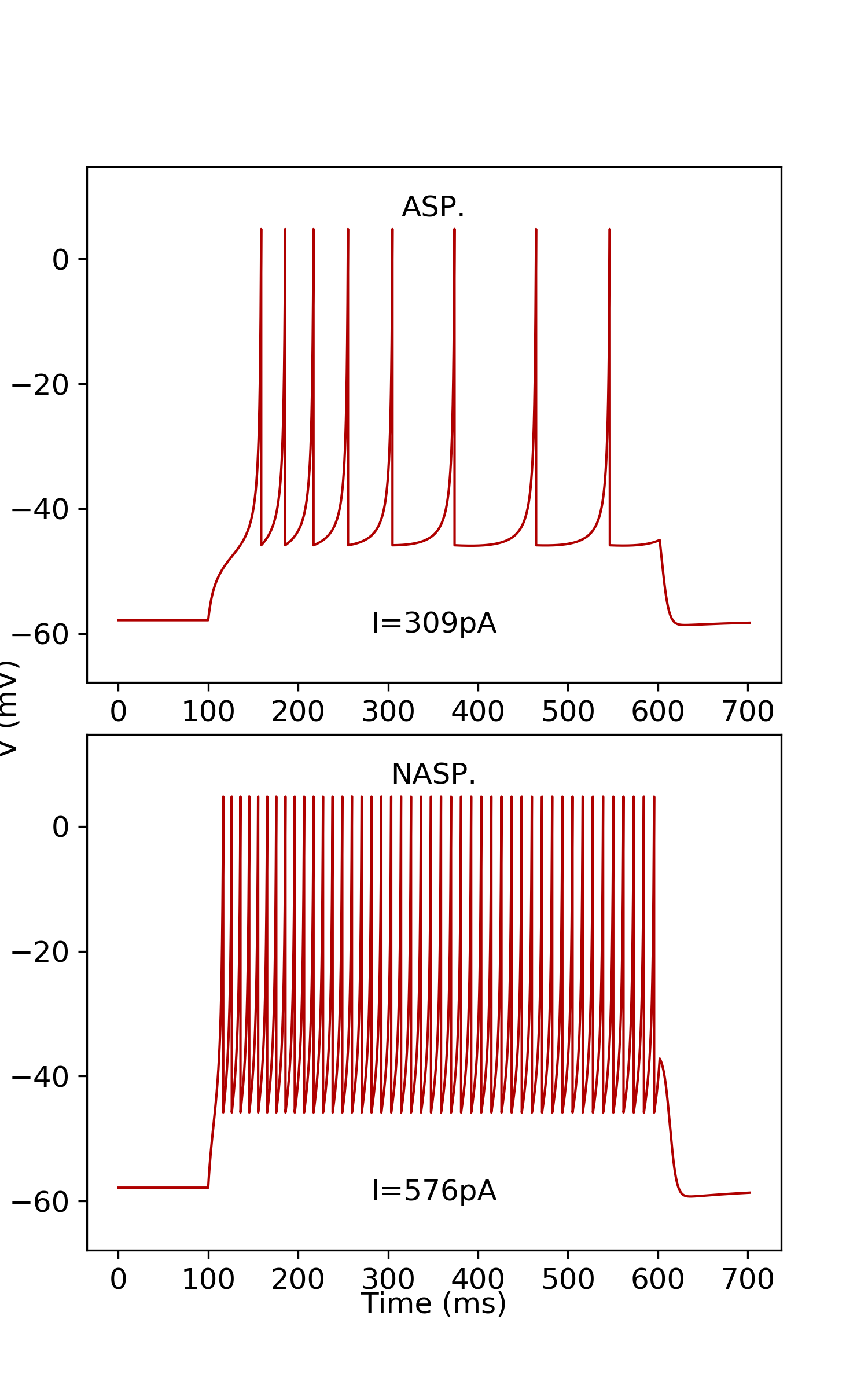
    ASP. [Evidence] [Firing Pattern]
    NASP [Evidence] [Firing Pattern]
    PSTUT [Evidence] [Firing Pattern]

    Izhikevich Model
    Parameters Single Compartment Downloads Simulate
    subtype: 1 k=2.64;a= 0.009;b= 3.59;d= 2;C= 227;Vr= -57.87;Vt= -37.93;Vpeak= 4.77;Vmin= -45.87; Simulate
    Images
    Image Missing
    ModelDB Model
    Model Accession Number PubMed ID

    Sources of Input
    Known sources
    Excitatory or Inhibitory
    CA1 Pyramidal
    CA1 Basket
    CA1 Schaffer Collateral-Associated
    CA1 Radial Trilaminar

    Potential sources
    Excitatory or Inhibitory
    DG Local-Projecting Cajal-Retzius*
    CA3 Pyramidal
    CA3c Pyramidal
    CA3c Umbrella Pyramidal*
    CA3 Trilaminar
    CA2 Pyramidal
    CA2 Wide-Arbor Basket
    CA2 Bistratified
    CA1 Deep Pyramidal
    CA1 Superficial Pyramidal
    CA1 Cajal-Retzius
    CA1 Local-Projecting Cajal-Retzius*
    CA1 Radiatum Giant
    CA1 Back-Projection
    CA1 Horizontal Basket
    CA1 R-P Basket*
    CA1 Trilayer Basket*
    CA1 Vertical Basket*
    CA1 Basket CCK+
    CA1 Horizontal Basket CCK+*
    CA1 Trilayer Basket CCK+*
    CA1 Bistratified
    CA1 Hippocampo-subicular Projecting ENK+
    CA1 Ivy
    CA1 Interneuron Specific LM-R
    CA1 Interneuron Specific LMO-O
    CA1 LMR
    CA1 LMR-LM*
    CA1 Interneuron Specific LMR-O*
    CA1 LMR-R*
    CA1 Interneuron Specific LMR-R
    CA1 LMR Projecting
    CA1 Neurogliaform
    CA1 Neurogliaform Projecting
    CA1 O-LM
    CA1 Recurrent O-LM
    CA1 O-LMR
    CA1 Recurrent O-LMR*
    CA1 Interneuron Specific O-R
    CA1 O-RP*
    CA1 Interneuron Specific O-Targeting QuadD
    CA1 Oriens/Alveus
    CA1 Oriens-Bistratified
    CA1 Oriens-QuadA Projecting
    CA1 OR-LM
    CA1 O-RPO*
    CA1 Perforant Path-Associated
    CA1 Perforant Path-Associated QuadD
    CA1 QuadD-RP*
    CA1 Quadrilaminar
    CA1 Interneuron Specific R-O
    CA1 R-Receiving Apical-Targeting
    CA1 R-RO*
    CA1 R-RP*
    CA1 Radiatum
    CA1 Interneuron Specific RO-O
    CA1 Interneuron Specific RO-R*
    CA1 RO-RP*
    CA1 RP-RPO*
    CA1 Schaffer Collateral-Correlated*
    CA1 Schaffer Collateral-Receiving R-Targeting
    CA1 SO-SO
    CA1 SO-SO Projecting*
    CA1 Trilaminar
    Sub CA1-Projecting Pyramidal
    EC LIII Small Pyramidal
    EC LIII Pyramidal

    Potential sources known to be avoided
    Excitatory or Inhibitory
    CA1 Axo-axonic
    CA1 Horizontal Axo-axonic

    Targets of Output
    Known targets
    Excitatory or Inhibitory
    CA1 Pyramidal
    CA1 Schaffer Collateral-Associated
    CA1 Radial Trilaminar

    Potential targets
    Excitatory or Inhibitory
    CA2 Wide-Arbor Basket
    CA1 Deep Pyramidal
    CA1 Superficial Pyramidal
    CA1 Radiatum Giant
    CA1 Axo-axonic
    CA1 Horizontal Axo-axonic
    CA1 Back-Projection
    CA1 Basket
    CA1 Horizontal Basket
    CA1 R-P Basket*
    CA1 Trilayer Basket*
    CA1 Vertical Basket*
    CA1 Basket CCK+
    CA1 Horizontal Basket CCK+*
    CA1 Trilayer Basket CCK+*
    CA1 Bistratified
    CA1 RO-receiving CA3-targeting*
    CA1 Hippocampo-subicular Projecting ENK+
    CA1 Ivy
    CA1 Interneuron Specific LMO-O
    CA1 LMR
    CA1 LMR-LM*
    CA1 Interneuron Specific LMR-O*
    CA1 LMR-R*
    CA1 Interneuron Specific LMR-R
    CA1 LMR Projecting
    CA1 O-LM
    CA1 Recurrent O-LM
    CA1 O-LMR
    CA1 Recurrent O-LMR*
    CA1 Interneuron Specific O-R
    CA1 O-RP*
    CA1 Interneuron Specific O-Targeting QuadD
    CA1 Oriens/Alveus
    CA1 Oriens-Bistratified
    CA1 Oriens-QuadA Projecting
    CA1 OR-LM
    CA1 O-RPO*
    CA1 Perforant Path-Associated
    CA1 Perforant Path-Associated QuadD
    CA1 QuadD-RP*
    CA1 Quadrilaminar
    CA1 Interneuron Specific R-O
    CA1 R-Receiving Apical-Targeting
    CA1 R-RO*
    CA1 R-RP*
    CA1 Radiatum
    CA1 Interneuron Specific RO-O
    CA1 Interneuron Specific RO-R*
    CA1 RO-RP*
    CA1 RP-RPO*
    CA1 Schaffer Collateral-Correlated*
    CA1 Schaffer Collateral-Receiving R-Targeting
    CA1 SO-SO
    CA1 SO-SO Projecting*
    CA1 Trilaminar

    Potential targets known to be avoided
    Excitatory or Inhibitory
    none known

    Oscillation Phase Locking
    Category
    Value