CA1 Perforant Path-Associated
* indicates new v2.0 neuron type
Name Supertype (ID:Family:Type:Subregion)
CA1 (i)3200p-DG_1000-Sub_100 Perforant Path-Associated S101304:Ivy/Neurogliaform Family:Ivy/Neurogliaform:CA1

Name derivation
This is a canonical Klausberger and Somogyi name that is the most well known in the cited literature. CA1 clarifies the subregion of origin, since the name is otherwise generic.

Synonym(s)
CA1 lacunosum-moleculare perforant path-associated cell
CA1 perforant path associated cell
CA1 perforant path-associated interneuron
CA1 perforant-path associated interneuron
CA1 R-LM interneuron
CA1 R-LM neuron

List of articles
Click here to view the list
Cossart R  (1998) Nat Neurosci
GluR5 kainate receptor activation in interneurons increases tonic inhibition of pyramidal cells.
Cossart R, Esclapez M, Hirsch JC, Bernard C, Ben-Ari Y.
Nat Neurosci, 1998 Oct, 1 (6), Pages: 470 - 478
PMID: 10196544; DOI: 10.1038/2185
Tags: morphology
Klausberger T  (2008) Science
Neuronal diversity and temporal dynamics: the unity of hippocampal circuit operations.
Klausberger T, Somogyi P.
Science, 2008 Jul 4, 321 (5885), Pages: 53 - 57
PMID: 18599766; DOI: 10.1126/science.1149381
Tags: morphology, connectivity, synapse probabilities
Klausberger T  (2009) Eur J Neurosci
GABAergic interneurons targeting dendrites of pyramidal cells in the CA1 area of the hippocampus.
Klausberger T.
Eur J Neurosci, 2009 Sep, 30 (6), Pages: 947 - 957
PMID: 19735288; DOI: 10.1111/j.1460-9568.2009.06913.x
Tags: morphology, connectivity, synapse probabilities
Somogyi P  (2005) J Physiol
Defined types of cortical interneurone structure space and spike timing in the hippocampus.
Somogyi P, Klausberger T.
J Physiol, 2005 Jan 1, 562 (Pt 1), Pages: 9 - 26
PMID: 15539390; DOI: 10.1113/jphysiol.2004.078915
Tags: morphology, connectivity, synapse probabilities
Somogyi P  (2010) Handbook of Brain Microcircuits
Chapter: Hippocampus: Intrinsic organisation
Somogyi P.
Handbook of Brain Microcircuits, 2010, Pages: 148 - 164
ISBN: 9780195389883
Tags: morphology, connectivity, synapse probabilities
Vida I  (1998) J Physiol
Unitary IPSPs evoked by interneurons at the stratum radiatum-stratum lacunosum-moleculare border in the CA1 area of the rat hippocampus in vitro.
Vida I, Halasy K, Szinyei C, Somogyi P, Buhl EH.
J Physiol, 1998 Feb 1, 506 ( Pt 3), Pages: 755 - 773
PMID: 9503336; DOI: 10.1111/j.1469-7793.1998.755bv.x
Tags: morphology, membrane biophysics, connectivity, firing patterns, synapse probabilities
Vida I  (2010) Hippocampal Microcircuits: A Computational Modeler's Resource Book
Morphology of Hippocampal Neurons
Vida I.
Hippocampal Microcircuits: A Computational Modeler's Resource Book, 2010, Pages: 27 - 68
ISBN: 9781441909954
Tags: morphology, connectivity, synapse probabilities

Morphology
Soma
CA1:SLM
CA1:SR
Axons
DG:SMo
CA1:SLM
SUB:SM
Dendrites
CA1:SLM
CA1:SR

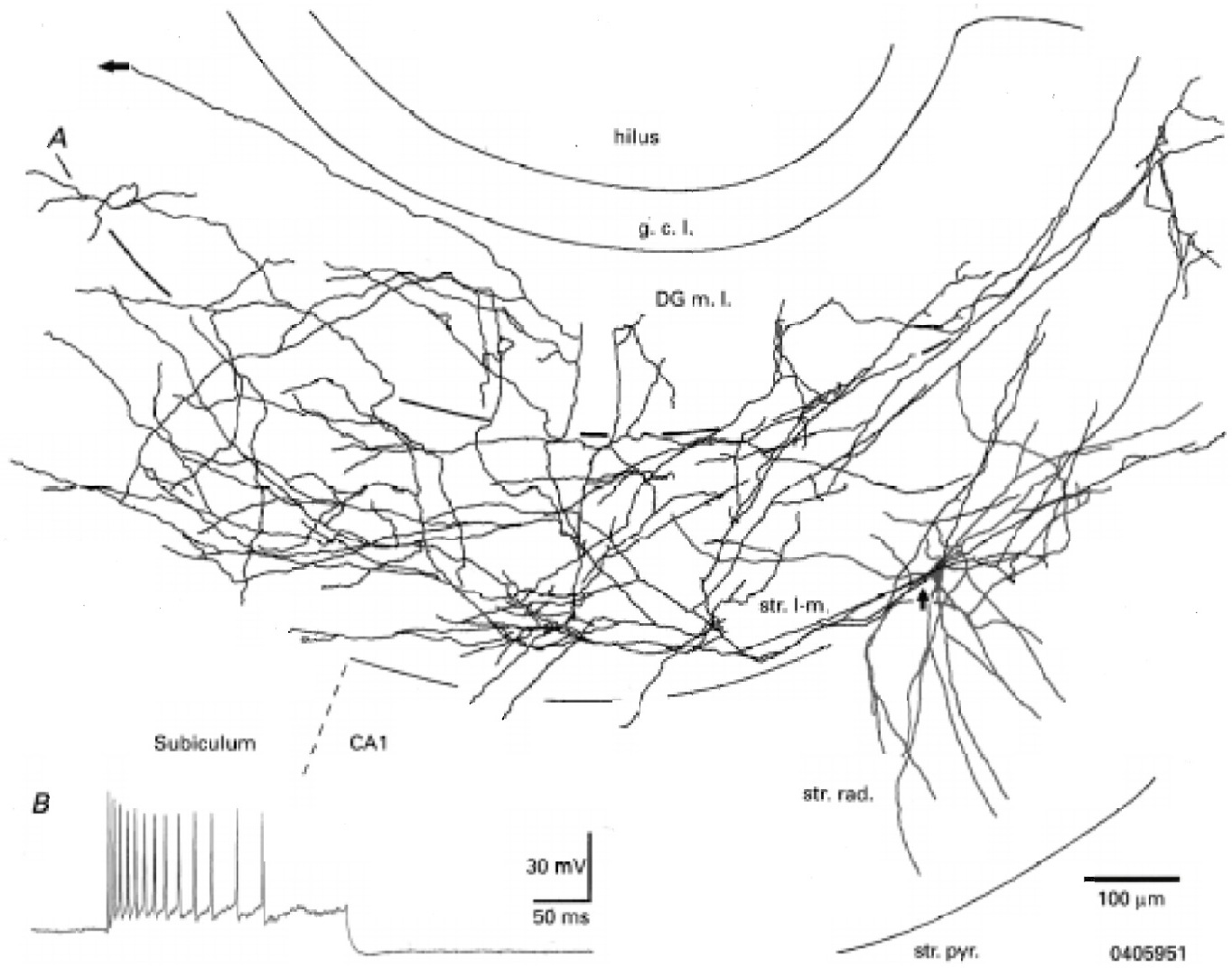
Representative figure
Unitary IPSPs evoked by interneurons at the stratum radiatum-stratum lacunosum-moleculare border in the CA1 area of the rat hippocampus in vitro.
Vida I, Halasy K, Szinyei C, Somogyi P, Buhl EH
J Physiol, 1998 Feb 1, 506 ( Pt 3) pages: 755 - 773
PMID: 9503336; DOI: 10.1111/j.1469-7793.1998.755bv.x


"Figure 5. Properties of a perforant path-associated interneuron {CA1 Perforant Path-Associated} [in CA1] A, light microscopic reconstruction of the interneuron (soma and dendrites in red, axon in black, main axon denoted by short arrow) having an axonal arbour not only within stratum lacunosum-moleculare (str. l-m.), but also in the outer portions of the dentate gyrus molecular layer (DG m.l.) and adjoining parts of the subiculum (CA1Ñsubicular border denoted by stippled line). A long arrow denotes the position of an additional collateral which (re)crossed the hippocampal fissure and gave rise to a large axonal plexus in the presubiculum (not shown)."


Molecular markers
Positive
CB1 (inference)
CCK (confirmed by inference)
Negative
AR-beta1 (multiple confirming inferences)
Chrna2 (inference)
CR (multiple confirming inferences)
ENK (multiple confirming inferences)
GABAa\alpha 6 (inference)
Gaba-a-alpha (inference)
mGluR1a (inference)
MOR (multiple confirming inferences)
NPY (inference)
PV (multiple confirming inferences)
SOM (multiple confirming inferences)
VIP
Mixed expression
None known

Electrophysiological properties
Key: [range] OR representative value±SD (measurements); Number of sources (total measurements): [min , max]

Resting membrane potential (Vrest): -55.4±3.1 mV (6); 1 source
Input resistance (Rin): 84.2±23.7 MΩ (6); 1 source
Time constant (τm): 11.9±5.9 ms (6); 1 source
Threshold potential (Vthresh): 9.3 mV (1); 1 source
Fast afterhyperpolaziring potential amplitude (Fast AHP): 7±2.6 mV (2); 1 source
Action potential amplitude (APampl): 69.4±5.3 mV (6); 1 source
Action potential width (APwidth): 0.73±0.1 ms (6); 1 source
Slow afterhyperpolarizing potential amplitude (Slow AHP): 12.4 mV (1); 1 source

Notes
Related classes: CA1 (-)3300p-DG 1110 perforant path I (PP I) neurons (active) CA1 (-)3220 perforant path-associated (PPA) neurons (new, proposed for suspension) CA1 (-)3202 perforant path-associated (PPA) neurons (new, proposed for suspension) The above two classes are being considered for merger into CA1 (-)3222 perforant path-associated (PPA) neurons

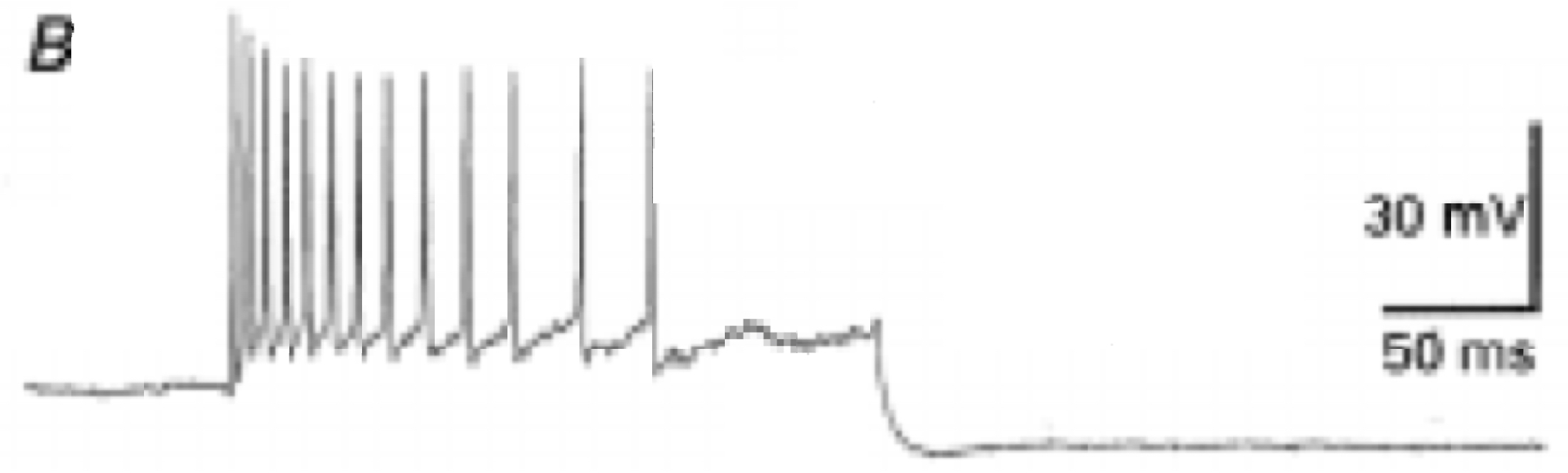
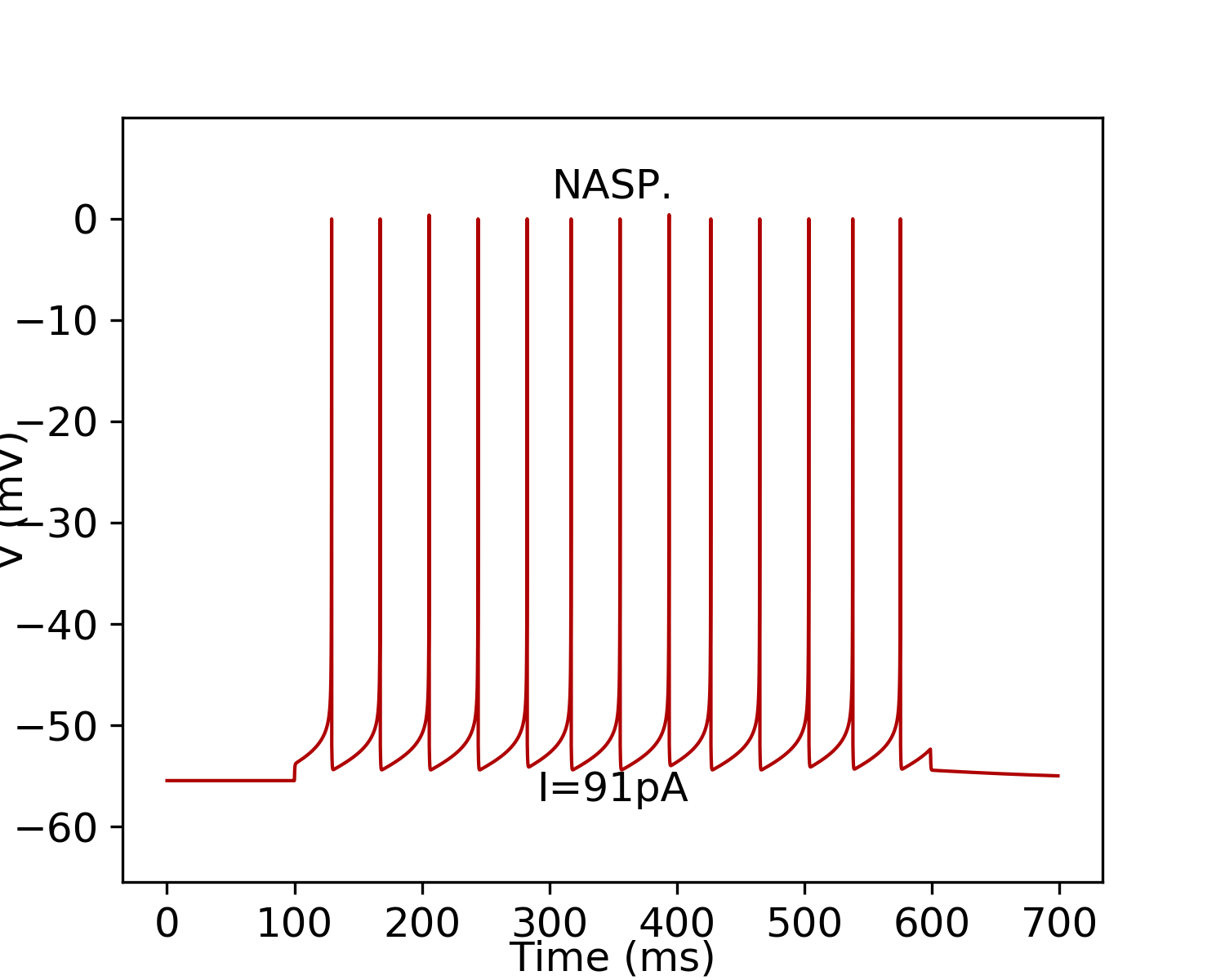
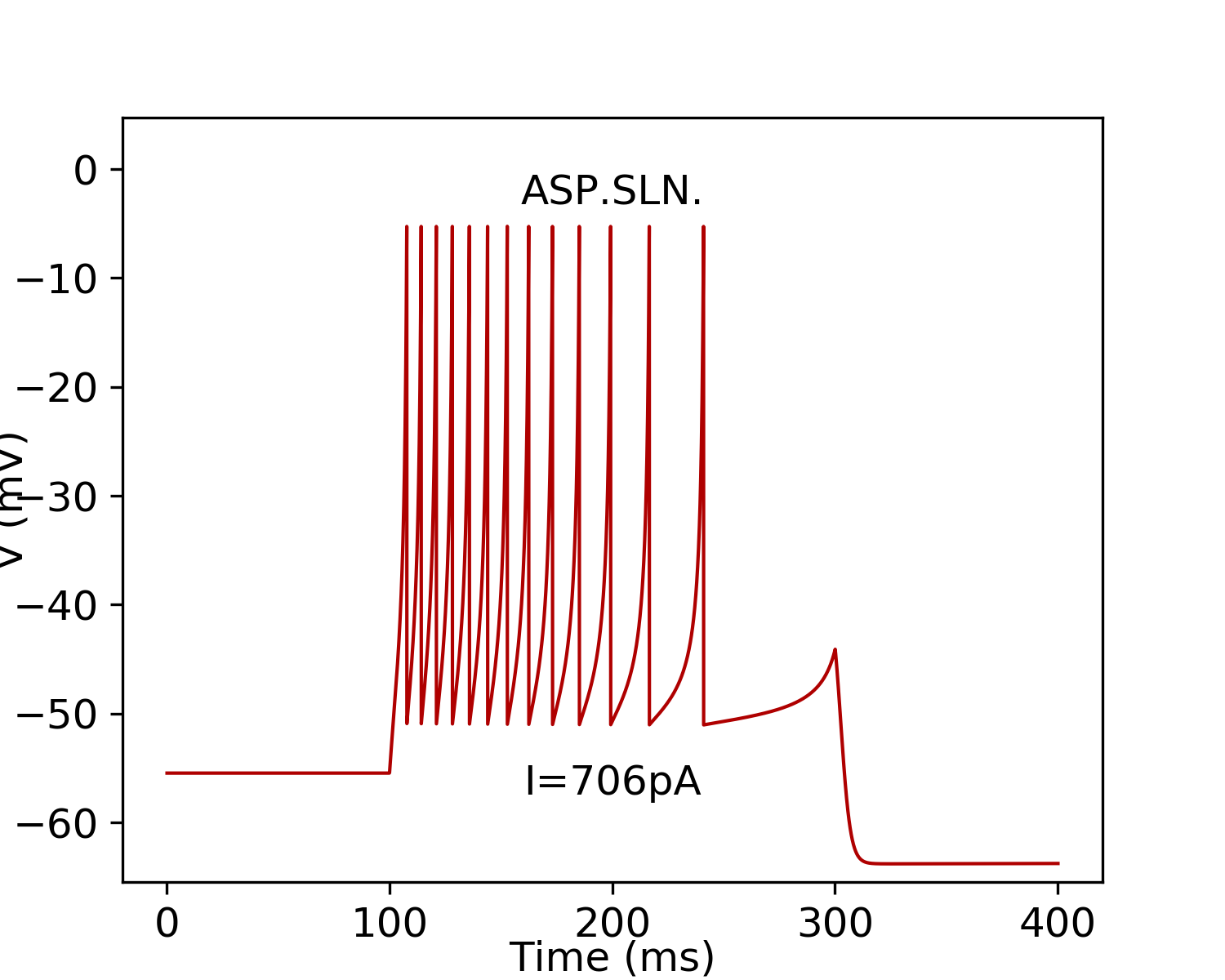
Firing Pattern
Images
Image MissingImage Missing
Parameters View page
ASP.SLN [Evidence] [Firing Pattern]
NASP [Evidence] [Firing Pattern]

Izhikevich Model
Parameters Single Compartment Downloads Simulate
subtype: 1 k=4.84;a= 0.045;b= -49.31;d= 194;C= 12;Vr= -55.44;Vt= -42.5;Vpeak= -0.05;Vmin= -51; Simulate
subtype: 2 k=4.1;a= 0;b= 5.05;d= 47;C= 233;Vr= -55.47;Vt= -46.1;Vpeak= -5.27;Vmin= -51.04; Simulate
Images
Image MissingImage Missing
ModelDB Model
Model Accession Number PubMed ID

Sources of Input
Known sources
Excitatory or Inhibitory
CA1 O-LM

Potential sources
Excitatory or Inhibitory
DG Local-Projecting Cajal-Retzius*
CA3 Pyramidal
CA3c Pyramidal
CA3c Umbrella Pyramidal*
CA3 Trilaminar
CA2 Pyramidal
CA2 Bistratified
CA1 Cajal-Retzius
CA1 Local-Projecting Cajal-Retzius*
CA1 Back-Projection
CA1 Bistratified
CA1 Hippocampo-subicular Projecting ENK+
CA1 Ivy
CA1 Interneuron Specific LM-R
CA1 LMR
CA1 LMR-LM*
CA1 LMR-R*
CA1 Interneuron Specific LMR-R
CA1 LMR Projecting
CA1 Neurogliaform
CA1 Neurogliaform Projecting
CA1 Recurrent O-LM
CA1 O-LMR
CA1 Recurrent O-LMR*
CA1 Interneuron Specific O-R
CA1 O-RP*
CA1 Oriens-Bistratified
CA1 Oriens-QuadA Projecting
CA1 OR-LM
CA1 O-RPO*
CA1 Perforant Path-Associated
CA1 Perforant Path-Associated QuadD
CA1 QuadD-RP*
CA1 Quadrilaminar
CA1 R-Receiving Apical-Targeting
CA1 R-RO*
CA1 R-RP*
CA1 Radiatum
CA1 Interneuron Specific RO-R*
CA1 RO-RP*
CA1 RP-RPO*
CA1 Schaffer Collateral-Associated
CA1 Schaffer Collateral-Correlated*
CA1 Schaffer Collateral-Receiving R-Targeting
CA1 Trilaminar
CA1 Radial Trilaminar
Sub CA1-Projecting Pyramidal
EC LIII Small Pyramidal
EC LIII Pyramidal

Potential sources known to be avoided
Excitatory or Inhibitory
none known

Targets of Output
Known targets
Excitatory or Inhibitory
DG Granule
CA1 Pyramidal

Potential targets
Excitatory or Inhibitory
DG Adult-Born Immature Granule*
DG Hilar Ectopic Granule
DG Semilunar Granule
DG Cajal-Retzius*
DG Local-Projecting Cajal-Retzius*
DG Mossy MOLDEN
DG AIPRIM
DG Axo-axonic
DG Granulosum-targeting Axo-axonic*
DG Axo-axonic GRALDEN*
DG Basket
DG Basket GRALDEN*
DG Basket CCK+
DG Interneuron Specific COLTAR*
DG COM-MOPP*
DG HICAP
DG Interneuron Specific IMOT*
DG Interneuron Specific HIMOLD*
DG Interneuron Specific HIPRO*
DG MOLAX
DG Molecular Layer*
DG Outer Molecular Layer
DG Total Molecular Layer
DG MOPP
DG Neurogliaform
DG Wide-Arbor Neurogliaform*
CA1 Deep Pyramidal
CA1 Superficial Pyramidal
CA1 Cajal-Retzius
CA1 Local-Projecting Cajal-Retzius*
CA1 Radiatum Giant
CA1 Axo-axonic
CA1 Basket
CA1 Vertical Basket*
CA1 Basket CCK+
CA1 Interneuron Specific LM-R
CA1 Interneuron Specific LMO-O
CA1 LMR
CA1 LMR-LM*
CA1 Interneuron Specific LMR-O*
CA1 LMR-R*
CA1 Interneuron Specific LMR-R
CA1 LMR Projecting
CA1 Neurogliaform
CA1 Neurogliaform Projecting
CA1 Interneuron Specific O-Targeting QuadD
CA1 Oriens/Alveus
CA1 Perforant Path-Associated
CA1 Perforant Path-Associated QuadD
CA1 QuadD-RP*
CA1 Quadrilaminar
CA1 Schaffer Collateral-Associated
CA1 Radial Trilaminar
Sub CA1-Projecting Pyramidal
Sub EC-Projecting Pyramidal
Sub Axo-axonic

Potential targets known to be avoided
Excitatory or Inhibitory
none known

Oscillation Phase Locking
Category
Value