CA2 Pyramidal
* indicates new v2.0 neuron type
Name Supertype (ID:Family:Type:Subregion)
CA2 (e)2333p-DG_0001-CA3_01011-CA1_0111 Pyramidal S040403:Glutamatergic PC:Pyramidal:CA2

Name derivation
CA2 distinguishes these cells from pyramidal cells in other subregions.

Synonym(s)
CA2 pyramid
CA2 pyramidal cell
CA2 pyramidal neuron

List of articles
Click here to view the list
Amaral D  (2007) The Hippocampus Book
Hippocampal Neuroanatomy
Amaral D, Lavenex P.
The Hippocampus Book, 2007, Pages: 35 - 112
ISBN: 9780195100273
Tags: morphology, connectivity, synapse probabilities
Fernandez-Lamo I  (2019) Cell Reports
Proximodistal Organization of the CA2 Hippocampal Area
Fernandez-Lamo I, Gomez-Dominguez D, Sanchez-Aguilera A, Oliva A, Morales AV, Valero M, Cid E, Berenyi A, de la Prida LM.
Cell Reports, 2019, Pages: 1734 - 1746
PMID: 30759386
Tags: phases
Ishizuka N  (1990) J Comp Neurol
Organization of intrahippocampal projections originating from CA3 pyramidal cells in the rat.
Ishizuka N, Weber J, Amaral DG.
J Comp Neurol, 1990 May 22, 295 (4), Pages: 580 - 623
PMID: 2358523; DOI: 10.1002/cne.902950407
Tags: morphology, synapse probabilities
Ishizuka N  (1995) J Comp Neurol
A quantitative analysis of the dendritic organization of pyramidal cells in the rat hippocampus.
Ishizuka N, Cowan WM, Amaral DG.
J Comp Neurol, 1995 Nov 6, 362 (1), Pages: 17 - 45
PMID: 8576427; DOI: 10.1002/cne.903620103
Tags: synapse probabilities
Kohara K  (2014) Nat Neurosci
Cell type-specific genetic and optogenetic tools reveal hippocampal CA2 circuits.
Kohara K, Pignatelli M, Rivest AJ, Jung HY, Kitamura T, Suh J, Frank D, Kajikawa K, Mise N, Obata Y, Wickersham IR, Tonegawa S.
Nat Neurosci, 2014 Feb, 17 (2), Pages: 269 - 279
PMID: 24336151; DOI: 10.1038/nn.3614
Tags: morphology, connectivity, synapse probabilities
Mercer A  (2007) J Neurosci
Characterization of neurons in the CA2 subfield of the adult rat hippocampus.
Mercer A, Trigg HL, Thomson AM.
J Neurosci, 2007 Jul 4, 27 (27), Pages: 7329 - 7338
PMID: 17611285; DOI: 10.1523/JNEUROSCI.1829-07.2007
Tags: morphology, synapse probabilities
Oliva A  (2016) Hippocampus
Spatial Coding and Physiological Properties of Hippocampal Neurons in the Cornu Ammonis Subregions
Oliva A, Fernandez-Ruiz A, Buzsaki G, Berenyi A.
Hippocampus, 2016, Pages: 1593 - 1607
PMID: 27650887
Tags: phases
Patton PE  (1995) Hippocampus
Connection matrix of the hippocampal formation: I. The dentate gyrus.
Patton PE, McNaughton B.
Hippocampus, 1995, 5 (4), Pages: 245 - 286
PMID: 8589792; DOI: 10.1002/hipo.450050402
Tags: morphology, connectivity, synapse probabilities
Rowland DC  (2013) J Neurosci
Transgenically targeted rabies virus demonstrates a major monosynaptic projection from hippocampal area CA2 to medial entorhinal layer II neurons.
Rowland DC, Weible AP, Wickersham IR, Wu H, Mayford M, Witter MP, Kentros CG.
J Neurosci, 2013 Sep 11, 33 (37), Pages: 14889 - 14898
PMID: 24027288; DOI: 10.1523/JNEUROSCI.1046-13.2013
Tags: morphology
Sanchez-Aguilera A  (2021) PLoS Biology
An update to Hippocampome.org by integrating single-cell phenotypes with circuit function in vivo
Sanchez-Aguilera A, Wheeler DW, Jurado-Parras T, Valero M, Nokia MS, Cid E, Fernandez-Lamo I, Sutton N, Garcia-Rincon D, de la Prida LM, Ascoli GA.
PLoS Biology, 2021, 19 (5), Pages: 1 - 28
PMID: 33956790; DOI: 10.1371/journal.pbio.3001213
Tags: phases
Tamamaki N  (1988) Brain Res
Three-dimensional analysis of the whole axonal arbors originating from single CA2 pyramidal neurons in the rat hippocampus with the aid of a computer graphic technique.
Tamamaki N, Abe K, Nojyo Y.
Brain Res, 1988 Jun 14, 452 (2-Jan), Pages: 255 - 272
PMID: 3401733; DOI: 10.1016/0006-8993(88)90030-3
Tags: morphology
Vida I  (2010) Hippocampal Microcircuits: A Computational Modeler's Resource Book
Morphology of Hippocampal Neurons
Vida I.
Hippocampal Microcircuits: A Computational Modeler's Resource Book, 2010, Pages: 27 - 68
ISBN: 9781441909954
Tags: morphology, connectivity, synapse probabilities

List of Hippocampome.org to NeuroMorpho.Org mappings
Click here to view the list of mappings
  • Araujo
  • Ascoli
    • ca2 (fits the general description of "CA2 Pyramidal" cells)
  • Dudek
  • Kole
  • MouseLight
    • AA0997 (fits the general description of "CA2 Pyramidal" cells)
  • Turner
    • l69 (fits the general description of "CA2 Pyramidal" cells)
  • Wittner

  • Morphology
    Soma
    CA2:SP
    Axons
    DG:H
    CA3:SR
    CA3:SL
    CA3:SP
    CA3:SO
    CA2:SR
    CA2:SP
    CA2:SO
    CA1:SR
    CA1:SP
    CA1:SO
    EC:II
    Dendrites
    CA2:SLM
    CA2:SR
    CA2:SP
    CA2:SO

    Representative figure
    Characterization of neurons in the CA2 subfield of the adult rat hippocampus.
    Mercer A, Trigg HL, Thomson AM
    J Neurosci, 2007 Jul 4, 27 (27), pages: 7329 - 7338
    PMID: 17611285; DOI: 10.1523/JNEUROSCI.1829-07.2007


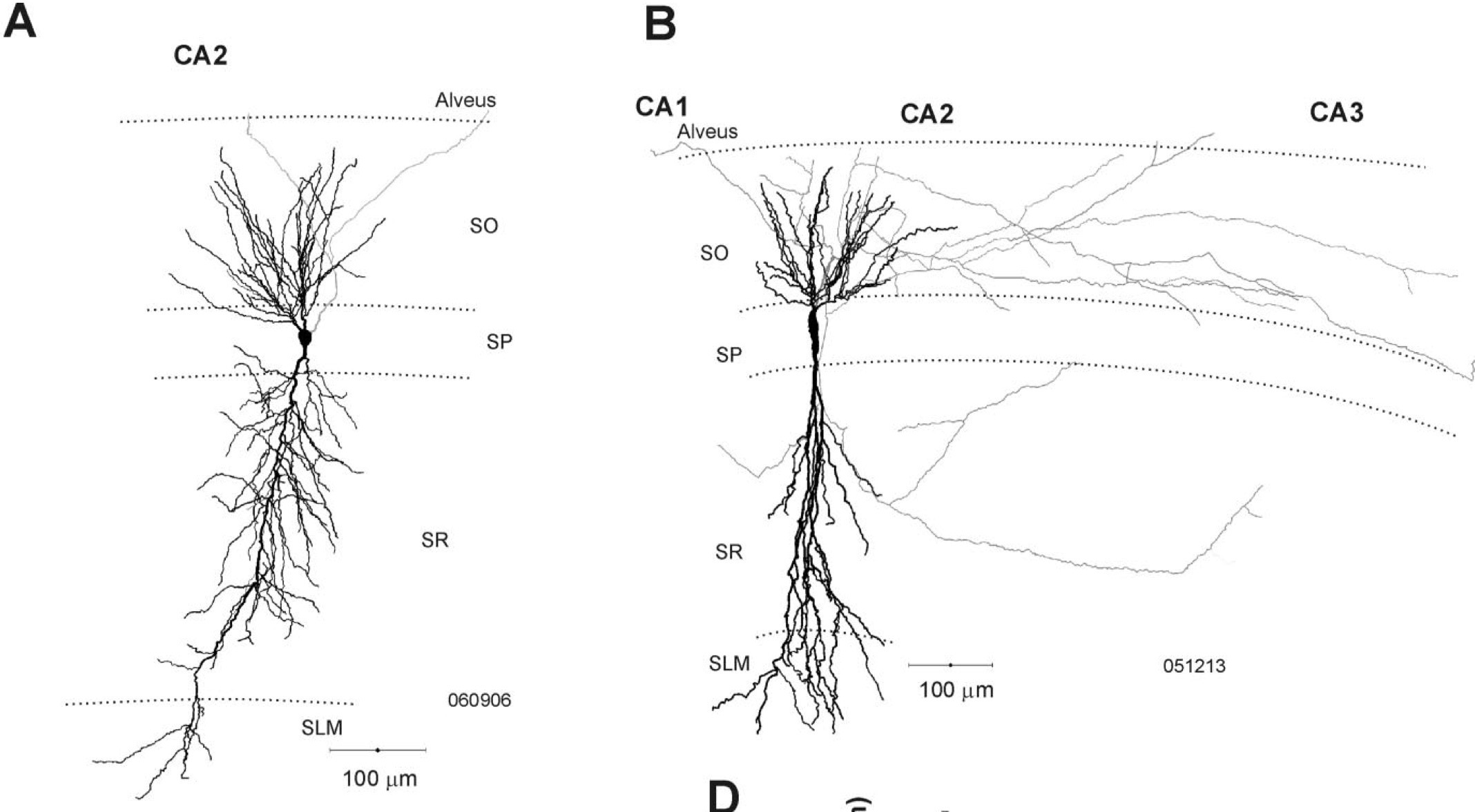
    "Figure 2. Morphological features of pyramidal cells recorded and filled in the CA1 and CA2 regions of the adult rat hippocampus. A, B, Neurolucida reconstructions of CA2 pyramidal cells. {CA2 Pyramidal} Like those in CA1, the dendritic arbors of CA2 pyramidal cells (black) extended through SO [stratum oriens] and SLM [stratum lacunosum moleculare]. Their axons (gray) arborized either exclusively in SO (A) or in SO and SR [stratum radiatum] of the CA2 and CA3 regions (B)."


    Molecular markers
    Positive
    alpha-actinin-2
    AMIGO2
    BDNF
    Caln
    CaM
    Disc1
    GABAa\alpha 4
    mGluR1
    mGluR4
    mGluR5
    NG
    PCP4
    SCIP
    vGlut1
    Negative
    Bok
    CB
    CB1
    CCK
    CoupTF II
    CR
    ENK
    ErbB4
    GABAa \delta
    GABAa\alpha 3
    GABAa\alpha 6 (confirmed by inference)
    GABAa\gamma 1
    GlyT2
    Id-2
    Kv3.1
    Man1a
    mGluR1a
    mGluR2
    MOR
    NKB
    nNOS
    NPY
    PPTA
    Prox1
    PV
    RLN
    SOM
    Sub P Rec
    TH
    vAChT
    vGAT
    vGluT2
    vGluT3
    VIP
    Mixed expression
    CGRP (subtypes)
    GABAa\alpha 2 (subcellular expression differences)
    GABAa\alpha 5 (subcellular expression differences)
    GABAa\beta 1 (subcellular expression differences)
    GABAa\beta 2 (subcellular expression differences)
    GABAa\beta 3 (subcellular expression differences)
    GABAa\gamma 2 (subcellular expression differences)
    Gaba-a-alpha (subcellular expression differences)
    mGluR5a (subcellular expression differences)

    Electrophysiological properties
    Key: [range] OR representative value±SD (measurements); Number of sources (total measurements): [min , max]

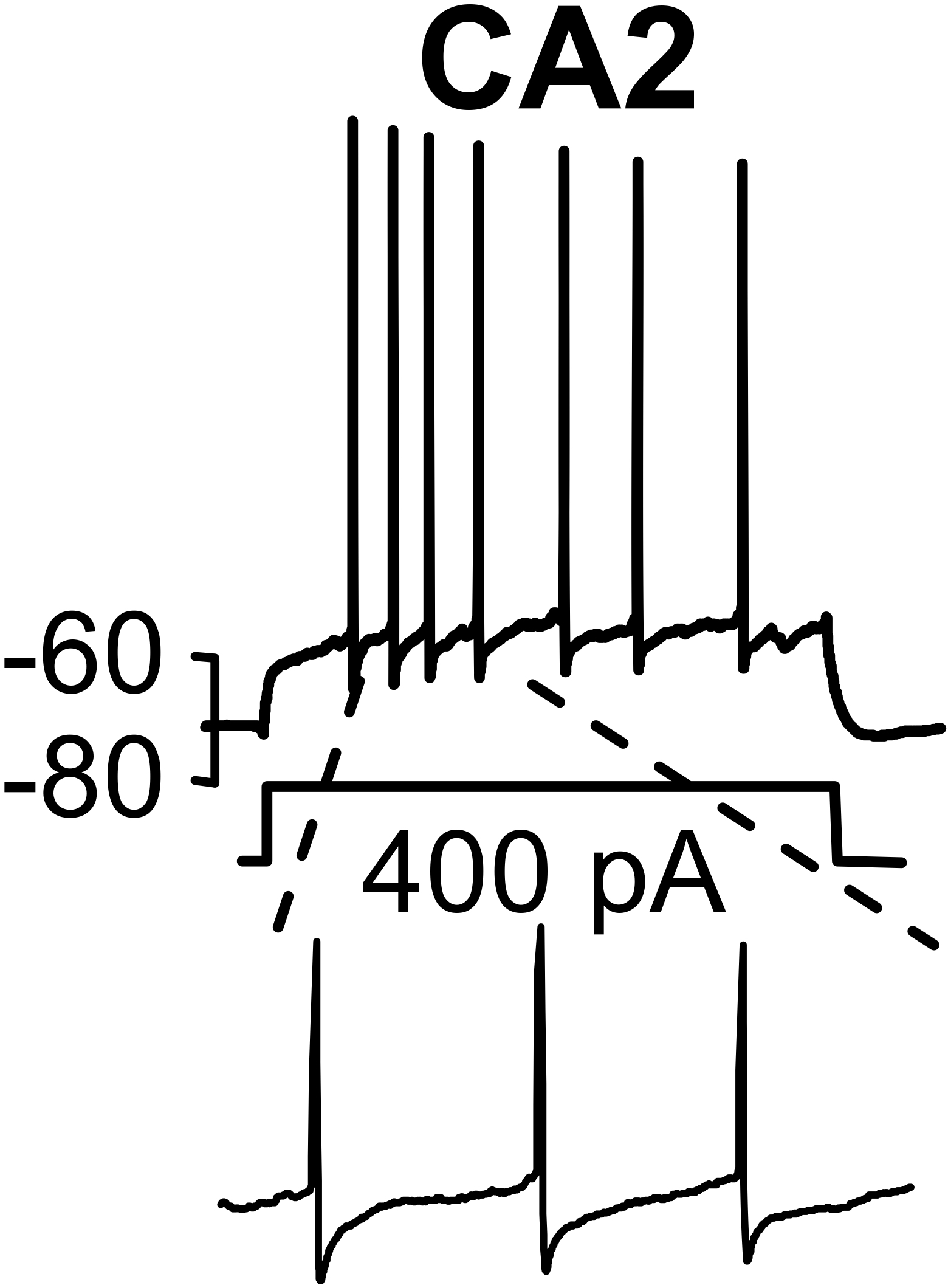
    Resting membrane potential (Vrest): -75.3±1 mV (19); 1 source
    Input resistance (Rin): 76.2±11.1 MΩ (19); 1 source
    Threshold potential (Vthresh): 16 mV (1); 1 source
    Fast afterhyperpolaziring potential amplitude (Fast AHP): 7.8 mV (1); 1 source
    Action potential amplitude (APampl): 84.8±1.6 mV (19); 1 source
    Action potential width (APwidth): 0.78±0.02 ms (19); 1 source
    Slow afterhyperpolarizing potential amplitude (Slow AHP): 1 mV (1); 1 source
    Sag ratio: 0.92 (1); 1 source

    Notes
    Status: addendum to currently active CA2 (+)2333p Pyramidal cells added - 01/28/2016

    Looks good to me. - CLR 12/08/2015

    I agree with adding a projection to LII EC from CA2 pyramidal neurons. Although the authors' statement that "these data are inconsistent with all recent reports" gave me pause, a look at the titles of articles citing this one did not suggest opposition to this finding. - CW 01/27/2016

    Looks good to me. - GAA 01/28/2016


    Firing Pattern
    Images
    Image Missing
    Parameters View page
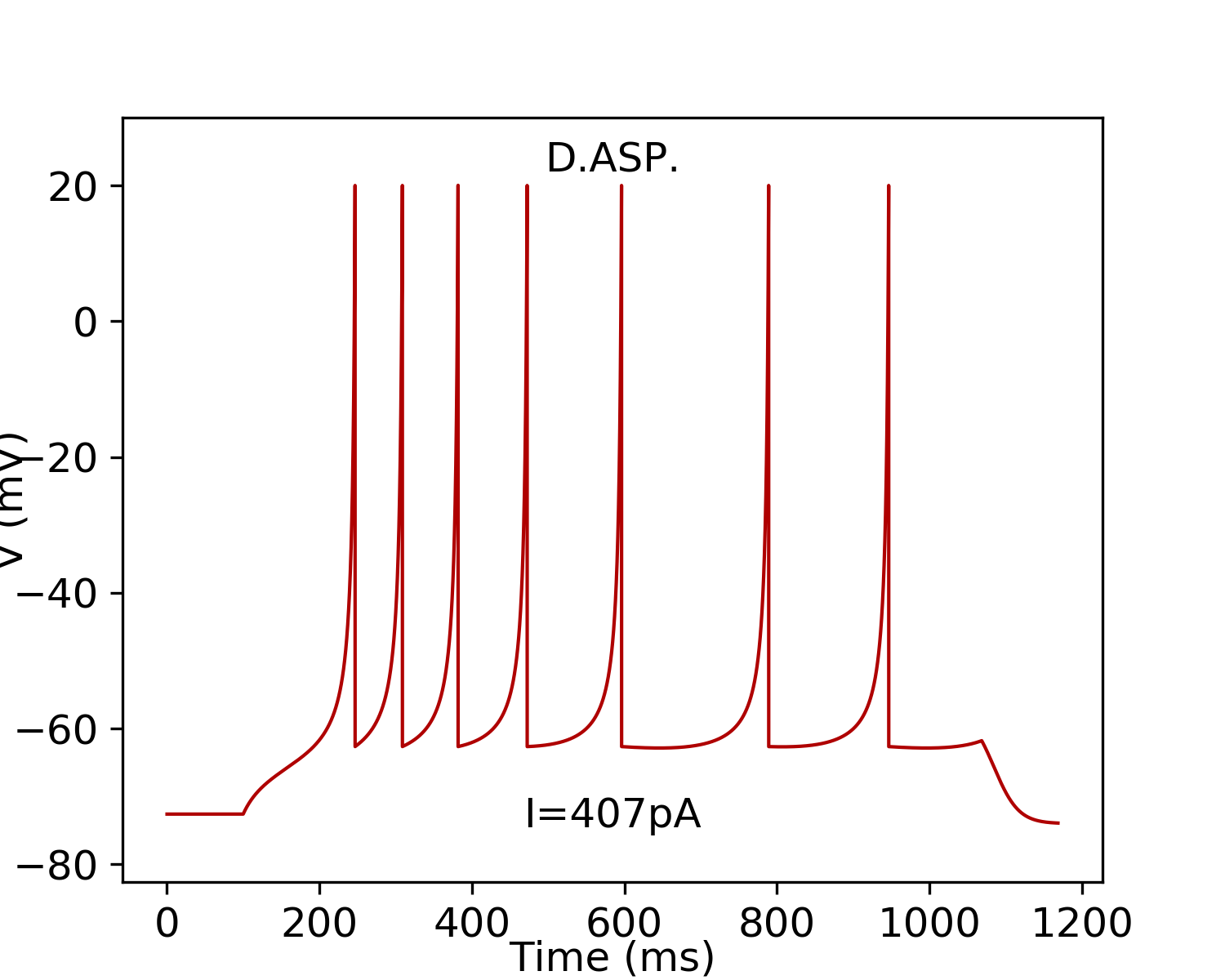
    D.ASP. [Evidence] [Firing Pattern]

    Izhikevich Model
    Parameters Single Compartment Downloads Simulate
    subtype: 1 k=5.94;a= 0.001;b= -15.89;d= 74;C= 1630;Vr= -72.59;Vt= -58.78;Vpeak= 19.99;Vmin= -62.65; Simulate
    Images
    Image Missing
    ModelDB Model
    Model Accession Number PubMed ID

    Sources of Input
    Known sources
    Excitatory or Inhibitory
    DG Granule
    CA2 Pyramidal
    CA2 Basket
    CA2 Wide-Arbor Basket
    CA2 Bistratified
    CA2 SP-SR
    MEC LII Stellate

    Potential sources
    Excitatory or Inhibitory
    CA3 Pyramidal
    CA3c Pyramidal
    CA3c Umbrella Pyramidal*
    CA3 Perforant Path-Associated Projecting*

    Potential sources known to be avoided
    Excitatory or Inhibitory
    none known

    Targets of Output
    Known targets
    Excitatory or Inhibitory
    CA2 Pyramidal
    CA2 Basket
    CA2 Wide-Arbor Basket
    CA2 Bistratified
    CA2 SP-SR
    CA1 Pyramidal

    Potential targets
    Excitatory or Inhibitory
    DG Adult-Born Immature Granule*
    DG Hilar Ectopic Granule
    DG Mossy
    DG Mossy MOLDEN
    DG AIPRIM
    DG Axo-axonic
    DG Granulosum-targeting Axo-axonic*
    DG Basket
    DG Basket CCK+
    DG HICAP
    DG Interneuron Specific IMOT*
    DG Hilus-Associated Interneuron*
    DG Interneuron Specific HIMOLD*
    DG HIPP
    DG Recurrent HIPP*
    DG HIPP-CAP*
    DG Recurrent HIPP-CAP*
    DG HIPROM
    DG Ivy*
    DG MOLAX
    DG Outer Molecular Layer
    DG Total Molecular Layer
    CA3 Pyramidal
    CA3 Athorny Pyramidal*
    CA3c Pyramidal
    CA3c Umbrella Pyramidal*
    CA3 Giant
    CA3 Granule
    CA3 Axo-axonic
    CA3 Horizontal Axo-axonic
    CA3 Basket
    CA3 Basket CCK+
    CA3 Horizontal Basket CCK+*
    CA3 Mossy Fiber-Associated Basket CCK+*
    CA3 Bistratified
    CA3 Ivy
    CA3 Bilayer Ivy*
    CA3 LMR-Targeting
    CA3 Lucidum*
    CA3 Lucidum LAX
    CA3 Lucidum ORAX
    CA3 Lucidum-Radiatum
    CA3 Spiny Lucidum
    CA3 Mossy Fiber-Associated
    CA3 Mossy Fiber-Associated ORDEN
    CA3 O-LM
    CA3 Recurrent O-LM*
    CA3 Interneuron Specific Oriens
    CA3 Perforant Path-Associated*
    CA3 Perforant Path-Associated Projecting*
    CA3 Interneuron Specific Quad
    CA3 QuadD-LM
    CA3 Radiatum
    CA3 R-LM
    CA3 SO-SO
    CA3 Trilaminar
    CA1 Deep Pyramidal
    CA1 Superficial Pyramidal
    CA1 Radiatum Giant
    CA1 Axo-axonic
    CA1 Horizontal Axo-axonic
    CA1 Back-Projection
    CA1 Basket
    CA1 Horizontal Basket
    CA1 R-P Basket*
    CA1 Trilayer Basket*
    CA1 Vertical Basket*
    CA1 Basket CCK+
    CA1 Horizontal Basket CCK+*
    CA1 Trilayer Basket CCK+*
    CA1 Bistratified
    CA1 RO-receiving CA3-targeting*
    CA1 Hippocampo-subicular Projecting ENK+
    CA1 Ivy
    CA1 Interneuron Specific LMO-O
    CA1 LMR
    CA1 LMR-LM*
    CA1 Interneuron Specific LMR-O*
    CA1 LMR-R*
    CA1 Interneuron Specific LMR-R
    CA1 LMR Projecting
    CA1 O-LM
    CA1 Recurrent O-LM
    CA1 O-LMR
    CA1 Recurrent O-LMR*
    CA1 Interneuron Specific O-R
    CA1 O-RP*
    CA1 Interneuron Specific O-Targeting QuadD
    CA1 Oriens/Alveus
    CA1 Oriens-Bistratified
    CA1 Oriens-QuadA Projecting
    CA1 OR-LM
    CA1 O-RPO*
    CA1 Perforant Path-Associated
    CA1 Perforant Path-Associated QuadD
    CA1 QuadD-RP*
    CA1 Quadrilaminar
    CA1 Interneuron Specific R-O
    CA1 R-Receiving Apical-Targeting
    CA1 R-RO*
    CA1 R-RP*
    CA1 Radiatum
    CA1 Interneuron Specific RO-O
    CA1 Interneuron Specific RO-R*
    CA1 RO-RP*
    CA1 RP-RPO*
    CA1 Schaffer Collateral-Associated
    CA1 Schaffer Collateral-Correlated*
    CA1 Schaffer Collateral-Receiving R-Targeting
    CA1 SO-SO
    CA1 SO-SO Projecting*
    CA1 Trilaminar
    CA1 Radial Trilaminar
    EC LI-II Multipolar-Pyramidal
    EC LI-II Pyramidal-Fan
    MEC LII Oblique Pyramidal
    MEC LII Stellate
    MEC LII-III Pyramidal-Multiform
    EC LII-III Pyramidal-Tripolar
    EC LIII Small Pyramidal
    LEC LIII Complex Pyramidal
    MEC LIII Bipolar Complex Pyramidal
    EC LIII Pyramidal
    EC LIII Stellate
    EC LIII-V Bipolar Pyramidal
    EC LIV-V Pyramidal-Horizontal
    MEC LV Principal*
    MEC LV Pyramidal
    EC LV Deep Pyramidal
    MEC LI-II Polar Interneuron*
    EC LII Axo-axonic
    MEC LII Basket
    EC LII Basket-Neurogliaform
    EC LIII Bipolar Interneuron*
    LEC LIII Multipolar Interneuron
    MEC LIII Superficial Multipolar Interneuron
    EC LII-III Superficial Polymorphic Interneuron*
    EC LIII Pyramidal-Looking Interneuron
    MEC LIII Superficial Trilayered Interneuron

    Potential targets known to be avoided
    Excitatory or Inhibitory
    none known

    Oscillation Phase Locking
    Category
    Value
    Theta (deg):187.57
    Theta range:[187.57, 189.49]
    Theta measurements:2
    Theta representative selection:   rats, adult, male,
    silicon probe, freely moving
    SWR ratio:0.52
    SWR ratio range:[0.52, 0.52]
    SWR ratio measurements:1
    SWR ratio representative selection:   rats, adult, male and female,
    sharp pipette, urethane
    In vivo firing rate (Hz):2.73
    Firing rate range:[2.73, 2.73]
    Firing rate measurements:1
    Firing rate representative selection:   rats, adult, male and female,
    sharp pipette, urethane
    Other:DS_ratio and 8 others
    Other representative selection:   rats, adult, male and female,
    sharp pipette, urethane