CA3 Basket CCK+
* indicates new v2.0 neuron type
Name Supertype (ID:Family:Type:Subregion)
CA3 (i)22232 Basket CCK+ S110802:Perisomatic-targeting:Basket CCK+:CA3

Name derivation
These cells are known to be CCK+. CA3 distinguishes these cells from basket CCK+ cells in other subregions. "CCK+" was selected as being more compact than "CCK-positive" or "cholecystokinin-positive."

Synonym(s)
CA3 basket 2
CA3 basket cell

List of articles
Click here to view the list
Freund TF  (1996) Hippocampus
Interneurons of the hippocampus.
Freund TF, Buzsaki G.
Hippocampus, 1996, 6 (4), Pages: 347 - 470
PMID: 8915675; DOI: 10.1002/(SICI)1098-1063(1996)6:4<347::AID-HIPO1>3.0.CO;2-I
Tags: morphology, connectivity, synapse probabilities
Lasztoczi B  (2011) J Neurosci
Terminal field and firing selectivity of cholecystokinin-expressing interneurons in the hippocampal CA3 area.
Lasztoczi B, Tukker JJ, Somogyi P, Klausberger T.
J Neurosci, 2011 Dec 7, 31 (49), Pages: 18073 - 18093
PMID: 22159120; DOI: 10.1523/JNEUROSCI.3573-11.2011
Tags: marker, phases
Szabadics J  (2009) J Neurosci
Functional specificity of mossy fiber innervation of GABAergic cells in the hippocampus.
Szabadics J, Soltesz I.
J Neurosci, 2009 Apr 1, 29 (13), Pages: 4239 - 4251
PMID: 19339618; DOI: 10.1523/JNEUROSCI.5390-08.2009
Tags: morphology, connectivity, firing patterns, synapse probabilities
Szabo GG  (2014) Hippocampus
Anatomically heterogeneous populations of CB1 cannabinoid receptor-expressing interneurons in the CA3 region of the hippocampus show homogeneous input-output characteristics.
Szabo GG, Papp OI, Mate Z, Szabo G, Hajos N.
Hippocampus, 2014 Dec, 24 (12), Pages: 1506 - 1523
PMID: 25044969; DOI: 10.1002/hipo.22330
Tags: morphology, connectivity, synapse probabilities
Supplemental PMIDs
Click here to view the list of PMIDs


Morphology
Soma
CA3:SL
CA3:SP
Axons
CA3:SP
Dendrites
CA3:SLM
CA3:SR
CA3:SL
CA3:SP
CA3:SO

Molecular markers
Positive
CB1 (confirmed by inference)
CCK (confirmed by inference)
vGluT3
Negative
CB
ChAT (multiple confirming inferences)
CoupTF II
CR (inference)
GABAa\alpha 6 (inference)
Gaba-a-alpha (inference)
Mus2R
NKB
PV (multiple confirming inferences)
SOM (confirmed by inference)
TH (multiple confirming inferences)
VIP (confirmed by inference)
Mixed expression
mGluR1 (subtypes)
mGluR1a (subtypes)
Sub P Rec (subtypes)

Electrophysiological properties
Key: [range] OR representative value±SD (measurements); Number of sources (total measurements): [min , max]

Threshold potential (Vthresh): 30.4 mV (1); 1 source
Fast afterhyperpolaziring potential amplitude (Fast AHP): 5.6 mV (1); 1 source
Action potential amplitude (APampl): 61 mV (1); 1 source
Slow afterhyperpolarizing potential amplitude (Slow AHP): 7.9 mV (1); 1 source
Sag ratio: 0.77 (1); 1 source

Notes

CA3 (i)22232 Basket CCK+ (BC CCK+) cells [2044]

Related types: CA3 (i)22232 Basket (v1.0 active)

Supplement notes: This neuron type is CCK+, which distinguishes it from the other neuron type.

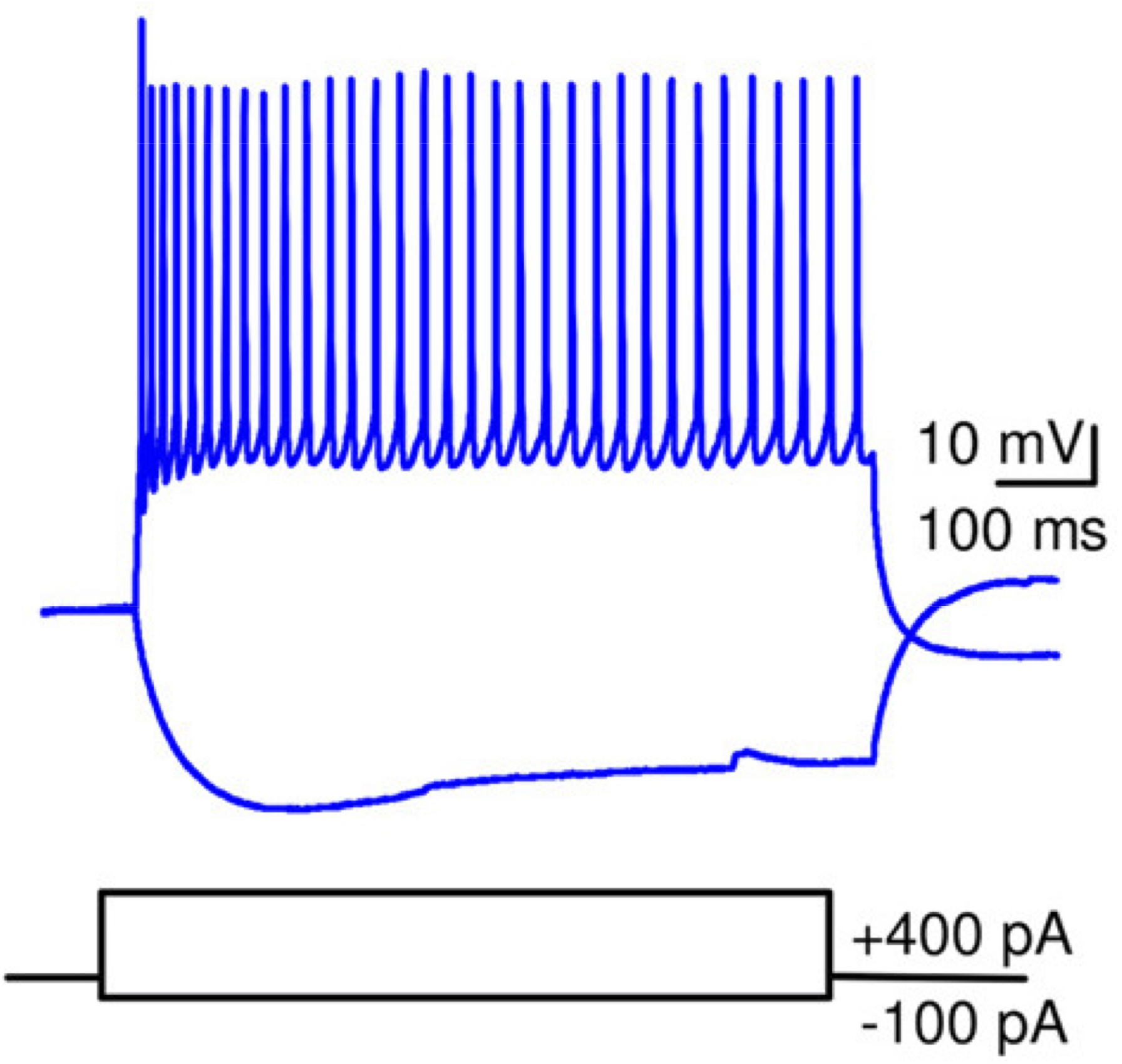
CCK+. PV-. SOM-. Electrophysiology. Firing pattern.

DWW 05/23/2023

I concur with the 22232 AD pattern. - JDK 05/23/2023

approved. - GAA 05/24/2023

Firing Pattern
Images
Image MissingImage Missing
Parameters View page
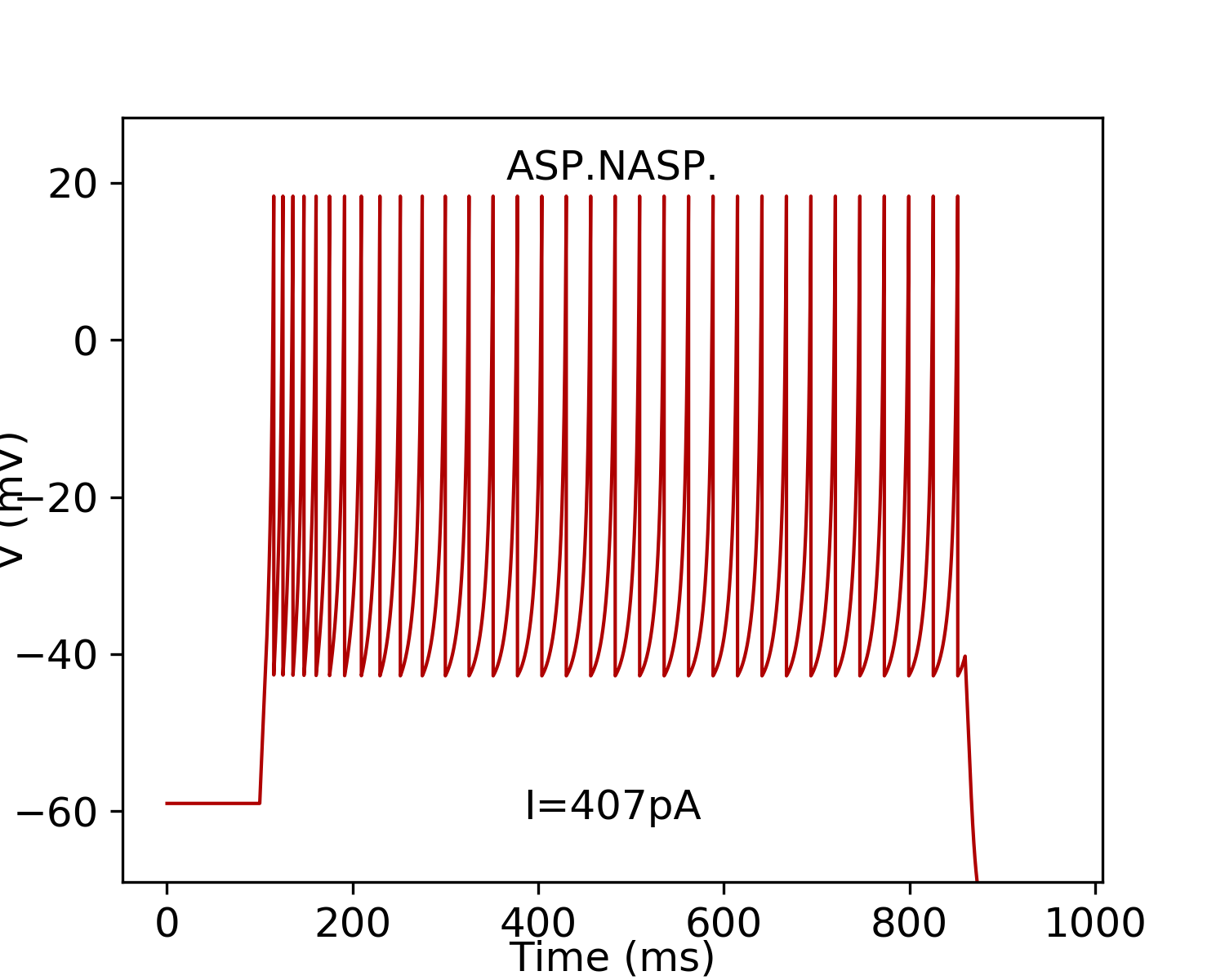
ASP.NASP [Evidence] [Firing Pattern]
NASP [Evidence] [Firing Pattern]

Izhikevich Model
Parameters Single Compartment Downloads Simulate
subtype: 1 k=0.58;a= 0.006;b= -1.24;d= 54;C= 135;Vr= -59;Vt= -39.4;Vpeak= 18.27;Vmin= -42.77; Simulate
Images
Image Missing
ModelDB Model
Model Accession Number PubMed ID

Sources of Input
Known sources
Excitatory or Inhibitory
DG Granule
CA3 Basket CCK+

Potential sources
Excitatory or Inhibitory
DG Adult-Born Immature Granule*
DG Hilar Ectopic Granule
DG Semilunar Granule
DG HIPROM
CA3 Pyramidal
CA3 Athorny Pyramidal*
CA3c Pyramidal
CA3c Umbrella Pyramidal*
CA3 Giant
CA3 Granule
CA3 Basket
CA3 Horizontal Basket CCK+*
CA3 Mossy Fiber-Associated Basket CCK+*
CA3 Bistratified
CA3 Ivy
CA3 Bilayer Ivy*
CA3 LMR-Targeting
CA3 Lucidum*
CA3 Lucidum LAX
CA3 Lucidum ORAX
CA3 Lucidum-Radiatum
CA3 Spiny Lucidum
CA3 Mossy Fiber-Associated
CA3 Mossy Fiber-Associated ORDEN
CA3 O-LM
CA3 Recurrent O-LM*
CA3 Interneuron Specific Oriens
CA3 Perforant Path-Associated*
CA3 Perforant Path-Associated Projecting*
CA3 Interneuron Specific Quad
CA3 QuadD-LM
CA3 Radiatum
CA3 R-LM
CA3 SO-SO
CA3 Trilaminar
CA2 Pyramidal
CA2 Wide-Arbor Basket
CA1 Back-Projection
CA1 RO-receiving CA3-targeting*
MEC LII Stellate

Potential sources known to be avoided
Excitatory or Inhibitory
CA3 Axo-axonic
CA3 Horizontal Axo-axonic

Targets of Output
Known targets
Excitatory or Inhibitory
CA3 Pyramidal
CA3 Basket CCK+

Potential targets
Excitatory or Inhibitory
CA3c Pyramidal
CA3c Umbrella Pyramidal*
CA3 Axo-axonic
CA3 Basket
CA3 Mossy Fiber-Associated Basket CCK+*
CA3 Bistratified
CA3 Ivy
CA3 Bilayer Ivy*
CA3 Spiny Lucidum
CA3 Mossy Fiber-Associated
CA3 Mossy Fiber-Associated ORDEN
CA3 Interneuron Specific Quad
CA3 QuadD-LM
CA2 Wide-Arbor Basket

Potential targets known to be avoided
Excitatory or Inhibitory
none known

Oscillation Phase Locking
Category
Value
Theta (deg):-47.00
Theta range:[-180.00, -15.00]
Theta measurements:5
Theta representative selection:   rats, adult, male,
juxtacellular, urethane plus supplemental doses of ketamine and xylazine
SWR ratio:0.66
SWR ratio range:[0.66, 1.07]
SWR ratio measurements:2
SWR ratio representative selection:   rats, adult, male,
juxtacellular, urethane plus supplemental doses of ketamine and xylazine
In vivo firing rate (Hz):2.17
Firing rate range:[0.99, 5.30]
Firing rate measurements:3
Firing rate representative selection:   rats, adult, male,
juxtacellular, urethane plus supplemental doses of ketamine and xylazine
Other:firingRateNonBaseline
Other representative selection:   rats, adult, male,
juxtacellular, urethane plus supplemental doses of ketamine and xylazine