CA3 Interneuron Specific Quad
* indicates new v2.0 neuron type
Name Supertype (ID:Family:Type:Subregion)
CA3 (i)03333p-DG_0003 Interneuron Specific Quad S091202:Interneuron Specific:IS:CA3

Name derivation
This cell is verified to preferentially target non-principal cells. Although more politically loaded, the phrase "interneuron specific" is more compact than "non-principal cell-specific" and is more commonly found in the cited literature. "Quad" describes the lcoations of the axons and dendrites in four layers. CA3 distinguishes these cells from interneuron specific cells in other subregions.

Synonym(s)
CA3 cell with hilar axon and hilar dendrites
CA3 VIP-containing neuron/interneuron
CA3 VIP-positive neuron

List of articles
Click here to view the list
Hajos N  (1996) Eur J Neurosci
Target selectivity and neurochemical characteristics of VIP-immunoreactive interneurons in the rat dentate gyrus.
Hajos N, Acsady L, Freund TF.
Eur J Neurosci, 1996 Jul, 8 (7), Pages: 1415 - 1431
PMID: 8758949; DOI: 10.1111/j.1460-9568.1996.tb01604.x
Tags: morphology, marker, connectivity, synapse probabilities


Morphology
Soma
CA3:SR
CA3:SL
CA3:SP
CA3:SO
Axons
DG:H
CA3:SR
CA3:SL
CA3:SP
CA3:SO
Dendrites
DG:H
CA3:SR
CA3:SL
CA3:SP
CA3:SO

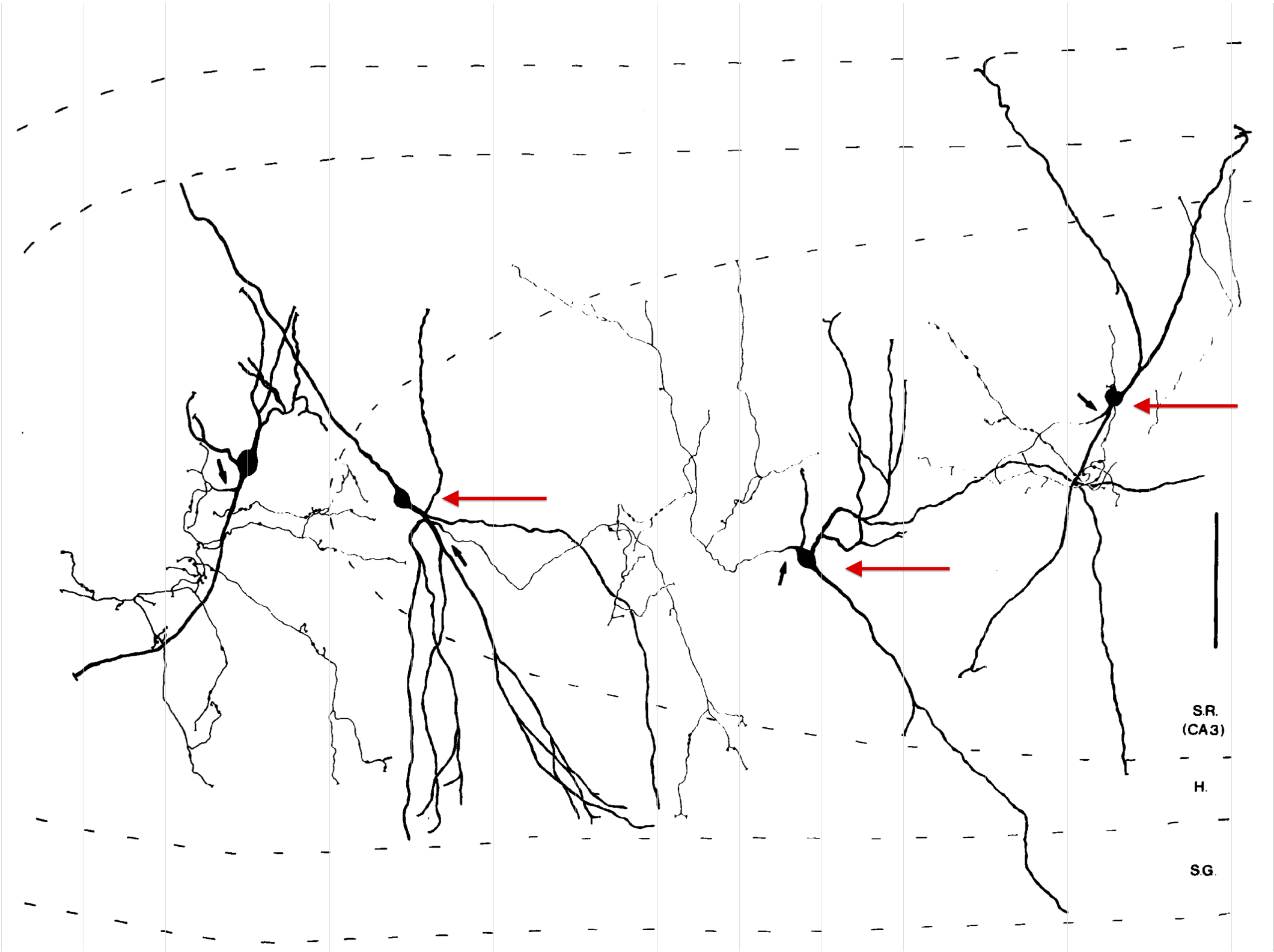
Representative figure
Target selectivity and neurochemical characteristics of VIP-immunoreactive interneurons in the rat dentate gyrus.
Hajos N, Acsady L, Freund TF
Eur J Neurosci, 1996 Jul, 8 (7), pages: 1415 - 1431
PMID: 8758949; DOI: 10.1111/j.1460-9568.1996.tb01604.x


"FIG. 3. VIP[vasoactive intestinal polypeptide]-positive neurons {CA3 Interneuron Specific Quad} [in CA3] with hilar axon and dendrites."


Molecular markers
Positive
VIP
Negative
CB (inference)
GABAa\alpha 6 (inference)
Gaba-a-alpha (multiple confirming inferences)
PV (multiple confirming inferences)
vGluT3 (inference)
Mixed expression
None known

Electrophysiological properties
None known

Notes
This class has been reinterpreted with multiple layers CA3:SR_SL_SP_SO enclosed by the hilus, which are not delineated by the authors. The ordering from top to bottom is unknown. If CA3c is ever separated out as a separate parcel, this class will be affected. Directed to Hájos paper by Freund and Buzsáki, who tried to draw parallels between IS-3 neurons in CA1, CA3, and DG, and, therefore, declared dendrites in all layers and axons only in the hilus (typo in F&B Table 2 - "IS-2" should be "IS-3"). Since this interpretation is counter to the single figure from Hájos, Freund and Buzsáki citations have been omitted from this cell type. A citation search yielded no further information. A neuron that had been previously interpreted as CA3 (-)03000 stratum radiatum has now been absorbed into this class. N = 3. 13 out of 166 VIP+ cells (8%) split across this cell type and DG (-)0003. Formed a small number of en passant or drumstick-like boutons. Axons difficult to follow once in DG:H. Non-principal cell specific targeting with multiple contacts on somata and dendrites.

Firing Pattern
Images
No image is associated with this neuron
Parameters
No parameter associated with this neuron
ModelDB Model
Model Accession Number PubMed ID

Sources of Input
Known sources
Excitatory or Inhibitory
none known

Potential sources
Excitatory or Inhibitory
DG Granule
DG Adult-Born Immature Granule*
DG Hilar Ectopic Granule
DG Semilunar Granule
DG Mossy
DG Mossy MOLDEN
DG AIPRIM
DG Axo-axonic
DG Interneuron Specific COLTAR*
DG Hilus-Associated Interneuron*
DG Interneuron Specific HIMOLD*
DG Recurrent HIPP*
DG Recurrent HIPP-CAP*
DG Interneuron Specific HIPRO*
DG HIPROM
DG Ivy*
DG MOCAP
DG Total Molecular Layer
CA3 Pyramidal
CA3 Athorny Pyramidal*
CA3c Pyramidal
CA3c Umbrella Pyramidal*
CA3 Giant
CA3 Granule
CA3 Basket
CA3 Basket CCK+
CA3 Horizontal Basket CCK+*
CA3 Mossy Fiber-Associated Basket CCK+*
CA3 Bistratified
CA3 Ivy
CA3 Bilayer Ivy*
CA3 LMR-Targeting
CA3 Lucidum*
CA3 Lucidum LAX
CA3 Lucidum ORAX
CA3 Lucidum-Radiatum
CA3 Spiny Lucidum
CA3 Mossy Fiber-Associated
CA3 Mossy Fiber-Associated ORDEN
CA3 O-LM
CA3 Interneuron Specific Oriens
CA3 Perforant Path-Associated Projecting*
CA3 Interneuron Specific Quad
CA3 Radiatum
CA3 SO-SO
CA3 Trilaminar
CA2 Pyramidal
CA2 Wide-Arbor Basket
CA1 Back-Projection
CA1 RO-receiving CA3-targeting*
MEC LV Pyramidal

Potential sources known to be avoided
Excitatory or Inhibitory
CA3 Axo-axonic
CA3 Horizontal Axo-axonic

Targets of Output
Known targets
Excitatory or Inhibitory
DG HIPP

Potential targets
Excitatory or Inhibitory
DG AIPRIM
DG Axo-axonic
DG Granulosum-targeting Axo-axonic*
DG Basket
DG Basket CCK+
DG HICAP
DG Interneuron Specific IMOT*
DG Hilus-Associated Interneuron*
DG Interneuron Specific HIMOLD*
DG Recurrent HIPP*
DG HIPP-CAP*
DG Recurrent HIPP-CAP*
DG HIPROM
DG Ivy*
DG MOLAX
DG Outer Molecular Layer
DG Total Molecular Layer
CA3 Axo-axonic
CA3 Horizontal Axo-axonic
CA3 Basket
CA3 Basket CCK+
CA3 Horizontal Basket CCK+*
CA3 Mossy Fiber-Associated Basket CCK+*
CA3 Bistratified
CA3 Ivy
CA3 Bilayer Ivy*
CA3 LMR-Targeting
CA3 Lucidum*
CA3 Lucidum LAX
CA3 Lucidum ORAX
CA3 Lucidum-Radiatum
CA3 Spiny Lucidum
CA3 Mossy Fiber-Associated
CA3 Mossy Fiber-Associated ORDEN
CA3 O-LM
CA3 Recurrent O-LM*
CA3 Interneuron Specific Oriens
CA3 Perforant Path-Associated*
CA3 Perforant Path-Associated Projecting*
CA3 Interneuron Specific Quad
CA3 QuadD-LM
CA3 Radiatum
CA3 R-LM
CA3 SO-SO
CA3 Trilaminar
CA2 Wide-Arbor Basket

Potential targets known to be avoided
Excitatory or Inhibitory
DG Adult-Born Immature Granule*
DG Hilar Ectopic Granule
DG Mossy
DG Mossy MOLDEN
CA3 Pyramidal
CA3 Athorny Pyramidal*
CA3c Pyramidal
CA3c Umbrella Pyramidal*
CA3 Giant
CA3 Granule

Oscillation Phase Locking
Category
Value