CA3 Mossy Fiber-Associated
* indicates new v2.0 neuron type
Name Supertype (ID:Family:Type:Subregion)
CA3 (i)03330p-DG_0001 Mossy Fiber-Associated S131502:Collateral-related:RO-targeting:CA3

Name derivation
This is the canonical mossy fiber-associated cell, and is the only cited name.

Synonym(s)
CA3 MF-associated cell
CA3 MFA
CA3 MFA interneuron
CA3 MFA neuron
CA3 mossy fiber-associated cell

List of articles
Click here to view the list
Losonczy A  (2004) Proc Natl Acad Sci U S A
Persistently active cannabinoid receptors mute a subpopulation of hippocampal interneurons.
Losonczy A, Biro AA, Nusser Z.
Proc Natl Acad Sci U S A, 2004 Feb 3, 101 (5), Pages: 1362 - 1367
PMID: 14734812; DOI: 10.1073/pnas.0304752101
Tags: morphology, membrane biophysics, firing patterns
Szabadics J  (2009) J Neurosci
Functional specificity of mossy fiber innervation of GABAergic cells in the hippocampus.
Szabadics J, Soltesz I.
J Neurosci, 2009 Apr 1, 29 (13), Pages: 4239 - 4251
PMID: 19339618; DOI: 10.1523/JNEUROSCI.5390-08.2009
Tags: morphology, marker, membrane biophysics, connectivity, firing patterns, synapse probabilities
Szabadics J  (2010) J Neurosci
Granule cells in the CA3 area.
Szabadics J, Varga C, Brunner J, Chen K, Soltesz I.
J Neurosci, 2010 Jun 16, 30 (24), Pages: 8296 - 8307
PMID: 20554881; DOI: 10.1523/JNEUROSCI.5602-09.2010
Tags: morphology, marker, connectivity, synapse probabilities


Morphology
Soma
CA3:SR
CA3:SL
Axons
DG:H
CA3:SR
CA3:SL
CA3:SP
Dendrites
CA3:SR
CA3:SL
CA3:SP

Representative figure
Functional specificity of mossy fiber innervation of GABAergic cells in the hippocampus.
Szabadics J, Soltesz I
J Neurosci, 2009 Apr 1, 29 (13), pages: 4239 - 4251
PMID: 19339618; DOI: 10.1523/JNEUROSCI.5390-08.2009


"Figure 6. CA3-specific MFAs {CA3 Mossy Fiber-Associated} [mossy fiber associated cells] were not found to be monosynaptically innervated by MFs [mossy fibers]. Dendritic (gray) and axonal (black) arborizations, firing pattern, and immunoreactivities of are presentative MFA (abbreviations same as in Fig.3A). Note that the majority of the axons are located in the stratum lucidum and in the hilus, and also that the dendrites are not aligned with the mossy fiber pathway."


Molecular markers
Positive
CB1 (inference)
CCK (confirmed by inference)
Negative
GABAa\alpha 6 (inference)
Gaba-a-alpha (inference)
mGluR1a (inference)
PV (confirmed by inference)
SOM (confirmed by inference)
Mixed expression
None known

Electrophysiological properties
Key: [range] OR representative value±SD (measurements); Number of sources (total measurements): [min , max]

Threshold potential (Vthresh): 21.4 mV (1); 2 sources (2): [21.4 , 39]
Fast afterhyperpolaziring potential amplitude (Fast AHP): 11.7 mV (1); 2 sources (2): [3.7 , 11.7]
Action potential amplitude (APampl): 62.8 mV (1); 2 sources (2): [44 , 62.8]
Action potential width (APwidth): 0.75 ms (1); 1 source
Sag ratio: 0.87 (1); 2 sources (2): [0.83 , 0.87]
Slow afterhyperpolarizing potential amplitude (Slow AHP): 4 mV (1); 1 source

Notes
The articles in this cell type were part of the old MFA 03332p cell type. That cell type has been split into this cell type and the 02332p cell type. Axons is SR are borderline; however, Dr. Ivan Soltesz in an e-mail suggests that MFA axons synapse with CA3 granule cells in SR. Axons in SO less than 15%.

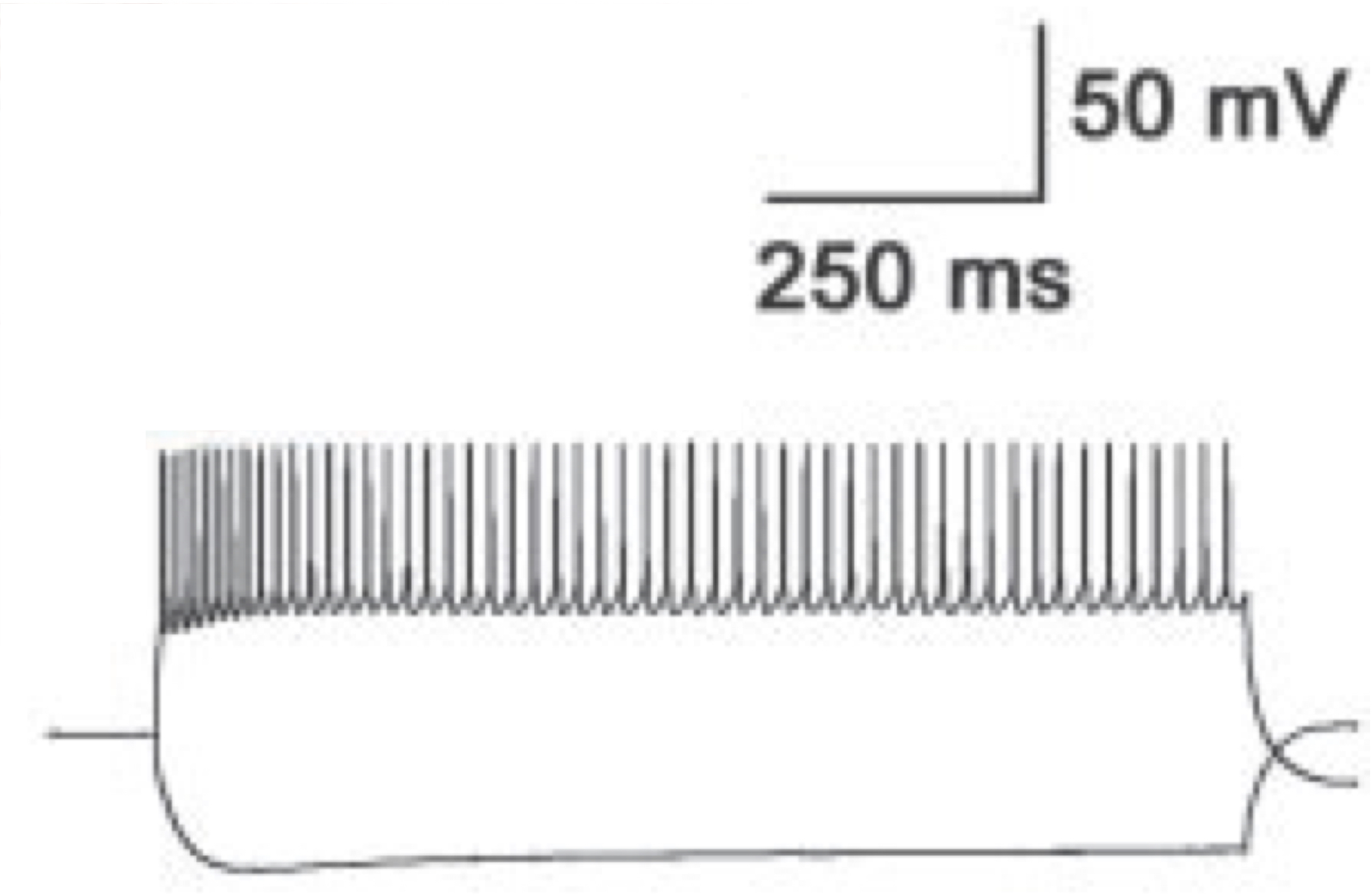
Firing Pattern
Images
Image MissingImage Missing
Parameters View page
ASP. [Evidence] [Firing Pattern]
ASP.NASP [Evidence] [Firing Pattern]

Izhikevich Model
Parameters Single Compartment Downloads Simulate
subtype: 1 k=0.55;a= 0.003;b= 3.69;d= 5;C= 185;Vr= -59.41;Vt= -36.59;Vpeak= 9.99;Vmin= -43.55; Simulate
Images
Image Missing
ModelDB Model
Model Accession Number PubMed ID

Sources of Input
Known sources
Excitatory or Inhibitory
none known

Potential sources
Excitatory or Inhibitory
DG Granule
DG Adult-Born Immature Granule*
DG Hilar Ectopic Granule
DG Semilunar Granule
DG HIPROM
CA3 Pyramidal
CA3c Pyramidal
CA3c Umbrella Pyramidal*
CA3 Giant
CA3 Granule
CA3 Axo-axonic
CA3 Horizontal Axo-axonic
CA3 Basket
CA3 Basket CCK+
CA3 Horizontal Basket CCK+*
CA3 Mossy Fiber-Associated Basket CCK+*
CA3 Bistratified
CA3 Ivy
CA3 Bilayer Ivy*
CA3 LMR-Targeting
CA3 Lucidum*
CA3 Lucidum LAX
CA3 Lucidum ORAX
CA3 Lucidum-Radiatum
CA3 Spiny Lucidum
CA3 Mossy Fiber-Associated
CA3 Mossy Fiber-Associated ORDEN
CA3 O-LM
CA3 Interneuron Specific Oriens
CA3 Perforant Path-Associated Projecting*
CA3 Interneuron Specific Quad
CA3 Radiatum
CA3 Trilaminar
CA2 Pyramidal
CA2 Wide-Arbor Basket
CA1 Back-Projection
CA1 RO-receiving CA3-targeting*

Potential sources known to be avoided
Excitatory or Inhibitory
none known

Targets of Output
Known targets
Excitatory or Inhibitory
CA3 Granule

Potential targets
Excitatory or Inhibitory
DG Adult-Born Immature Granule*
DG Hilar Ectopic Granule
DG Mossy
DG Mossy MOLDEN
DG AIPRIM
DG Axo-axonic
DG Granulosum-targeting Axo-axonic*
DG Basket
DG Basket CCK+
DG HICAP
DG Interneuron Specific IMOT*
DG Hilus-Associated Interneuron*
DG Interneuron Specific HIMOLD*
DG HIPP
DG Recurrent HIPP*
DG HIPP-CAP*
DG Recurrent HIPP-CAP*
DG HIPROM
DG Ivy*
DG MOLAX
DG Outer Molecular Layer
DG Total Molecular Layer
CA3 Pyramidal
CA3 Athorny Pyramidal*
CA3c Pyramidal
CA3c Umbrella Pyramidal*
CA3 Giant
CA3 Axo-axonic
CA3 Basket
CA3 Basket CCK+
CA3 Mossy Fiber-Associated Basket CCK+*
CA3 Bistratified
CA3 Ivy
CA3 Bilayer Ivy*
CA3 LMR-Targeting
CA3 Lucidum*
CA3 Lucidum LAX
CA3 Lucidum ORAX
CA3 Lucidum-Radiatum
CA3 Spiny Lucidum
CA3 Mossy Fiber-Associated
CA3 Mossy Fiber-Associated ORDEN
CA3 Perforant Path-Associated*
CA3 Perforant Path-Associated Projecting*
CA3 Interneuron Specific Quad
CA3 QuadD-LM
CA3 Radiatum
CA3 R-LM
CA2 Wide-Arbor Basket

Potential targets known to be avoided
Excitatory or Inhibitory
none known

Oscillation Phase Locking
Category
Value