|
|
|
* indicates new v2.0 neuron type
|
|
Name
|
|
Supertype (ID:Family:Type:Subregion)
|
|
|
CA3 (i)22232 Axo-axonic
|
S110902:Perisomatic-targeting:Axo-axonic:CA3
|
|
Name derivation
|
|
|
|
The phrase "chandelier cell" has fallen out of use. CA3 distinguishes these cells from axo-axonic cells in other subregions.
|
|
Synonym(s)
|
|
|
|
CA3 AA
|
|
|
CA3 AAC
|
|
|
CA3 axo-axonic cell
|
|
|
CA3 chandelier cell
|
|
|
Click here to view the list
Dugladze T (2012) Science
Segregation of axonal and somatic activity during fast network oscillations. Dugladze T, Schmitz D, Whittington MA, Vida I, Gloveli T.
Science,
2012 Jun 15, 336 (6087),
Pages: 1458 - 1461
PMID: 22700932; DOI: 10.1126/science.1222017
Tags: morphology, membrane biophysics, firing patterns
Freund TF (1996) Hippocampus
Interneurons of the hippocampus. Freund TF, Buzsaki G.
Hippocampus,
1996, 6 (4),
Pages: 347 - 470
PMID: 8915675; DOI: 10.1002/(SICI)1098-1063(1996)6:4<347::AID-HIPO1>3.0.CO;2-I
Tags: morphology, connectivity, synapse probabilities
Gulyas AI (1993) Eur J Neurosci
Precision and variability in postsynaptic target selection of inhibitory cells in the hippocampal CA3 region. Gulyas AI, Miles R, Hajos N, Freund TF.
Eur J Neurosci,
1993 Dec 1, 5 (12),
Pages: 1729 - 1751
PMID: 8124523; DOI: 10.1111/j.1460-9568.1993.tb00240.x
Tags: morphology, connectivity, synapse probabilities
Hajos N (2013) J Neurosci
Input-output features of anatomically identified CA3 neurons during hippocampal sharp wave/ripple oscillation in vitro. Hajos N, Karlocai MR, Nemeth B, Ulbert I, Monyer H, Szabo G, Erdelyi F, Freund TF, Gulyas AI.
J Neurosci,
2013 Jul, 33 (28),
Pages: 11677 - 11691
PMID: 23843535; DOI: 10.1523/JNEUROSCI.5729-12.2013
Tags: synapse probabilities
Vida I (2010) Hippocampal Microcircuits: A Computational Modeler's Resource Book
Morphology of Hippocampal Neurons Vida I.
Hippocampal Microcircuits: A Computational Modeler's Resource Book,
2010,
Pages: 27 - 68
ISBN: 9781441909954
Tags: morphology, connectivity, synapse probabilities
Viney TJ (2013) Nat Neurosci
Network state-dependent inhibition of identified hippocampal CA3 axo-axonic cells in vivo. Viney TJ, Lasztoczi B, Katona L, Crump MG, Tukker JJ, Klausberger T, Somogyi P.
Nat Neurosci,
2013 Dec, 16 (12),
Pages: 1802 - 1811
PMID: 24141313; DOI: 10.1038/nn.3550
Tags: marker, connectivity, phases
|
|
Supplemental PMIDs
|
|
|
|
Click here to view the list of PMIDs
|
|
List of Hippocampome.org to NeuroMorpho.Org mappings
|
|
|
Click here to view the list of mappings
|
|
|
Precision and variability in postsynaptic target selection of inhibitory cells in the hippocampal CA3 region.
Gulyas AI, Miles R, Hajos N, Freund TF
Eur J Neurosci, 1993 Dec 1, 5 (12), pages: 1729 - 1751
PMID: 8124523; DOI: 10.1111/j.1460-9568.1993.tb00240.x
|
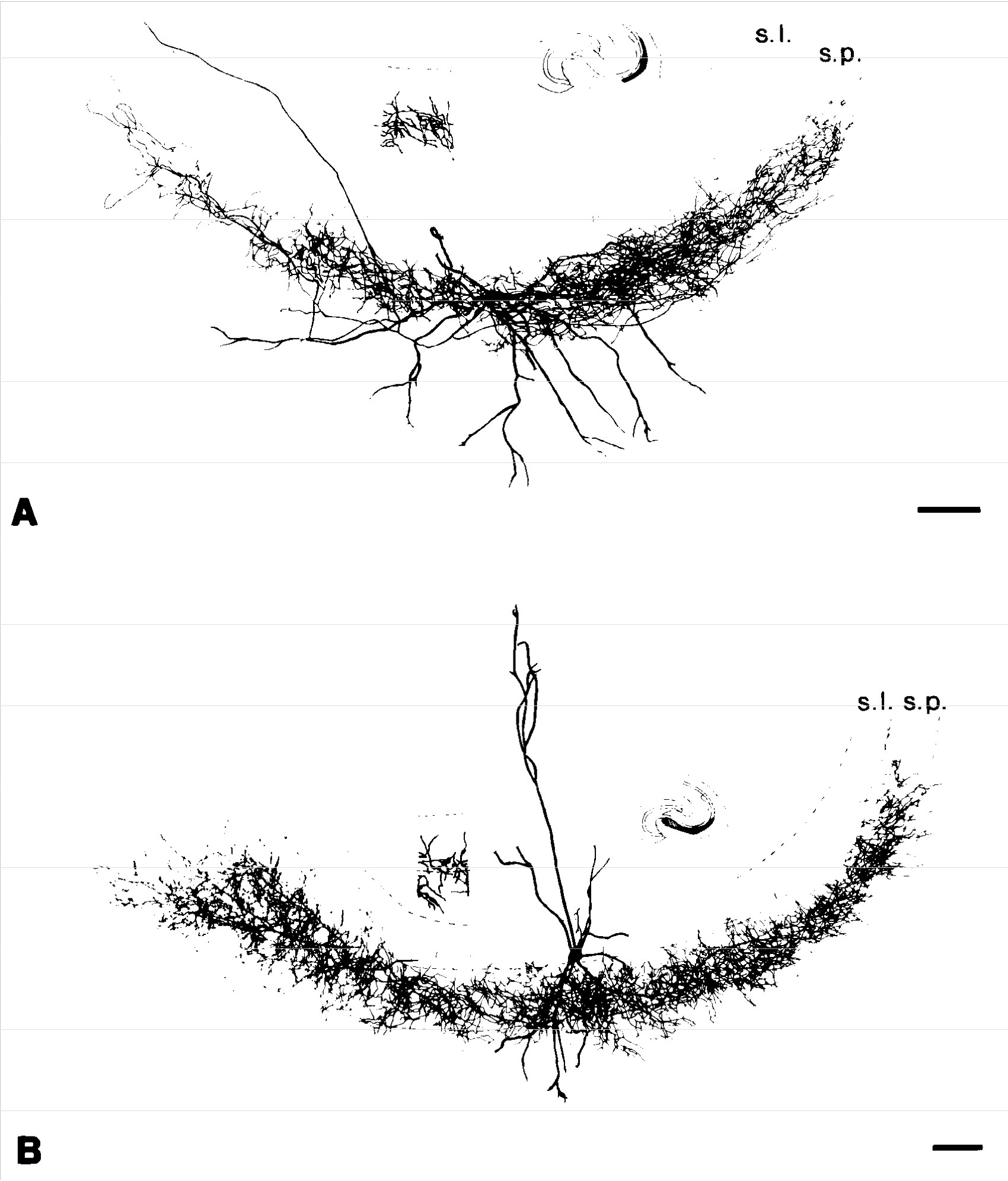
"FIG. 2. Two axo-axonic cells {CA3 Axo-axonic} in the CA3 area (AA[axo-axonic]2, AA3), reconstructed from four sections (80 [micro]m thick each). (A) The multipolar cell body of AA2 was
located in stratum pyramidale. The dendrites ran in all directions in a horizontally elongated field, primarily in stratum oriens. Two primary dendrites penetrating
stratum lucidum were cut. The axon arbor of the cell occupied the lower half of stratum pyramidale and the adjacent part of stratum oriens of the CA3a and
b areas. (J3) The cell body of AA3 was located in stratum lucidum next to stratum pyramidale. The dendrites ran horizontally turning towards strata oriens and radiatum. The axon arbor was rather large, spread from CA3a to CA3c. and was slightly more superficially located than the arbor of AA2 but sparsely spread
into stratum oriens. In CA3c the axon cloud became rather loose, similarly to the pyramidal cells. Here the characteristic rows of boutons are discernible. The inset on the left (on this and the subsequent figures) shows axons from a single 80 [micro]m thick section to illustrate the relative laminar position and bouton density. s.l., stratum lucidum; s.P., stratum pyramidale. Scale: 100 [micro]m." |
| Mixed expression |
|
|
None known |
|
Electrophysiological properties
|
|
|
Axo-axonic cells exclusively target pyramidal cells while basket cells are known to also target other interneurons.
Synapse exclusively with AIS of pyramidal cells
Gulyas et al. 1993 is in guinea pigs
perisomatic axonal targeting interpreted as PCL
extended interpretation of SP in apical and basal directions
supplement to CA3 (i)22232 Axo-axonic added - 11/29/2015 |
| Parameters
|
Single Compartment
|
Downloads
|
Simulate
|
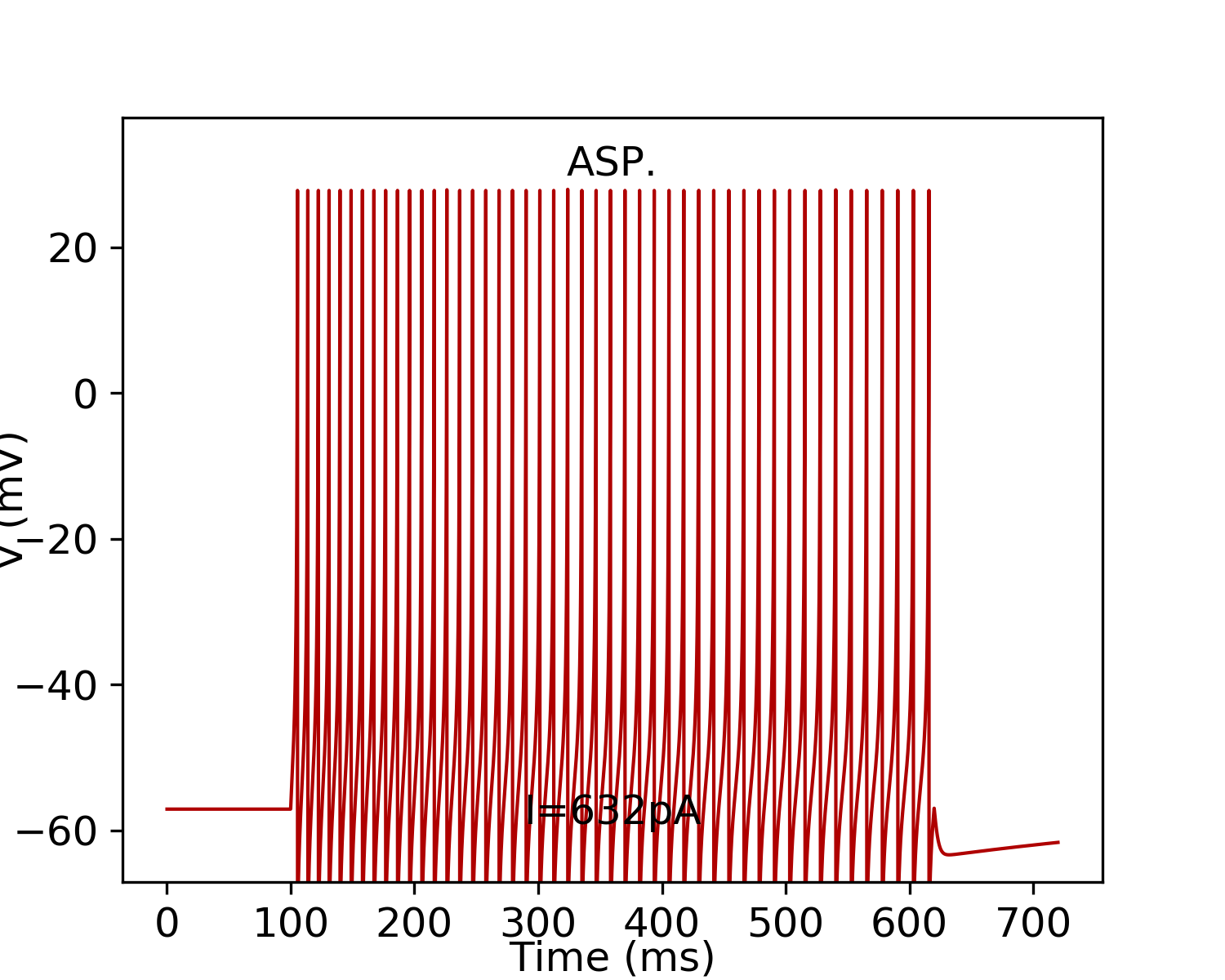
| subtype: 1 k=3.96;a= 0.005;b= 8.68;d= 15;C= 165;Vr= -57.1;Vt= -51.72;Vpeak= 27.8;Vmin= -73.97; | | Simulate
|
|
Model Accession Number
|
PubMed ID
|
|
|
|
|
Potential sources known to be avoided
|
|
|
|
|
|
Potential targets known to be avoided
|
|
| Oscillation Phase Locking |
| Category | Value | | Theta (deg): | -1.30 | | Theta range: | [-25.60, 67.30] | | Theta measurements: | 6 | | Theta representative selection: | rats, adult, unknown sex,
juxtacellular, urethane plus supplemental doses of ketamine and xylazine | | SWR ratio: | 0.00 | | SWR ratio range: | [0.00, 0.46] | | SWR ratio measurements: | 12 | | SWR ratio representative selection: | rats, adult, unknown sex,
juxtacellular, urethane plus supplemental doses of ketamine and xylazine | | In vivo firing rate (Hz): | 19.70 | | Firing rate range: | [7.63, 27.90] | | Firing rate measurements: | 10 | | Firing rate representative selection: | rats, adult, unknown sex,
juxtacellular, urethane plus supplemental doses of ketamine and xylazine | | Other: | firingRateNonBaseline | | Other representative selection: | rats, adult, unknown sex,
juxtacellular, urethane plus supplemental doses of ketamine and xylazine |
|
 Browse
 Search
 Help