|
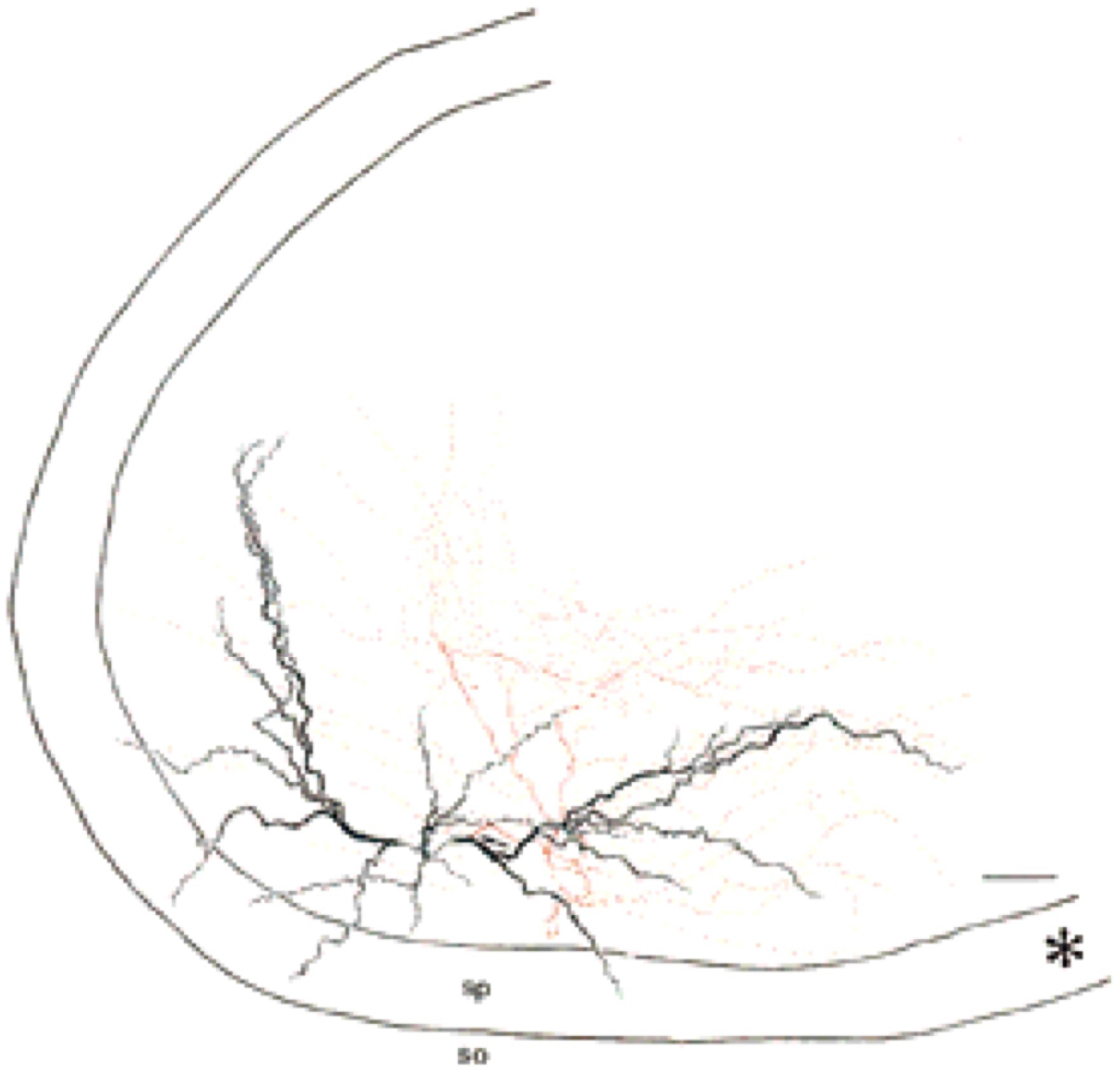
CA3 03300 lucidum cell (LC)
DWW
|
I think the cell on pg. 3 looks like A on p. 7, even more than C. Can we combine all 3. Otherwise, I think we should leave 6C out. 03320 - CW
|
|
I would put pg 3 in the other packet (03320) and agree it looks like Fig 6A. However, I would not merge the two packets bec. I think there's a class with less-than-significant presence of D in SP (Spruston Fig 6C + Fig 2 + Fig 3). - CLR
|
CA3 03320 aspiny lucidum cell (aSLC)
N = 1
DWW
|
N = 5 is stated on p. 3. On p. 4, why isn't C included? I agree w. interpretations. - CW 05/04/2011
|
CA3 03320 lucidum cell (LC)
N = 2
Fig. 6C is categorized as a CA3 03300 aspiny lucidum cell (aSLC).
I'm not sure Figs 2+3 belong in this packet. They only have dendrites in SL. Other interpretations are good. - CLR 05/11/2011
|
I'm okay with keeping 2+3, and I agree with interpretations. - CW 05/18/2011
|
CA3 03300 aspiny lucidum cell (aSLC)
N = 1
DWW
Overall, I find it confusing to see the same material with the same interpret. in multiple packets. - CW
|
In this instance, I agree that the Spruston figures in question (2 & 3) don't add much to either packet, and may in fact confuse the issue because they're only partial-neuron pictures. I would either leave in both packets or remove from both, but see no reason to put in one and not the other.
|
|
In general, I'm not bothered by having the same evidence in multiple packets and favor a case-by-case decision. - CLR 06/29/2011
|
CA3 03300 aspiny lucidum cell (aSLC)
N = 1
DWW, CLR, CW
|
Susp. ani. Fold into 03320 - GAA
|
CA3 03320 lucidum cell (LC)
N = 3
The 03300 class has been folded into this 03320 class, since they differ only by dendrites in SP.
This packet contains citations from:
Background references checked and included in another packet:
|
Szabadics and Soltesz, 2009 (CA3 01320 spiny lucidum cells)
|
|
Toth and McBain, 1998 (CA3 02330 lucidum cells)
|
|
Toth and McBain, 1998 (CA3 00300 lucidum cells)
|
Background references checked and omitted:
|
Aaron et al., 2003: unable to stain axons
|
|
Acsady et al., 1997: no axonal information
|
|
Acsady et al., 1998: no axonal information
|
|
Gulyas et al., 1992: unable to stain axons
|
|
Hsu and Buzsaki, 1993: ischemic cells only
|
|
Jinno et al., 2007: single CA3 cell that projects to CA1:SR_SP
|
|
Soriano and Frotscher, 1993: unable to stain axons
|
|
Szabadics et al., 2010: no axonal information
|
|
Takacs et al., 2008: unable to stain axons
|
|
Wittner et al., 2006: no axonal or dendritic details
|
DWW
|
Overall OK; interp question [Spruston et al., 1997, Fig. 6C] ? D:SP Maybe SO, but could maybe be 03300 - CLR
|
CA3 03320 lucidum cell (LC)
The 03300 class has been mapped into this 03320 class, since they differ only by dendrites in SP and would otherwise end up in suspended animation.
Figs. 2 & 3 from Spruston have now been removed.
The contrast in some of the figures has been artficially enhanced to make them more legible.
DWW, CLR
|
Looks good. I would slightly prefer 03300 interpretation. Pls specify if mixed spiny & aspiny (subclasses?). Subclass possibilities:
|
|
SP - asp
|
|
Pyr L vs not
|
|
calretinin vs not
|
|
electrophys ... - GAA 07/25/2011
|
CA3 03300 lucidum cell (LC)
N = 3, one spiny and two aspiny
The 03320 class has been mapped into this 03300 class, since they differ only by dendrites in SP.
New rule invoked: when compressing classes, leave axons in PCL because of the issue of terget specificity but discount dendrites. Therefore, this class is now considered 03300 (instead of 03320).
Previously approved by DWW, CLR, CW as 03320. GAA does not need to see packet again if we agree to the rule change and approve as 03300.
Potential for future subclasses based on spiny/aspiny, markers (calretinin), electrophysiology, etc.
GAA 07/25/2011
CA3 (-)03300 lucidum cells-2 (LC-2)
N = 3, one spiny and two aspiny
|
Merger status:
|
none being considered
|
Notes:
The 03320 class has been mapped into this 03300 class, since they differ only by dendrites in SP.
New rule invoked: when compressing classes, leave axons in PCL because of the issue of terget specificity but discount dendrites. Therefore, this class is now considered 03300 (instead of 03320).
The contrast in some of the figures has been artificially enhanced to make them more legible.
Borderline dendrites in SP
GAA 07/25/2011
CA3 (i)03300 Lucidum-Radiatum (L-R) cells [2014]
|
Related types:
|
CA3 (i)03322 radiatum cell (v2.0 on-hold)
|
|
CA3 (i)03311 Lucidum ORAX (v1.0 active)
|
Notes: Neurite differences in the principal cell Layers invoked rule: when compressing types, leave axons in the PCL because of the issue of target specificity, but discount dendrites.
Allene et al., 2012: ephys, synaptic ephys, lengths
Because of the invoked rule, these two types [CA3 (i)03300 Lucidum-Radiatum and Allene et al., 2012] should be merged together as 03300. - DWW 10/19/2021
|
How much emphasis should we put on the GDP reconstruction coming from P1-P7 mice for our decision to make this an active 2.0 type? I think compression makes sense but not certain if we should continue to leave on-hold until we have more evidence from older mice/rats for this proposed cell type. - JDK 11/03/2021
|
|
The 03300 type is already an active v1.0 type, so I have no hesitation in absorbing the GDP neuron into the v1.0 type. - DWW 11/03/2021
|
|
Okay noted, then I am in favor of the compression. - JDK 11/03/2021
|
Update: Principal cell layer invoked rule: record axons in the PCL when boutons are present or when axons are branching and ostensibly targeting the PCL and not just passing through, but discount dendrites. - 11/15/2021
After re-review with our updated new invoked rule, I am still in favor of compression for these cell types to CA3 (i) 03300. - JDK 11/22/2021
|
I approve. - GAA 01/26/2022
|
|
 Browse
 Search
 Help