DG Interneuron Specific HIMOLD*
* indicates new v2.0 neuron type
Name Supertype (ID:Family:Type:Subregion)
DG (i)2203 Interneuron Specific HIMOLD* S091201:Interneuron Specific:IS:DG

Name derivation
This is a new name derived from the interneuron specificity and is in the vein of HICAP, MOPP, and HIPP that stands for "HIlus and MOlecular Layer Dendrites."

Synonym(s)
DG hilus-projecting cell

List of articles
Click here to view the list
Wei YT  (2021) Journal of Comparative Neurology
Morpho-physiological properties and connectivity of vasoactive intestinal polypeptide-expressing interneurons in the mouse hippocampal dentate gyrus
Wei YT, Wu JW, Yeh CW, Shen HC, Wu KP, Vida I, Lien CC.
Journal of Comparative Neurology, 2021, 529 (10), Pages: 2658 - 2675
PMID: 33484471; DOI: 10.1002/cne.25116
Tags: morphology, marker, membrane biophysics


Morphology
Soma
DG:SMo
DG:SMi
DG:SG
DG:H
Axons
DG:H
Dendrites
DG:SMo
DG:SMi
DG:H

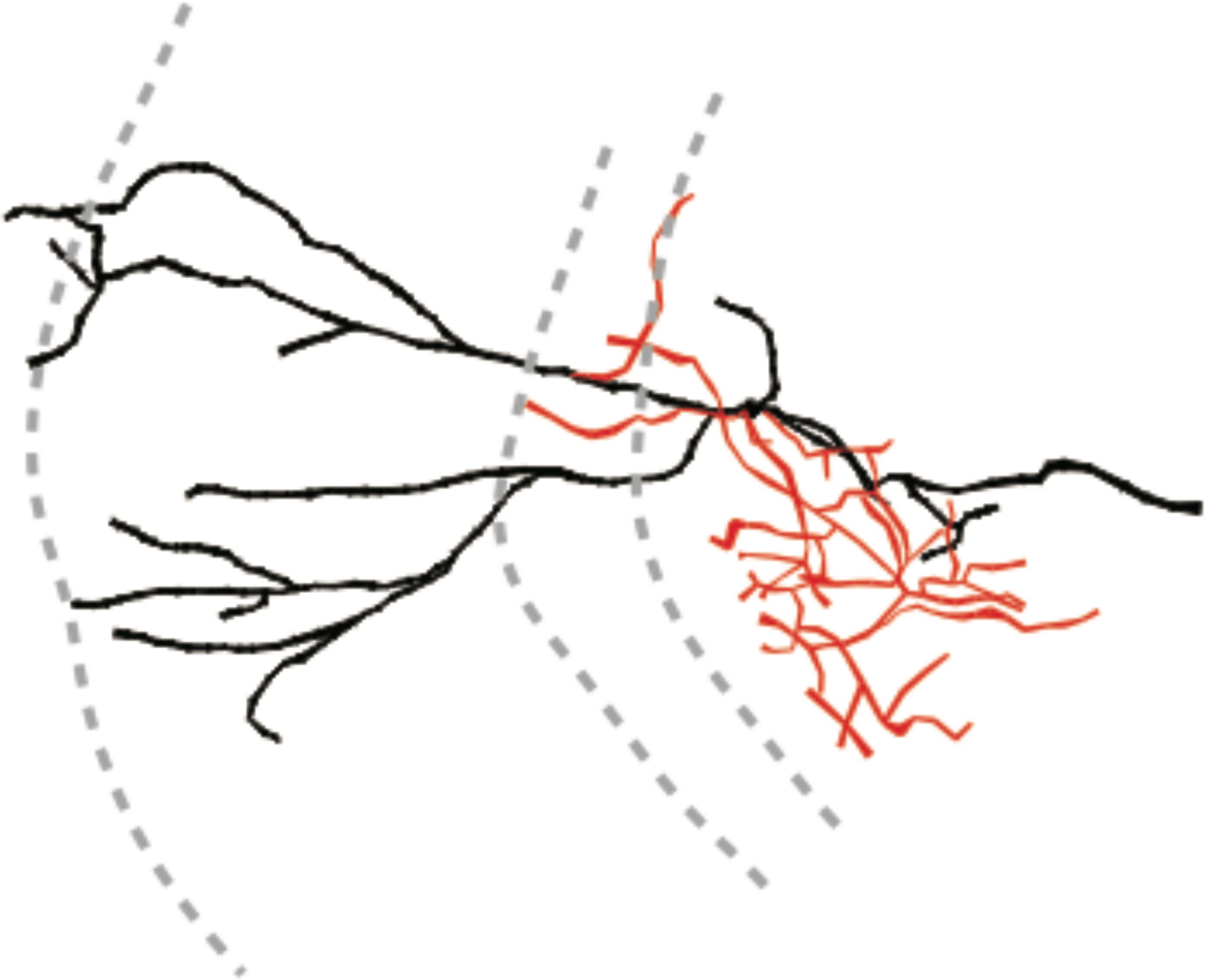
Representative figure
Morpho-physiological properties and connectivity of vasoactive intestinal polypeptide-expressing interneurons in the mouse hippocampal dentate gyrus
Wei YT, Wu JW, Yeh CW, Shen HC, Wu KP, Vida I, Lien CC
Journal of Comparative Neurology, 2021, 529 (10), pages: 2658 - 2675
PMID: 33484471; DOI: 10.1002/cne.25116


"FIGURE 4 Morphological reconstructions of the DG VIP+ INs [interneurons]. (aÐd) All of the 40 reconstructed VIP+ INs. The dendrites were depicted in black, and the axons were shown in the same color codes as in Figure 3(a). Values of Rin and RMP were shown below the cell"


Molecular markers
Positive
VIP
Negative
GABAa\alpha 6 (inference)
Gaba-a-alpha (multiple confirming inferences)
mGluR1a (inference)
PV (inference)
SOM (multiple confirming inferences)
vGluT3 (inference)
Mixed expression
None known

Electrophysiological properties
Key: [range] OR representative value±SD (measurements); Number of sources (total measurements): [min , max]

Resting membrane potential (Vrest): -47.5±2.2 mV (27); 1 source
Input resistance (Rin): 889±73 MΩ (27); 1 source
Threshold potential (Vthresh): 11.3±3.2 mV (27); 1 source
Action potential amplitude (APampl): 71.6±2.3 mV (27); 1 source
Action potential width (APwidth): 0.88±0.04 ms (27); 1 source
Max firing rate (Max F.R.): 25.2±2.5 Hz (27); 1 source

Notes

DG (i)2203 Interneuron-Specific HIMOLD {HIlus and MOlecular Layer Dendrites} (IS HIMOLD) cells [1105]

Related types: DG (i)2203 HIMOLD (v2.0 on-hold unapproved)

Notes: These cells are VIP+ and are speculated by the authors to be interneuron specific, which distinguishes them from the on-hold cell, which is CB1R+.

VIP+. Ephys. FP. Lengths.

After review of IS HIPRO QuadD [#1105], I am in agreement with the evidence as provided in the packet.

How come this cell type {DG (i)2203 HIPMOLD [#1097]} is on hold, and is there a chance for a potential merger of these two types? Looking at the portal, expression of CB1 usually means no expression of VIP, but there are a few cases where there are positive-negative evidence of VIP expression (e.g. CA1 Basket CCK+). - JDK 11/22/2021

I can see your confusion. Embedded is the correct packet. However, when I first created the embedded packet, I had interpreted the cell as 2203 and named it DG HIMOLD. I later must have decided to re-interpret the cell as 2223 to better match this IS neuron type. Something that needs to be answered is whether both the IS and non-IS neuron types should be interpreted as 2203 or 2223. - DWW 11/23/2021

Thanks for providing me with the packet for the DG HIMOLD cells. Looking at the A-D patterns from both packets, I think that the dendrites have very low presence within the granule layer and these dendrites appear to be merely passing through and branching out much more extensively within the hilar layer. So I think 2203 is more appropriate than 2223 for both types.
If you agree, this leaves us then with making a distinction between these two types based on expression of CB1 or VIP. I think we could go either way by leaving the two types distinct or compressing to a single type. I would say I am more in favor of leaving them distinct, with the VIP+ type being named DG (i) 2203 IS HIMOLD and the CB1+ type being named DG (i) 2203 HIMOLD. What do you think? - JDK 11/23/2021

I concur with the 2203 interpretation and with the separation of the two neuron types. - DWW 11/23/2021

I approve. The distinction with the on-hold type is not so much agreeable on the basis of the distinct expression patterns (VIP vs CCK), as those are not mutually exclusive, but rather based on the absence of evidence that the on-hold type is ISâ?¦ - GAA 01/25/2022

Firing Pattern
Images
No image is associated with this neuron
Parameters
No parameter associated with this neuron
ModelDB Model
Model Accession Number PubMed ID

Sources of Input
Known sources
Excitatory or Inhibitory
none known

Potential sources
Excitatory or Inhibitory
DG Granule
DG Adult-Born Immature Granule*
DG Hilar Ectopic Granule
DG Semilunar Granule
DG Cajal-Retzius*
DG Local-Projecting Cajal-Retzius*
DG Mossy
DG Mossy MOLDEN
DG AIPRIM
DG Interneuron Specific COLTAR*
DG COM-MOPP*
DG HICAP
DG Interneuron Specific IMOT*
DG Hilus-Associated Interneuron*
DG Interneuron Specific HIMOLD*
DG HIPP
DG Recurrent HIPP*
DG HIPP-CAP*
DG Recurrent HIPP-CAP*
DG Interneuron Specific HIPRO*
DG HIPROM
DG Ivy*
DG MOCAP
DG MOLAX
DG Molecular Layer*
DG Outer Molecular Layer
DG Total Molecular Layer
DG MOPP
DG Neurogliaform
DG Wide-Arbor Neurogliaform*
CA3c Pyramidal
CA3c Umbrella Pyramidal*
CA3 Spiny Lucidum
CA3 Mossy Fiber-Associated
CA3 Mossy Fiber-Associated ORDEN
CA3 Perforant Path-Associated Projecting*
CA3 Interneuron Specific Quad
CA2 Pyramidal
CA1 Local-Projecting Cajal-Retzius*
CA1 Back-Projection
CA1 LMR Projecting
CA1 Neurogliaform Projecting
CA1 Perforant Path-Associated
EC LI-II Pyramidal-Fan
MEC LII Stellate
EC LII-III Pyramidal-Tripolar
EC LIV-V Pyramidal-Horizontal
MEC LV Pyramidal

Potential sources known to be avoided
Excitatory or Inhibitory
DG Axo-axonic
DG Axo-axonic GRALDEN*

Targets of Output
Known targets
Excitatory or Inhibitory
none known

Potential targets
Excitatory or Inhibitory
DG AIPRIM
DG Axo-axonic
DG Granulosum-targeting Axo-axonic*
DG Basket
DG Basket CCK+
DG HICAP
DG Interneuron Specific IMOT*
DG Hilus-Associated Interneuron*
DG Interneuron Specific HIMOLD*
DG HIPP
DG Recurrent HIPP*
DG HIPP-CAP*
DG Recurrent HIPP-CAP*
DG HIPROM
DG Ivy*
DG MOLAX
DG Outer Molecular Layer
DG Total Molecular Layer
CA3 Interneuron Specific Quad

Potential targets known to be avoided
Excitatory or Inhibitory
DG Adult-Born Immature Granule*
DG Hilar Ectopic Granule
DG Mossy
DG Mossy MOLDEN

Oscillation Phase Locking
Category
Value