|
DG (i) 1003 Recurrent HIPP neurons (Recurr HIPP)
|
Related types:
|
DG (i)1002 HIPP (v1.0 active)
|
|
DG (i)1102 HIPP-CAP (v2.0 proposed active)
|
|
DG (i)1103 Recurrent HIPP-CAP (v2.0 proposed active)
|
Quality: N:A:SG{low}
Notes:
SOM+. Firing patterns. spiny. CR+.
A's have en passant varicosities. A's do not have drumstick-like boutons.
Savanthrapadian cell is currently on-hold.
Martinez (1999) added to bring this packet into active status. - 08/29/2016
approved as active - CLR 09/27/2016
|
I agree with this cell type.
I do not agree with some parts of the interpretation (of number of cells) in Savanthrapadian paper. All HIPP cells had at least Axons:DG:1?0? and Dendrites:DG:0002 morphology. 6 connected pairs in DG:H is reported, which means at least 6 presynaptic cells had Axons:DG:1?01 and Dendrites:DG:0002 morphology. Among connected pairs, 10:12 were IHC:SOM+.
{Note: If you plan to report connection probability in the packet, I suggest you to use 6:115 (within 70 μm distance) instead of 5%. The actual number of pairs might help us do better analysis with Fissure test or U test or even pull the data from different sources. Another study confirms that 4:68 (5.9%) pairs of any inhibitory neuron in DG:H within 80 μm distance are chemically connected, which might suggest that these recurrent HIPP-CAP cells provide the main IN->IN connectivity in DG:H.} - KM 10/15/2016
|
|
I want us to re-evaluate DG 1002 HIPP, 1103 Recurrent HIPP-CAP, and 1102 HIPP-CAP taking into consideration the best images we have for HIPP. The axons in the 1102 and 1103 packets are very sparse, especially when compared to the HIPP images from the portal (see below). Both of the HIPP neurons have axons in SMI and the hilus. I am not convinced that the proposed new types are different from HIPP. I think further debate is warranted; consequently, I do not appove these types. â?? CW 10/17/2016
|
|
After discussion with Giorgio, we have decided to keep the canonical 1002 HIPP as is. These new cells need to be evaluated relative to that interpretation. - DWW 01/31/2017
|
Buckmaster 1993 cell added. - 02/02/2017
I still do not see enough evidence to have three types of HIPPy neurons. In the 1103 packet, the figure on page 6 is two neurons, which may be misleading in the representation of axons in SMi, and the figures on pages 10 and 15 are too sparse. With this said, having the three types does cover a broad base, is similar to CA1, and is approved by Giorgio, so I will not protest further. - CW 02/01/2017
|
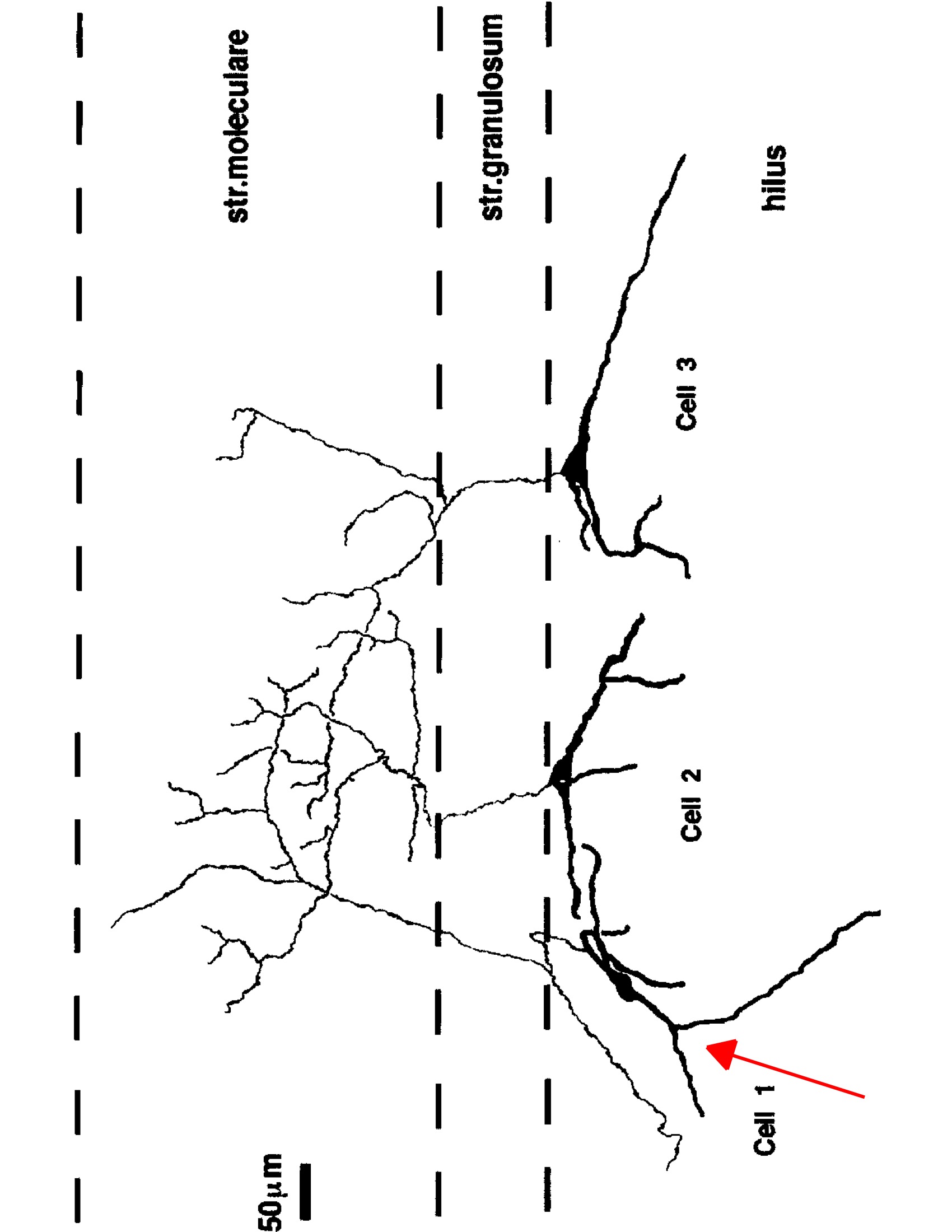
I actually think the evidence is quite strong for the canonical 1002 (which I agree is a must-have) and 1102. The 1103 is a little bit trickier, but I think it stands. With respect to the 2 Savanthrapadian neurons on pg 6 (and 8 â?? same pair) of the packet, the presynaptic neuron has plenty of collaterals in SMi for a 1103 call. There are also lots of additional branches in Fig 1A3 (pg 6) that I donâ??t see in Fig 3B (pg 8) that presumably come from the post-synaptic neuron. I think we have n=2 right here. The Martinez neuron (Fig 1B; pg 10) also looks like a pretty clear 1103 to me. However, I think the Katona Fig 3 cell 1 (pg 15) is a 1003 -- a branch that I first thought was from cell 1 seems to actually be from cell 2. An argument could also be made for 1003 for Buckmaster Fig 6A. I'm not saying we should create an active 1003 packet now, but do note that the 3 CA1 O-LM varieties we currently have are 1002, 1102, and 1003 (but no 1103). I would bet that all 4 varieties exist in DG and CA1. - CLR 02/27/2017
|
DG (i)1003 Recurrent HIPP (Recurr HIPP) cells [1014]
|
Related types:
|
DG (i)1123p SHI Projecting (approved v2.0 on-hold)
|
|
DG (i)1323p IML projecting (approved v2.0 on-hold)
|
|
DG (i)1002 HIPP (v 1.0 active)
|
|
DG (i)1103 Recurrent HIPP-CAP (v2.0 active)
|
|
DG (i)1102 HIPP-CAP (v2.0 active)
|
Notes: This packet is a proposed merger of a v1.0 on-hold cell (Katona) and an unapproved v2.0 on-hold cell (Buckmaster). The DG (i)1123p and 1103p cells project, whereas the current cells do not project. The canonical 1002 HIPP cells do not have axons in DG:H, which the current cells do. The two HIPP-CAP variants have axons in DG:SMi, which the current cells appear to avoid.
sparsely spiny to spiny D's.
OK - KM 04/08/2018
|
OK, but why on-hold and not active? (N = 2) - GAA 04/20/2018
|
Due to the parallel with CA1 (i)1003 Recurrent O-LM, it is now being proposed that this cell type be changed from on-hold to active status. - 04/25/2018
OK - KM 05/24/2018
|
 Browse
 Search
 Help