DG Semilunar Granule
* indicates new v2.0 neuron type
Name Supertype (ID:Family:Type:Subregion)
DG (e)2311p-CA3_00100 Semilunar Granule S010101:Glutamatergic GC:Granule:DG

Name derivation
This is the only name in the cited literature.

Synonym(s)
DG semilunar granule cell

List of articles
Click here to view the list
Gupta A  (2012) J Neurosci
Decrease in tonic inhibition contributes to increase in dentate semilunar granule cell excitability after brain injury.
Gupta A, Elgammal FS, Proddutur A, Shah S, Santhakumar V.
J Neurosci, 2012 Feb 15, 32 (7), Pages: 2523 - 37
PMID: 22396425; DOI: 10.1523/JNEUROSCI.4141-11.2012
Tags: synapse probabilities
Larimer P  (2010) Nat Neurosci
Representing information in cell assemblies: persistent activity mediated by semilunar granule cells.
Larimer P, Strowbridge BW.
Nat Neurosci, 2010 Feb, 13 (2), Pages: 213 - 222
PMID: 20037579; DOI: 10.1038/nn.2458
Tags: morphology
Williams PA  (2007) J Neurosci
Semilunar granule cells: glutamatergic neurons in the rat dentate gyrus with axon collaterals in the inner molecular layer.
Williams PA, Larimer P, Gao Y, Strowbridge BW.
J Neurosci, 2007 Dec 12, 27 (50), Pages: 13756 - 13761
PMID: 18077687; DOI: 10.1523/JNEUROSCI.4053-07.2007
Tags: morphology, membrane biophysics, connectivity, firing patterns, synapse probabilities

Supplemental PMIDs
Click here to view the list of PMIDs

List of Hippocampome.org to NeuroMorpho.Org mappings
Click here to view the list of mappings
  • MouseLight
  • Santhakumar

  • Morphology
    Soma
    DG:SMi
    Axons
    DG:SMi
    DG:SG
    DG:H
    CA3:SL
    Dendrites
    DG:SMo
    DG:SMi

    Representative figure
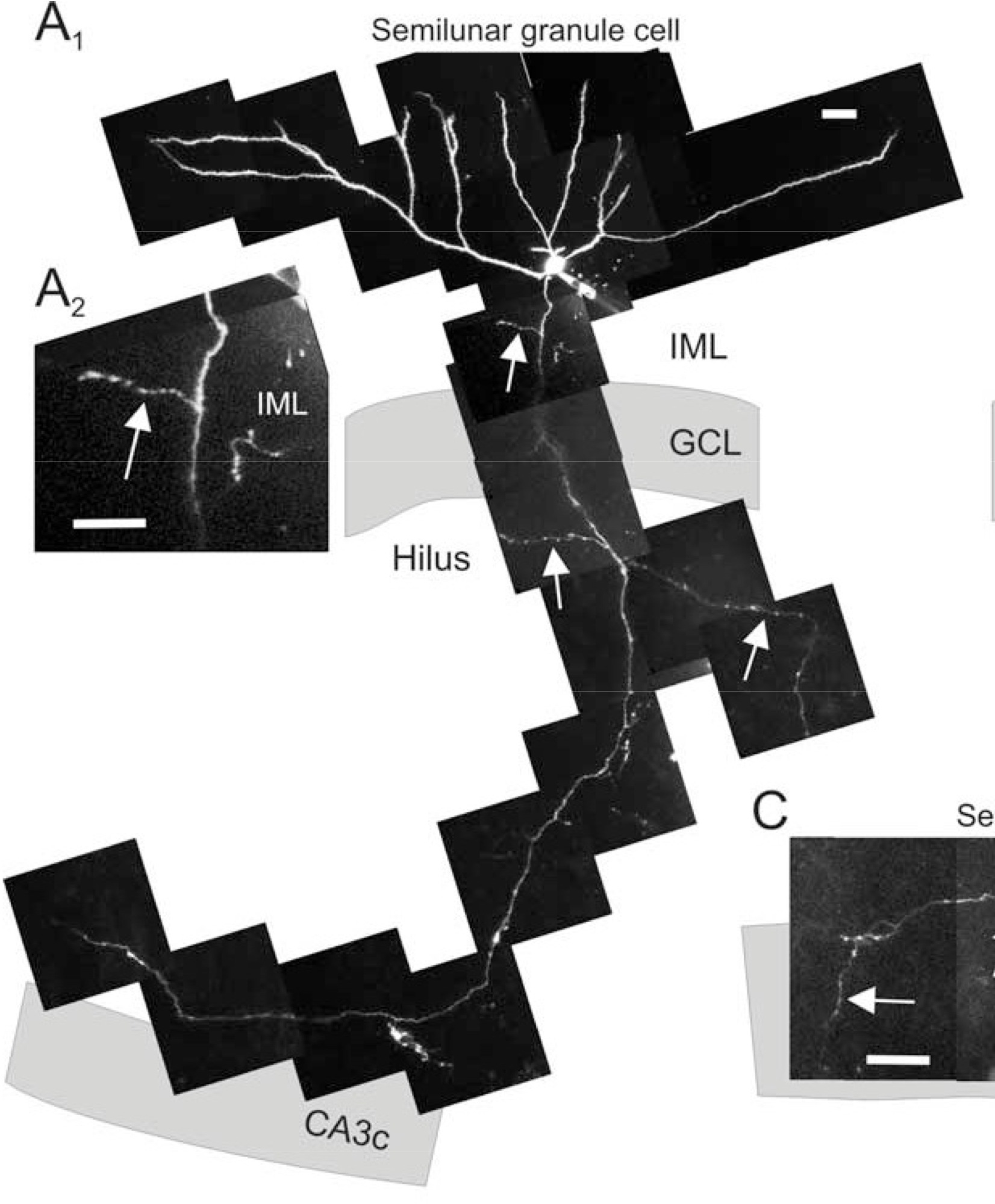
    Semilunar granule cells: glutamatergic neurons in the rat dentate gyrus with axon collaterals in the inner molecular layer.
    Williams PA, Larimer P, Gao Y, Strowbridge BW
    J Neurosci, 2007 Dec 12, 27 (50), pages: 13756 - 13761
    PMID: 18077687; DOI: 10.1523/JNEUROSCI.4053-07.2007


    "Figure 1. Two-photon reconstructions of SGCs [semilunar granule cells] {DG Semilunar Granule} and GCs [granule cells] {DG Granule} [in the dentate gyrus] A1, Reconstruction of a SGC filled with Alexa594. Axon collaterals are visibile in both the hilus, directed toward the CA3c, and in the IML [inner molecular layer]. A2, Enlargement of IML axon collateral (A1, A2, arrows)."


    Molecular markers
    Positive
    None known
    Negative
    GABAa\alpha 6 (inference)
    mGluR1a (inference)
    SOM (multiple confirming inferences)
    Mixed expression
    None known

    Electrophysiological properties
    Key: [range] OR representative value±SD (measurements); Number of sources (total measurements): [min , max]

    Resting membrane potential (Vrest): -78±8.1 mV (11); 1 source
    Input resistance (Rin): 128.3±17.5 MΩ (11); 1 source
    Time constant (τm): 19.6±3.4 ms (11); 1 source
    Threshold potential (Vthresh): 37 mV (1); 1 source
    Fast afterhyperpolaziring potential amplitude (Fast AHP): 21 mV (1); 1 source
    Action potential amplitude (APampl): 85.6±2.3 mV (11); 1 source
    Max firing rate (Max F.R.): >11 Hz (1); 1 source

    Notes
    All SGC neurons have D:SMo_SMi and A:H. In Williams (2007), 4 of 10 reconstructions have A:SM, which is later restated as not all reconstructions have A:SMi. 3 of these 4 reconstructions have A:SG. Unable to infer about the presence of A:SG when there is no A:SMi, so insufficient data to establish a second (suspended) class. SGCs and GCs share polarized dendrites, similar sized somata, and a primary axon directed toward H. Contact mossy cells and interneurons in the hilus. In Larimer (2010), perforant path stimulation is interpreted as D:SMo. In Larimer (2010), the youngest rats may be adolescents.

    Firing Pattern
    Images
    Image Missing
    Parameters View page
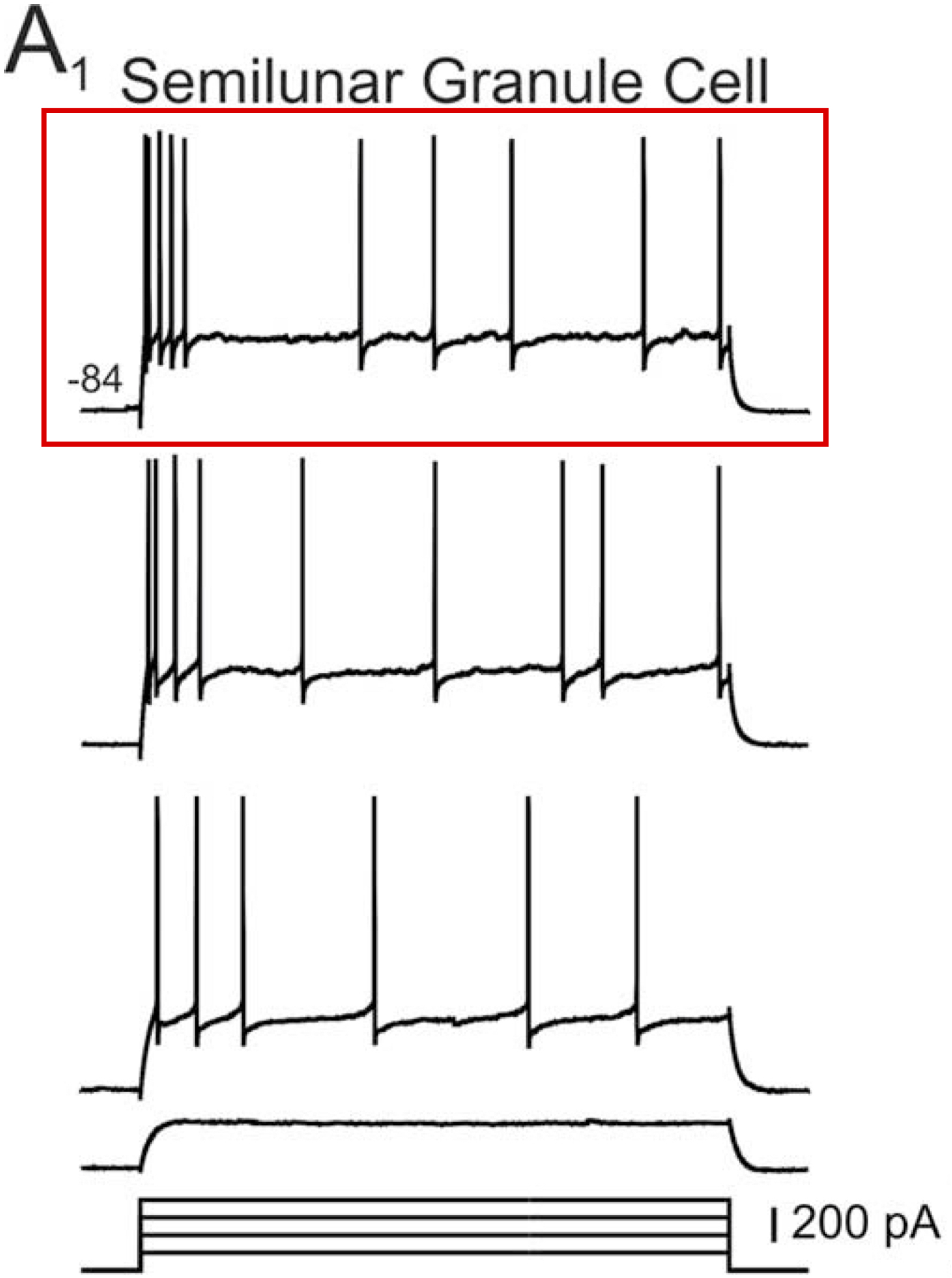
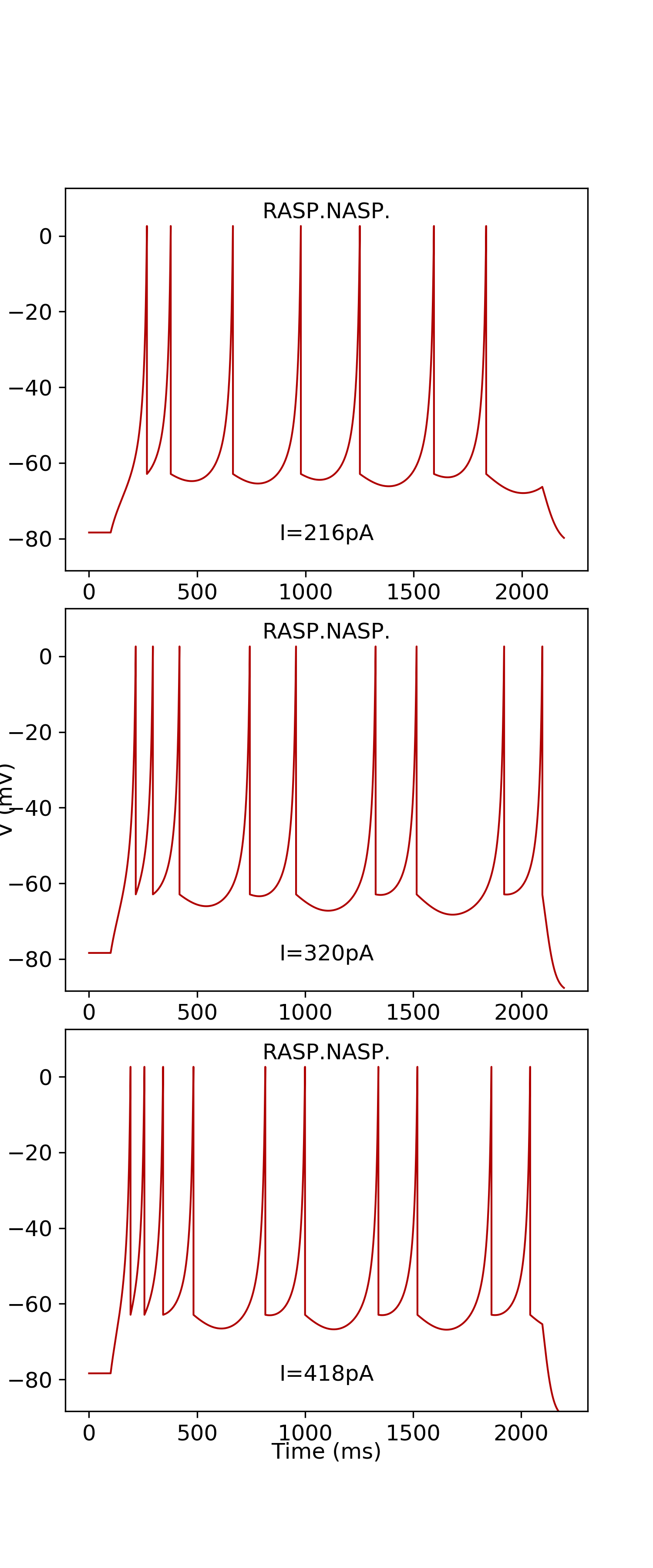
    RASP.NASP [Evidence] [Firing Pattern]
    TSTUT.NASP [Evidence] [Firing Pattern]

    Izhikevich Model
    Parameters Single Compartment Downloads Simulate
    subtype: 1 k=0.94;a= 0;b= -77.49;d= 182;C= 910;Vr= -78.38;Vt= -58.4;Vpeak= 2.61;Vmin= -62.9; Simulate
    Images
    Image Missing
    ModelDB Model
    Model Accession Number PubMed ID

    Sources of Input
    Known sources
    Excitatory or Inhibitory
    none known

    Potential sources
    Excitatory or Inhibitory
    DG Semilunar Granule
    DG Cajal-Retzius*
    DG Local-Projecting Cajal-Retzius*
    DG Mossy
    DG Mossy MOLDEN
    DG AIPRIM
    DG COM-MOPP*
    DG HICAP
    DG HIPP
    DG Recurrent HIPP*
    DG HIPP-CAP*
    DG Recurrent HIPP-CAP*
    DG HIPROM
    DG Ivy*
    DG MOCAP
    DG MOLAX
    DG Molecular Layer*
    DG Outer Molecular Layer
    DG Total Molecular Layer
    DG MOPP
    DG Neurogliaform
    DG Wide-Arbor Neurogliaform*
    CA3c Pyramidal
    CA3 Spiny Lucidum
    CA3 Perforant Path-Associated Projecting*
    CA1 Local-Projecting Cajal-Retzius*
    CA1 LMR Projecting
    CA1 Neurogliaform Projecting
    CA1 Perforant Path-Associated
    EC LI-II Pyramidal-Fan
    MEC LII Stellate
    EC LII-III Pyramidal-Tripolar
    EC LIV-V Pyramidal-Horizontal
    MEC LV Pyramidal

    Potential sources known to be avoided
    Excitatory or Inhibitory
    DG Interneuron Specific COLTAR*
    DG Interneuron Specific IMOT*

    Targets of Output
    Known targets
    Excitatory or Inhibitory
    DG Mossy

    Potential targets
    Excitatory or Inhibitory
    DG Granule
    DG Adult-Born Immature Granule*
    DG Hilar Ectopic Granule
    DG Semilunar Granule
    DG Mossy MOLDEN
    DG AIPRIM
    DG Axo-axonic
    DG Granulosum-targeting Axo-axonic*
    DG Axo-axonic GRALDEN*
    DG Basket
    DG Basket GRALDEN*
    DG Basket CCK+
    DG COM-MOPP*
    DG HICAP
    DG Interneuron Specific IMOT*
    DG Hilus-Associated Interneuron*
    DG Interneuron Specific HIMOLD*
    DG HIPP
    DG Recurrent HIPP*
    DG HIPP-CAP*
    DG Recurrent HIPP-CAP*
    DG Interneuron Specific HIPRO*
    DG HIPROM
    DG Ivy*
    DG MOCAP
    DG MOLAX
    DG Molecular Layer*
    DG Outer Molecular Layer
    DG Total Molecular Layer
    DG Wide-Arbor Neurogliaform*
    CA3 Pyramidal
    CA3c Pyramidal
    CA3c Umbrella Pyramidal*
    CA3 Axo-axonic
    CA3 Basket
    CA3 Basket CCK+
    CA3 Mossy Fiber-Associated Basket CCK+*
    CA3 Bistratified
    CA3 Ivy
    CA3 Bilayer Ivy*
    CA3 LMR-Targeting
    CA3 Lucidum*
    CA3 Lucidum LAX
    CA3 Lucidum ORAX
    CA3 Lucidum-Radiatum
    CA3 Spiny Lucidum
    CA3 Mossy Fiber-Associated
    CA3 Mossy Fiber-Associated ORDEN
    CA3 Interneuron Specific Quad
    CA3 QuadD-LM

    Potential targets known to be avoided
    Excitatory or Inhibitory
    none known

    Oscillation Phase Locking
    Category
    Value